Pitching Machine Market Size, Share & Demand Report By Type (Wheel-Based, Arm-Based, Programmable Smart Machines), By End-Use (Sports Academies, Schools & Colleges, Home Use), By Application (Professional Training, Recreational), By Distribution Channel (Online, Offline), By Region & Segment Forecasts, 2025–2034
USD 3950
Market Overview
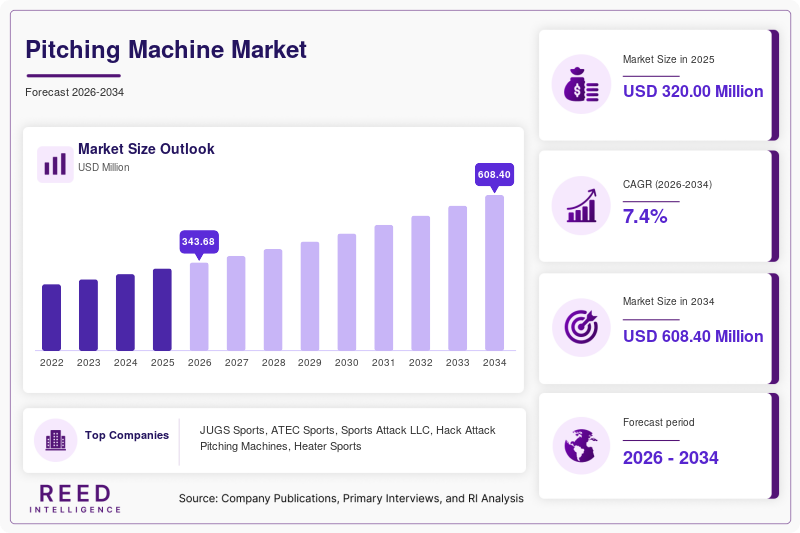
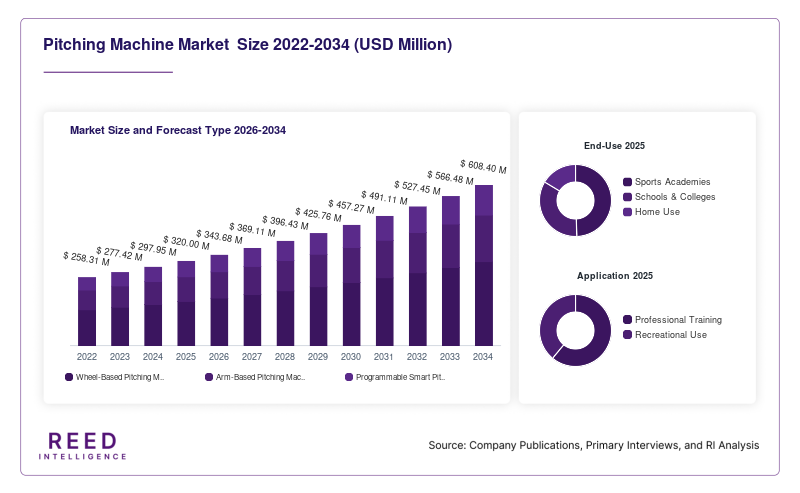
The global Pitching Machine Market size was valued at approximately USD 320 million in 2025 and is projected to reach USD 610 million by 2034, expanding at a CAGR of 7.4% during the forecast period (2025–2034). The market is experiencing steady expansion due to increasing participation in baseball and softball across both developed and emerging economies. The growing emphasis on sports training, performance analytics, and skill development at amateur and professional levels has significantly contributed to the adoption of pitching machines globally.
A key global factor supporting market growth is the rising integration of sports technology into training ecosystems. Educational institutions, sports academies, and professional clubs are increasingly investing in automated training equipment to enhance accuracy, consistency, and player performance. Pitching machines offer controlled environments for repetitive training, making them essential tools for coaches and athletes alike.
Key Highlights:
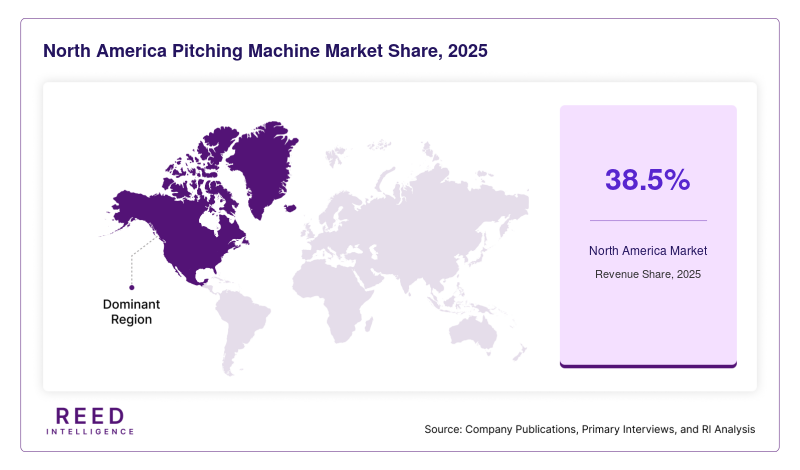
- North America accounted for a dominant regional share of 38.5% in 2025, while Asia Pacific is projected to be the fastest-growing region with a CAGR of 8.6%.
- Among segments, wheel-based pitching machines dominated with a share of 46.2% in 2024, while programmable smart machines are expected to grow fastest at a CAGR of 9.1%.
- The sports academies segment led the end-use category with 41.7% share, whereas home-use machines are projected to expand at a CAGR of 8.9%.
- The United States remained the dominant country, with market values estimated at USD 120 million in 2024 and USD 128 million in 2025.
Market Trends
Integration of Smart and Programmable Technologies
The Pitching Machine Market is witnessing a transition toward smart and programmable machines equipped with advanced features such as variable speed control, pitch type simulation, and mobile app connectivity. These machines allow coaches and players to customize training sessions with precision, enhancing performance tracking and efficiency. The inclusion of artificial intelligence and data analytics is further enabling real-time feedback, making training more interactive and result-oriented.
Rising Demand for Portable and Compact Machines
Another notable trend shaping the market is the increasing preference for lightweight and portable pitching machines. Consumers, especially individual players and small training facilities, are opting for compact solutions that are easy to transport and set up. This trend is particularly prominent in emerging markets where space constraints and budget considerations influence purchasing decisions. Manufacturers are focusing on ergonomic designs and battery-operated models to cater to this growing demand.
Market Drivers
Increasing Participation in Baseball and Softball
The growing popularity of baseball and softball across various regions is a major driver for the Pitching Machine Market. Grassroots programs, school-level competitions, and international tournaments are encouraging participation among younger demographics. This expansion in the player base has increased demand for efficient training equipment that supports skill development and consistency.
Expansion of Sports Training Infrastructure
The rapid development of sports academies and training centers worldwide is further boosting market growth. Governments and private organizations are investing in sports infrastructure to promote physical fitness and professional training. Pitching machines are becoming standard equipment in these facilities due to their ability to deliver consistent pitches and reduce reliance on manual pitching, thereby improving training efficiency.
Market Restraint
High Initial Investment and Maintenance Costs
One of the key challenges facing the Pitching Machine Market is the relatively high cost associated with advanced machines. High-performance models with programmable features and durable components require significant upfront investment, which may limit adoption among small training centers and individual users. Additionally, maintenance and repair costs can further increase the total cost of ownership.
This restraint is particularly evident in developing regions where budget constraints and limited access to financing options hinder widespread adoption. While entry-level machines are available, they often lack advanced functionalities, creating a gap between affordability and performance. Manufacturers are addressing this issue by introducing mid-range models and flexible pricing strategies; however, cost sensitivity remains a notable barrier to market expansion.
Market Opportunities
Growth in Emerging Markets
Emerging economies in Asia Pacific, Latin America, and parts of the Middle East are presenting significant growth opportunities for the Pitching Machine Market. Increasing disposable income, urbanization, and growing awareness of sports training are driving demand in these regions. Local governments are also promoting sports development initiatives, creating a favorable environment for market expansion.
Adoption in Home Training and Recreational Use
The rising trend of home-based training is creating new opportunities for manufacturers. With increasing interest in personalized fitness and skill development, consumers are investing in compact pitching machines for recreational use. The availability of user-friendly and affordable models is further supporting this trend. This shift toward home training is expected to open new revenue streams and diversify the market’s customer base.
Segmental Analysis
By Type
Wheel-based pitching machines dominated the Pitching Machine Market in 2024, accounting for approximately 46.2% of the total share. These machines were widely preferred due to their reliability, consistent performance, and ability to simulate various pitch types. Their widespread adoption across training academies and professional teams contributed to their dominant position.
Programmable smart pitching machines are expected to grow at the fastest CAGR of 9.1% during the forecast period. The increasing demand for customized training sessions and real-time performance tracking will drive growth in this segment. Advanced features such as app integration and automated pitch adjustments will further enhance their adoption.
By End-Use
Sports academies held the largest share of 41.7% in 2024, driven by the increasing number of training facilities and structured coaching programs. These institutions relied heavily on pitching machines to provide consistent training environments and improve player performance.
The home-use segment is projected to grow at a CAGR of 8.9% over the forecast period. Rising interest in personal training and the availability of affordable, compact machines will drive growth in this segment. Consumers will increasingly adopt these machines for recreational and skill development purposes.
By Distribution Channel
Offline channels dominated the market in 2024, accounting for a significant share due to the preference for physical inspection and direct purchase of equipment. Specialty sports stores and authorized dealers played a key role in driving sales.
Online distribution channels are expected to grow at a CAGR of 8.3% during the forecast period. The increasing penetration of e-commerce platforms and the convenience of online purchasing will support growth. Enhanced product visibility and competitive pricing will further boost online sales.
By Application
Professional training applications dominated the Pitching Machine Market in 2024, accounting for the largest share due to the high demand from professional teams and training institutions. These applications required high-performance machines capable of delivering precise and consistent pitches.
Recreational applications are expected to grow at a CAGR of 8.7% during the forecast period. The growing interest in casual sports activities and home-based training will drive demand in this segment. The availability of user-friendly machines will further support growth.
Regional Analysis
North America
North America held a dominant share of 38.5% in the Pitching Machine Market in 2025 and will continue to maintain steady growth, expanding at a CAGR of 6.8% through 2034. The region’s well-established sports culture and strong presence of baseball and softball leagues have contributed to consistent demand for advanced training equipment. High adoption of technologically advanced machines and significant investments in sports infrastructure supported market growth in this region.
The United States dominated the regional market due to its extensive network of professional leagues, collegiate sports programs, and youth training academies. The presence of a structured sports ecosystem and continuous technological upgrades in training equipment contributed to sustained demand. Additionally, partnerships between equipment manufacturers and training institutions have enhanced product accessibility.
Europe
Europe accounted for a notable share of the Pitching Machine Market in 2025 and is expected to grow at a CAGR of 6.9% during the forecast period. The region’s increasing interest in baseball and softball, particularly in countries such as the United Kingdom, Germany, and Italy, supported market expansion. Investments in sports infrastructure and the introduction of training programs have further fueled demand.
Germany emerged as a dominant country within the region due to its growing sports culture and increasing participation in international baseball events. The country’s focus on structured training programs and adoption of modern equipment has contributed to steady growth in demand for pitching machines.
Asia Pacific
Asia Pacific captured a significant share of the Pitching Machine Market in 2025 and is projected to grow at the fastest CAGR of 8.6% through 2034. The region’s expanding sports ecosystem, coupled with rising disposable incomes and urbanization, has created a favorable environment for market growth. Increasing popularity of baseball in countries such as Japan, South Korea, and China has driven demand for training equipment.
Japan led the regional market due to its strong baseball culture and widespread participation across schools and professional leagues. The country’s emphasis on skill development and adoption of advanced training technologies has supported consistent demand for pitching machines.
Middle East & Africa
The Middle East & Africa region held a smaller share of the Pitching Machine Market in 2025 but is expected to grow at a CAGR of 7.2% over the forecast period. The region is witnessing gradual growth in sports participation and infrastructure development. Government initiatives aimed at promoting sports and fitness are contributing to market expansion.
The United Arab Emirates emerged as a key country in this region due to its investments in sports facilities and increasing interest in international sports. The country’s focus on hosting sports events and developing training infrastructure has supported demand for advanced equipment, including pitching machines.
Latin America
Latin America accounted for a moderate share of the Pitching Machine Market in 2025 and is expected to grow at a CAGR of 7.5% during the forecast period. The region’s strong baseball culture, particularly in countries such as Mexico and the Dominican Republic, has driven demand for training equipment.
Mexico dominated the regional market due to its well-established baseball ecosystem and growing number of training academies. The country’s focus on nurturing talent and improving training facilities has contributed to increased adoption of pitching machines across various levels of play.
Competitive Landscape
The Pitching Machine Market is characterized by the presence of several established players focusing on product innovation and strategic partnerships. Companies are investing in research and development to introduce advanced features and improve product performance.
JUGS Sports is considered a leading player in the market, known for its extensive product portfolio and strong presence in professional and amateur training segments. The company recently introduced a new line of smart pitching machines with enhanced programmability and mobile integration, strengthening its competitive position.
Other key players are focusing on expanding their distribution networks and enhancing customer engagement through digital platforms. The competitive landscape remains moderately fragmented, with companies competing on product quality, pricing, and technological advancements.
Key Players
- JUGS Sports
- ATEC Sports
- Sports Attack LLC
- Hack Attack Pitching Machines
- Heater Sports
- First Pitch Baseline
- Louisville Slugger
- Wilson Sporting Goods
- Spinball Sports
- Bata Baseball Machines
Recent Developments
- In 2025, JUGS Sports launched a new AI-enabled pitching machine with customizable pitch sequences.
- Sports Attack LLC expanded its product portfolio with portable, battery-operated machines.
- ATEC Sports introduced upgraded models with enhanced durability and improved pitch accuracy.
- Heater Sports focused on expanding its presence in emerging markets through online sales channels.
- Spinball Sports developed compact pitching machines targeting home-use consumers.
Pitching Machine Market Segments
Type
- Wheel-Based Pitching Machines
- Arm-Based Pitching Machines
- Programmable Smart Pitching Machines
End-Use
- Sports Academies
- Schools & Colleges
- Home Use
Application
- Professional Training
- Recreational Use
Distribution Channel
- Online Retail
- Specialty Sports Stores
- Authorized Dealers
- Multi-Brand Retail Outlets
By Region
- North America
- Europe
- APAC
- Middle East and Africa
- LATAM