Plague Market Size, Share & Demand Report By Product (Diagnostics, Vaccines, Therapeutics), By End-Use (Public Health Laboratories, Hospitals, Research Institutes), By Distribution Channel (Direct Procurement, Medical Distributors, Online Platforms) & Segment Forecasts, 2025–2033
USD 3950
Market Overview
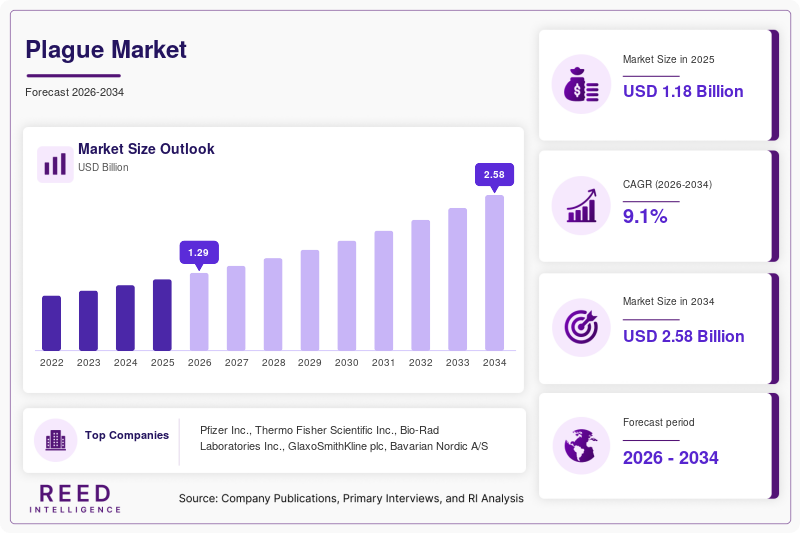
The global Plague Market size was valued at USD 1.18 billion in 2025 and is projected to reach USD 2.64 billion by 2033, registering a compound annual growth rate (CAGR) of 9.1% during 2025–2034. The market comprises diagnostic solutions, vaccines, therapeutics, and public health surveillance tools used for the detection, prevention, and treatment of plague infections caused by Yersinia pestis. Although plague cases remain relatively rare globally, the continued risk of zoonotic transmission and sporadic outbreaks has led governments and health organizations to strengthen disease preparedness infrastructure.
A major factor supporting market growth globally has been the expansion of infectious disease surveillance programs. Public health agencies have increasingly invested in early detection platforms and emergency response mechanisms for high-risk pathogens. These initiatives have improved laboratory capacity, diagnostic accessibility, and treatment stockpiles, supporting steady demand for plague-related diagnostics and therapeutics. International health regulations and preparedness frameworks have further encouraged collaboration between biotechnology companies and public health institutions, accelerating product development and distribution.
Key Highlights
- North America dominated the market with a 36.8% share in 2025, while Asia Pacific is expected to record the fastest CAGR of 10.7% during the forecast period.
- Within segmentation, Diagnostics represented the leading product segment, while Vaccines are expected to grow at the fastest CAGR of 10.9%.
- By end-use, Public health laboratories accounted for the largest share, whereas research institutes are projected to expand at a CAGR of 10.5%.
- The United States led the country-level market with USD 328 million in 2025 and is estimated to reach USD 349 million in 2026.
Market Trends
Expansion of Rapid Molecular Diagnostics
One notable trend shaping the Plague Market is the increasing adoption of rapid molecular diagnostic technologies. Traditional diagnostic methods such as bacterial culture and microscopy often require specialized laboratory infrastructure and extended processing times. To address these limitations, healthcare providers are gradually adopting polymerase chain reaction (PCR) assays and molecular detection kits capable of identifying Yersinia pestis within hours.
Rapid diagnostics enable quicker outbreak containment by allowing public health agencies to implement timely isolation and treatment measures. As portable diagnostic platforms become more widely available, healthcare systems in endemic areas are integrating them into routine surveillance programs. This shift toward faster testing solutions is expected to influence purchasing decisions across hospitals, laboratories, and field-based healthcare operations.
Increased Integration of Digital Disease Surveillance
Another emerging trend is the integration of digital disease surveillance systems in infectious disease management. Governments and global health organizations are deploying digital epidemiology platforms that combine laboratory data, environmental monitoring, and case reporting. These systems allow authorities to detect unusual patterns of rodent or flea populations and identify early indicators of potential outbreaks.
Advanced data analytics and geographic information systems (GIS) are helping health officials track disease spread and allocate medical resources more efficiently. As digital infrastructure improves, the adoption of integrated surveillance networks is expected to support more proactive plague monitoring strategies worldwide.
Market Drivers
Rising Focus on Zoonotic Disease Preparedness
Increasing attention toward zoonotic diseases has become a significant driver for the Plague Market. Health authorities worldwide have recognized that pathogens transmitted from animals to humans pose long-term global health risks. As a result, national governments have expanded surveillance programs that monitor wildlife reservoirs such as rodents and fleas known to carry Yersinia pestis.
These preparedness initiatives have increased demand for laboratory testing kits, vaccines, and antimicrobial therapies designed for plague management. Public health agencies are also strengthening emergency stockpiles of critical medications and diagnostics, further supporting the market’s growth.
Growing Investments in Infectious Disease Research
Another major driver is the growth in funding dedicated to infectious disease research and biodefense initiatives. Universities, pharmaceutical companies, and biotechnology firms are investing in the development of improved vaccines, novel therapeutics, and advanced diagnostic platforms targeting high-risk pathogens.
These investments are encouraging collaborative research programs between academic institutions and government agencies. The resulting pipeline of innovative diagnostic assays and treatment candidates is expected to improve clinical outcomes and expand the scope of products available in the plague healthcare ecosystem.
Market Restraint
Limited Disease Incidence and Market Demand Concentration
A key restraint affecting the Plague Market is the relatively low global incidence of plague infections. Compared with other infectious diseases, plague outbreaks occur infrequently and are often confined to specific geographic regions. As a result, the overall demand for dedicated plague diagnostics, vaccines, and therapeutics remains concentrated in limited markets.
Pharmaceutical companies may face challenges in maintaining sustainable commercial returns due to the niche nature of the disease. The sporadic occurrence of outbreaks can lead to fluctuating procurement patterns, especially for vaccines and diagnostic kits. Governments and international health organizations often represent the primary buyers of these products, creating a procurement structure heavily dependent on public sector funding.
Additionally, limited clinical case numbers can complicate large-scale clinical trials required for regulatory approval of new treatments or vaccines. These factors may slow product innovation and restrict private-sector participation in the market. Despite these challenges, continued government support and public health initiatives remain critical for sustaining the development of plague prevention and treatment technologies.
Market Opportunities
Development of Next-Generation Vaccines
The development of next-generation vaccines presents a promising opportunity within the Plague Market. Several biotechnology companies are exploring recombinant and subunit vaccine platforms that can offer improved safety profiles and longer-lasting immunity. These advanced vaccines may enable broader immunization strategies in high-risk regions.
Research programs are focusing on multi-antigen formulations designed to enhance immune responses against Yersinia pestis. If successful, these innovations could improve preventive healthcare strategies and expand vaccine procurement by governments and international health agencies.
Expansion of Point-of-Care Diagnostic Technologies
Another emerging opportunity lies in the expansion of point-of-care diagnostic technologies. Portable diagnostic devices that provide rapid detection results can significantly improve disease management in remote or resource-limited environments. These solutions reduce the need for centralized laboratory infrastructure and allow frontline healthcare workers to diagnose infections directly in the field.
Advancements in microfluidics, biosensors, and portable PCR platforms are enabling faster and more accurate pathogen detection. As healthcare systems prioritize early detection of infectious diseases, point-of-care diagnostics are expected to create new growth avenues for manufacturers and diagnostic technology developers.
Segmental Analysis
By Product
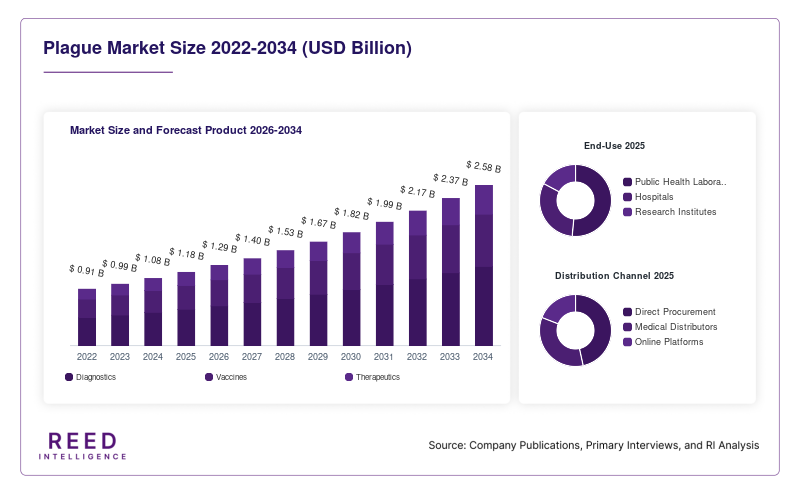
Diagnostics represented the dominant product segment with a 41.5% share in 2025. The widespread use of laboratory testing for early detection of plague infections supported this leadership position. Diagnostic products include PCR assays, immunoassay kits, and bacterial culture solutions used by hospitals and public health laboratories. Rapid detection capabilities are critical for initiating timely treatment and preventing disease spread, making diagnostics an essential component of outbreak management.
Vaccines are projected to be the fastest-growing subsegment with a CAGR of 10.9% during the forecast period. Ongoing research into recombinant vaccine technologies will improve immunogenicity and safety profiles. As governments strengthen preventive healthcare strategies, vaccine stockpiling and immunization programs for high-risk populations will increase demand for advanced vaccine formulations.
By End-Use
Public health laboratories accounted for the largest share of 38.6% in 2025. These institutions play a central role in disease surveillance and outbreak response. Laboratories conduct confirmatory testing for suspected cases, monitor pathogen strains, and coordinate with health authorities to track disease transmission patterns.
Research institutes will emerge as the fastest-growing end-use segment with a projected CAGR of 10.5%. Increasing research programs focusing on bacterial pathogenesis and vaccine development will drive demand for laboratory testing equipment and experimental therapeutics. Academic institutions are expected to expand collaborations with biotechnology companies, accelerating innovation in diagnostic technologies.
By Distribution Channel
Direct procurement represented the dominant distribution channel with a 45.3% share in 2025. Government health departments and public institutions often purchase plague diagnostics and treatments directly from manufacturers through centralized procurement programs. This model ensures stable supply chains and efficient distribution of critical medical products.
Online and specialized medical distributors will experience the fastest growth at a CAGR of 9.8%. Digital procurement platforms allow healthcare facilities to source diagnostic kits and laboratory reagents more efficiently. The expansion of digital supply chain systems will support faster product availability, particularly for research laboratories and smaller healthcare facilities.
Regional Analysis
North America
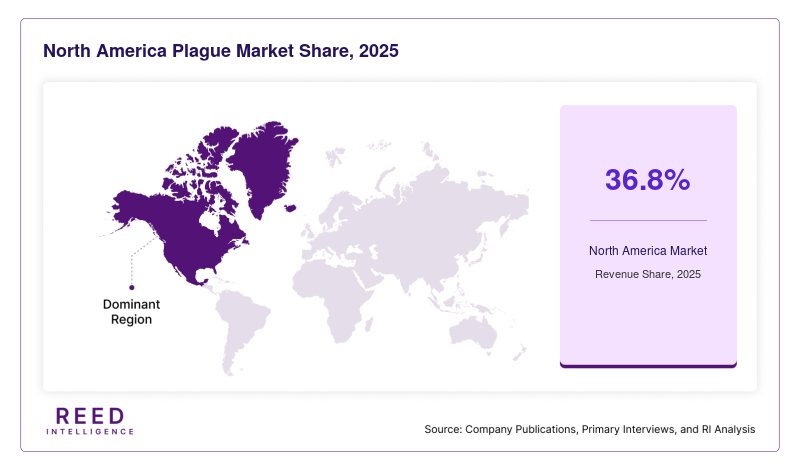
North America accounted for 36.8% of the global Plague Market share in 2025, reflecting strong public health infrastructure and advanced diagnostic capabilities. The region’s market growth will continue steadily and is expected to expand at a CAGR of 8.5% between 2025 and 2034. Federal funding for infectious disease preparedness and biodefense programs will support the procurement of diagnostics and therapeutics across public health laboratories and healthcare institutions.
The United States represented the dominant country in the region due to its established epidemiological monitoring networks and extensive research ecosystem. The country maintains specialized surveillance programs that monitor wildlife reservoirs and vector populations in plague-endemic areas of the western states. In addition, the presence of advanced biotechnology companies and government research agencies supports the development of novel diagnostic assays and vaccines.
Europe
Europe held 23.4% of the global Plague Market share in 2025. The regional market will expand at a projected CAGR of 8.8% through 2034, driven by cross-border infectious disease monitoring initiatives and strong collaboration among research institutions.
Within Europe, Germany emerged as the dominant country due to its advanced biomedical research infrastructure and active participation in infectious disease surveillance programs. German research institutes have been involved in developing molecular diagnostic technologies capable of detecting rare bacterial pathogens. The presence of biotechnology companies specializing in diagnostic platforms has also supported the regional supply of testing solutions for high-risk pathogens.
Asia Pacific
Asia Pacific represented 21.6% of the global market in 2025 and will record the fastest CAGR of 10.7% during the forecast period. Expanding healthcare infrastructure and increasing awareness of zoonotic diseases will support market growth across the region.
China was the dominant country within Asia Pacific due to its extensive public health surveillance programs and large-scale research initiatives focused on infectious diseases. The country has implemented nationwide monitoring systems to track zoonotic disease patterns in rural and semi-urban areas. These efforts have improved laboratory diagnostic capacity and facilitated faster identification of bacterial pathogens.
Middle East & Africa
The Middle East & Africa accounted for 11.2% of the global Plague Market share in 2025. The market will expand at a CAGR of 9.4% through 2034, supported by strengthening disease monitoring frameworks and international health collaborations.
South Africa emerged as the dominant country within the region due to its expanding network of public health laboratories and research institutions. The country’s investment in infectious disease diagnostics and epidemiological surveillance has enhanced its capacity to monitor bacterial pathogens. Partnerships with international research organizations have also supported knowledge exchange and technology adoption in laboratory testing.
Latin America
Latin America represented 7.0% of the global market share in 2025 and will grow at a CAGR of 9.2% through 2034. Government health programs and regional disease surveillance networks will contribute to steady demand for diagnostic tools and antimicrobial treatments.
Within the region, Brazil held the leading position due to its large healthcare system and established infectious disease research institutes. The country’s national health authorities have expanded vector monitoring and laboratory diagnostic capabilities to address emerging zoonotic threats. These efforts have supported improved detection and reporting of rare bacterial infections.
Competitive Landscape
The Plague Market features a mix of biotechnology companies, diagnostic manufacturers, and pharmaceutical firms involved in infectious disease research and treatment development. Companies compete through product innovation, collaborations with public health agencies, and participation in government procurement programs.
Pfizer Inc. remains one of the leading participants due to its expertise in vaccine development and infectious disease therapeutics. The company has expanded research initiatives aimed at developing advanced vaccine platforms targeting bacterial pathogens.
Other companies such as Thermo Fisher Scientific, Bio-Rad Laboratories, GlaxoSmithKline, and Bavarian Nordic contribute to the market through diagnostic technologies, vaccine development programs, and laboratory testing solutions. Strategic partnerships with research institutions and public health organizations continue to shape the competitive landscape as companies focus on developing improved diagnostic assays and preventive therapies.
Key Players List
- Pfizer Inc.
- Thermo Fisher Scientific Inc.
- Bio-Rad Laboratories Inc.
- GlaxoSmithKline plc
- Bavarian Nordic A/S
- Sanofi SA
- Merck & Co., Inc.
- Becton, Dickinson and Company
- Abbott Laboratories
- Roche Diagnostics
- Hologic Inc.
- Siemens Healthineers AG
- BioMérieux SA
- Qiagen N.V.
- Takeda Pharmaceutical Company Limited
Recent Developments
- Pfizer Inc. expanded research initiatives focused on bacterial pathogen vaccine platforms in 2024.
- Thermo Fisher Scientific introduced advanced PCR diagnostic kits designed for rare infectious pathogens in 2023.
- Bavarian Nordic increased investment in vaccine development programs targeting high-risk zoonotic diseases.
- Bio-Rad Laboratories expanded its molecular diagnostic portfolio for infectious disease detection.
- Qiagen launched new sample preparation technologies to improve molecular diagnostic efficiency in microbiology laboratories.
Plague Market Segments
Product
- Diagnostics
- Vaccines
- Therapeutics
End-Use
- Public Health Laboratories
- Hospitals
- Research Institutes
Distribution Channel
- Direct Procurement
- Medical Distributors
- Online Platforms
By Region
- North America
- Europe
- APAC
- Middle East and Africa
- LATAM