Planar Lightwave Circuit Splitter Market Size, Share & Demand Report By Type (1×N PLC Splitters, 2×N PLC Splitters), By Application (FTTH Networks, FTTx Networks, 5G Network Infrastructure, CATV), By End-Use (Telecommunications, Data Centers, Enterprise Networks), By Installation Type (Rack-Mounted, Module-Based, Bare Fiber), By Region & Segment Forecasts, 2026–2034
USD 3950
Market Overview
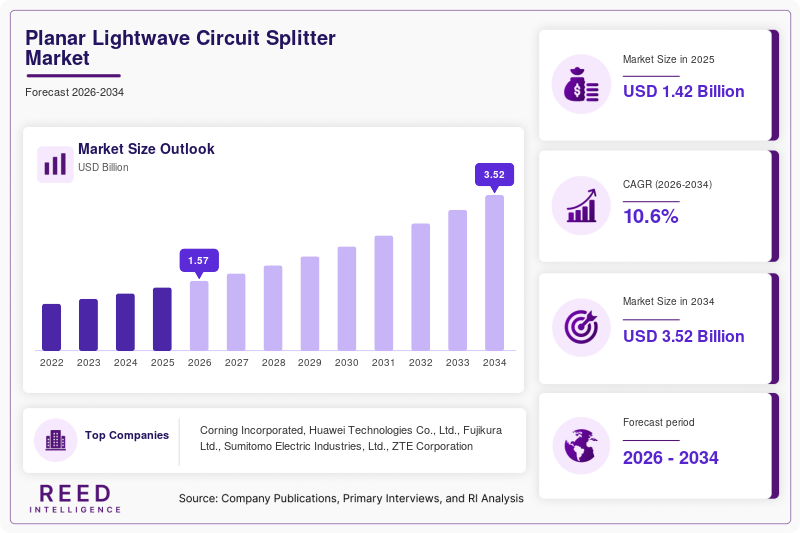
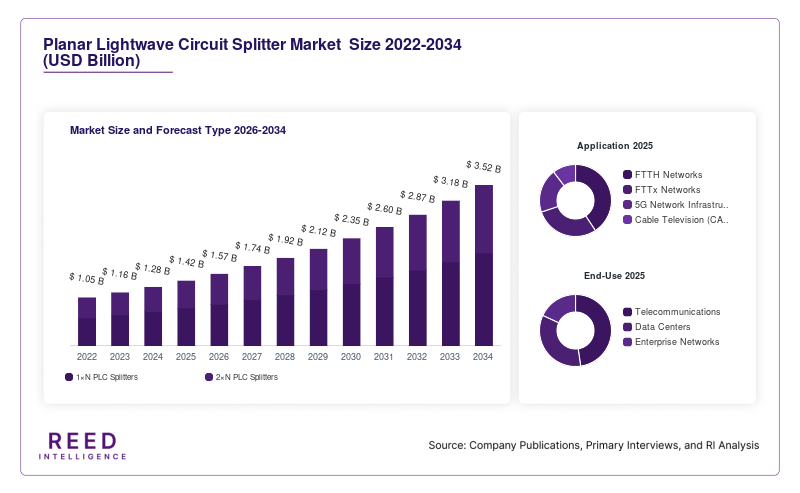
The global Planar Lightwave Circuit Splitter Market size was valued at USD 1.42 billion in 2026 and is projected to reach USD 3.18 billion by 2034, expanding at a CAGR of 10.6% from 2026 to 2034. The market is experiencing steady expansion due to the increasing deployment of fiber-optic networks across residential, commercial, and industrial sectors. One of the primary global factors supporting this growth is the rapid expansion of high-speed broadband infrastructure, particularly driven by fiber-to-the-home (FTTH) and 5G backhaul deployments.
Planar lightwave circuit (PLC) splitters play a vital role in optical communication systems by distributing optical signals efficiently across multiple endpoints. Their compact size, high reliability, and low insertion loss make them a preferred component in passive optical networks (PONs). With the rise in data consumption, cloud computing, and IoT adoption, telecom operators are increasingly investing in optical network upgrades, further driving the Planar Lightwave Circuit Splitter Market growth.
Key Highlights
- Asia Pacific dominated the market with 41.8% share in 2025, while North America is projected to be the fastest-growing region with a CAGR of 11.9%.
- By type, 1×N PLC splitters held the largest share of 46.5% in 2025, while 2×N PLC splitters are expected to grow at a CAGR of 11.4%.
- By application, FTTH networks led with 52.3% share, whereas 5G network infrastructure is anticipated to grow at a CAGR of 12.2%.
- China remained the dominant country, with market values of USD 310 million in 2024 and USD 345 million in 2025.
Market Trends
Integration of PLC Splitters in Next-Generation Optical Networks
The growing transition toward next-generation optical networks, including XG-PON and NG-PON2 technologies, is significantly influencing the Planar Lightwave Circuit Splitter Market trends. These advanced networks require highly efficient and low-loss signal distribution systems, making PLC splitters a core component. Their ability to maintain performance over wide wavelength ranges enhances their adoption in modern telecom infrastructures.
Miniaturization and High-Density Packaging:
Manufacturers are focusing on compact and high-density PLC splitter designs to meet space constraints in data centers and telecom cabinets. This trend is driving innovation in chip-level integration and packaging techniques, improving performance while reducing overall system footprint. The demand for space-efficient components is expected to further boost market growth.
Market Drivers
Rising Demand for Fiber-to-the-Home (FTTH) Deployment
The increasing adoption of FTTH services is a major driver for the Planar Lightwave Circuit Splitter Market. As consumers demand higher internet speeds and stable connectivity, telecom providers are rapidly expanding fiber networks. PLC splitters enable efficient signal distribution in FTTH systems, making them indispensable in broadband infrastructure development.
Expansion of 5G Network Infrastructure
The global rollout of 5G networks is significantly boosting demand for optical components. PLC splitters are widely used in 5G backhaul and fronthaul networks to manage signal distribution efficiently. The need for high bandwidth and low latency connectivity is accelerating investments in fiber-optic technologies, directly contributing to market growth.
Market Restraint
High Initial Installation Costs
Despite long-term benefits, the high initial cost associated with deploying fiber-optic infrastructure and PLC splitter systems acts as a restraint. Small and medium telecom operators may face financial challenges in upgrading legacy systems, limiting market penetration in certain regions.
Market Opportunities
Growth in Data Center Optical Connectivity
The increasing demand for hyperscale data centers presents a strong opportunity for the Planar Lightwave Circuit Splitter Market. As cloud computing and big data applications expand, the need for efficient optical signal distribution within data centers is rising, creating new avenues for PLC splitter adoption.
Emerging Smart City Projects
Smart city initiatives across developing regions are creating opportunities for advanced communication networks. PLC splitters are essential for supporting interconnected systems such as surveillance, traffic management, and smart utilities, thereby driving future market demand.
Segmental Analysis
By Type
The 1×N PLC splitters segment dominated the market with a 46.5% share in 2025, owing to its widespread use in passive optical networks for distributing signals from a single input to multiple outputs. Its cost efficiency and scalability made it a preferred choice.
The 2×N PLC splitters segment is expected to grow at a CAGR of 11.4%, driven by increasing demand for bidirectional signal transmission in advanced telecom systems. Their ability to support redundant network configurations will enhance their adoption.
By Application
The FTTH networks segment held the largest share of 52.3% in 2025, supported by the rapid expansion of residential fiber connections worldwide.
The 5G network infrastructure segment is projected to grow at a CAGR of 12.2%, driven by increasing investments in next-generation mobile networks. The need for efficient signal distribution in dense network environments is a key growth factor.
By End-Use
The telecommunications sector dominated with a 61.7% share in 2025, as PLC splitters are widely used in broadband and mobile networks.
The data centers segment is expected to grow at a CAGR of 11.8%, fueled by rising demand for high-speed data processing and storage solutions.
By Installation Type
The rack-mounted PLC splitters segment held the largest share of 44.2% in 2025, due to ease of integration in telecom infrastructure.
The module-based PLC splitters segment is projected to grow at a CAGR of 10.9%, supported by increasing demand for flexible and compact solutions.
Regional Analysis
North America
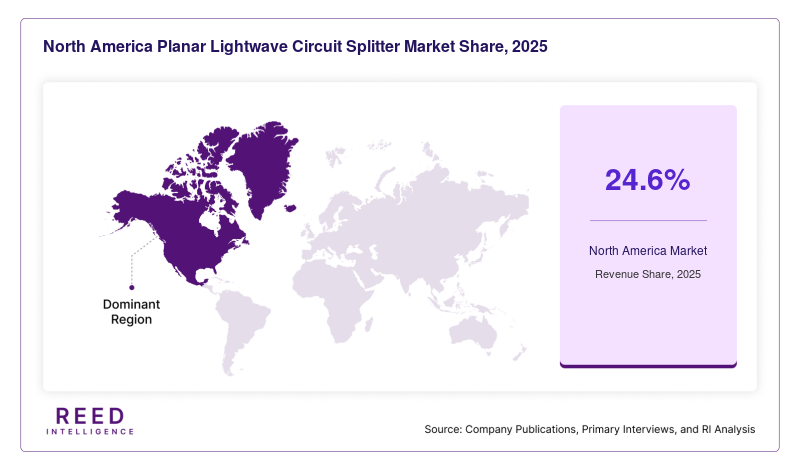
North America accounted for 24.6% of the market share in 2025 and is expected to grow at a CAGR of 11.9% during the forecast period. The United States dominated the region due to strong investments in fiber-optic infrastructure. The rapid deployment of 5G networks and increased demand for high-speed broadband services are key growth factors.
Europe
Europe held 21.3% share in 2025 and will grow at a CAGR of 10.2%. Germany led the regional market, supported by government-backed digitalization initiatives. The region’s focus on upgrading legacy telecom networks is driving the adoption of PLC splitters.
Asia Pacific
Asia Pacific dominated the Planar Lightwave Circuit Splitter Market with a 41.8% share in 2025 and is projected to grow at a CAGR of 10.8%. China emerged as the leading country, driven by extensive fiber network deployment and strong manufacturing capabilities.
Middle East & Africa
The Middle East & Africa region captured 6.5% share in 2025 and is expected to grow at a CAGR of 9.7%. The UAE led the region due to increasing investments in smart infrastructure and telecom expansion projects.
Latin America
Latin America accounted for 5.8% share in 2025 and is anticipated to grow at a CAGR of 9.3%. Brazil dominated the regional market, supported by growing broadband penetration and government initiatives to improve connectivity.
Competitive Landscape
The Planar Lightwave Circuit Splitter Market is moderately competitive, with several global and regional players focusing on product innovation and strategic partnerships. Leading companies are investing in advanced manufacturing technologies to improve efficiency and reduce costs. The market leader, Corning Incorporated, has strengthened its position through continuous innovation in fiber-optic solutions and expansion of its global footprint.
Other key players such as Huawei Technologies Co., Ltd., Fujikura Ltd., and Sumitomo Electric Industries, Ltd. are focusing on expanding their product portfolios to cater to growing demand in telecom and data center applications. Companies are also forming strategic collaborations with telecom operators to enhance market reach. Additionally, advancements in integrated photonics and miniaturization are driving competition among players to offer compact and high-performance PLC splitters.
Key Players List
- Corning Incorporated
- Huawei Technologies Co., Ltd.
- Fujikura Ltd.
- Sumitomo Electric Industries, Ltd.
- ZTE Corporation
- Broadex Technologies Co., Ltd.
- NTT Electronics Corporation
- Tianyisc Communication Co., Ltd.
- Wooriro Co., Ltd.
- Browave Corporation
- Ilsintech Co., Ltd.
- FiberHome Telecommunication Technologies Co., Ltd.
- Tongding Group Co., Ltd.
- PPI Networks
- Senko Advanced Components, Inc.
Recent Developments
- In 2025, Corning Incorporated introduced a new series of high-density PLC splitters designed for 5G network applications.
- Huawei Technologies expanded its optical component manufacturing capacity to meet rising global demand.
- Fujikura Ltd. launched advanced low-loss PLC splitters for next-generation PON systems.
- Sumitomo Electric Industries developed compact PLC modules targeting data center applications.
- FiberHome Telecommunication Technologies announced strategic partnerships to expand its presence in emerging markets.
Planar Lightwave Circuit Splitter Market Segments
Type
- 1×N PLC Splitters
- 2×N PLC Splitters
Application
- FTTH Networks
- FTTx Networks
- 5G Network Infrastructure
- Cable Television (CATV)
End-Use
- Telecommunications
- Data Centers
- Enterprise Networks
Installation Type
- Rack-Mounted
- Module-Based
- Bare Fiber
By Region
- North America
- Europe
- APAC
- Middle East and Africa
- LATAM