Plaque Disclosing Market Size, Share & Demand Report By Product Type (Tablets, Liquid Solutions, Gels), By Application (Dental Diagnosis, Educational Use, Research), By End-Use (Dental Clinics, Hospitals, Homecare), By Distribution Channel (Online Retail, Pharmacies & Dental Stores, Hospital Supply Chains), By Region & Segment Forecasts, 2026–2034
USD 3950
Market Overview
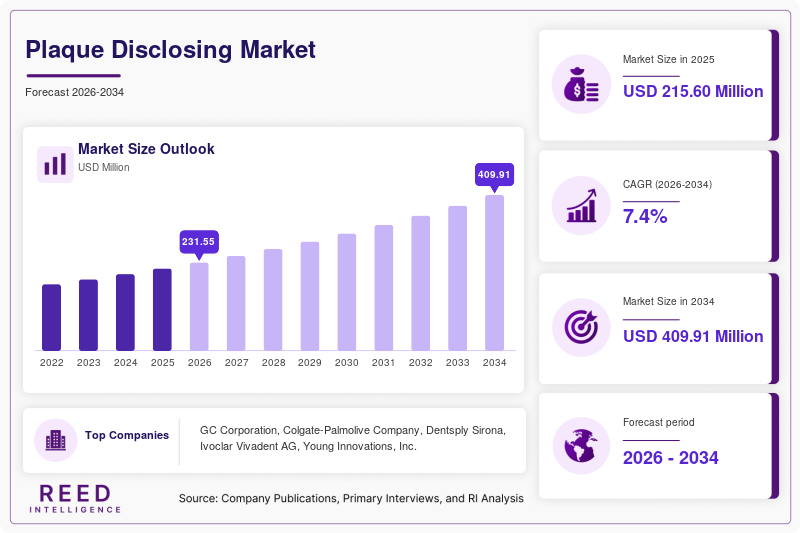
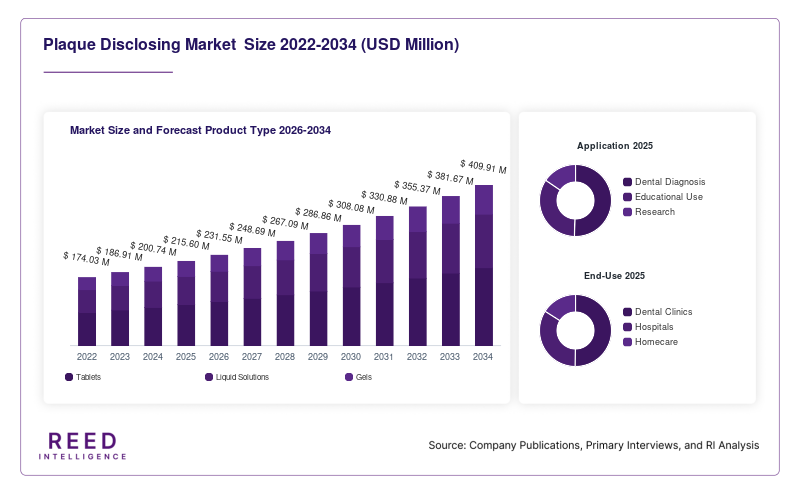
The global Plaque Disclosing Market size was valued at USD 215.6 million in 2026 and is projected to reach USD 382.4 million by 2034, expanding at a CAGR of 7.4% during the forecast period (2026–2034). The market has experienced steady expansion due to increasing awareness regarding preventive dental care and oral hygiene education across both developed and emerging economies. A major global factor supporting market growth has been the rising integration of preventive dentistry programs in schools and community healthcare systems, encouraging early diagnosis and plaque control practices.
Dental professionals and consumers are increasingly adopting plaque disclosing solutions as part of routine oral hygiene practices, enabling visualization of plaque deposits and improving brushing effectiveness. The growing penetration of dental clinics, along with advancements in easy-to-use formulations such as tablets, liquids, and gels, has further accelerated product adoption globally.
Key Highlights:
- North America dominated the market with a 34.8% share in 2025, while Asia Pacific is projected to grow at the fastest CAGR of 8.6% (2026–2034).
- By product type, tablets accounted for 42.3% share in 2025, whereas liquid solutions are expected to grow at a CAGR of 8.1%.
- By end-use, dental clinics held the largest share at 46.5% in 2025, while homecare usage is projected to grow at 8.9% CAGR.
- The U.S. remained the dominant country, with market values of USD 58.2 million in 2024 and USD 62.7 million in 2025.
Market Trends
Rising Demand for Home-Based Oral Care Monitoring
The Plaque Disclosing Market is witnessing a notable shift toward home-based dental care solutions. Consumers are increasingly adopting plaque disclosing tablets and solutions to monitor oral hygiene independently. This trend is supported by growing health awareness and digital content promoting preventive dental care routines. The availability of easy-to-use products through e-commerce platforms has strengthened this trend.
Product Innovation in Multi-Color Disclosing Agents
Manufacturers are focusing on innovation by introducing dual-tone and tri-color disclosing agents that differentiate between new and old plaque. These advanced products enhance patient education and clinical accuracy. Such innovations are gaining traction in dental practices and educational institutions, contributing to improved diagnosis and treatment planning.
Market Drivers
Increasing Awareness of Preventive Dental Care
Growing awareness regarding oral hygiene and preventive care has significantly driven the Plaque Disclosing Market. Government initiatives, dental campaigns, and educational programs have emphasized early detection of plaque to prevent periodontal diseases. This has increased demand for plaque disclosing products among both professionals and consumers.
Expansion of Dental Healthcare Infrastructure
The rapid expansion of dental clinics and healthcare facilities globally has supported market growth. Emerging economies are witnessing increased investments in dental care infrastructure, which has improved access to diagnostic tools, including plaque disclosing agents. This trend has strengthened the adoption of these products in routine dental procedures.
Market Restraint
Limited Awareness in Low-Income Regions
Despite steady growth, limited awareness and accessibility in low-income and rural regions remain a key restraint. Many populations still lack access to dental care services and preventive tools, restricting market penetration in these areas.
Market Opportunities
Growth in Pediatric Dentistry Applications
The increasing focus on pediatric oral health presents a significant opportunity for the Plaque Disclosing Market. Schools and pediatric dental clinics are adopting these products to educate children about proper brushing techniques, creating long-term demand.
Expansion Through E-Commerce Channels
The rapid growth of online retail platforms offers a promising opportunity for manufacturers. E-commerce enables wider product reach, especially in emerging markets, and allows consumers to access a variety of plaque disclosing products conveniently.
Segmental Analysis
By Product Type
The tablet segment dominated the market with a 42.3% share in 2025. Tablets are widely used due to their convenience, accurate dosage, and ease of application. They are commonly used in both dental clinics and homecare settings, making them a preferred choice among consumers.
The liquid solutions segment is expected to grow at a CAGR of 8.1% during the forecast period. This growth will be driven by their ease of application in clinical settings and effectiveness in covering larger oral areas. Liquids are particularly useful in professional dental procedures where precision and thorough coverage are required.
By Application
The dental diagnosis segment held the largest share at 48.7% in 2025. Plaque disclosing agents are extensively used in diagnosing plaque accumulation and evaluating oral hygiene conditions, making them essential tools in dental practices.
The educational application segment is projected to grow at a CAGR of 8.4%. This growth will be fueled by increasing use in schools and dental awareness programs aimed at teaching proper brushing techniques and improving oral hygiene habits among children.
By End-Use
The dental clinics segment dominated with a 46.5% share in 2025. Dental professionals rely on plaque disclosing products for accurate diagnosis and patient education, which has driven their widespread use in clinical settings.
The homecare segment is expected to grow at a CAGR of 8.9%, driven by rising consumer awareness and demand for self-monitoring tools. The availability of user-friendly products has made it easier for individuals to incorporate these solutions into daily oral care routines.
By Distribution Channel
The offline segment held the largest share at 61.2% in 2025. Pharmacies, dental supply stores, and clinics remain key distribution channels, offering professional guidance and trusted product availability.
The online segment is anticipated to grow at a CAGR of 9.2%, supported by increasing internet penetration and the convenience of e-commerce platforms. Consumers are increasingly purchasing oral care products online due to wider selection and competitive pricing.
Regional Analysis
North America
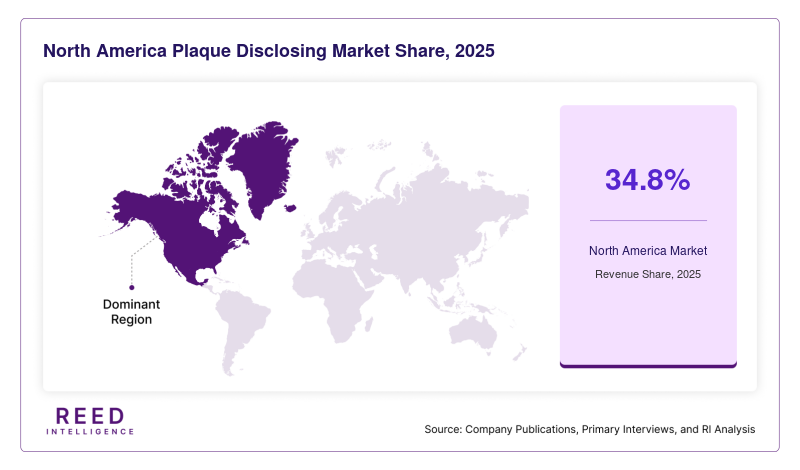
North America accounted for 34.8% of the market share in 2025 and is expected to grow at a CAGR of 6.8% during 2026–2034. The United States dominated the region due to high dental care awareness and advanced healthcare infrastructure. The presence of established dental product manufacturers and widespread adoption of preventive dental practices contributed to market leadership.
Europe
Europe held 27.1% share in 2025 and is projected to expand at a CAGR of 6.9%. Germany emerged as the dominant country due to its strong dental healthcare system and emphasis on preventive dentistry. Increased public health initiatives supporting oral hygiene have supported market growth in the region.
Asia Pacific
Asia Pacific captured 21.6% of the market share in 2025 and will grow at the fastest CAGR of 8.6%. China dominated the region, driven by increasing dental awareness, rising disposable income, and expansion of private dental clinics. The growing middle-class population is also contributing to higher adoption of oral care products.
Middle East & Africa
The Middle East & Africa held 8.4% share in 2025 and is anticipated to grow at a CAGR of 7.2%. The United Arab Emirates led the region due to improving healthcare infrastructure and increasing focus on dental tourism. Government initiatives aimed at enhancing oral health awareness have further supported growth.
Latin America
Latin America accounted for 8.1% of the market share in 2025 and is projected to grow at a CAGR of 7.5%. Brazil dominated the region owing to expanding dental services and increasing awareness of oral hygiene practices. The rising number of dental clinics has also contributed to market expansion.
Competitive Landscape
The Plaque Disclosing Market is moderately fragmented, with several global and regional players competing through product innovation and distribution expansion. Leading companies are focusing on developing advanced formulations and expanding their presence in emerging markets.
A key market leader is GC Corporation, which has strengthened its position through continuous product innovation and strong distribution networks. The company recently introduced an advanced multi-color disclosing solution designed for enhanced diagnostic accuracy.
Other notable players include Colgate-Palmolive Company, known for its extensive oral care portfolio; Young Innovations, Inc., which offers a wide range of dental consumables; Ivoclar Vivadent AG, recognized for high-quality dental materials; and Dentsply Sirona, a major player in dental equipment and consumables.
These companies are investing in research and development to improve product efficacy and user experience. Strategic partnerships, product launches, and expansion into untapped markets remain key strategies shaping the competitive landscape.
Key Players List
- GC Corporation
- Colgate-Palmolive Company
- Dentsply Sirona
- Ivoclar Vivadent AG
- Young Innovations, Inc.
- Kerr Corporation
- Sunstar Suisse S.A.
- TePe Oral Hygiene Products Ltd.
- Curaprox (Curaden AG)
- Prestige Consumer Healthcare Inc.
- Butler (Sunstar Group)
- VOCO GmbH
- Hu-Friedy Mfg. Co., LLC
- Oraldent Ltd.
- Sultan Healthcare
Recent Developments
- In 2025, GC Corporation launched a next-generation tri-color plaque disclosing solution aimed at improving diagnostic precision in dental clinics.
- In 2024, Colgate-Palmolive expanded its oral care product line by introducing consumer-friendly plaque disclosing tablets for home use.
- In 2025, Dentsply Sirona strengthened its distribution network in Asia Pacific to enhance market penetration.
- In 2024, Ivoclar Vivadent introduced a new gel-based disclosing agent for targeted application in clinical procedures.
- In 2025, Young Innovations partnered with regional distributors to expand its presence in emerging markets.
Plaque Disclosing Market Segments
Product Type
- Tablets
- Liquid Solutions
- Gels
Application
- Dental Diagnosis
- Educational Use
- Research
End-Use
- Dental Clinics
- Hospitals
- Homecare
Distribution Channel
- Online Retail
- Pharmacies & Dental Stores
- Hospital Supply Chains
By Region
- North America
- Europe
- APAC
- Middle East and Africa
- LATAM