Plaster Accelerator Market Size, Share Demand Report By Product Type (Gypsum-Based Accelerators, Aluminum Sulfate Accelerators, Potassium-Based Accelerators, Polymer-Modified Accelerators, Others), By Application (Residential Construction, Commercial Construction, Industrial Construction, Prefabricated Building Systems, Renovation and Remodeling), By End Use (Construction Contractors, Infrastructure Developers, Industrial Facility Builders, Real Estate Developers, Others) – Global Forecast 2026–
USD 3950
Market Overview
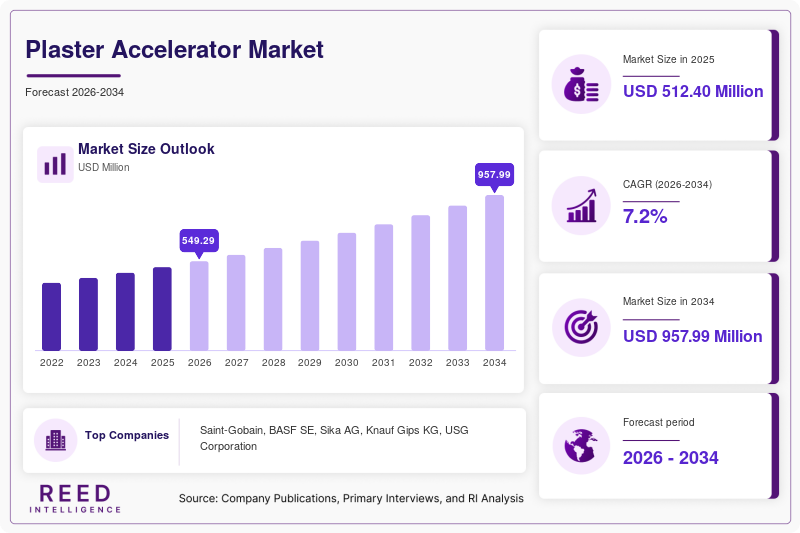
The global Plaster Accelerator Market size was valued at USD 512.4 million in 2026 and is projected to reach USD 891.7 million by 2034, expanding at a CAGR of 7.2% during the forecast period from 2026 to 2034. The market continues to witness stable growth due to the increasing demand for fast-setting construction materials across residential, commercial, and industrial infrastructure projects. Plaster accelerators are widely used to reduce drying and curing time in gypsum-based plasters, wall finishing compounds, and decorative construction materials. Rising urbanization, rapid infrastructure modernization, and increasing renovation activities have created sustained demand for high-performance additives that improve construction efficiency.
One major global factor supporting the growth of the Plaster Accelerator Market is the expansion of large-scale urban housing and smart city development projects. Governments and private developers are increasingly focusing on reducing construction timelines while maintaining surface quality and durability. This has encouraged contractors to adopt plaster accelerators that improve workability and shorten application cycles. The growing preference for prefabricated construction systems and dry-mix building materials has further strengthened product adoption across emerging economies. In addition, manufacturers are investing in advanced formulations with improved compatibility, moisture resistance, and environmental compliance to meet evolving construction standards.
Key Highlights
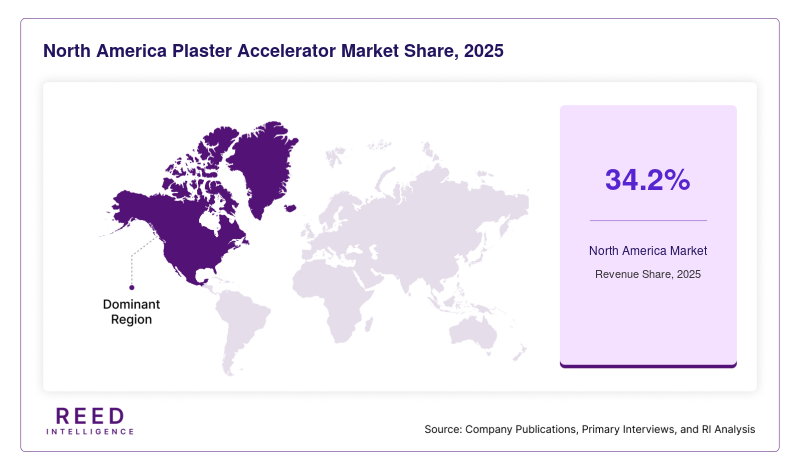
- North America dominated the market with a 34.2% share in 2025, while Asia Pacific is expected to grow at the fastest CAGR of 9.1% during 2026–2034.
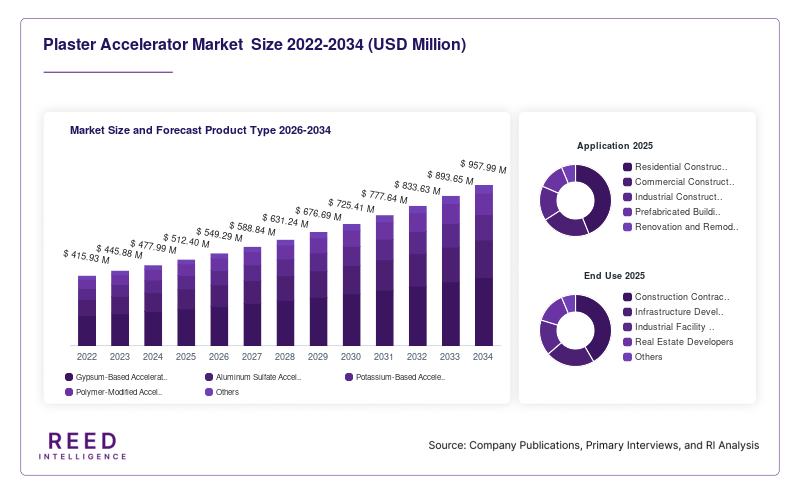
- By product type, gypsum-based accelerators accounted for the largest share of 39.6%, while polymer-modified accelerators are projected to grow at a CAGR of 9.8%.
- By application, residential construction led with a 44.3% share, whereas prefabricated building systems are expected to expand at a CAGR of 10.1%.
- By end use, construction contractors held the dominant share of 47.4%, while industrial infrastructure developers are anticipated to grow at a CAGR of 8.9%.
- The United States remained the dominant country, with market values of USD 146 million in 2024 and USD 158 million in 2025.
Market Trends
Rising Adoption of Dry-Mix Construction Materials
The increasing use of dry-mix construction products has become an important trend shaping the Plaster Accelerator Market. Contractors and builders are adopting ready-to-use plaster materials because they reduce labor dependency, improve application consistency, and minimize construction waste. Plaster accelerators are becoming essential additives in these formulations because they help optimize setting time and improve bonding performance. Demand is particularly increasing in urban residential developments and commercial renovation projects where faster completion schedules are required. Manufacturers are also introducing customized accelerators designed for different climatic conditions and substrate materials. The growing popularity of mechanized plastering systems and automated wall-finishing technologies is further strengthening the use of advanced accelerators across modern construction environments.
Increasing Preference for Sustainable and Low-Emission Additives
Environmental compliance and sustainability goals are influencing product innovation across the construction chemicals sector. Construction companies are increasingly selecting plaster accelerators with reduced volatile organic compound content and lower environmental impact. Manufacturers are focusing on eco-friendly raw materials and recyclable packaging to align with green building standards and sustainable infrastructure policies. Demand for low-emission additives is increasing in Europe and North America where environmental regulations are becoming stricter for construction materials. Companies are also investing in research to develop formulations that provide rapid curing while reducing energy consumption during building operations. The trend toward sustainable construction practices is expected to create long-term demand for advanced plaster accelerator technologies with improved environmental performance.
Market Drivers
Expanding Residential and Commercial Construction Activities
The continuous rise in residential housing demand and commercial infrastructure investments is driving the growth of the Plaster Accelerator Market. Urban population growth and migration toward metropolitan regions have increased the need for apartments, office buildings, shopping centers, and hospitality projects. Construction companies are under pressure to complete projects within shorter timelines while maintaining surface finishing quality. Plaster accelerators help reduce curing delays and improve productivity during interior wall and ceiling applications. In developing countries, government-supported affordable housing initiatives are further contributing to market expansion. Rapid construction activity in transportation terminals, educational institutions, and healthcare facilities is also increasing the consumption of gypsum-based materials and related accelerators across multiple construction applications.
Growing Demand for Time-Efficient Construction Solutions
The construction industry is increasingly prioritizing speed, efficiency, and labor optimization, which has accelerated the adoption of plaster accelerators. Contractors are facing rising labor costs and project management challenges, encouraging the use of additives that shorten setting time and reduce operational downtime. Plaster accelerators improve application efficiency by allowing quicker finishing and earlier coating or painting processes. The growing use of prefabricated building systems has also created demand for controlled curing materials that ensure production consistency. In regions with extreme weather conditions, accelerators help maintain reliable plaster performance despite environmental variations. As infrastructure projects become more complex and schedule-driven, demand for efficient plastering solutions is expected to continue increasing throughout the forecast period.
Market Restraint
Volatility in Raw Material Prices and Product Compatibility Challenges
Fluctuations in the prices of raw materials used in plaster accelerator production remain a major challenge for market participants. Ingredients such as aluminum sulfate, potassium compounds, specialty polymers, and chemical additives are affected by changing energy prices, mining costs, and transportation expenses. This volatility increases manufacturing costs and creates pricing pressure across the supply chain. Smaller manufacturers often face difficulties maintaining profit margins while competing with large multinational companies. In addition, compatibility issues between accelerators and certain plaster formulations can affect product performance and application quality. Inconsistent curing, reduced adhesion strength, or surface cracking may occur if additives are not correctly matched with gypsum compositions or environmental conditions. These technical limitations can discourage adoption among contractors unfamiliar with advanced formulation requirements, particularly in price-sensitive markets where low-cost traditional materials remain common.
Market Opportunities
Growth of Smart Cities and Urban Infrastructure Projects
The expansion of smart city programs and urban infrastructure modernization projects is creating strong opportunities for the Plaster Accelerator Market. Governments across Asia Pacific, the Middle East, and Latin America are investing heavily in transportation networks, public housing, commercial complexes, and smart urban facilities. These projects require rapid construction methods that reduce labor dependency and improve operational efficiency. Plaster accelerators support fast-track building schedules by enabling quicker wall finishing and interior surface preparation. Increasing investments in metro rail systems, airports, and mixed-use developments are expected to generate sustained demand for advanced plaster additives. Manufacturers are also collaborating with construction firms to develop specialized accelerator formulations suitable for large-scale infrastructure applications and varying environmental conditions.
Rising Adoption of Prefabricated and Modular Construction Systems
The growing popularity of prefabricated and modular construction methods presents a favorable opportunity for market expansion. Builders are increasingly using factory-manufactured wall panels, gypsum boards, and modular structural systems to improve project efficiency and reduce construction waste. Plaster accelerators play a critical role in ensuring rapid curing and consistent performance during panel manufacturing and assembly operations. Demand for modular housing, portable commercial buildings, and industrial prefabricated units is increasing in regions facing labor shortages and urban housing pressure. Manufacturers are introducing high-performance accelerators with enhanced durability, moisture resistance, and compatibility with automated production systems. As modular construction gains wider acceptance across residential and industrial sectors, the requirement for reliable plaster acceleration solutions is expected to rise steadily.
Segmental Analysis
By Product Type
Gypsum-based accelerators accounted for the largest share of the Plaster Accelerator Market in 2024, representing 39.6% of global revenue. These accelerators are widely preferred because of their compatibility with standard gypsum plasters used in residential and commercial construction. Contractors favor gypsum-based formulations due to their cost efficiency, ease of application, and reliable setting performance. Demand has remained particularly strong in wall finishing, ceiling applications, and decorative interior construction where rapid curing improves project timelines. Manufacturers are also focusing on improving moisture resistance and surface smoothness in gypsum-based accelerators to enhance overall construction quality. Growth in dry-mix plaster consumption and rising urban infrastructure investments continue to strengthen the dominance of this segment across developed and emerging economies.
By Application
Residential construction emerged as the dominant application segment in 2024, accounting for 44.3% of the global Plaster Accelerator Market. Rapid urbanization, population growth, and increasing apartment construction activities have driven the consumption of gypsum plasters and associated additives. Builders use plaster accelerators extensively in residential projects to reduce drying time and accelerate interior finishing operations. The growing demand for affordable housing and large-scale housing complexes in developing economies has further supported segment growth. In addition, homeowners are increasingly investing in renovation and remodeling projects that require quick-setting plaster systems for efficient execution. Manufacturers are introducing user-friendly formulations tailored for residential contractors and small-scale builders to expand product accessibility.
By End Use
Construction contractors held the dominant share of the Plaster Accelerator Market in 2024, accounting for 47.4% of total revenue. Contractors are the primary users of plaster accelerators because they manage large-scale interior finishing operations across residential, commercial, and infrastructure projects. The segment benefits from increasing pressure to complete projects within shorter deadlines while maintaining quality standards. Contractors prefer accelerators that improve workability, reduce curing time, and support efficient labor management. The rising adoption of mechanized plastering equipment and ready-mix plaster products has further strengthened demand among professional construction firms. In addition, increasing investments in urban infrastructure and commercial real estate development continue to create stable opportunities for contractor-driven product consumption.
Regional Analysis
North America
North America accounted for 34.2% of the global Plaster Accelerator Market in 2025 and maintained its position as the leading regional market. The region is projected to expand at a CAGR of 6.8% during the forecast period due to increasing renovation activities and commercial infrastructure modernization. The United States and Canada continue to experience demand for rapid interior finishing materials across residential housing and office construction projects. Strong adoption of dry-mix plaster products and mechanized wall application systems has supported the use of advanced accelerators. In addition, the growing emphasis on labor efficiency and reduced construction timelines has encouraged contractors to invest in high-performance additives.
The United States remained the dominant country within North America because of its extensive residential remodeling sector and large-scale infrastructure investments. Rising spending on educational institutions, healthcare facilities, and urban transportation hubs has increased the demand for fast-setting plaster systems. Another important growth factor is the increasing preference for sustainable building certifications and low-emission construction chemicals. Manufacturers are developing environmentally compliant accelerators with improved curing performance to meet evolving regulatory standards. The presence of established construction chemical companies and advanced distribution networks also supports market expansion across the country.
Europe
Europe represented a significant share of the Plaster Accelerator Market in 2025 and is expected to grow at a CAGR of 6.5% between 2026 and 2034. The region benefits from a mature construction industry focused on energy-efficient buildings and renovation of aging infrastructure. Countries such as Germany, France, and the United Kingdom continue to invest in commercial redevelopment and residential modernization projects. Plaster accelerators are increasingly used in interior finishing systems designed to improve construction productivity and surface durability. Demand for eco-friendly and low-emission additives is particularly strong in Western Europe, where sustainability regulations influence purchasing decisions across the building materials industry.
Germany remained the dominant country in the European market due to its strong industrial construction sector and advanced building technologies. The country has witnessed increasing use of prefabricated construction systems in both residential and commercial applications, creating stable demand for controlled curing solutions. A unique growth factor supporting the German market is the widespread adoption of energy-efficient renovation practices in public and private buildings. Builders are incorporating advanced gypsum-based materials that require reliable acceleration performance for faster installation. Continuous investment in green infrastructure development and sustainable urban planning is expected to maintain regional demand growth.
Asia Pacific
Asia Pacific is anticipated to register the fastest CAGR of 9.1% during the forecast period, supported by rapid urbanization and expanding infrastructure investments. The region accounted for a substantial share of the global Plaster Accelerator Market in 2025 due to strong construction activity in China, India, Japan, and Southeast Asian countries. Rising population growth and increasing demand for affordable housing projects have accelerated the use of gypsum plasters and wall-finishing materials. Contractors are adopting plaster accelerators to improve construction efficiency and manage large project volumes. The growing popularity of modular construction systems and smart city developments is also contributing to market expansion.
China remained the dominant country in Asia Pacific because of its extensive urban development projects and industrial construction activities. Government investments in transportation infrastructure, residential complexes, and public utility facilities continue to create strong demand for rapid construction materials. One unique growth factor driving the Chinese market is the increasing adoption of automated construction technologies and mechanized plastering equipment. Large construction firms are integrating advanced additives to improve consistency and reduce project delays. In addition, domestic manufacturers are expanding production capacity to meet rising regional demand and support export opportunities across neighboring countries.
Middle East & Africa
The Middle East & Africa region is witnessing gradual growth in the Plaster Accelerator Market and is projected to expand at a CAGR of 7.4% during the forecast period. Infrastructure diversification programs and tourism-related construction activities are supporting market demand across the region. Countries within the Gulf Cooperation Council are investing in commercial complexes, hospitality facilities, airports, and entertainment projects, creating opportunities for advanced construction materials. Plaster accelerators are increasingly used in high-temperature environments where faster curing and improved moisture resistance are required. Demand for premium interior finishing solutions has also increased in luxury residential and commercial developments.
Saudi Arabia emerged as the dominant country in the regional market due to ongoing infrastructure transformation initiatives and large-scale urban development projects. The country continues to invest in smart cities, industrial zones, and transportation infrastructure under long-term economic diversification strategies. A unique factor supporting market growth is the expansion of large tourism and hospitality projects requiring efficient interior finishing systems. Construction firms are using advanced accelerators to improve productivity and meet tight project deadlines. Increasing participation of international construction companies and material suppliers is also encouraging technological advancements in plaster formulations across the region.
Latin America
Latin America accounted for a moderate share of the Plaster Accelerator Market in 2025 and is expected to grow at a CAGR of 6.9% through 2034. The region is experiencing increasing construction activity in residential housing, retail facilities, and public infrastructure projects. Countries such as Brazil, Mexico, and Chile are investing in urban redevelopment and transportation improvements to support economic growth. Plaster accelerators are gaining popularity because they help reduce construction delays and improve application efficiency in humid climatic conditions. Demand for cost-effective building materials and dry-mix plaster products is also increasing among contractors and developers.
Brazil remained the leading country in the Latin American market due to expanding urban housing demand and public infrastructure investments. Government initiatives supporting affordable housing projects have increased the consumption of gypsum-based construction materials. A unique growth factor in Brazil is the rising use of modern wall-finishing technologies in commercial and high-rise residential buildings. Construction companies are adopting advanced plaster additives to enhance durability and reduce labor-intensive processes. The expansion of local manufacturing facilities and increasing foreign investment in construction chemicals are expected to further support regional market growth.
Competitive Landscape
The Plaster Accelerator Market is moderately fragmented, with global and regional manufacturers competing through product innovation, pricing strategies, and distribution network expansion. Leading companies are investing in research and development activities to improve curing efficiency, environmental compliance, and compatibility with advanced gypsum formulations. Market participants are also focusing on strategic partnerships with construction contractors and dry-mix plaster manufacturers to strengthen their market presence.
Saint-Gobain remained one of the leading companies in the global market due to its extensive product portfolio and strong distribution capabilities across construction material segments. The company recently introduced enhanced gypsum additive solutions designed for high-performance wall-finishing applications and prefabricated construction systems. Other major players are expanding manufacturing facilities in Asia Pacific and the Middle East to address increasing regional demand.
Key Players
- Saint-Gobain
- BASF SE
- Sika AG
- Knauf Gips KG
- USG Corporation
- RPM International Inc.
- Arkema Group
- Fosroc International
- Mapei S.p.A.
- Dow Inc.
- Wacker Chemie AG
- Pidilite Industries Ltd.
- GCP Applied Technologies
- Chryso Group
- LafargeHolcim
Recent Developments
- In March 2025, Saint-Gobain introduced an advanced gypsum-based plaster accelerator solution designed for rapid-curing wall applications with improved moisture resistance and enhanced finishing performance.
- In January 2025, Sika AG launched polymer-modified plaster accelerator additives integrated with high-bonding technology for prefabricated construction systems and commercial interior projects.
- In September 2024, BASF SE expanded its sustainable plaster accelerator portfolio for energy-efficient buildings and low-emission construction material applications across Europe and Asia Pacific.
- In June 2024, Knauf Gips KG increased production capacity at its Asia Pacific manufacturing facilities to address rising demand for dry-mix plaster systems in residential and infrastructure construction projects.
Plaster Accelerator Market Segments
Product Type
- Gypsum-Based Accelerators
- Aluminum Sulfate Accelerators
- Potassium-Based Accelerators
- Polymer-Modified Accelerators
- Others
Application
- Residential Construction
- Commercial Construction
- Industrial Construction
- Prefabricated Building Systems
- Renovation and Remodeling
End Use
- Construction Contractors
- Infrastructure Developers
- Industrial Facility Builders
- Real Estate Developers
- Others
By Region
- North America
- Europe
- APAC
- Middle East and Africa
- LATAM