Plastic-Based Egg Packaging Market Size, Share & Demand Report By Product Type (Egg Cartons, Egg Trays, Clamshell Egg Containers), By Material Type (PET (Polyethylene Terephthalate), PVC (Polyvinyl Chloride)), By Capacity (6-Egg Packaging, 12-Egg Packaging, 18-Egg Packaging, 24-Egg Packaging), By End User (Poultry Farms, Retail Food Distribution, Food Processing Companies), By Region & Segment Forecasts, 2026–2034
USD 3950
Market Overview
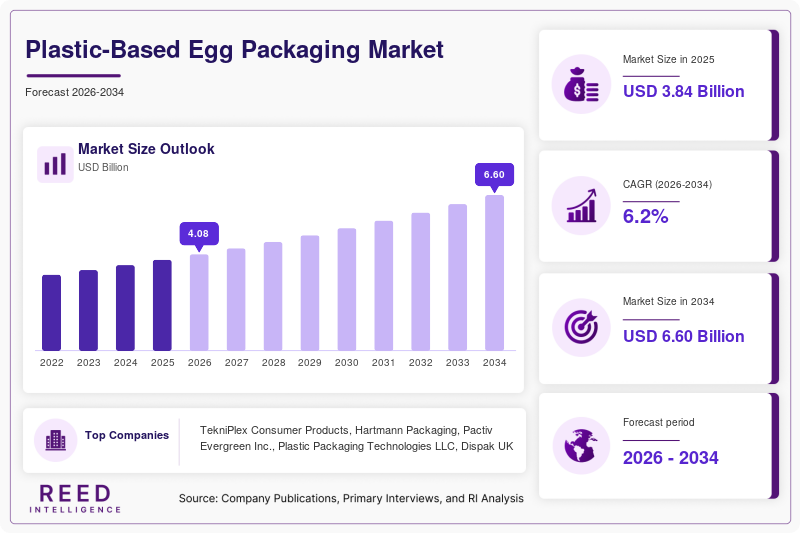
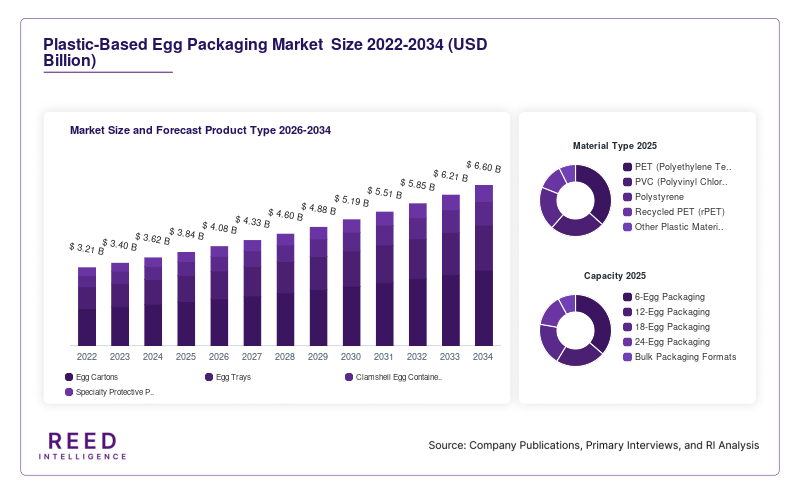
The Plastic-Based Egg Packaging Market was valued at USD 3.84 billion in 2026 and is projected to reach USD 6.21 billion by 2034, expanding at a CAGR of 6.2% during the forecast period (2026–2034). The market continues to grow steadily due to increasing global egg consumption, expanding retail food distribution networks, and rising demand for protective packaging solutions that minimize product damage during transportation and storage. Plastic-based egg packaging remains widely adopted because of its durability, lightweight structure, transparency, moisture resistance, and cost efficiency.
A major global factor supporting market growth is the continued expansion of organized food retail and modern grocery distribution systems. Supermarkets, hypermarkets, convenience stores, and e-commerce grocery platforms increasingly require packaging formats that ensure product safety, visibility, and shelf-life performance. Plastic egg cartons and trays provide reliable protection against breakage while allowing consumers to inspect egg quality before purchase, making them a preferred packaging option across many markets.
Key Highlights
- Asia Pacific accounted for the largest market share of 41.9% in 2025, while Latin America is anticipated to register the fastest CAGR of 7.4% during 2026–2034.
- By Product Type, Egg Cartons held the largest market share of 57.6% in 2025, while Clamshell Egg Containers are projected to grow at a CAGR of 7.0%.
- By Material Type, PET (Polyethylene Terephthalate) represented 48.8% market share in 2025, while Recycled PET (rPET) is forecast to expand at 7.6% CAGR.
- By Capacity, 12-Egg Packaging accounted for 44.5% share in 2025, whereas 18-Egg Packaging is expected to grow at 7.2% CAGR.
- By End User, Retail Food Distribution captured 61.4% market share in 2025, while E-commerce Grocery Distribution is projected to register a CAGR of 8.1%.
- China, the dominant country market, recorded values of USD 598 million in 2024 and USD 643 million in 2025.
Market Trends
Growing Adoption of Recycled Plastic Packaging Materials
Packaging manufacturers are increasingly utilizing recycled plastic materials to meet sustainability goals and regulatory expectations. Recycled PET-based egg cartons are gaining acceptance among retailers and food producers due to their reduced environmental footprint and compatibility with circular economy initiatives. Improvements in recycling technologies continue to enhance material quality and packaging performance.
Increasing Use of Transparent Retail Packaging Designs
Consumers increasingly prefer packaging that allows direct product visibility. Transparent plastic egg cartons enable buyers to inspect eggs without opening the package, improving purchasing confidence and reducing product handling. Retailers are adopting clear packaging formats to improve shelf presentation and enhance product differentiation.
Market Drivers
Rising Global Egg Consumption and Poultry Production
Increasing demand for affordable protein sources is driving higher egg production worldwide. Population growth, urbanization, and changing dietary preferences continue to support egg consumption across developed and emerging economies. This expansion in production volumes is creating sustained demand for efficient egg packaging solutions.
Expansion of Organized Food Retail Infrastructure
The rapid growth of supermarkets, hypermarkets, and modern food distribution channels has increased demand for durable packaging capable of protecting eggs throughout storage and transportation processes. Retailers require standardized packaging formats that support efficient inventory management and product presentation.
Market Restraint
Environmental Concerns Regarding Plastic Waste Generation
Growing concerns surrounding plastic waste and single-use packaging continue to challenge market growth. Regulatory restrictions on plastic usage and increasing consumer preference for sustainable alternatives may limit adoption in regions with stringent environmental policies.
Market Opportunities
Development of High-Recycled-Content Packaging Solutions
Manufacturers have significant opportunities to introduce egg packaging products incorporating higher percentages of recycled plastic content. Such innovations can support sustainability objectives while maintaining protective performance standards required by food distributors and retailers.
Growth of Online Grocery and Home Delivery Services
The continued expansion of online grocery platforms presents new opportunities for advanced protective packaging solutions. Durable plastic-based egg packaging can help minimize breakage during last-mile delivery operations while supporting growing e-commerce food distribution networks.
Segmental Analysis
By Product Type
The Plastic-Based Egg Packaging Market is segmented into:
- Egg Cartons
- Egg Trays
- Clamshell Egg Containers
- Specialty Protective Packaging
Egg Cartons accounted for 57.6% market share in 2025 due to their widespread utilization in retail packaging applications. Their stackability, durability, and consumer-friendly design contributed to segment leadership.
Clamshell Egg Containers are projected to register the fastest CAGR of 7.0% during the forecast period. Enhanced product visibility and growing preference for premium retail presentation will support segment growth.
By Material Type
The market includes:
- PET (Polyethylene Terephthalate)
- PVC (Polyvinyl Chloride)
- Polystyrene
- Recycled PET (rPET)
- Other Plastic Materials
PET held 48.8% market share in 2025 owing to its excellent clarity, impact resistance, and compatibility with food packaging applications.
Recycled PET (rPET) is expected to expand at a CAGR of 7.6% through 2034. Increasing sustainability commitments and regulatory encouragement for recycled packaging materials will drive adoption.
By Capacity
The market is categorized into:
- 6-Egg Packaging
- 12-Egg Packaging
- 18-Egg Packaging
- 24-Egg Packaging
- Bulk Packaging Formats
12-Egg Packaging represented 44.5% share in 2025 because it remains the standard retail format preferred by consumers and food retailers across numerous markets.
18-Egg Packaging is anticipated to grow at a CAGR of 7.2% due to increasing demand from larger households seeking cost-effective bulk purchasing options.
By End User
The market consists of:
- Poultry Farms
- Retail Food Distribution
- Food Processing Companies
- E-commerce Grocery Distribution
- Institutional Buyers
Retail Food Distribution accounted for 61.4% market share in 2025, reflecting the dominant role of supermarkets, hypermarkets, and grocery retailers in egg sales worldwide.
E-commerce Grocery Distribution is projected to witness the fastest growth at a CAGR of 8.1%. Increasing adoption of online grocery shopping and home delivery services will continue creating demand for protective packaging formats.
Competitive Landscape
The Plastic-Based Egg Packaging Market remains moderately fragmented, with manufacturers focusing on packaging innovation, recycled material integration, product customization, and operational efficiency improvements. Market participants continue investing in thermoforming technologies and sustainable packaging development to strengthen competitive positioning.
TekniPlex Consumer Products remains a leading participant due to its extensive food packaging portfolio and advanced thermoformed plastic packaging capabilities. The company recently expanded development efforts focused on recyclable packaging solutions designed to support sustainability objectives across food packaging applications.
Hartmann Packaging, Dispak UK, Pactiv Evergreen, and Plastic Packaging Technologies LLC continue strengthening market presence through product innovation, production expansion, and strategic partnerships with food producers and retailers.
Key Players List
- TekniPlex Consumer Products
- Hartmann Packaging
- Pactiv Evergreen Inc.
- Plastic Packaging Technologies LLC
- Dispak UK
- Dolco Packaging Corporation
- Ovotherm International Handels GmbH
- Cascades Inc.
- Sabert Corporation
- CKF Inc.
- Sonoco Products Company
- Coveris Holdings S.A.
- Placon Corporation
- Primapack SAE
- Huhtamaki Oyj
Regional Analysis
North America
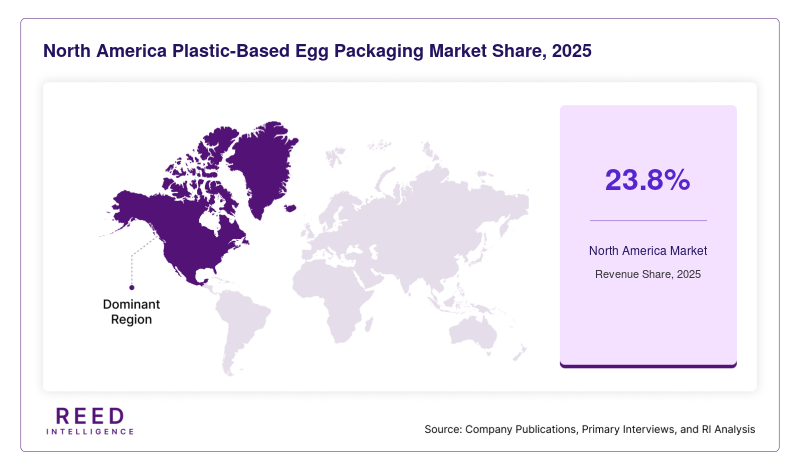
North America accounted for 23.8% of the Plastic-Based Egg Packaging Market share in 2025 and is projected to grow at a CAGR of 5.7% during 2026–2034. The region maintained steady demand due to well-established poultry industries, advanced food packaging technologies, and strong retail distribution infrastructure.
The United States dominated the regional market owing to large-scale egg production operations and widespread adoption of transparent retail packaging formats that support consumer convenience and product visibility.
Europe
Europe held 24.3% market share in 2025 and is expected to register a CAGR of 5.8% through 2034. Demand remained supported by advanced food safety standards and sophisticated packaging manufacturing capabilities.
Germany emerged as the leading country market because of its highly developed food packaging sector and continued investments in recyclable plastic packaging technologies designed to improve sustainability performance.
Asia Pacific
Asia Pacific represented 41.9% of global market revenue in 2025 and is forecast to expand at a CAGR of 6.9% during the forecast period. Strong poultry production growth and increasing modernization of food retail channels contributed significantly to regional market expansion.
China dominated the regional market due to large-scale egg production capacity, rising consumer demand for packaged food products, and continuous expansion of organized retail infrastructure across urban and semi-urban areas.
Middle East & Africa
The Middle East & Africa accounted for 4.8% market share in 2025 and is projected to grow at a CAGR of 6.5% during 2026–2034. Expanding food distribution networks and growing poultry production activities supported market development.
Saudi Arabia led the regional market because of increasing investments in domestic food production, modern retail expansion, and improvements in food supply chain management systems.
Latin America
Latin America captured 5.2% market share in 2025 and is expected to register the fastest CAGR of 7.4% through 2034. Growing urban populations and increasing consumption of packaged food products continue to stimulate packaging demand.
Brazil dominated the regional market owing to its large poultry industry, strong agricultural production capabilities, and increasing penetration of organized food retail formats across major metropolitan regions.
Competitive Landscape
The Plastic-Based Egg Packaging Market remains moderately fragmented, with manufacturers focusing on packaging innovation, recycled material integration, product customization, and operational efficiency improvements. Market participants continue investing in thermoforming technologies and sustainable packaging development to strengthen competitive positioning.
TekniPlex Consumer Products remains a leading participant due to its extensive food packaging portfolio and advanced thermoformed plastic packaging capabilities. The company recently expanded development efforts focused on recyclable packaging solutions designed to support sustainability objectives across food packaging applications.
Hartmann Packaging, Dispak UK, Pactiv Evergreen, and Plastic Packaging Technologies LLC continue strengthening market presence through product innovation, production expansion, and strategic partnerships with food producers and retailers.
Key Players List
- TekniPlex Consumer Products
- Hartmann Packaging
- Pactiv Evergreen Inc.
- Plastic Packaging Technologies LLC
- Dispak UK
- Dolco Packaging Corporation
- Ovotherm International Handels GmbH
- Cascades Inc.
- Sabert Corporation
- CKF Inc.
- Sonoco Products Company
- Coveris Holdings S.A.
- Placon Corporation
- Primapack SAE
- Huhtamaki Oyj
Recent Developments
- In 2025, several packaging manufacturers introduced egg cartons containing higher percentages of recycled PET materials.
- Multiple producers expanded thermoforming production capacity to support growing demand from retail food distributors.
- New lightweight packaging designs were launched to reduce material consumption while maintaining product protection.
- Companies increased investments in food-grade recycled plastic processing technologies.
- Strategic partnerships between packaging suppliers and poultry producers were established to improve supply chain efficiency and packaging customization.
Plastic-Based Egg Packaging Market Segments
Product Type
- Egg Cartons
- Egg Trays
- Clamshell Egg Containers
- Specialty Protective Packaging
Material Type
- PET (Polyethylene Terephthalate)
- PVC (Polyvinyl Chloride)
- Polystyrene
- Recycled PET (rPET)
- Other Plastic Materials
Capacity
- 6-Egg Packaging
- 12-Egg Packaging
- 18-Egg Packaging
- 24-Egg Packaging
- Bulk Packaging Formats
End User
- Poultry Farms
- Retail Food Distribution
- Food Processing Companies
- E-commerce Grocery Distribution
- Institutional Buyers
By Region
- North America
- Europe
- APAC
- Middle East and Africa
- LATAM