Plastic Contract Manufacturing Market Size, Share & Demand Report By Manufacturing Process (Injection Molding, Blow Molding, Thermoforming, Rotational Molding, 3D Printing), By Material Type (Polypropylene, Polyethylene, Polycarbonate, Acrylonitrile Butadiene Styrene, Bioplastics), By End-Use Industry (Healthcare, Automotive, Consumer Electronics, Packaging, Industrial Equipment) By Region & Segment Forecasts, 2025–2033
USD 3950
Market Overview
The Plastic Contract Manufacturing Market size was valued at USD 38.6 billion in 2024 and is projected to reach USD 67.9 billion by 2033, registering a CAGR of 6.4% during 2025–2033. Plastic contract manufacturing refers to outsourced plastic production services including design support, prototyping, molding, assembly, and finishing for industries such as healthcare, automotive, consumer electronics, and packaging. These services enable original equipment manufacturers (OEMs) to reduce capital expenditure, accelerate product development cycles, and improve operational flexibility.
A key global factor supporting the growth of the Plastic Contract Manufacturing Market is the rising adoption of outsourcing strategies among OEMs. Companies across multiple industries are increasingly delegating component manufacturing to specialized plastic manufacturers to reduce operational complexity and focus on core competencies such as product design and marketing. Contract manufacturers offer advanced molding technologies, scalable production capabilities, and integrated services, which improve efficiency and cost management.
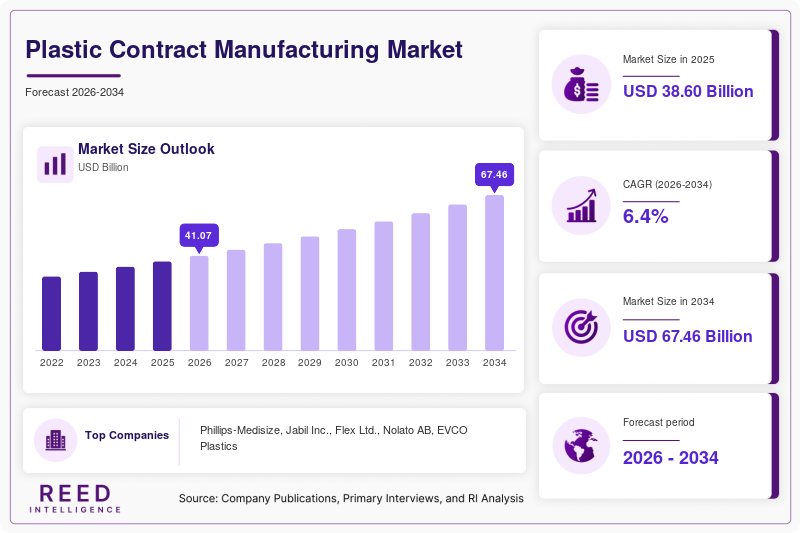
Key Highlights
- Dominant region: Asia Pacific accounted for 38% of the Plastic Contract Manufacturing Market share in 2025, while Middle East & Africa is projected to grow the fastest with a CAGR of 7.8%.
- Leading segment: Injection molding held the largest share at 44% in 2024, while 3D printing contract manufacturing is expected to expand at the fastest CAGR of 8.3%.
- Leading end-use: Healthcare represented 26% of the market share in 2024, while consumer electronics will grow at 7.5% CAGR through 2033.
- Dominant country: The United States market was valued at USD 8.4 billion in 2024 and reached USD 8.9 billion in 2025.
Market Trends
Integration of Advanced Manufacturing Technologies
The Plastic Contract Manufacturing Market has been influenced by the growing integration of advanced production technologies such as automated injection molding, robotics, and digital manufacturing systems. Contract manufacturers are increasingly deploying automated production lines to improve precision, reduce labor dependency, and enhance production efficiency. The integration of digital monitoring tools enables real-time quality control and predictive maintenance, which helps manufacturers minimize production downtime. These technological improvements support the manufacturing of complex plastic components required by industries such as healthcare equipment and consumer electronics.
Rising Demand for Sustainable Plastic Manufacturing
Sustainability initiatives are shaping production strategies in the Plastic Contract Manufacturing Market. Contract manufacturers are gradually adopting recycled polymers, biodegradable materials, and energy-efficient manufacturing processes. Many OEMs now require suppliers to comply with environmental standards and sustainability targets. As a result, contract manufacturers are investing in closed-loop recycling systems and eco-friendly material sourcing practices. This shift toward sustainable production is expected to influence product design, material selection, and supplier partnerships across industries relying on plastic components.
Market Drivers
Expansion of Medical Device Manufacturing
The healthcare sector has created strong demand within the Plastic Contract Manufacturing Market due to the increasing production of medical devices and diagnostic equipment. Plastic components are widely used in disposable medical tools, drug delivery devices, and laboratory consumables. Contract manufacturers provide cleanroom production facilities and precision molding technologies required for medical-grade plastics. As healthcare companies focus on scaling production and meeting regulatory requirements, outsourcing plastic component manufacturing has become a practical approach to ensure consistent quality and regulatory compliance.
Increasing Use of Lightweight Components in Transportation
The transportation industry has supported growth in the Plastic Contract Manufacturing Market as manufacturers continue to seek lightweight materials to improve fuel efficiency and reduce vehicle emissions. Plastic components are increasingly used in automotive interiors, under-the-hood components, and structural parts. Contract manufacturers offer specialized molding capabilities that enable the production of durable plastic components with complex geometries. These capabilities help vehicle manufacturers reduce production costs while meeting performance requirements, thereby supporting the broader adoption of plastic components.
Market Restraint
Volatility in Raw Material Prices
Fluctuations in the prices of petrochemical-based raw materials have posed a challenge for the Plastic Contract Manufacturing Market. Plastics such as polypropylene, polyethylene, and polycarbonate are derived from crude oil and natural gas derivatives. Changes in energy markets often influence the cost structure of plastic production.
Contract manufacturers operate under long-term supply agreements with OEMs, which can limit their ability to pass sudden raw material cost increases to customers. This situation can affect profit margins and pricing strategies. In addition, smaller contract manufacturers may face greater financial pressure due to limited bargaining power with raw material suppliers.
Supply chain disruptions have also contributed to raw material price fluctuations, particularly when global logistics conditions affect the availability of polymer resins. Contract manufacturers must continuously adjust procurement strategies and inventory management practices to maintain stable production levels.
As a result, volatility in raw material prices can influence production planning and cost forecasting across the Plastic Contract Manufacturing Market.
Market Opportunities
Growth of Electronics Manufacturing
The expansion of global electronics production presents a significant opportunity for the Plastic Contract Manufacturing Market. Consumer electronics devices require numerous plastic components such as casings, connectors, and structural parts. Contract manufacturers equipped with precision molding and micro-manufacturing capabilities are positioned to supply these components at large production volumes. The growth of wearable electronics, smart home devices, and connected consumer products will further expand the demand for specialized plastic components.
Development of Bio-Based Plastics
The increasing development of bio-based and biodegradable plastics is creating opportunities for contract manufacturers to expand their service offerings. Many industries are exploring alternatives to conventional petroleum-based plastics to reduce environmental impact. Contract manufacturers that adopt new processing techniques compatible with bio-based materials can establish new partnerships with companies focused on sustainable product development. As research into plant-derived polymers continues to progress, contract manufacturers may play a role in scaling production for commercial applications.
Segmental Analysis
By Manufacturing Process
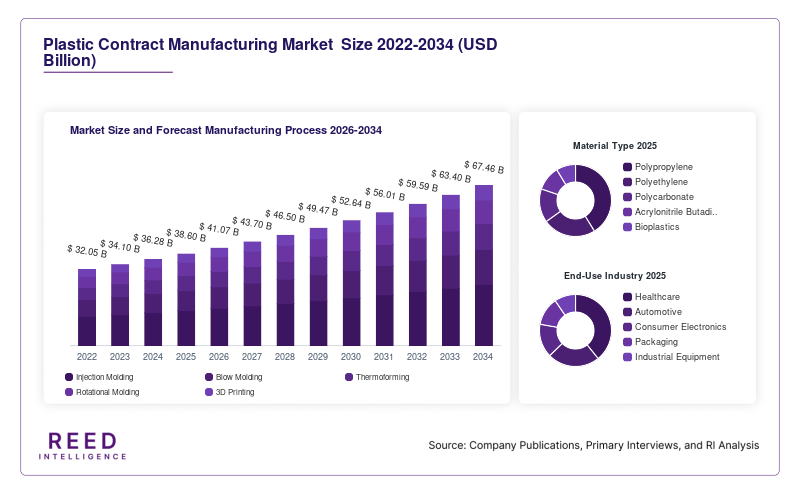
Injection molding dominated the Plastic Contract Manufacturing Market with 44% share in 2024. This process has been widely adopted due to its ability to produce high-volume plastic components with consistent precision. Contract manufacturers utilize injection molding for applications requiring detailed geometries and tight tolerances. Industries such as medical devices, automotive components, and electronics rely on injection molding for the production of housings, connectors, and structural parts.
3D printing contract manufacturing will grow at the fastest CAGR of 8.3% through 2033. The technology will enable manufacturers to produce complex designs and small production batches with reduced tooling requirements. Contract manufacturers will increasingly adopt additive manufacturing to support rapid prototyping and customized production for industries such as healthcare and aerospace.
By Material Type
Polypropylene held the largest share of the Plastic Contract Manufacturing Market at 28% in 2024. The material has been widely used due to its durability, chemical resistance, and cost-effectiveness. Contract manufacturers utilize polypropylene for packaging components, consumer products, and automotive parts. Its versatility allows manufacturers to produce a wide range of plastic components across industries.
Bioplastics will experience the fastest growth with a CAGR of 7.6% during the forecast period. The development of environmentally friendly materials will encourage manufacturers to adopt bio-based polymers derived from renewable sources. Contract manufacturers will expand processing capabilities to accommodate new materials that support sustainability initiatives across multiple industries.
By End-Use Industry
Healthcare accounted for 26% of the Plastic Contract Manufacturing Market share in 2024. The sector requires precision-engineered plastic components used in medical devices, diagnostic systems, and laboratory equipment. Contract manufacturers provide specialized molding processes and regulatory-compliant production environments to support healthcare applications.
Consumer electronics will grow at the fastest CAGR of 7.5% through 2033. The expansion of smart devices, wearable electronics, and connected home products will increase the demand for durable and lightweight plastic components. Contract manufacturers will supply casings, structural components, and connectors designed for compact electronic devices.
Regional Analysis
North America
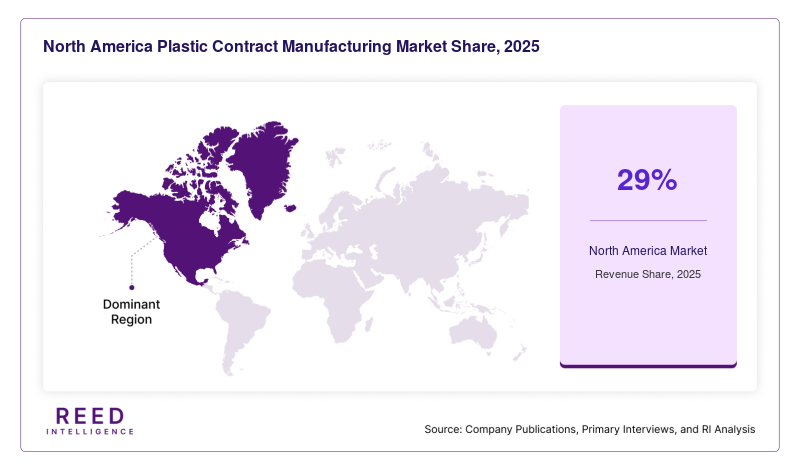
North America accounted for 29% of the Plastic Contract Manufacturing Market share in 2025 and is expected to grow at a CAGR of 5.8% during 2025–2033. The region has maintained a strong contract manufacturing ecosystem supported by advanced production facilities, technological capabilities, and established supply chains. Industries such as healthcare, aerospace, and automotive have generated consistent demand for outsourced plastic component production. Contract manufacturers in the region often provide integrated services including product design, prototyping, molding, and assembly.
The United States remained the dominant country in the regional Plastic Contract Manufacturing Market. A key factor contributing to growth is the country’s strong network of medical technology companies that rely on precision plastic components for devices and diagnostic systems. Contract manufacturers provide specialized production capabilities, including cleanroom manufacturing environments, which are necessary for healthcare applications. The presence of established OEMs and advanced manufacturing infrastructure has supported the continued demand for plastic contract manufacturing services.
Europe
Europe represented 24% of the Plastic Contract Manufacturing Market share in 2025 and will grow at a CAGR of 5.6% through 2033. The region has developed a well-structured manufacturing ecosystem supported by engineering expertise and industrial automation. Plastic contract manufacturers in Europe frequently serve industries such as automotive, packaging, and industrial machinery. Regulatory standards related to product safety and environmental compliance influence production processes and material selection across the region.
Germany emerged as the dominant country within the European Plastic Contract Manufacturing Market. The country’s strong automotive manufacturing base has contributed to demand for plastic components used in vehicle interiors, electronics housings, and structural elements. German contract manufacturers are recognized for precision molding capabilities and engineering expertise. Collaboration between automotive manufacturers and plastic suppliers has supported the development of advanced polymer components designed for durability and performance.
Asia Pacific
Asia Pacific accounted for 38% of the Plastic Contract Manufacturing Market share in 2025 and is projected to grow at a CAGR of 6.9% between 2025 and 2033. The region has served as a global manufacturing hub due to cost-efficient labor, extensive supply chains, and large-scale production capabilities. Plastic contract manufacturers in Asia Pacific provide services to industries such as consumer electronics, automotive, packaging, and medical devices. Rapid industrialization and export-oriented manufacturing have supported the expansion of contract manufacturing operations.
China dominated the regional Plastic Contract Manufacturing Market due to its extensive manufacturing infrastructure and established electronics production sector. A significant growth factor has been the large network of OEMs and component suppliers operating within industrial clusters. Contract manufacturers in China provide large-volume production capabilities and integrated services, which enable international companies to outsource plastic component production. The availability of raw materials and manufacturing expertise has supported continued growth in the country.
Middle East & Africa
The Middle East & Africa region held 5% of the Plastic Contract Manufacturing Market share in 2025 and will expand at a CAGR of 7.8% through 2033. Growth in this region is influenced by industrial diversification initiatives and increasing investment in manufacturing infrastructure. Several countries have begun developing domestic manufacturing capabilities to reduce reliance on imports and strengthen local supply chains.
Saudi Arabia represented the dominant country within the regional Plastic Contract Manufacturing Market. The country has invested in petrochemical production and industrial development programs, which support the availability of raw materials used in plastic manufacturing. Contract manufacturers benefit from access to polymer feedstock and expanding industrial zones that support manufacturing operations. These initiatives have encouraged the establishment of new production facilities and partnerships with international manufacturers.
Latin America
Latin America accounted for 4% of the Plastic Contract Manufacturing Market share in 2025 and is expected to grow at a CAGR of 6.1% during the forecast period. The region has gradually expanded its contract manufacturing capabilities as industries such as consumer goods, automotive, and packaging increase production activities. Contract manufacturers provide localized production services that support regional supply chains.
Brazil remained the dominant country in the Latin American Plastic Contract Manufacturing Market. The country has a diverse manufacturing sector and a large consumer goods market that requires plastic components for packaging and household products. Contract manufacturers in Brazil supply molded components for domestic manufacturers and regional export markets. Industrial development initiatives and increasing manufacturing investments have supported the gradual expansion of contract manufacturing services.
Competitive Landscape
The Plastic Contract Manufacturing Market features a mix of global contract manufacturers and specialized plastic component producers. Companies compete based on manufacturing expertise, technological capabilities, production capacity, and industry specialization. Many manufacturers focus on providing integrated services including product design support, prototyping, molding, assembly, and finishing.
One of the prominent market leaders is Phillips-Medisize, recognized for its extensive expertise in medical device contract manufacturing. The company has expanded its production capabilities by investing in advanced molding technologies and automated production systems designed for precision plastic components.
Other companies in the market focus on strengthening partnerships with OEMs across industries such as healthcare, automotive, and consumer electronics. Manufacturers are also expanding their geographic presence and adopting digital manufacturing technologies to improve operational efficiency and production quality.
Key Players
- Phillips-Medisize
- Flex Ltd.
- Jabil Inc.
- EVCO Plastics
- Nypro (Jabil Healthcare)
- Tessy Plastics Corp.
- Mack Molding
- GW Plastics
- C&J Industries
- Rosti Group
Recent Developments
- 2024: Several contract manufacturers expanded injection molding capacity to meet increasing demand from healthcare device manufacturers.
- 2024: Manufacturers invested in automated production systems to improve precision and production efficiency.
- 2023: Plastic contract manufacturing companies began integrating additive manufacturing technologies for rapid prototyping services.
- 2023: Partnerships between electronics companies and contract manufacturers increased to support the production of plastic components for smart devices.
Plastic Contract Manufacturing Market Segments
Manufacturing Process
- Injection Molding
- Blow Molding
- Thermoforming
- Rotational Molding
- 3D Printing
Material Type
- Polypropylene
- Polyethylene
- Polycarbonate
- Acrylonitrile Butadiene Styrene (ABS)
- Bioplastics
End-Use Industry
- Healthcare
- Automotive
- Consumer Electronics
- Packaging
- Industrial Equipment
By Region
- North America
- Europe
- APAC
- Middle East and Africa
- LATAM