Plastic Packaging Sacks Market Size, Share & Demand Report By Material Type (Polypropylene, Polyethylene, Biodegradable Plastics, Others), By Product Type (Woven Sacks, Valve Sacks, Gusseted Sacks, Laminated Sacks, Open Mouth Sacks), By End-Use Industry (Agriculture, Food and Beverage, Construction, Chemicals, Retail and E-Commerce, Others), By Region & Segment Forecasts, 2026–2034
USD 3950
Market Overview
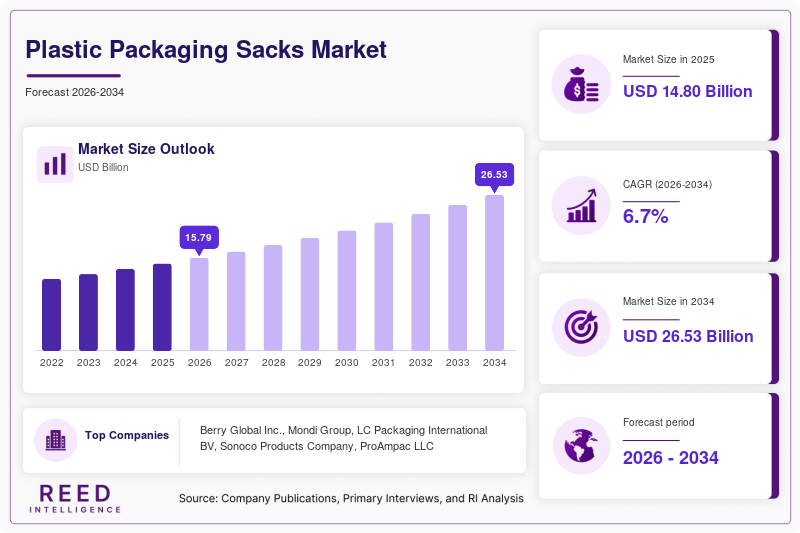
The global Plastic Packaging Sacks Market size was valued at USD 14.8 billion in 2026 and is projected to reach USD 24.9 billion by 2034, expanding at a CAGR of 6.7% during the forecast period. The market continues to experience steady expansion due to rising industrial packaging demand across agriculture, food processing, construction, chemicals, and retail sectors. Plastic packaging sacks remain widely used because of their lightweight structure, durability, moisture resistance, and cost efficiency in bulk transportation and storage applications. Manufacturers are increasingly adopting advanced polymer blends and recyclable materials to improve strength, extend shelf life, and support sustainability targets established by regulatory authorities and multinational companies.
Growing international trade activities and the rapid expansion of e-commerce distribution networks have created higher demand for flexible packaging solutions that can withstand long transportation cycles. Plastic packaging sacks are increasingly preferred for transporting grains, fertilizers, pet food, cement, animal feed, and industrial chemicals because they reduce product loss and improve handling efficiency. Demand has also accelerated from developing economies where infrastructure growth and rising agricultural exports continue to increase the need for durable bulk packaging products. Furthermore, technological advancements in woven polypropylene sacks, laminated sacks, and multi-layer flexible packaging formats are supporting market penetration across industrial and consumer applications.
Key Highlights
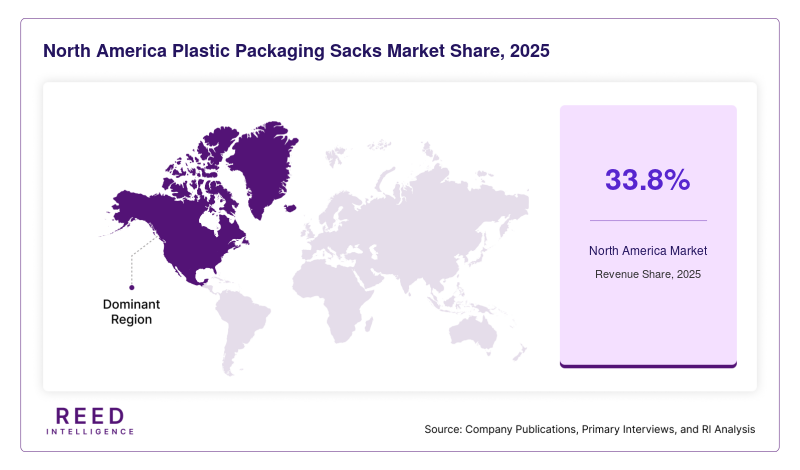
- North America dominated the market with a 33.8% share in 2025, while Asia Pacific is expected to grow at the fastest CAGR of 8.9% during 2026–2034.
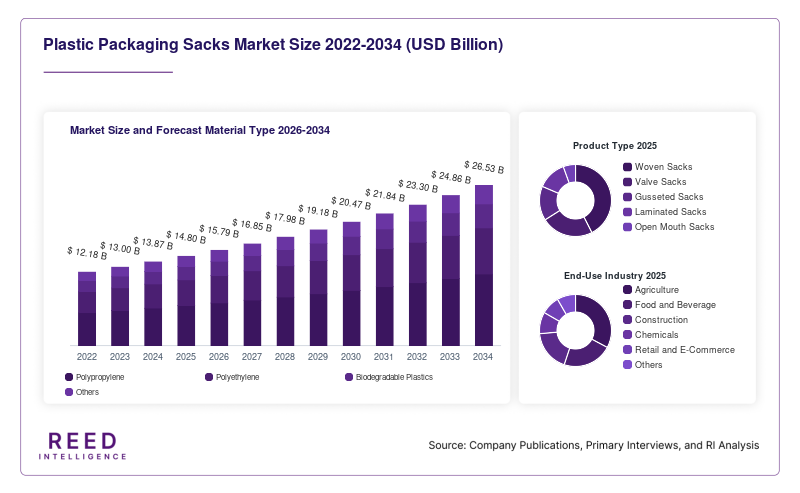
- By material type, polypropylene sacks accounted for the largest share of 44.1%, while biodegradable plastic sacks are projected to grow at a CAGR of 10.8%.
- By product type, woven sacks led with a 47.6% share, whereas valve sacks are expected to expand at a CAGR of 9.6%.
- By end-use industry, agriculture represented the highest share of 31.4%, while food and beverage applications are anticipated to grow at a CAGR of 9.2%.
- The United States remained the dominant country, with market values of USD 3.6 billion in 2024 and USD 3.9 billion in 2025.
Market Trends
Rising Adoption of Recyclable and Sustainable Sack Materials
The Plastic Packaging Sacks Market is witnessing a significant shift toward recyclable and sustainable packaging solutions as governments and corporations continue to implement environmental targets. Packaging manufacturers are increasing investments in mono-material sacks, recyclable polyethylene structures, and reusable woven polypropylene formats to reduce landfill waste and improve material recovery rates. Large food processing and agricultural companies are also demanding packaging formats that align with extended producer responsibility regulations and circular economy standards. This trend has encouraged innovation in lightweight sack structures that use less resin while maintaining durability and load-bearing performance. In addition, manufacturers are introducing sacks produced with post-consumer recycled content to attract environmentally conscious buyers and improve corporate sustainability reporting.
The demand for sustainable packaging is also growing among retail and e-commerce businesses that aim to reduce transportation costs and carbon emissions. Flexible plastic sacks consume fewer resources during manufacturing and transportation compared to rigid alternatives, making them attractive for industrial supply chains. Companies operating in the fertilizer, animal feed, and cement industries are increasingly transitioning toward recyclable packaging systems to meet procurement requirements from international buyers. This transition is expected to reshape product development strategies across the market over the next decade.
Expansion of High-Performance Industrial Packaging Applications
Industrial sectors are increasingly demanding high-strength plastic packaging sacks capable of handling bulk materials under harsh transportation and storage conditions. This trend is particularly visible in construction, chemicals, mining, and agricultural industries where sacks must resist punctures, moisture, and contamination during long-distance logistics operations. Manufacturers are developing advanced woven and laminated sack structures with enhanced tensile strength and barrier properties to meet these requirements. Multi-layer sack designs and UV-resistant coatings are becoming more common because they extend product life and minimize losses during storage.
Automation in filling and packaging operations is also influencing product innovation within the Plastic Packaging Sacks Market. Companies are designing sacks compatible with automated filling systems, robotic handling equipment, and digital inventory tracking technologies. Smart printing and labeling features are increasingly integrated into packaging sacks to improve traceability and supply chain management. In addition, industrial buyers are seeking customized packaging sizes and branding solutions to improve product differentiation in competitive markets. These evolving requirements are expected to support technological advancements and premium product demand throughout the forecast period.
Market Drivers
Growth of Agricultural and Food Export Activities
The rapid expansion of agricultural production and food export activities is one of the primary factors driving the Plastic Packaging Sacks Market. Countries across Asia Pacific, Latin America, and Africa are increasing grain, rice, sugar, fertilizer, and animal feed exports to meet rising global food demand. Plastic packaging sacks provide cost-effective and durable packaging solutions for these products because they protect contents from moisture, contamination, and transportation damage. Agricultural cooperatives and food processors are increasingly using woven polypropylene sacks and laminated sacks for bulk packaging applications due to their high load capacity and ease of handling.
The growing global population and changing dietary preferences are further increasing packaged food consumption, creating additional demand for food-grade packaging sacks. Food manufacturers prefer plastic packaging sacks because they offer strong barrier protection and extended shelf life for flour, sugar, cereals, and processed food ingredients. In addition, rising mechanization in agriculture and improvements in supply chain infrastructure are encouraging the use of standardized packaging systems for bulk commodity movement. These factors continue to support stable long-term demand for plastic packaging sacks across international trade channels.
Increasing Demand from Construction and Chemical Industries
The expansion of construction activities and industrial manufacturing is significantly contributing to the growth of the Plastic Packaging Sacks Market. Cement, sand, adhesives, chemicals, and industrial minerals are commonly transported and stored using plastic sacks because they provide strong structural integrity and minimize leakage during transportation. Rapid urbanization and infrastructure development projects in emerging economies are increasing demand for reliable industrial packaging products capable of handling heavy materials under challenging environmental conditions.
Chemical manufacturers are also increasing the use of plastic packaging sacks for fertilizers, resins, powders, and specialty compounds due to their resistance to moisture and chemical exposure. The market is benefiting from growing investments in infrastructure, renewable energy projects, and industrial expansion across developing economies. Furthermore, the adoption of advanced valve sacks and laminated industrial sacks is improving operational efficiency in automated packaging facilities. These innovations reduce packaging waste, improve filling speed, and lower transportation costs, making plastic packaging sacks an important component of modern industrial supply chains.
Market Restraint
Environmental Regulations and Volatility in Raw Material Prices
The Plastic Packaging Sacks Market faces significant challenges due to increasing environmental regulations associated with plastic waste management and carbon emissions. Governments across Europe and parts of North America are introducing stricter policies regarding single-use plastics, recycling targets, and packaging sustainability standards. These regulations are forcing manufacturers to invest in recyclable materials, waste collection systems, and environmentally compliant production technologies, which can increase operational costs. Smaller manufacturers often face difficulties adapting to evolving regulatory frameworks because of limited financial resources and technological capabilities.
Fluctuations in raw material prices also create uncertainty across the market. Polypropylene and polyethylene resin prices are closely linked to crude oil market movements, making production costs highly volatile. Sudden increases in resin prices can reduce profit margins and disrupt long-term supply agreements between manufacturers and industrial buyers. In addition, growing public awareness regarding plastic pollution has encouraged some end users to explore alternative packaging materials such as paper-based sacks and biodegradable packaging solutions. Although plastic packaging sacks continue to offer strong performance and cost advantages, environmental concerns and raw material volatility remain key factors that could limit market growth during the forecast period.
Market Opportunities
Increasing Penetration of Biodegradable and Bio-Based Plastic Sacks
The growing demand for environmentally responsible packaging products is creating substantial opportunities for biodegradable and bio-based plastic sacks. Packaging manufacturers are investing in compostable polymers, starch-based blends, and bio-derived polyethylene materials to address sustainability concerns while maintaining durability and product protection standards. Several food processing and agricultural companies are actively seeking eco-friendly packaging alternatives that comply with government regulations and support corporate sustainability goals. This shift is encouraging innovation in biodegradable sack technologies that can perform effectively in industrial logistics applications.
The opportunity is particularly strong in developed markets where environmental awareness among consumers and businesses continues to rise. Retailers and multinational food brands are increasingly integrating sustainable packaging targets into supplier contracts, creating long-term demand for biodegradable sack solutions. Advancements in polymer science are also improving the strength, flexibility, and moisture resistance of bio-based plastic sacks, making them more suitable for industrial and commercial applications. As production costs gradually decline and manufacturing capabilities expand, biodegradable sacks are expected to gain wider acceptance across the Plastic Packaging Sacks Market.
Growth Potential in Emerging E-Commerce and Retail Supply Chains
The expansion of e-commerce and organized retail networks is creating new growth opportunities for plastic packaging sack manufacturers. Online grocery platforms, agricultural marketplaces, and bulk retail distributors increasingly require lightweight and durable packaging solutions capable of protecting products during long-distance transportation. Plastic packaging sacks provide flexibility, cost efficiency, and customization options that support the operational needs of rapidly growing retail distribution systems.
Emerging economies in Asia Pacific, Latin America, and the Middle East are witnessing strong growth in warehouse infrastructure and logistics investments, creating additional demand for industrial packaging materials. Retailers are also adopting digitally printed sacks and branded flexible packaging solutions to improve customer engagement and product visibility. Furthermore, the growing use of automated packaging equipment in distribution centers is encouraging the adoption of standardized sack formats compatible with high-speed filling and sealing operations. These developments are expected to create significant opportunities for manufacturers focusing on innovation, customization, and supply chain efficiency.
Segmental Analysis
By Material Type
Polypropylene sacks accounted for the largest share of the Plastic Packaging Sacks Market in 2024, representing 44.1% of total revenue. The segment continues to dominate because polypropylene provides high tensile strength, lightweight properties, moisture resistance, and cost efficiency for industrial and commercial packaging applications. Woven polypropylene sacks are extensively used in agriculture, chemicals, food processing, and construction industries due to their ability to carry heavy loads while maintaining durability during transportation and storage. Manufacturers also prefer polypropylene because it supports customization through lamination, coating, and digital printing technologies. The material offers strong resistance to tearing and environmental stress, making it suitable for bulk packaging operations across global trade networks. In addition, the growing use of recyclable polypropylene materials is improving the sustainability profile of plastic packaging sacks, further strengthening market demand across developed and emerging economies.
Biodegradable plastic sacks are projected to register the fastest CAGR of 10.8% during the forecast period due to increasing environmental awareness and regulatory pressure regarding plastic waste reduction. Companies are investing in compostable polymers and bio-based resin technologies to meet sustainability targets established by governments and multinational organizations. Food processing companies and retail distributors are increasingly adopting biodegradable sacks to improve environmental compliance and brand reputation. Technological advancements in biodegradable materials are also improving product strength, flexibility, and moisture resistance, allowing these sacks to compete more effectively with conventional plastics. Demand is particularly strong in Europe and North America where consumers and industrial buyers are prioritizing sustainable packaging solutions. Furthermore, ongoing research into advanced bio-polymer formulations is expected to reduce production costs and expand application areas, creating long-term growth opportunities for biodegradable plastic sacks.
By Product Type
Woven sacks represented the dominant product type in the Plastic Packaging Sacks Market in 2024, accounting for 47.6% of total market revenue. These sacks are widely preferred across industrial sectors because they provide exceptional durability, high load-bearing capacity, and resistance to punctures and tearing. Agriculture, fertilizer, cement, and animal feed industries extensively use woven sacks for bulk packaging and transportation purposes. Manufacturers continue to enhance woven sack performance through advanced weaving technologies, UV-resistant coatings, and laminated structures that improve moisture protection and product shelf life. The product segment also benefits from cost-effective manufacturing processes and compatibility with automated filling systems used in large industrial facilities. In addition, woven sacks are increasingly produced using recyclable polypropylene materials, supporting sustainability initiatives without compromising packaging performance or operational efficiency.
Valve sacks are expected to witness the fastest growth during the forecast period, expanding at a CAGR of 9.6%. The increasing demand for automated and high-speed packaging operations in cement, chemicals, and food processing industries is driving adoption of valve sack designs. These sacks improve filling efficiency and reduce product leakage during transportation and storage. Manufacturers are introducing advanced sealing technologies and multi-layer valve sack structures to enhance product protection and operational reliability. The segment is also benefiting from the growing trend toward automation in industrial packaging facilities where consistent filling speed and reduced labor dependency are important operational priorities. Furthermore, valve sacks provide strong stacking stability and efficient warehouse handling capabilities, making them increasingly attractive for large-scale industrial supply chains seeking cost optimization and productivity improvements.
By End-Use Industry
The agriculture segment held the largest share of the Plastic Packaging Sacks Market in 2024, contributing 31.4% of overall revenue. The segment dominates because plastic sacks are extensively used for packaging grains, rice, seeds, fertilizers, animal feed, and other agricultural commodities. Woven polypropylene sacks remain highly preferred due to their moisture resistance, durability, and ability to withstand rough handling during transportation and storage. Expanding global food demand and increasing agricultural exports from developing economies continue to support strong consumption of industrial packaging sacks. Governments are also investing in food security programs and agricultural infrastructure improvements, which is increasing demand for standardized bulk packaging solutions. Furthermore, plastic packaging sacks help reduce product losses caused by contamination, moisture exposure, and transportation damage, making them essential for modern agricultural supply chains and export operations.
The food and beverage segment is projected to grow at the fastest CAGR of 9.2% during the forecast period due to rising packaged food consumption and expanding international food trade activities. Food manufacturers are increasingly adopting high-barrier plastic sacks for flour, sugar, starch, cereals, and processed food ingredients because they provide strong protection against moisture and contamination. Growing urbanization and changing consumer lifestyles are also increasing demand for packaged food products that require reliable and cost-effective bulk packaging solutions. The segment is benefiting from technological advancements in food-grade packaging materials, digital printing capabilities, and resealable sack designs that improve convenience and product visibility. In addition, regulatory standards regarding food safety and hygiene are encouraging manufacturers to adopt advanced multi-layer plastic packaging sacks with enhanced protective properties and traceability features.
Regional Analysis
North America
North America accounted for 33.8% of the global Plastic Packaging Sacks Market in 2025 and continues to maintain a strong position due to the presence of established industrial and agricultural supply chains. The region is projected to expand at a CAGR of 5.8% during the forecast period as demand for durable bulk packaging products remains stable across food processing, chemicals, and construction industries. The increasing focus on recyclable packaging formats and sustainable manufacturing practices is also encouraging investments in advanced polymer technologies and reusable woven sack solutions.
The United States remained the dominant country in the regional market because of its large agricultural exports, advanced logistics infrastructure, and strong industrial production base. The country is witnessing increased adoption of high-performance polypropylene sacks in fertilizer, animal feed, and food ingredient applications. One unique growth factor supporting the U.S. market is the rising demand for automated packaging systems in warehouse and distribution operations. Manufacturers are increasingly introducing valve sacks and digitally printed packaging formats compatible with automated filling technologies to improve operational efficiency.
Europe
Europe represented a significant share of the Plastic Packaging Sacks Market in 2025 and is expected to grow at a CAGR of 5.4% through 2034. The regional market is strongly influenced by environmental regulations promoting recyclable and reusable packaging materials across industrial sectors. Countries within the European Union are increasing investments in circular economy initiatives, encouraging packaging companies to develop lightweight and mono-material sack solutions. Demand remains stable from agriculture, chemicals, and specialty food industries that require high-strength packaging with advanced barrier protection.
Germany dominated the European market due to its advanced manufacturing capabilities and strong industrial export sector. The country has witnessed increasing demand for laminated and woven plastic sacks used in chemicals, construction materials, and processed food transportation. A unique factor supporting market growth in Germany is the rapid adoption of sustainable industrial packaging standards by multinational manufacturers. Packaging producers are collaborating with recycling companies and resin suppliers to improve material recovery rates and meet stringent environmental compliance requirements.
Asia Pacific
Asia Pacific is expected to register the fastest CAGR of 8.9% during the forecast period due to rapid industrialization, urbanization, and agricultural expansion across developing economies. The region continues to witness strong demand for plastic packaging sacks from fertilizer, rice, grain, and cement industries. Growing infrastructure investments and rising manufacturing activities are increasing the need for durable and cost-effective industrial packaging solutions. In addition, the availability of low-cost raw materials and labor has encouraged major packaging manufacturers to expand production facilities within the region.
China remained the leading country in the Asia Pacific market because of its large manufacturing sector and extensive export activities. The country has experienced strong growth in woven polypropylene sack production for industrial and agricultural applications. One unique growth factor supporting the Chinese market is the rapid expansion of domestic e-commerce logistics networks. Online grocery and industrial distribution platforms are increasing demand for lightweight and customizable packaging formats that can support large-scale transportation and automated warehouse handling systems.
Middle East & Africa
The Middle East & Africa region accounted for a moderate share of the Plastic Packaging Sacks Market in 2025 and is projected to grow at a CAGR of 6.1% during the forecast period. Market growth is supported by increasing construction activities, expanding agricultural investments, and rising demand for industrial packaging products across developing economies. Countries in the Gulf region are investing heavily in infrastructure and manufacturing diversification projects, which is increasing consumption of cement, chemicals, and building materials packaged in durable plastic sacks.
Saudi Arabia dominated the regional market because of its large petrochemical industry and expanding construction sector. The country is witnessing higher adoption of heavy-duty woven sacks for industrial material transportation and storage. A unique factor contributing to regional growth is the increasing investment in agricultural modernization projects across arid regions. Governments are supporting fertilizer distribution and food security initiatives, creating consistent demand for moisture-resistant and high-capacity packaging sacks suitable for harsh environmental conditions.
Latin America
Latin America maintained steady growth in the Plastic Packaging Sacks Market in 2025 and is anticipated to expand at a CAGR of 6.4% during the forecast period. The region benefits from strong agricultural exports, rising food processing activities, and growing industrial production. Plastic packaging sacks are widely used for coffee, sugar, grains, fertilizers, and animal feed transportation because they offer durability and cost advantages in long-distance logistics operations. Increasing trade agreements and export-oriented agricultural investments are also supporting market expansion.
Brazil remained the dominant country in the regional market due to its extensive agricultural production and expanding food export sector. The country has experienced rising demand for woven polypropylene sacks used in grain storage and transportation applications. One unique growth factor supporting the Brazilian market is the modernization of rural logistics infrastructure and storage facilities. Investments in agricultural supply chain efficiency are encouraging the use of standardized bulk packaging systems capable of reducing transportation losses and improving export competitiveness.
Competitive Landscape
The Plastic Packaging Sacks Market is moderately fragmented with the presence of international packaging companies and regional manufacturers competing on pricing, material innovation, sustainability initiatives, and distribution capabilities. Major players are focusing on product customization, recyclable packaging technologies, and strategic capacity expansions to strengthen their market positions. Companies are also investing in advanced manufacturing equipment to improve production efficiency and support automated industrial packaging requirements.
Berry Global Inc. remained one of the leading participants in the market due to its broad flexible packaging portfolio and strong global manufacturing network. The company has increased investments in recyclable packaging materials and lightweight industrial sack solutions to address growing sustainability demand from industrial and food processing customers. Other major companies are actively pursuing mergers, regional expansions, and partnerships with resin suppliers to improve supply chain resilience and product innovation capabilities.
Key Players
- Berry Global Inc.
- Mondi Group
- LC Packaging International BV
- Sonoco Products Company
- ProAmpac LLC
- Smurfit Kappa Group
- Hood Packaging Corporation
- Muscat Polymers Pvt. Ltd.
- UFlex Limited
- Emmbi Industries Limited
- Al-Tawfiq Company
- NNZ Group
- Conitex Sonoco
- FlexSack Inc.
- Interplast Group
Recent Developments
- In February 2026, Berry Global Inc. introduced a new recyclable woven polypropylene sack series designed for agricultural and industrial bulk packaging applications.
- In August 2025, Mondi Group expanded its sustainable packaging production capacity in Europe to support rising demand for recyclable industrial sack solutions.
- In November 2025, ProAmpac LLC launched advanced digitally printed valve sacks compatible with automated filling systems used in the construction and chemical sectors.
- In March 2026, UFlex Limited announced investments in biodegradable packaging material research to strengthen its sustainable industrial packaging portfolio.
- In January 2026, LC Packaging International BV partnered with regional distributors in Latin America to expand agricultural bulk packaging operations across export markets.
Plastic Packaging Sacks Market Segments
Material Type
- Polypropylene
- Polyethylene
- Biodegradable Plastics
- Others
Product Type
- Woven Sacks
- Valve Sacks
- Gusseted Sacks
- Laminated Sacks
- Open Mouth Sacks
End-Use Industry
- Agriculture
- Food and Beverage
- Construction
- Chemicals
- Retail and E-Commerce
- Others
By Region
- North America
- Europe
- APAC
- Middle East and Africa
- LATAM