Plastic Scrap Grinder Machine Market Size, Share & Demand Report By Type (Heavy-Duty Grinders, Medium-Duty Grinders, Light-Duty Grinders, Smart Automated Grinders), By Material Type (Polyethylene (PE), Polypropylene (PP), Polyethylene Terephthalate (PET), Polyvinyl Chloride (PVC), Others), By Application (Industrial Recycling, Post-Consumer Recycling, Commercial Recycling), By End-Use Industry (Packaging, Automotive, Electronics, Construction, Others), By Distribution Channel (Direct Sales, Dist
USD 3950
Market Overview
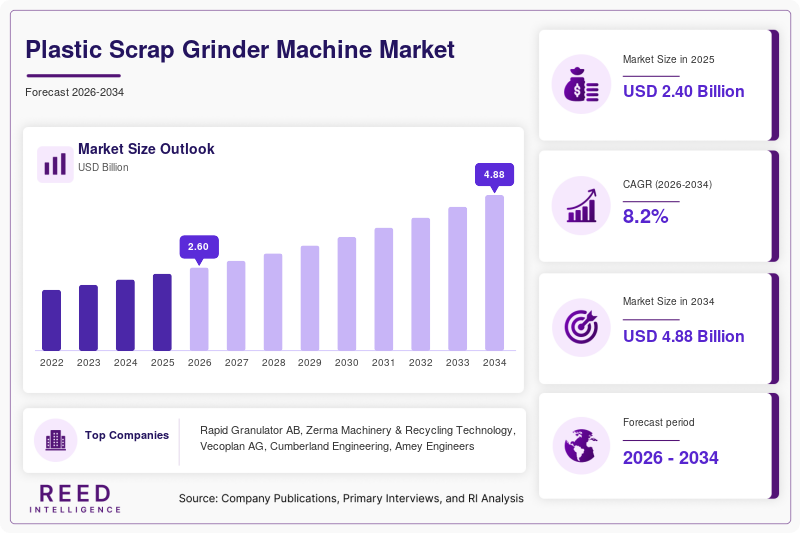
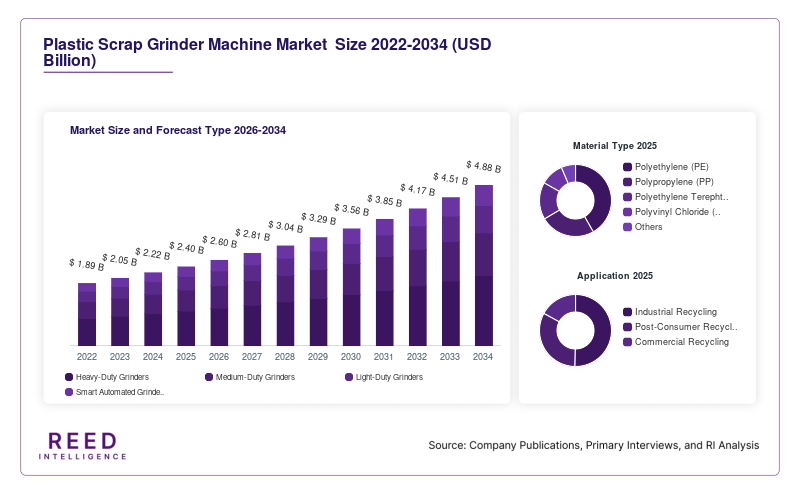
The global Plastic Scrap Grinder Machine Market size was valued at approximately USD 2.4 billion in 2025 and is projected to reach USD 4.9 billion by 2034, expanding at a CAGR of 8.2% during the forecast period (2025–2034). The market growth is being supported by the rising global emphasis on sustainable waste management and circular economy practices, which has significantly increased the adoption of plastic recycling technologies across industrial and municipal sectors.
Plastic scrap grinder machines play a crucial role in reducing plastic waste into reusable granules, making them indispensable for recycling operations, manufacturing industries, and packaging sectors. Increasing regulatory pressure on plastic waste disposal and the growing cost advantages of recycled plastic materials have further contributed to market expansion. Additionally, advancements in automation and energy-efficient grinding systems are improving operational productivity and lowering maintenance costs, thereby boosting adoption rates globally.
Key Highlights
- Asia Pacific dominated the market with a share of 38% in 2025, while Latin America is projected to register the fastest CAGR of 9.4% during the forecast period.
- The heavy-duty grinder segment accounted for the largest share among types at 46%, while smart automated grinders are expected to grow at the fastest CAGR of 9.8%.
- The industrial recycling application segment led with 52% share, whereas post-consumer waste recycling is projected to expand at a CAGR of 9.1%.
- China remained the dominant country with a market value of USD 620 million in 2025 and is expected to reach USD 670 million in 2026.
Market Trends
Integration of Automation and Smart Controls
Manufacturers in the Plastic Scrap Grinder Machine Market are increasingly incorporating automation and IoT-enabled monitoring systems into their equipment. These smart grinders provide real-time performance tracking, predictive maintenance alerts, and optimized energy consumption. As industries focus on improving operational efficiency and minimizing downtime, automated systems are becoming a preferred choice, particularly in large-scale recycling plants. This trend is also aligned with the broader adoption of Industry 4.0 technologies.
Rising Demand for Energy-Efficient Machinery
Energy efficiency has emerged as a key purchasing criterion among end-users. Modern grinder machines are being designed with advanced motor technologies, noise reduction systems, and low-power consumption features. This trend is driven by rising electricity costs and increasing environmental regulations aimed at reducing industrial carbon footprints. Manufacturers are also investing in research to develop machines that deliver higher output with lower energy input, thereby improving overall sustainability and cost-effectiveness.
Market Drivers
Increasing Plastic Recycling Initiatives
Governments and private organizations worldwide are promoting recycling initiatives to manage plastic waste effectively. Policies encouraging the use of recycled materials in manufacturing are significantly boosting the demand for plastic scrap grinder machines. These machines are essential for converting waste plastic into reusable raw materials, making them a critical component of recycling infrastructure.
Growth in Manufacturing and Packaging Industries
The expansion of manufacturing sectors such as automotive, electronics, and packaging has led to increased generation of plastic scrap. Companies are adopting grinder machines to reduce waste and reuse materials internally, thereby lowering production costs. The growing packaging industry, particularly in emerging economies, is also contributing to higher demand for efficient plastic waste processing equipment.
Market Restraint
High Initial Investment and Maintenance Costs
The Plastic Scrap Grinder Machine Market faces challenges due to the high upfront costs associated with advanced grinding equipment. Small and medium-sized enterprises often find it difficult to invest in technologically advanced machines due to budget constraints. Additionally, maintenance costs, including blade replacement and machine servicing, can be significant over time.
These cost-related barriers can limit adoption, particularly in developing regions where access to financing and technical expertise is limited. Moreover, the availability of low-cost alternatives with lower efficiency may discourage investment in high-quality machines. This restraint could slow market penetration, especially among smaller recycling facilities.
Market Opportunities
Expansion in Emerging Economies
Emerging markets in Asia, Africa, and Latin America present significant growth opportunities for the Plastic Scrap Grinder Machine Market. Rapid urbanization and increasing waste generation in these regions are driving the need for efficient recycling solutions. Governments are also introducing policies to improve waste management infrastructure, creating favorable conditions for market expansion.
Technological Innovations in Grinding Systems
Continuous advancements in grinding technology offer new growth avenues for manufacturers. Innovations such as hybrid grinding systems, noise reduction mechanisms, and modular machine designs are enhancing product performance. These developments are attracting investments from industries seeking cost-effective and efficient recycling solutions, thereby expanding the market scope.
Segmental Analysis
By Type
Heavy-duty grinder machines accounted for the largest share of 46% in 2025. These machines were widely used in industrial applications due to their high capacity and ability to process large volumes of plastic waste efficiently.
Smart automated grinders are expected to grow at the fastest CAGR of 9.8% during the forecast period. Their ability to enhance operational efficiency through automation and real-time monitoring will drive adoption across advanced recycling facilities.
By Material Type
Polyethylene (PE) processing dominated the market with a share of 34% in 2025. The widespread use of PE in packaging and consumer goods contributed to its leading position.
Polyethylene terephthalate (PET) processing is projected to grow at a CAGR of 9.2%, driven by increasing recycling of plastic bottles and packaging materials. The rising demand for recycled PET in various industries will support growth.
By Application
Industrial recycling accounted for the largest share of 52% in 2025. The need to manage large volumes of plastic waste generated by manufacturing industries drove this segment.
Post-consumer waste recycling is expected to grow at a CAGR of 9.1%, supported by increasing consumer awareness and government initiatives promoting recycling of household plastic waste.
By End-Use Industry
The packaging industry dominated the market with a 41% share in 2025. High plastic usage in packaging materials resulted in significant waste generation, driving demand for grinder machines.
The automotive industry is projected to grow at a CAGR of 8.7%, driven by the increasing use of recycled plastics in vehicle manufacturing to reduce costs and environmental impact.
By Distribution Channel
Direct sales accounted for the largest share of 58% in 2025, as manufacturers preferred direct procurement from suppliers for customized solutions.
Online distribution channels are expected to grow at a CAGR of 10.1%, driven by the increasing adoption of digital platforms and ease of product comparison and procurement.
Regional Analysis
North America
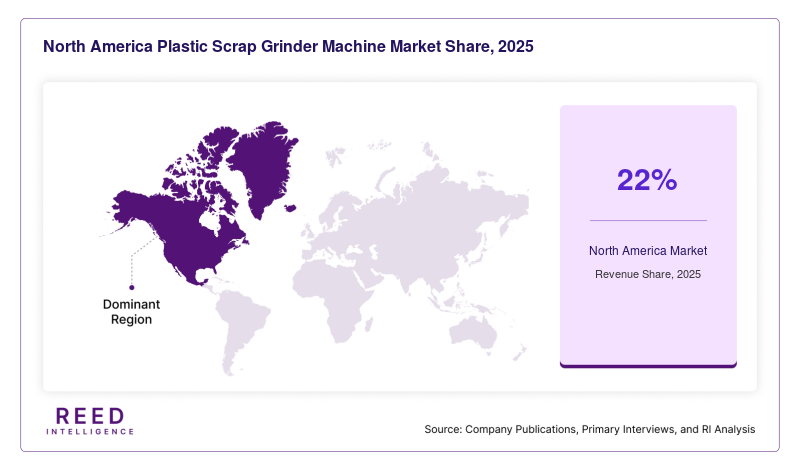
North America accounted for approximately 22% of the Plastic Scrap Grinder Machine Market share in 2025 and is expected to grow at a CAGR of 7.5% during the forecast period. The region’s growth will be driven by stringent environmental regulations and advanced recycling infrastructure.
The United States dominated the regional market due to strong adoption of sustainable manufacturing practices. The presence of well-established recycling facilities and high awareness regarding plastic waste management supported demand for advanced grinder machines.
Europe
Europe held a market share of around 26% in 2025 and is projected to expand at a CAGR of 7.8% from 2025 to 2034. The region’s focus on circular economy initiatives will continue to drive growth.
Germany emerged as the leading country, supported by its robust industrial base and strict waste management policies. The country’s emphasis on recycling efficiency and technological innovation contributed significantly to market expansion.
Asia Pacific
Asia Pacific dominated the Plastic Scrap Grinder Machine Market with a 38% share in 2025 and is expected to grow at a CAGR of 8.9% during the forecast period. Rapid industrialization and increasing plastic consumption will drive demand.
China led the region due to its large manufacturing sector and government initiatives promoting recycling. The country’s focus on reducing plastic waste and improving recycling rates has boosted the adoption of grinder machines.
Middle East & Africa
The Middle East & Africa region accounted for 7% of the market share in 2025 and is projected to grow at a CAGR of 8.3%. Increasing investments in waste management infrastructure will support growth.
The United Arab Emirates dominated the region, driven by initiatives to improve sustainability and reduce landfill waste. Government-backed projects aimed at enhancing recycling capabilities contributed to market development.
Latin America
Latin America held a market share of approximately 7% in 2025 and is expected to register the fastest CAGR of 9.4% during the forecast period. Growing awareness of environmental issues will fuel market expansion.
Brazil emerged as the leading country due to increasing investments in recycling facilities and supportive government policies. The rising demand for recycled plastic materials in manufacturing sectors has accelerated the adoption of grinder machines.
Competitive Landscape
The Plastic Scrap Grinder Machine Market is moderately fragmented, with several regional and global players competing based on product innovation, pricing, and distribution capabilities. Key companies are focusing on developing energy-efficient and automated machines to strengthen their market position.
The market leader, Rapid Granulator AB, has been actively investing in advanced grinding technologies and recently introduced a new series of energy-efficient machines designed for high-performance recycling operations. Other major players are also expanding their product portfolios and geographic presence through partnerships and acquisitions.
Companies are emphasizing research and development to introduce innovative solutions that meet evolving industry requirements. The competitive environment is expected to intensify as new entrants enter the market with cost-effective products.
Key Players
- Rapid Granulator AB
- Zerma Machinery & Recycling Technology
- Vecoplan AG
- Cumberland Engineering
- Amey Engineers
- Shini Plastics Technologies
- Pallmann Industries
- Herbold Meckesheim GmbH
- Jordan Reduction Solutions
- WITTMANN Group
- Nelmor Company
- Avian Machinery
- Polytec Industrial
- Weima Maschinenbau GmbH
- Santec Group
Recent Developments
- Rapid Granulator AB launched a new energy-efficient grinder series in 2025 to improve operational efficiency.
- Vecoplan AG expanded its production capacity to meet rising global demand.
- Zerma Machinery introduced automated control systems for enhanced machine performance.
- WITTMANN Group developed compact grinder solutions for small-scale applications.
- Herbold Meckesheim GmbH partnered with recycling firms to expand its market presence.
Plastic Scrap Grinder Machine Market Segments
Type
- Heavy-Duty Grinders
- Medium-Duty Grinders
- Light-Duty Grinders
- Smart Automated Grinders
Material Type
- Polyethylene (PE)
- Polypropylene (PP)
- Polyethylene Terephthalate (PET)
- Polyvinyl Chloride (PVC)
- Others
Application
- Industrial Recycling
- Post-Consumer Recycling
- Commercial Recycling
End-Use Industry
- Packaging
- Automotive
- Electronics
- Construction
- Others
Distribution Channel
- Direct Sales
- Distributors
- Online Channels
By Region
- North America
- Europe
- APAC
- Middle East and Africa
- LATAM