Plastic Solar Cell Market Size, Share & Demand Report By Type (Organic Photovoltaic (OPV) Cells, Hybrid Plastic Solar Cells), By Material (Polymer-Based Materials, Small Molecule-Based Materials), By Application (Building-Integrated Photovoltaics (BIPV), Portable Electronics, Automotive, Others), By End-Use Industry (Construction, Consumer Electronics, Automotive, Energy), By Region & Segment Forecasts, 2025–2034
USD 3950
Market Overview
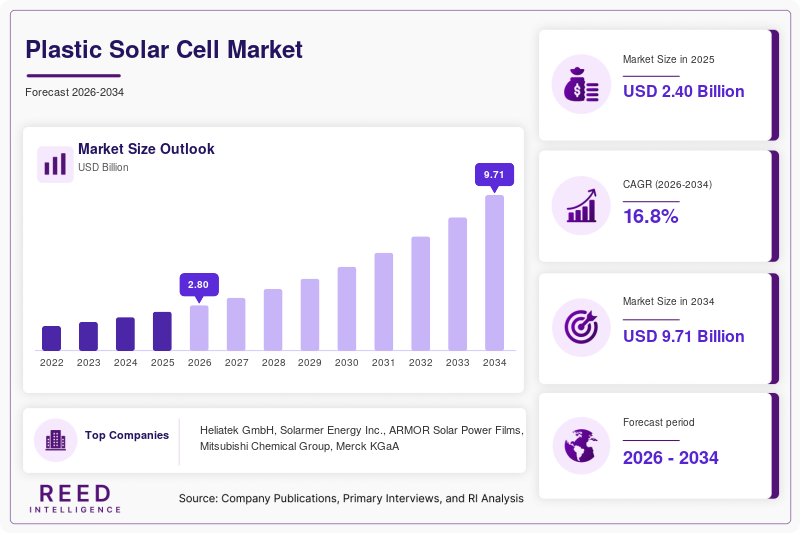
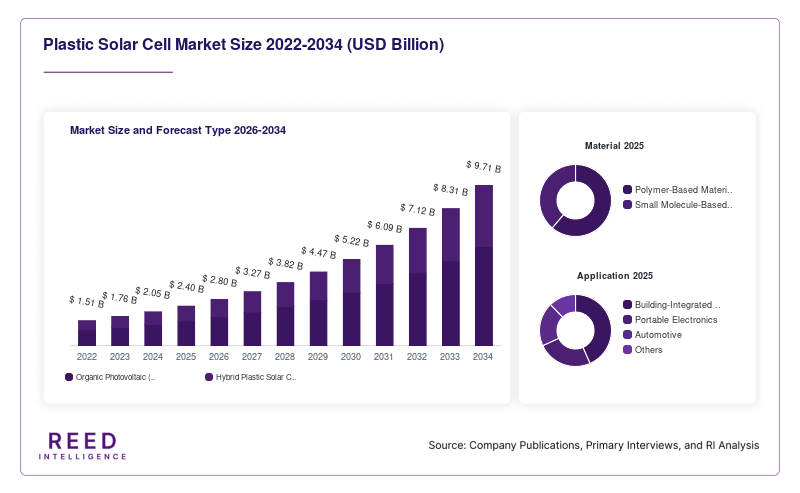
The Plastic Solar Cell Market size was valued at approximately USD 2.4 billion in 2025 and is projected to reach USD 9.8 billion by 2034, expanding at a compound annual growth rate (CAGR) of 16.8% from 2025 to 2034. The market growth has been strongly supported by the global transition toward lightweight, flexible, and cost-efficient renewable energy solutions, particularly in portable and building-integrated applications. Plastic solar cells, also known as organic photovoltaic (OPV) cells, are gaining traction due to their low manufacturing cost, mechanical flexibility, and compatibility with diverse substrates.
A key global factor accelerating the Plastic Solar Cell Market size is the rising adoption of decentralized energy systems. Governments and private sectors are investing in renewable technologies that can be easily integrated into urban infrastructure, consumer electronics, and remote energy systems. Plastic solar cells meet these requirements by offering scalability and ease of installation compared to traditional silicon-based panels.
Key Highlights
- Asia Pacific dominated the market with 42.3% share in 2025, while Latin America is expected to register the fastest growth at a CAGR of 18.6%.
- By type, Organic Photovoltaic (OPV) cells led with 64.5% share, while Hybrid plastic solar cells are projected to grow fastest at 19.4% CAGR.
- By application, Building-Integrated Photovoltaics (BIPV) dominated with 38.7% share, while portable electronics is expected to grow fastest at 20.1% CAGR.
- China remained the dominant country, with a market value of USD 620 million in 2025, expected to reach USD 710 million in 2026.
Market Trends
Increasing Adoption of Flexible and Wearable Energy Solutions
The Plastic Solar Cell Market is witnessing strong growth due to the rising demand for flexible and wearable energy devices. Plastic solar cells can be integrated into clothing, backpacks, and portable devices, enabling continuous power generation. This trend is particularly relevant in consumer electronics and military applications, where lightweight and flexible power sources are essential. Advances in printable electronics and roll-to-roll manufacturing are further enhancing the scalability of these solutions.
Advancements in Efficiency and Material Innovation
Continuous innovation in organic semiconductor materials is significantly improving the efficiency and durability of plastic solar cells. Researchers are focusing on non-fullerene acceptors and hybrid materials to enhance power conversion efficiency and lifespan. These advancements are narrowing the performance gap between plastic solar cells and traditional silicon-based alternatives, thereby strengthening the overall Plastic Solar Cell Market outlook. The integration of nanotechnology and improved encapsulation techniques is also contributing to longer operational stability.
Market Drivers
Growing Demand for Lightweight Renewable Energy Technologies
The increasing need for portable and lightweight energy solutions is a major driver of the Plastic Solar Cell Market growth. Traditional solar panels are often rigid and heavy, limiting their use in mobile and unconventional applications. Plastic solar cells, with their flexibility and low weight, provide an ideal alternative for sectors such as transportation, consumer electronics, and temporary installations.
Expansion of Building-Integrated Photovoltaics (BIPV)
The rapid adoption of BIPV systems is significantly boosting the Plastic Solar Cell Market size. These cells can be seamlessly integrated into windows, facades, and rooftops, enabling buildings to generate energy without compromising aesthetics. Urbanization and green building initiatives are driving the demand for such solutions. Plastic solar cells offer transparency and design flexibility, making them suitable for modern architectural requirements.
Market Restraint
Limited Efficiency Compared to Conventional Solar Technologies
One of the primary challenges in the Plastic Solar Cell Market is the relatively lower efficiency of plastic solar cells compared to silicon-based photovoltaic systems. Although significant improvements have been made, plastic solar cells still face limitations in terms of energy conversion efficiency and long-term durability. This restricts their adoption in large-scale power generation applications where high efficiency is critical.
Additionally, environmental factors such as moisture, oxygen exposure, and UV degradation can affect the performance and lifespan of plastic solar cells. While advancements in encapsulation technologies are addressing these concerns, the cost associated with improving durability can offset some of the economic advantages. As a result, end-users may prefer traditional solar technologies for applications requiring long-term reliability and high output.
Market Opportunities
Integration in Smart Cities and IoT Infrastructure
The development of smart cities presents a significant opportunity for the Plastic Solar Cell Market. Plastic solar cells can be integrated into sensors, smart lighting systems, and IoT devices, providing decentralized energy solutions. Their flexibility and lightweight nature make them ideal for deployment in urban environments where space and structural constraints exist.
Expansion in Emerging Economies
Emerging markets in Asia, Africa, and Latin America offer substantial growth potential for the Plastic Solar Cell Market. These regions are focusing on expanding renewable energy access in rural and off-grid areas. Plastic solar cells provide a cost-effective and easy-to-install solution for such applications. Government initiatives supporting renewable energy adoption and increasing investments in infrastructure development are expected to drive demand.
Segmental Analysis
By Type
Organic Photovoltaic (OPV) cells dominated the Plastic Solar Cell Market with a 64.5% share in 2025. Their dominance is attributed to their cost-effectiveness, flexibility, and ease of manufacturing. OPV cells are widely used in applications where lightweight and adaptable energy solutions are required, making them a preferred choice across multiple industries.
Hybrid plastic solar cells are expected to witness the fastest growth, with a projected CAGR of 19.4%. Their growth will be driven by improved efficiency and enhanced stability compared to traditional OPV cells. The integration of inorganic materials is expected to significantly enhance performance, making them suitable for a broader range of applications.
By Material
Polymer-based materials held the largest share of 58.2% in 2025 due to their flexibility and compatibility with roll-to-roll manufacturing processes. These materials are widely used in the production of plastic solar cells, contributing to lower production costs and scalability.
Small molecule-based materials are projected to grow at a CAGR of 18.7%, driven by their higher efficiency and improved charge transport properties. These materials are expected to play a crucial role in enhancing the overall performance of plastic solar cells.
By Application
Building-Integrated Photovoltaics (BIPV) accounted for 38.7% of the Plastic Solar Cell Market share in 2025. The segment’s dominance is driven by the increasing adoption of sustainable building solutions and the integration of renewable energy systems into infrastructure.
Portable electronics are expected to grow at the fastest CAGR of 20.1%, driven by the rising demand for lightweight and flexible energy sources. Plastic solar cells are increasingly being used in wearable devices and mobile gadgets, supporting this growth.
By End-Use Industry
The construction sector dominated the market with a 35.4% share in 2025, driven by the adoption of energy-efficient building solutions. Plastic solar cells are being integrated into building materials, enabling structures to generate their own power.
The consumer electronics segment is projected to grow at a CAGR of 19.8%, supported by increasing demand for portable and wearable devices. The integration of plastic solar cells into electronic products is expected to drive this growth.
Regional Analysis
North America
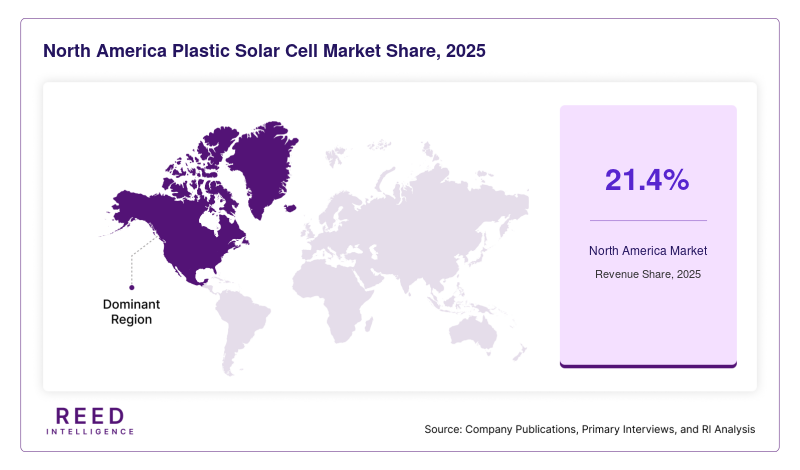
North America accounted for approximately 21.4% of the Plastic Solar Cell Market share in 2025 and is expected to grow at a CAGR of 15.2% during the forecast period. The region’s growth is supported by increasing investments in renewable energy technologies and innovation in flexible electronics. The presence of advanced research institutions and strong funding for clean energy projects further contributes to market expansion.
The United States dominated the regional market due to its strong focus on technological innovation. The country’s growth is driven by the increasing adoption of plastic solar cells in defense and aerospace applications, where lightweight and portable energy solutions are critical.
Europe
Europe held a 19.8% share of the Plastic Solar Cell Market in 2025 and is projected to grow at a CAGR of 14.9%. The region’s emphasis on sustainability and stringent environmental regulations are key factors supporting market growth. Increasing adoption of green building practices is also contributing to demand.
Germany emerged as the leading country in Europe, driven by its strong renewable energy policies. The country’s focus on energy-efficient buildings and integration of photovoltaic technologies into infrastructure is fueling the adoption of plastic solar cells.
Asia Pacific
Asia Pacific dominated the Plastic Solar Cell Market with a 42.3% share in 2025 and is expected to grow at a CAGR of 17.5%. The region’s growth is attributed to rapid industrialization, urbanization, and increasing investments in renewable energy projects. The availability of low-cost manufacturing and raw materials further supports market expansion.
China led the regional market due to its large-scale production capabilities. The country’s growth is driven by its strong manufacturing base and government support for renewable energy technologies, making it a key hub for plastic solar cell production.
Middle East & Africa
The Middle East & Africa accounted for 8.6% of the Plastic Solar Cell Market share in 2025 and is expected to grow at a CAGR of 16.1%. The region’s growth is supported by increasing investments in renewable energy projects and the need for off-grid power solutions.
The United Arab Emirates dominated the regional market, driven by its focus on diversifying energy sources. The country is investing in innovative solar technologies to support sustainable development and reduce reliance on fossil fuels.
Latin America
Latin America held a 7.9% share of the Plastic Solar Cell Market in 2025 and is projected to grow at the fastest CAGR of 18.6%. The region’s growth is driven by increasing demand for renewable energy in remote and rural areas.
Brazil emerged as the leading country, supported by its expanding renewable energy sector. The country’s focus on improving energy access and reducing electricity costs is driving the adoption of plastic solar cells.
Competitive Landscape
The Plastic Solar Cell Market is characterized by the presence of several global and regional players focusing on innovation and product development. Companies are investing in research to improve efficiency and durability while reducing production costs. Strategic collaborations and partnerships are also common to expand market presence.
One of the leading players, Heliatek GmbH, has strengthened its position through continuous innovation in organic photovoltaic technology. The company recently introduced advanced flexible solar films designed for building integration, enhancing its product portfolio and market reach.
Other key players are focusing on expanding their production capacities and entering emerging markets to capitalize on growth opportunities. The competitive landscape remains dynamic, with companies striving to achieve technological advancements and gain a competitive edge.
Key Players List
- Heliatek GmbH
- Solarmer Energy Inc.
- ARMOR Solar Power Films
- Mitsubishi Chemical Group
- Merck KGaA
- BASF SE
- Konarka Technologies
- Dyesol Ltd.
- Sunew
- InfinityPV ApS
- Epishine AB
- NanoFlex Power Corporation
- Eight19 Ltd.
- Oxford PV
- EneCoat Technologies
Recent Developments
- 2025: Heliatek GmbH launched next-generation ultra-thin solar films for commercial buildings.
- 2025: Epishine AB expanded its production capacity for printed organic solar cells.
- 2024: ARMOR Solar Power Films introduced new roll-to-roll manufacturing technology.
- 2024: Mitsubishi Chemical Group developed advanced polymer materials for improved efficiency.
- 2024: Oxford PV invested in hybrid solar cell research to enhance performance.
Plastic Solar Cell Market Segments
Type
- Organic Photovoltaic (OPV) Cells
- Hybrid Plastic Solar Cells
Material
- Polymer-Based Materials
- Small Molecule-Based Materials
Application
- Building-Integrated Photovoltaics (BIPV)
- Portable Electronics
- Automotive
- Others
End-Use Industry
- Construction
- Consumer Electronics
- Automotive
- Energy
Distribution Channel
- Direct Sales
- Distributors and Wholesalers
- Online Sales Channels
- Specialty Energy Solution Providers
By Region
- North America
- Europe
- APAC
- Middle East and Africa
- LATAM