Plastic Waste Pyrolysis Oil Market Size, Share & Demand Report By Feedstock Type (Polyethylene, Polypropylene, Polystyrene, Polyvinyl Chloride, Mixed Plastic Waste), By Application (Fuel Production, Petrochemical Feedstock, Electricity Generation, Industrial Heating), By End-Use Industry (Energy & Utilities, Chemical Industry, Automotive, Manufacturing, Waste Management), By Region & Segment Forecasts, 2026–2034
USD 3950
Market Overview
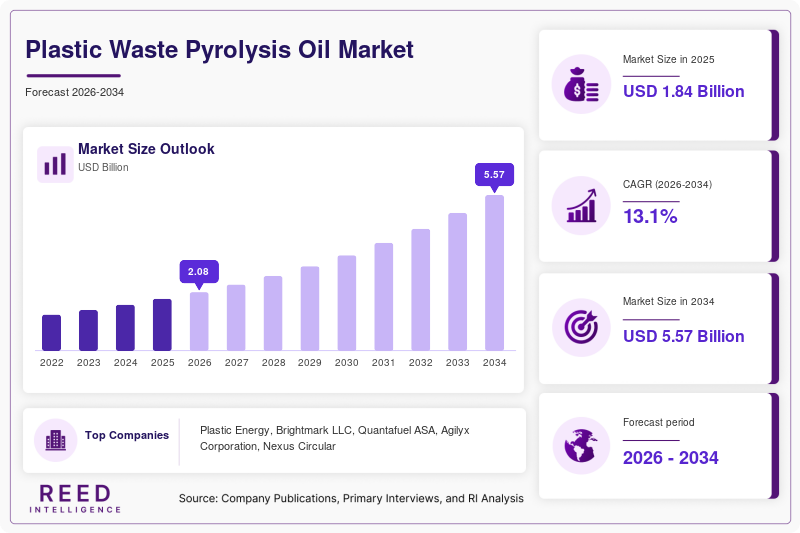
The global Plastic Waste Pyrolysis Oil Market size was valued at USD 1.84 billion in 2026 and is projected to reach USD 4.92 billion by 2034, expanding at a CAGR of 13.1% during the forecast period from 2026 to 2034. The market is gaining momentum as governments, petrochemical companies, and waste management firms increase investments in circular economy initiatives and alternative fuel technologies. Plastic waste pyrolysis oil is produced through the thermal decomposition of mixed plastic waste in oxygen-limited environments, generating liquid hydrocarbons that can be refined into fuels, chemicals, and feedstocks for industrial applications.
The increasing volume of non-recyclable plastic waste has become a major global environmental challenge. Countries across North America, Europe, and Asia Pacific are implementing stricter landfill diversion regulations and extended producer responsibility policies, encouraging industries to adopt advanced recycling technologies. Pyrolysis technology offers an effective pathway for converting low-value plastic waste into commercially useful oil while reducing dependence on virgin fossil resources. In addition, rising demand for sustainable feedstock in petrochemical production is strengthening the commercial outlook for pyrolysis oil producers.
Key Highlights
- North America dominated the market with a 35.4% share in 2025.
- Asia Pacific is expected to grow at the fastest CAGR of 14.2% during 2026–2034.
- By feedstock type, polyethylene accounted for the largest share of 39.1%.
- while polypropylene is projected to grow at a CAGR of 14.8%.
- By application, fuel production led with a 44.6% share.
- whereas petrochemical feedstock is expected to expand at a CAGR of 15.1%.
- The United States remained the dominant country, with market values of USD 520 million in 2024 and USD 598 million in 2025.
Market Trends
Expansion of Circular Economy Partnerships Across the Petrochemical Sector
The market is witnessing increased collaboration between petrochemical manufacturers, waste management companies, and recycling technology providers. Large chemical producers are investing in plastic waste pyrolysis oil projects to secure sustainable feedstock and reduce reliance on virgin fossil materials. Several integrated partnerships now involve plastic collection networks, sorting facilities, and advanced pyrolysis plants operating under long-term supply agreements. This trend is improving the commercial viability of the market by creating a stable ecosystem for feedstock procurement and oil distribution. Companies are also establishing certification systems for recycled-content materials, which is increasing confidence among packaging manufacturers and industrial buyers. Growing regulatory pressure on plastic waste disposal and carbon emissions continues to accelerate these collaborative initiatives across developed and emerging economies.
Rising Adoption of Catalytic and Continuous Pyrolysis Technologies
Technology innovation remains a major trend shaping the Plastic Waste Pyrolysis Oil Market. Continuous pyrolysis systems are increasingly replacing batch processing units due to their higher operational efficiency, lower downtime, and improved oil yield consistency. Catalytic pyrolysis methods are also gaining popularity because they produce cleaner and higher-grade hydrocarbon outputs suitable for petrochemical applications. Manufacturers are focusing on automation, temperature optimization, and advanced emission control systems to improve economic performance. These developments are attracting investments from energy companies seeking scalable recycling infrastructure. In addition, modular pyrolysis units designed for decentralized waste processing are becoming more common in urban and industrial areas where plastic waste generation is high. Improved technological efficiency is expected to lower operational costs and support wider commercial adoption during the forecast period.
Market Drivers
Increasing Global Plastic Waste Generation and Landfill Restrictions
Rapid urbanization, population growth, and rising consumer packaging demand are contributing to significant increases in global plastic waste generation. Conventional recycling systems often struggle to process mixed and contaminated plastics, leading to growing landfill accumulation and environmental pollution. Governments across several regions are implementing landfill taxes, single-use plastic regulations, and waste diversion targets that encourage advanced recycling alternatives. Plastic waste pyrolysis technology provides a practical solution for converting non-recyclable plastics into useful energy products and industrial feedstocks. Municipal authorities and private waste operators are increasingly adopting pyrolysis systems to manage difficult waste streams more effectively. This regulatory and environmental pressure is creating strong long-term demand for pyrolysis oil production facilities and associated infrastructure investments.
Growing Demand for Sustainable Alternative Fuels and Feedstocks
Industries are actively seeking lower-carbon fuel sources and sustainable raw materials to support climate targets and environmental compliance. Plastic waste pyrolysis oil is gaining attention as a substitute for conventional fossil-derived fuels and petrochemical feedstocks. Refineries and chemical manufacturers are evaluating pyrolysis oil integration into existing production systems to reduce greenhouse gas emissions and improve circularity. The aviation, marine, and industrial heating sectors are also exploring pyrolysis-derived fuels for future energy diversification. Rising volatility in crude oil markets has further encouraged industries to diversify feedstock supply chains through waste-derived alternatives. Financial incentives, carbon reduction programs, and increasing corporate sustainability commitments are expected to strengthen demand for pyrolysis oil products throughout the forecast period.
Market Restraint
High Capital Costs and Feedstock Quality Challenges
Despite strong growth potential, the Plastic Waste Pyrolysis Oil Market faces challenges related to high capital investment requirements and inconsistent feedstock quality. Commercial-scale pyrolysis plants require substantial investments in reactors, emission control systems, storage infrastructure, and advanced sorting technologies. Smaller companies often face difficulties securing long-term financing due to uncertain returns and fluctuating oil prices. In addition, mixed plastic waste streams can contain contaminants such as chlorine, metals, and moisture, which reduce oil quality and increase processing complexity. Poor feedstock quality may lead to operational inefficiencies, equipment corrosion, and higher maintenance costs. Regulatory approval processes for waste-to-fuel facilities can also delay project implementation. In some developing economies, limited waste segregation infrastructure further restricts access to suitable plastic feedstock. These operational and financial barriers may slow market penetration in price-sensitive regions and create challenges for new entrants attempting to scale production capacity.
Market Opportunities
Development of Sustainable Aviation and Marine Fuel Applications
The growing transition toward low-emission transportation fuels is creating significant opportunities for the Plastic Waste Pyrolysis Oil Market. Aviation and marine industries are under increasing pressure to reduce carbon emissions while maintaining fuel reliability and supply stability. Pyrolysis oil can serve as an intermediate feedstock for producing sustainable aviation fuel and low-sulfur marine fuel through additional refining processes. Governments and transportation regulators are introducing decarbonization targets that encourage investment in alternative fuel technologies. Energy companies are also exploring co-processing methods that integrate pyrolysis-derived hydrocarbons into conventional refinery operations. As fuel certification standards evolve and processing technologies improve, demand for waste-derived liquid hydrocarbons is expected to increase steadily across transportation sectors.
Expansion of Waste-to-Energy Infrastructure in Emerging Economies
Emerging economies are generating large volumes of unmanaged plastic waste due to rapid industrialization and urban population growth. Many countries in Asia Pacific, Latin America, and Africa are investing in waste-to-energy infrastructure to reduce landfill dependency and improve environmental management. Plastic waste pyrolysis projects are attracting attention because they provide both waste reduction and energy generation benefits. Public-private partnerships and foreign investments are supporting the development of regional pyrolysis facilities in industrial clusters and urban municipalities. In addition, governments are introducing incentives for renewable energy projects and advanced recycling technologies. The availability of abundant plastic waste feedstock combined with rising energy demand creates favorable conditions for long-term market expansion in developing regions.
Segmental Analysis
By Feedstock Type
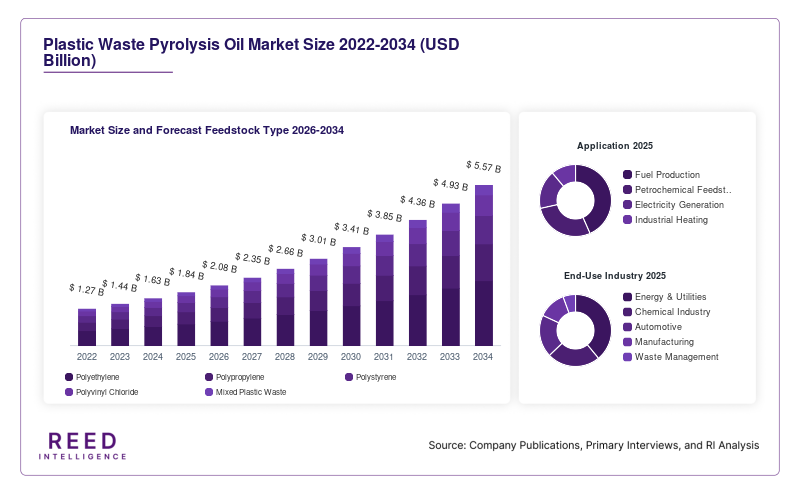
Polyethylene accounted for the largest market share of 39.1% in 2024 due to its widespread use in packaging films, containers, and consumer products. The abundance of polyethylene waste in municipal and industrial waste streams makes it a preferred feedstock for pyrolysis operations. This material offers relatively high oil yield and favorable hydrocarbon composition, supporting efficient conversion into usable fuel products and petrochemical feedstocks. Waste management operators are increasingly prioritizing polyethylene recovery because of its commercial viability and compatibility with large-scale pyrolysis systems. Additionally, improvements in sorting technologies and collection infrastructure have enhanced the availability of polyethylene waste for recycling facilities. The material’s strong presence in global packaging applications is expected to sustain its dominant position within the market over the coming years.
Polypropylene is expected to register the fastest CAGR of 14.8% during the forecast period owing to increasing industrial demand and rising availability of polypropylene waste from automotive, consumer goods, and packaging applications. Pyrolysis of polypropylene generates high-quality hydrocarbon oils suitable for refining and chemical processing, which is attracting greater interest from petrochemical companies. Manufacturers are also focusing on catalyst development and reactor optimization to improve conversion efficiency for polypropylene-based feedstocks. Growing demand for circular economy solutions in automotive and industrial manufacturing sectors is supporting the collection and reuse of polypropylene materials. In addition, rising investments in advanced waste segregation systems are improving feedstock purity, enabling more efficient pyrolysis processing and higher-value oil production.
By Application
Fuel production represented the dominant application segment with a 44.6% market share in 2024 due to increasing demand for alternative liquid fuels derived from waste materials. Pyrolysis oil is widely utilized as an industrial heating fuel and can also be upgraded into diesel-like products for transportation and power generation applications. Rising energy costs and concerns regarding fossil fuel dependency are encouraging industries to explore waste-derived fuel solutions. Municipal waste operators and industrial facilities are adopting pyrolysis systems to convert non-recyclable plastics into commercially usable energy products. In addition, favorable environmental policies promoting waste-to-energy technologies are contributing to the expansion of fuel production applications. The ability of pyrolysis oil to support both waste reduction and energy recovery objectives strengthens its market position.
Petrochemical feedstock is anticipated to witness the fastest CAGR of 15.1% during the forecast period as chemical producers seek sustainable alternatives to virgin fossil-based raw materials. Pyrolysis oil can be refined into naphtha-like feedstocks used in the production of plastics, chemicals, and synthetic materials. Growing regulatory pressure to incorporate recycled content into packaging and consumer products is increasing demand for chemically recycled feedstocks. Major petrochemical companies are entering long-term agreements with pyrolysis technology providers to secure sustainable hydrocarbon supplies. Technological advancements in oil purification and catalytic upgrading are improving compatibility with conventional petrochemical processes. This trend is expected to create substantial growth opportunities for pyrolysis oil suppliers serving the chemical manufacturing sector.
By End-Use Industry
The energy and utilities segment held the largest share of the Plastic Waste Pyrolysis Oil Market in 2024 because of the growing use of pyrolysis oil in industrial heating and power generation applications. Utilities and industrial energy producers are increasingly adopting waste-derived fuels to reduce operational costs and support carbon reduction goals. Pyrolysis oil offers flexibility for integration into existing combustion systems and energy infrastructure, making it an attractive alternative fuel source. Governments in several countries are also encouraging waste-to-energy investments through financial incentives and environmental regulations. In addition, rising concerns regarding energy security and fossil fuel price volatility are driving interest in locally sourced alternative fuels. These factors continue to support the strong position of the energy and utilities segment.
The chemical industry segment is projected to expand at the fastest CAGR of 15.4% during the forecast period due to increasing demand for recycled hydrocarbon feedstocks in chemical manufacturing processes. Companies are focusing on sustainable raw material sourcing to comply with environmental regulations and corporate sustainability commitments. Pyrolysis oil provides a viable pathway for producing recycled plastics and specialty chemicals without relying entirely on virgin crude oil derivatives. Partnerships between waste recycling firms and chemical manufacturers are accelerating the commercialization of advanced recycling technologies. Furthermore, increasing consumer demand for sustainable packaging products is encouraging chemical producers to integrate recycled-content materials into production lines. Continuous innovation in refining and upgrading technologies is expected to enhance the economic feasibility of pyrolysis oil utilization within the chemical industry.
Regional Analysis
North America
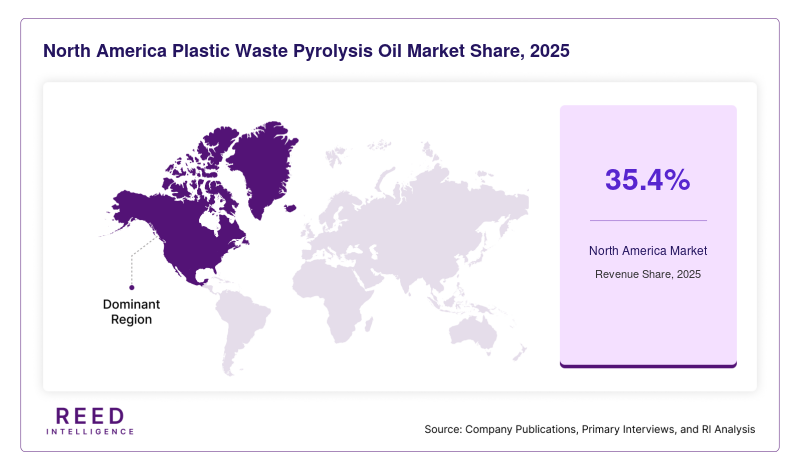
North America accounted for 35.4% of the global Plastic Waste Pyrolysis Oil Market share in 2025 and continues to maintain a strong position due to established waste management infrastructure and increasing investments in advanced recycling technologies. The region is projected to expand at a CAGR of 12.4% during the forecast period. Growing concerns regarding plastic landfill accumulation and carbon emissions are driving the adoption of pyrolysis facilities across the United States and Canada. Large petrochemical companies are actively integrating recycled feedstocks into production systems, which supports regional market growth.
The United States remains the dominant country in North America due to strong investment activity and favorable regulatory developments. Several energy and chemical companies are partnering with technology providers to establish commercial-scale pyrolysis plants. Increasing state-level restrictions on plastic waste disposal are accelerating adoption across industrial sectors. In addition, the presence of advanced refinery infrastructure allows easier integration of pyrolysis oil into existing hydrocarbon processing systems. Growing demand for sustainable fuels and recycled-content packaging materials is further strengthening the country’s market outlook.
Europe
Europe held a substantial share of the Plastic Waste Pyrolysis Oil Market in 2025 due to stringent environmental regulations and ambitious circular economy targets established by regional authorities. The market in Europe is forecast to grow at a CAGR of 12.9% from 2026 to 2034. Countries across the region are increasing investments in chemical recycling technologies to reduce landfill waste and improve plastic recovery rates. Strong policy support for sustainable materials and carbon reduction initiatives is encouraging industrial adoption of pyrolysis oil solutions.
Germany represents the leading country within the European market owing to its advanced recycling ecosystem and strong industrial manufacturing base. The country has implemented comprehensive waste segregation systems that improve feedstock quality for pyrolysis operations. Chemical producers and energy firms are also collaborating on pilot and commercial-scale recycling projects. Additionally, European Union regulations promoting recycled content in packaging applications are creating stable demand for pyrolysis-derived feedstocks. Technological innovation and strong environmental governance continue to support long-term regional growth.
Asia Pacific
Asia Pacific is anticipated to register the fastest CAGR of 14.2% during the forecast period due to rising plastic waste volumes and rapid industrial expansion. The region is experiencing strong demand for waste-to-energy technologies as governments attempt to address growing environmental concerns. Increasing urbanization and expanding manufacturing activity are generating significant quantities of plastic waste suitable for pyrolysis processing. Several countries are investing in advanced recycling infrastructure to improve waste management efficiency and reduce dependence on imported fossil fuels.
China remains the dominant contributor to regional revenue generation because of its extensive industrial base and increasing focus on environmental sustainability. Government initiatives promoting resource recovery and industrial waste utilization are encouraging the deployment of pyrolysis technologies. Domestic energy companies are also investing in waste-derived fuel production to diversify energy sources. In addition, the availability of abundant plastic waste feedstock and lower operational costs supports commercial scalability. Rapid industrial growth and supportive policy measures are expected to sustain market expansion across Asia Pacific.
Middle East & Africa
The Middle East & Africa region is gradually emerging as a promising market for plastic waste pyrolysis oil due to increasing investments in waste management modernization and energy diversification strategies. The market is projected to expand at a CAGR of 11.5% during the forecast period. Governments are recognizing the economic potential of converting plastic waste into usable fuel products while reducing environmental pollution. Rising industrial activity and urban waste generation are encouraging the adoption of alternative waste processing technologies across several countries in the region.
Saudi Arabia leads the regional market due to strong investments in petrochemical diversification and industrial sustainability initiatives. The country is exploring advanced recycling technologies as part of broader economic transformation programs aimed at reducing dependence on crude oil exports. Industrial zones and refinery operators are evaluating pyrolysis integration opportunities for sustainable hydrocarbon production. Additionally, increasing awareness regarding plastic waste management and energy efficiency is supporting demand for waste conversion infrastructure throughout the country.
Latin America
Latin America is witnessing gradual growth in the Plastic Waste Pyrolysis Oil Market as regional governments strengthen waste management regulations and promote renewable energy projects. The market is forecast to grow at a CAGR of 10.8% from 2026 to 2034. Expanding urban populations and rising consumer packaging consumption are contributing to increased plastic waste generation. Several municipalities are evaluating pyrolysis systems as an alternative to landfill disposal and open waste burning. Foreign investments and technology partnerships are also supporting market development across the region.
Brazil remains the dominant country in Latin America due to its large industrial economy and growing environmental policy framework. The country is investing in circular economy programs aimed at improving recycling efficiency and reducing plastic pollution. Local energy companies are exploring waste-derived fuel opportunities to supplement conventional fuel supplies. In addition, expanding industrial manufacturing and increasing public awareness regarding sustainability are encouraging the adoption of pyrolysis technologies. Infrastructure improvements and policy support are expected to drive long-term market growth in Brazil.
Competitive Landscape
The Plastic Waste Pyrolysis Oil Market is moderately fragmented, with established energy companies, recycling technology providers, and waste management firms competing to expand production capacity and improve technology efficiency. Companies are focusing on strategic partnerships, plant expansions, and technology licensing agreements to strengthen their market position. Increasing investments in advanced catalytic pyrolysis systems and feedstock purification technologies are shaping competitive dynamics across the industry.
Plastic Energy is considered one of the leading companies in the market due to its strong international project portfolio and collaboration with petrochemical manufacturers. The company has expanded its advanced recycling operations to support circular plastic production initiatives across Europe and Asia. Brightmark LLC, Quantafuel ASA, Agilyx Corporation, and Nexus Circular are also actively investing in commercial-scale pyrolysis infrastructure and refining technologies. Several companies are entering long-term supply agreements with chemical producers to secure stable demand for pyrolysis oil products. Recent industry developments indicate growing consolidation as larger energy and chemical companies acquire stakes in advanced recycling ventures to strengthen sustainability strategies.
Key Players
- Plastic Energy
- Brightmark LLC
- Quantafuel ASA
- Agilyx Corporation
- Nexus Circular
- Klean Industries
- OMV AG
- BASF SE
- Chevron Phillips Chemical
- SABIC
- Shell plc
- TotalEnergies
- Recycling Technologies Ltd.
- Alterra Energy
- Green Envirotec Holdings
Recent Developments
- Plastic Energy announced the expansion of its advanced recycling facility network to increase commercial pyrolysis oil production capacity for European petrochemical customers.
- Brightmark LLC initiated development of a new large-scale plastic waste conversion plant designed to process mixed plastic feedstock into transportation fuel and chemical feedstocks.
- Quantafuel ASA entered a strategic partnership with a refinery operator to improve integration of pyrolysis oil into conventional hydrocarbon refining processes.
- Agilyx Corporation introduced upgraded catalytic pyrolysis technology aimed at improving oil quality and reducing energy consumption in commercial operations.
- Shell plc expanded investment activities in chemical recycling infrastructure to strengthen sustainable feedstock sourcing for plastics manufacturing operations.
Plastic Waste Pyrolysis Oil Market Segments
Feedstock Type
- Polyethylene
- Polypropylene
- Polystyrene
- Polyvinyl Chloride
- Mixed Plastic Waste
Application
- Fuel Production
- Petrochemical Feedstock
- Electricity Generation
- Industrial Heating
End-Use Industry
- Energy & Utilities
- Chemical Industry
- Automotive
- Manufacturing
- Waste Management
By Region
- North America
- Europe
- APAC
- Middle East and Africa
- LATAM