Platform Screen Door (PSD) Market Size, Share & Demand Report By Type (Full-Height Platform Screen Doors, Half-Height Platform Screen Doors, Semi-Height Platform Screen Doors), By Application (Metro Rail Transit, Airport Transit Systems, Bus Rapid Transit Systems, Railway Stations), By Operation (Automatic Platform Screen Door Systems, Semi-Automatic Platform Screen Door Systems, Manual Platform Screen Door Systems), By Region & Segment Forecasts, 2026–2034
USD 3950
Market Overview
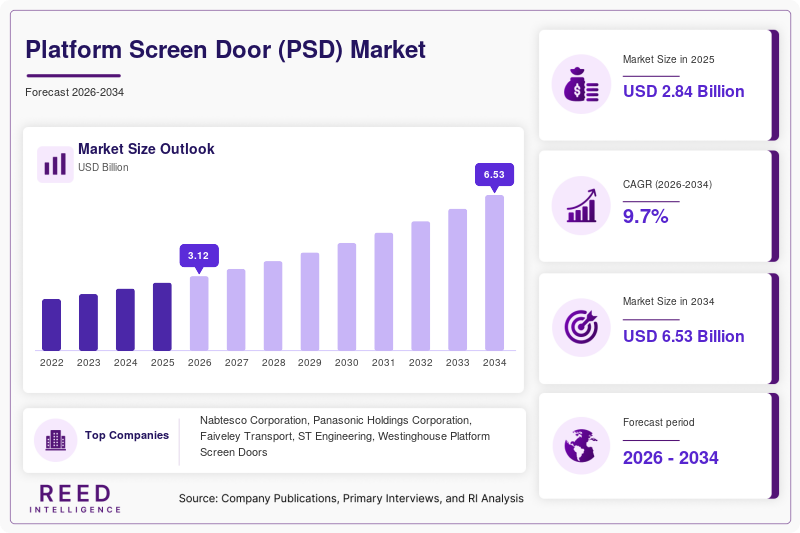
The global Platform Screen Door (PSD) Market size was valued at USD 2.84 billion in 2026 and is projected to reach USD 5.97 billion by 2034, expanding at a CAGR of 9.7% during the forecast period. The market is witnessing stable expansion due to rising investments in metro rail infrastructure, airport transit systems, and smart urban transportation projects across developed and emerging economies. Platform screen doors are increasingly deployed in urban rail systems to improve passenger safety, reduce accidental falls, optimize station climate control, and enhance operational efficiency in high-density transit networks. Governments and transport authorities are prioritizing automated rail infrastructure upgrades to manage increasing passenger volumes and improve commuter experience.
A major factor supporting market growth is the rapid expansion of urban transit modernization programs worldwide. Several countries are investing in advanced railway signaling, automated train operations, and energy-efficient station infrastructure to improve public transportation reliability. Platform screen doors have become a preferred solution because they reduce track intrusion incidents, improve air-conditioning efficiency in underground stations, and support driverless train operations. The increasing integration of smart sensors, AI-enabled monitoring systems, and predictive maintenance platforms is further contributing to market expansion.
Key Highlights
- North America dominated the market with a 33.8% share in 2025, while Asia Pacific is expected to grow at the fastest CAGR of 11.6% during 2026–2034.
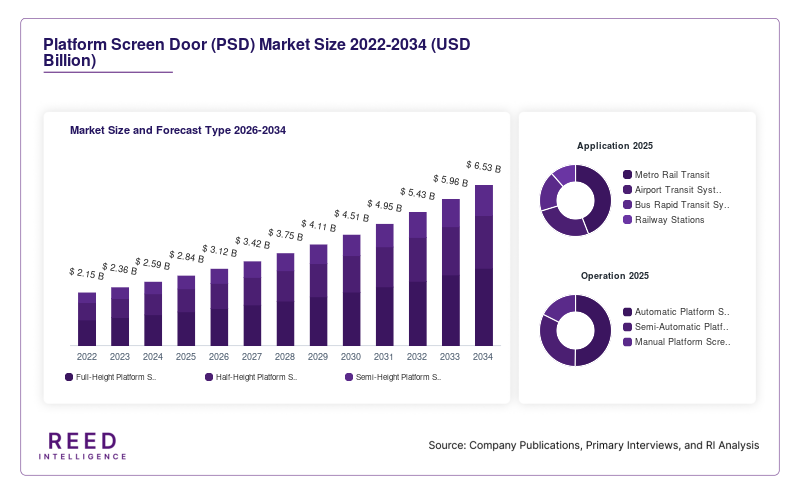
- By type, full-height platform screen doors accounted for the largest share of 46.4%, while half-height platform screen doors are projected to grow at a CAGR of 10.9%.
- By application, metro rail transit led with a 52.7% share, whereas airport transit systems are expected to expand at a CAGR of 11.3%.
- By operation, automatic platform screen door systems held the dominant share of 63.9%, while semi-automatic systems are forecast to grow at a CAGR of 9.8%.
- China remained the dominant country, with market values of USD 620 million in 2024 and USD 685 million in 2025.
Market Trends
Integration of Smart Monitoring and Predictive Maintenance Technologies
The Platform Screen Door (PSD) Market is experiencing increased adoption of intelligent monitoring technologies integrated with predictive maintenance systems. Transit authorities are investing in sensor-enabled PSD infrastructure capable of detecting door alignment issues, operational failures, and passenger movement patterns in real time. Advanced analytics platforms connected with centralized control systems are helping railway operators minimize maintenance downtime and improve passenger safety standards. Smart monitoring solutions are particularly valuable in densely populated metro networks where uninterrupted operations are critical for maintaining commuter schedules and station efficiency.
The adoption of Internet of Things (IoT)-enabled systems is also improving long-term operational performance. PSD manufacturers are developing remote diagnostics tools that reduce inspection costs and improve maintenance planning accuracy. Automated monitoring systems support faster response times during technical faults and help transit operators avoid service interruptions. The trend is gaining traction in countries investing heavily in smart city transportation infrastructure, including China, Japan, South Korea, and the United Arab Emirates. Increasing demand for energy-efficient and digitally connected transit systems is expected to accelerate deployment of smart PSD technologies over the forecast period.
Growing Deployment of Automated and Driverless Metro Systems
The increasing implementation of automated metro rail systems is creating strong demand for advanced platform screen door installations worldwide. Many urban transportation authorities are deploying driverless train networks to improve passenger handling capacity, operational precision, and railway safety. Platform screen doors play an important role in automated transit operations because they synchronize with train movement and reduce the risk of unauthorized platform access. As a result, PSD systems are becoming a standard infrastructure component in newly developed metro corridors and automated railway stations.
Several governments are supporting rail automation projects to reduce traffic congestion and improve urban mobility. Countries such as Singapore, France, Saudi Arabia, and India are expanding autonomous metro systems integrated with fully automated PSD infrastructure. Demand for synchronized door systems with advanced control software is increasing as railway operators focus on reducing accidents and improving commuter convenience. Manufacturers are also introducing lightweight and modular door systems suitable for retrofitting older stations. The transition toward smart transportation ecosystems and automated urban mobility solutions is expected to strengthen long-term growth opportunities for PSD providers globally.
Market Drivers
Expansion of Urban Rail Infrastructure Projects Across Emerging Economies
The rapid growth of urban populations and increasing pressure on public transportation systems are driving investments in metro rail and rapid transit infrastructure worldwide. Governments in emerging economies are allocating substantial budgets toward railway modernization projects to reduce road congestion, improve environmental sustainability, and strengthen urban mobility networks. Platform screen doors are increasingly incorporated into new transit stations because they improve passenger protection and operational efficiency. Growing urbanization in countries such as China, India, Indonesia, and Brazil is creating significant demand for modern railway safety infrastructure.
The construction of new metro corridors and high-capacity transit networks is contributing to higher deployment of PSD systems across underground and elevated railway stations. Transit operators are prioritizing automated infrastructure to improve station airflow management and reduce platform accidents. Additionally, international funding for sustainable public transportation projects is supporting adoption of advanced rail technologies in developing regions. Large-scale smart city initiatives are also encouraging investments in intelligent transportation systems integrated with automated platform safety solutions. These factors continue to strengthen the long-term outlook for the Platform Screen Door (PSD) Market.
Increasing Focus on Passenger Safety and Energy Efficiency
Passenger safety remains one of the primary factors driving demand for platform screen door systems across rail transit networks. Railway authorities are implementing stricter safety regulations to minimize incidents involving accidental falls, trespassing, and track intrusion. PSD systems create a physical barrier between passengers and train tracks, significantly reducing operational risks in crowded metro stations. Rising commuter volumes in urban transportation systems are increasing the need for advanced passenger management solutions that improve station safety standards.
In addition to safety benefits, platform screen doors contribute to energy efficiency in underground transit stations. These systems help maintain controlled indoor temperatures by separating train tunnels from passenger platforms, reducing air-conditioning losses and lowering energy consumption. Transit operators are increasingly adopting PSD infrastructure to achieve sustainability goals and reduce long-term operational costs. Modern systems also improve station cleanliness by limiting dust and noise generated from train movement. Growing awareness regarding sustainable infrastructure development and energy-efficient transportation facilities is expected to support market growth during the forecast period.
Market Restraint
High Installation and Retrofitting Costs Limiting Adoption in Older Transit Systems
One of the major challenges affecting the Platform Screen Door (PSD) Market is the high cost associated with installation, customization, and retrofitting activities. Many older metro and railway stations were not originally designed to accommodate PSD systems, making infrastructure modifications technically complex and financially demanding. Retrofitting projects often require platform reconstruction, signaling adjustments, train-door synchronization upgrades, and electrical integration, which significantly increase implementation costs. Smaller transit authorities with limited infrastructure budgets may delay or reduce PSD adoption because of these financial constraints.
The complexity of integrating PSD systems into aging rail networks can also lead to temporary service disruptions and increased maintenance requirements during installation phases. Inconsistent train alignment and platform variations in older transit systems create additional engineering challenges for PSD manufacturers. Cost concerns are particularly evident in developing economies where transportation agencies prioritize network expansion over advanced safety upgrades. Furthermore, fluctuations in raw material prices and supply chain disruptions may increase manufacturing and installation expenses. Although long-term operational benefits remain favorable, high upfront capital investment continues to restrain widespread adoption across legacy transportation infrastructure.
Market Opportunities
Rising Investments in High-Speed Rail and Intercity Transportation Networks
The expansion of high-speed rail and intercity transportation infrastructure presents significant growth opportunities for the Platform Screen Door (PSD) Market. Governments worldwide are increasing investments in modern rail connectivity projects to improve economic integration, reduce highway congestion, and support low-emission transportation systems. High-speed railway stations require advanced passenger safety solutions due to higher train speeds and increasing commuter volumes. Platform screen doors help improve passenger flow management while reducing safety risks associated with high-speed train operations.
Countries including China, Spain, Japan, and Saudi Arabia are investing heavily in high-speed rail corridor development, creating long-term demand for PSD installations. New intercity rail stations are increasingly designed with integrated automation and intelligent passenger safety systems. Manufacturers are introducing customized platform door systems capable of handling variable train configurations and complex station layouts. The growing preference for environmentally sustainable public transportation and cross-border railway connectivity projects is expected to create additional opportunities for market participants over the coming years.
Increasing Adoption of Smart City Transportation Infrastructure
The global expansion of smart city projects is generating favorable opportunities for companies operating in the Platform Screen Door (PSD) Market. Urban planners and government authorities are focusing on intelligent transportation ecosystems that integrate digital infrastructure, automated transit management, and advanced passenger safety technologies. Platform screen doors align with smart city objectives by improving operational efficiency, supporting automated train systems, and enhancing commuter safety within urban transit stations.
Many cities are investing in integrated transportation hubs equipped with AI-enabled monitoring systems, centralized station management platforms, and energy-efficient infrastructure. PSD manufacturers are collaborating with railway technology providers to develop connected systems that support predictive maintenance and real-time operational monitoring. Growing adoption of contactless transit systems and digitally managed metro operations is also increasing the importance of synchronized platform safety solutions. Emerging smart transportation projects in Southeast Asia, the Gulf region, and Latin America are expected to provide substantial market expansion opportunities during the forecast period.
Segmental Analysis
By Type
Full-height platform screen doors accounted for the largest share of the Platform Screen Door (PSD) Market in 2024, representing 46.4% of global revenue. These systems are widely deployed in underground metro stations and high-capacity transit environments where passenger safety and climate control are major priorities. Full-height PSD systems create a complete barrier between train tracks and passenger platforms, helping reduce accidents, improve station cleanliness, and maintain controlled air circulation. Transit operators prefer these systems because they support advanced automated train operations and reduce noise generated from train movement. The increasing adoption of driverless metro systems and high-density urban transportation networks continues to strengthen demand for full-height platform screen doors across developed and emerging markets.
Half-height platform screen doors are expected to register the fastest CAGR of 10.9% during the forecast period due to their lower installation cost and operational flexibility. These systems are increasingly used in elevated rail stations, suburban transit networks, and retrofitting projects where full-height infrastructure modifications may not be feasible. Half-height PSD solutions require lower structural adjustments and are suitable for transit operators seeking cost-effective passenger safety improvements. Manufacturers are introducing lightweight materials and modular installation technologies that reduce deployment time and maintenance expenses. Growing investments in secondary urban transit systems and regional metro expansion projects are expected to support rapid adoption of half-height platform screen door systems in multiple developing economies.
By Application
Metro rail transit emerged as the dominant application segment in the Platform Screen Door (PSD) Market, accounting for 52.7% of global revenue in 2024. Urban metro systems require efficient passenger safety infrastructure due to high commuter density and frequent train operations. Platform screen doors are increasingly integrated into metro stations to reduce track intrusion incidents, improve passenger flow management, and enhance operational reliability. The growing development of underground rail networks in major metropolitan regions is further supporting segment expansion. Governments are prioritizing smart public transportation systems with advanced automation and energy-efficient infrastructure, increasing demand for PSD installations in metro transit environments.
Airport transit systems are projected to grow at the fastest CAGR of 11.3% during the forecast period. Increasing expansion of airport people mover systems and automated shuttle services is creating strong demand for synchronized platform safety technologies. Modern airports are investing in intelligent transit infrastructure to improve passenger convenience and reduce operational risks associated with automated transportation systems. Platform screen doors help manage passenger movement efficiently while supporting climate-controlled terminal environments. Rising global air passenger traffic and ongoing airport modernization projects in Asia Pacific, the Middle East, and North America are expected to accelerate PSD deployment across airport transit applications over the next decade.
By Operation
Automatic platform screen door systems held the largest share of the Platform Screen Door (PSD) Market in 2024, accounting for 63.9% of global revenue. These systems are widely adopted in modern metro networks because they synchronize automatically with train doors and improve station operational efficiency. Automatic PSD systems reduce human intervention, minimize safety risks, and support driverless train operations in high-capacity transit environments. Railway operators prefer fully automated solutions because they improve commuter flow management and reduce operational delays. Integration with centralized railway control systems and predictive maintenance platforms further strengthens the demand for automatic PSD infrastructure in urban transportation networks.
Semi-automatic platform screen door systems are expected to witness the fastest growth, expanding at a CAGR of 9.8% during the forecast period. These systems are gaining popularity in developing regions and retrofitting projects where transportation authorities seek affordable safety solutions without extensive infrastructure upgrades. Semi-automatic PSD systems offer operational flexibility and lower implementation costs compared to fully automated alternatives. Manufacturers are developing compact and energy-efficient systems suitable for smaller transit stations and regional rail networks. The increasing modernization of suburban transportation systems and growing awareness regarding passenger safety standards are expected to drive segment growth in the coming years.
Regional Analysis
North America
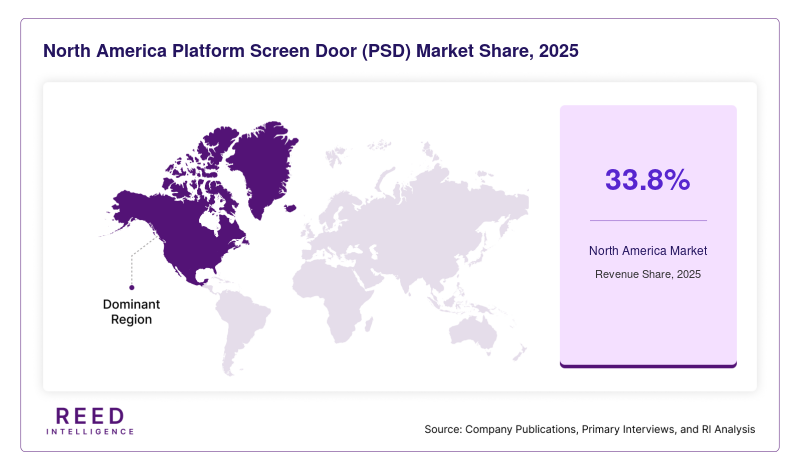
North America accounted for 33.8% of the global Platform Screen Door (PSD) Market in 2025 and is projected to expand at a CAGR of 8.4% during the forecast period. Market growth in the region is supported by increasing modernization of urban transit infrastructure and rising investments in automated rail safety systems. Transit authorities in major metropolitan areas are prioritizing platform safety upgrades to improve passenger security and operational efficiency. Demand for energy-efficient station infrastructure and integrated transportation management systems is also contributing to PSD deployment across subway and airport transit networks.
The United States remains the dominant country in the North American market due to continuous investments in metro modernization and smart transportation infrastructure. Large cities including New York, Chicago, and San Francisco are implementing railway safety enhancement programs focused on reducing passenger accidents and improving station automation. The growing adoption of driverless transit technologies and climate-controlled underground stations is creating additional opportunities for PSD manufacturers. Federal transportation funding and urban mobility initiatives continue to support infrastructure expansion across the country.
Europe
Europe represented 27.4% of the global Platform Screen Door (PSD) Market in 2025 and is anticipated to register a CAGR of 8.9% from 2026 to 2034. The region benefits from well-established public transportation infrastructure and strict railway safety regulations. European transit operators are focusing on upgrading aging metro systems with automated platform safety solutions to improve commuter experience and reduce operational risks. Increasing emphasis on sustainable transportation and energy-efficient infrastructure is encouraging adoption of modern PSD systems in underground rail stations.
France emerged as the dominant country within the European market due to its extensive metro network modernization activities and investment in automated rail systems. Paris continues to expand smart transit infrastructure integrated with advanced passenger management technologies. The country’s focus on reducing carbon emissions through efficient public transportation systems is strengthening demand for platform screen doors. Additionally, ongoing development of cross-border rail connectivity and urban mobility projects across Western Europe is supporting long-term regional market growth.
Asia Pacific
Asia Pacific held 24.6% of the global Platform Screen Door (PSD) Market in 2025 and is expected to grow at the fastest CAGR of 11.6% during the forecast period. Rapid urbanization, expanding metro rail networks, and large-scale smart city investments are driving substantial market demand across the region. Governments are allocating significant resources toward modern railway infrastructure capable of supporting growing urban populations and increasing passenger traffic. The adoption of automated train systems and intelligent station technologies is accelerating PSD installation across newly developed transit corridors.
China remains the leading country in the Asia Pacific market due to aggressive expansion of urban metro systems and high-speed railway infrastructure. The country continues to invest heavily in smart transportation projects aimed at improving urban mobility and passenger safety. Increasing deployment of fully automated metro lines in major cities such as Beijing, Shanghai, and Shenzhen is creating strong demand for advanced PSD systems. Government support for sustainable public transportation and rapid technological innovation in railway automation further strengthens market growth prospects.
Middle East & Africa
The Middle East & Africa accounted for 7.2% of the global Platform Screen Door (PSD) Market in 2025 and is projected to grow at a CAGR of 9.5% over the forecast period. The region is witnessing increasing investments in urban transportation infrastructure, particularly in Gulf Cooperation Council countries. Governments are developing advanced metro systems and integrated transit networks to support economic diversification and rising urban populations. Platform screen doors are increasingly used in premium transportation projects to improve passenger safety, operational reliability, and station climate management.
Saudi Arabia leads the regional market due to extensive investments in metro rail projects and smart city developments. The expansion of Riyadh Metro and other urban transit initiatives is generating strong demand for advanced platform safety systems. Large-scale infrastructure projects associated with tourism development and economic transformation strategies are also contributing to market growth. The increasing adoption of automated transportation technologies and energy-efficient urban infrastructure is expected to create additional opportunities across the region.
Latin America
Latin America captured 7.0% of the global Platform Screen Door (PSD) Market in 2025 and is expected to expand at a CAGR of 8.1% during the forecast period. Regional market growth is supported by increasing investments in public transportation modernization and urban mobility improvements. Several countries are upgrading metro rail systems to reduce traffic congestion and improve commuter safety in densely populated urban centers. Demand for platform screen doors is gradually increasing as transportation authorities focus on enhancing passenger management and reducing operational disruptions.
Brazil remains the dominant country in the Latin American market due to continued development of urban rail infrastructure in major cities such as São Paulo and Rio de Janeiro. Government initiatives focused on improving public transportation efficiency and reducing carbon emissions are encouraging adoption of modern transit technologies. The growing need for safer railway operations and increasing urban population density are supporting PSD deployment across metro expansion projects. International financing for sustainable transportation initiatives is also contributing to regional market development.
Competitive Landscape
The Platform Screen Door (PSD) Market is moderately consolidated, with leading companies focusing on technological innovation, strategic partnerships, and regional expansion initiatives to strengthen market positioning. Major market participants are investing in smart automation technologies, predictive maintenance platforms, and lightweight modular door systems to improve operational performance and reduce installation complexity. Companies are also collaborating with metro rail authorities and infrastructure developers to secure long-term contracts associated with urban transit modernization projects.
Nabtesco Corporation remains one of the leading companies in the market due to its strong product portfolio and extensive presence in railway automation solutions. The company continues to focus on advanced synchronization technologies and intelligent control systems for automated transit infrastructure. In a recent development, the company introduced upgraded PSD control software designed to improve door response accuracy and reduce maintenance downtime in high-capacity metro environments.
Key Players
- Nabtesco Corporation
- Panasonic Holdings Corporation
- Faiveley Transport
- ST Engineering
- Westinghouse Platform Screen Doors
- KTK Group Co., Ltd.
- Jiacheng Railway International
- Fangda Intelligent Control Co., Ltd.
- Gilgen Door Systems
- Horton Automatics
- Shanghai Electric Group
- Manusa
- Ningbo Ownic Technology Co., Ltd.
- Polarteknik Oy
- Stanley Access Technologies
Recent Developments
- In March 2026, Panasonic Holdings Corporation launched an upgraded AI-enabled platform screen door monitoring system designed to improve predictive maintenance efficiency and enhance passenger safety across urban metro networks.
- In September 2025, ST Engineering expanded its railway infrastructure partnership portfolio across Southeast Asia to strengthen deployment of automated platform screen door systems in newly developed metro corridors.
- In November 2025, Siemens Mobility introduced a modular retrofit platform screen door solution targeting aging railway stations requiring lower installation downtime and improved operational flexibility.
- In January 2026, Nabtesco Corporation announced an advanced synchronized door control platform compatible with fully automated and driverless metro rail systems operating in high-density urban environments.
Platform Screen Door (PSD) Market Segments
Type
- Full-Height Platform Screen Doors
- Half-Height Platform Screen Doors
- Semi-Height Platform Screen Doors
Application
- Metro Rail Transit
- Airport Transit Systems
- Bus Rapid Transit Systems
- Railway Stations
Operation
- Automatic Platform Screen Door Systems
- Semi-Automatic Platform Screen Door Systems
- Manual Platform Screen Door Systems
By Region
- North America
- Europe
- APAC
- Middle East and Africa
- LATAM