Playground Equipment Market Size, Share & Trends Analysis Report By Product Type (Swings and Slides, Climbing Equipment, Combination Play Structures), By Material (Metal, Plastic, Wood), By Installation Type (Outdoor and Indoor), By End User (Public Parks and Municipalities, Schools and Childcare Centers), By Sales Channel (Direct Sales, Distributors and Dealers and Online Channels) Forecasts, 2026–2034
USD 3950
Playground Equipment Market Size
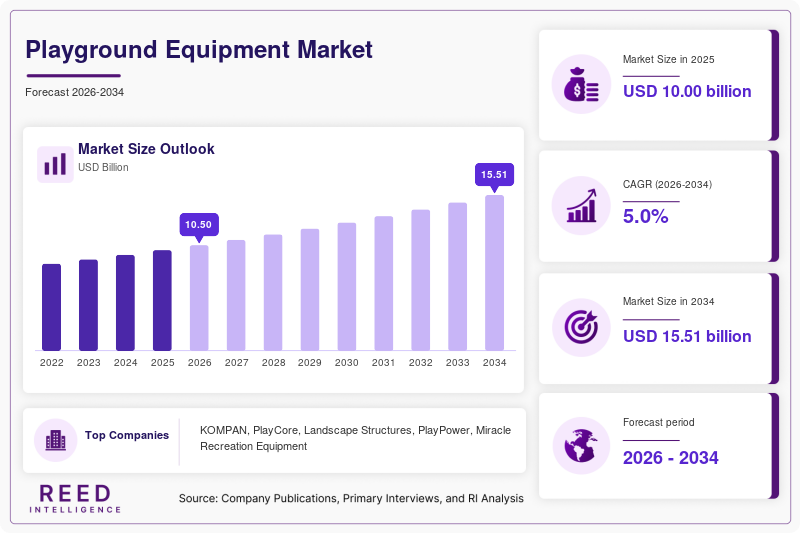
The global Playground Equipment Market was valued at USD 10.00 billion in 2025 and is estimated to reach USD 10.50 billion in 2026. Based on the supplied forecast, the market is projected to reach USD 15.51 billion by 2034, registering a CAGR of 5.00% during 2026–2034.
The supplied values are mathematically consistent after rounding. Growth from USD 10.50 billion in 2026 to USD 15.51 billion in 2034 implies approximately 5.00% CAGR. The 2025-to-2034 trajectory also aligns with a 5.00% annual growth assumption.
The market includes playground structures and equipment used in public parks, schools, childcare facilities, residential communities, commercial recreation facilities and indoor play areas. The analysis distinguishes equipment sales from related project revenue, such as installation, protective surfacing, landscaping and maintenance, because companies and industry sources do not always report these activities separately.
Playground equipment comprises physical structures designed to support children’s play, including swings, slides, climbing frames, combination structures, spring riders, seesaws, spinners and sensory or balance equipment. The market also includes indoor play systems and selected accessible or inclusive play products. Purchasing decisions depend on safety, durability, age suitability, accessibility, available space, installation requirements and total lifecycle cost.
The commercial structure extends beyond the equipment itself. A public playground project may require site assessment, design, foundations, surfacing, installation, inspection and ongoing maintenance. Suppliers that provide an integrated project can compete on coordination, safety documentation and long-term service, while equipment-only manufacturers may compete more directly on product design, price and delivery time. KOMPAN’s 2025 annual report describes a business covering playgrounds, outdoor sports and fitness facilities, installation, surfacing, landscaping and after-sales services, illustrating the breadth of this project-based model.
Demand comes from several distinct buyer groups. Municipalities and public agencies procure equipment through capital budgets and tender processes; schools and childcare centers prioritize age-appropriate design, safety and frequent-use durability; residential developers may include playgrounds as an amenity; and commercial recreation operators use play equipment to attract families and support customer retention. Each group has different procurement cycles and requirements, so overall market growth does not translate into uniform growth across all end users.
Playground Equipment Market Drivers
Public-space renewal and new recreational facilities sustain equipment demand
Municipalities, schools, childcare providers and residential developers need playgrounds that remain safe, functional and appropriate for their users. Demand can arise from new construction as well as renovation of older play areas whose structures, surfacing or layouts require replacement. Renovation projects are commercially important because they can generate purchases even where no new park or school is being built.
Procurement decisions are affected by local budgets, grants, land availability and the condition of existing facilities. Public-sector spending can create large project opportunities, but tendering, approvals and budget cycles may lengthen the time between a supplier’s initial engagement and final order. Manufacturers with established public-sector relationships, project-design capabilities and installation support can be better positioned to compete for these contracts.
Safety requirements increase the importance of engineered equipment
Playground equipment must be designed to account for falls, entrapment, protrusions, pinch points, structural stability and the suitability of equipment for different age groups. The CPSC’s 2025 handbook emphasizes protective surfacing, appropriate layouts, age-appropriate equipment and ongoing inspection. ASTM International’s F1487-25 specification addresses safety and performance for public-use playground equipment, including use zones, equipment requirements, installation, structural integrity and maintenance.
These requirements influence product engineering, material selection, testing, installation instructions and purchaser due diligence. They can favor suppliers with strong technical documentation and quality-control processes. However, compliance does not eliminate all injury risks, and the standards applicable to a project depend on jurisdiction, equipment type and the buyer’s requirements.
Inclusive play design broadens equipment specifications
Public agencies, schools and recreation planners increasingly consider how play areas can accommodate children with different physical and sensory abilities. Inclusive playground design can involve accessible routes, transfer platforms, ground-level activities, supportive swings, sensory elements and layouts that allow children to play together.
This creates opportunities for suppliers that offer a range of accessible products and can integrate them into a coherent site design. Accessibility should not be reduced to installing a single piece of specialized equipment: routes, surfacing, transitions, usable space and the arrangement of play activities also affect whether a site can be used meaningfully. Project specifications and applicable accessibility requirements therefore shape the overall equipment package.
Playground Equipment Market Restraints
High installation and lifecycle costs constrain procurement
The total cost of a playground includes more than the equipment purchase price. Site preparation, foundations, protective surfacing, drainage, accessibility features, transport, installation and inspections can materially increase project expenditure. Larger structures may also require specialized installation teams and longer site closures.
Public buyers must balance these costs against competing priorities, while private developers compare playground investment with other amenities. Suppliers can address the constraint through modular designs, transparent lifecycle-cost estimates and scalable equipment packages. However, reducing the initial price without preserving durability or safety can increase maintenance and replacement costs later.
Safety liability and maintenance requirements increase operating complexity
Playground owners must maintain equipment and surfacing, inspect for wear or damage and address hazards that emerge during use. A structure that was safe at installation can become unsafe if components loosen, surfaces deteriorate or site conditions change. The CPSC recommends regular attention to equipment condition, protective surfacing, age suitability and supervision.
These requirements create recurring responsibilities for schools, municipalities, childcare centers and commercial operators. They also influence product selection: buyers may prefer suppliers that provide maintenance documentation, spare parts and inspection support. The restraint is particularly relevant to organizations with limited maintenance budgets or staff capacity.
Weather exposure and material deterioration affect ownership economics
Outdoor equipment is exposed to ultraviolet radiation, moisture, temperature changes, corrosion and repeated mechanical loading. Different materials present different trade-offs. Metal can offer structural strength but may require corrosion protection; plastics can support molded shapes and color variety but must be designed for outdoor durability; and wood can suit naturalistic designs but requires appropriate treatment, detailing and maintenance.
Poor material selection or inadequate maintenance can shorten the service life of equipment and increase the cost of ownership. Suppliers must design for local climatic conditions and disclose appropriate maintenance requirements. Buyers also need to consider heat exposure, drainage, surface condition and the likely frequency of inspections.
Playground Equipment Market Opportunities
Modular and configurable systems can reduce project complexity
Modular equipment lets buyers combine slides, climbing features, platforms and other elements according to the available space, age range and budget. A modular approach can support phased installations and allow a site to expand as funding becomes available. It can also help suppliers offer standardized components while retaining design flexibility.
The commercial opportunity is strongest where customers need to adapt playgrounds to different site conditions without commissioning an entirely bespoke structure. Suppliers must still verify that the assembled configuration meets applicable safety requirements and that later modifications do not create new hazards or invalidate the original design assumptions.
Inclusive and sensory equipment can expand product differentiation
Playgrounds that incorporate ground-level activities, tactile features, accessible routes and different levels of physical challenge can serve a wider range of users. Sensory play elements may also create additional ways for children to interact with the space. Buyers can use these features to meet project objectives related to participation, accessibility and community use.
For manufacturers, the opportunity includes both specialized products and integrated design services. The limitation is that inclusion depends on the full site design and not just individual equipment features. Suppliers need to work with planners, accessibility specialists and users to avoid treating inclusive design as a superficial add-on.
Sustainable materials and longer service life can influence tender decisions
Public agencies and property developers may consider material durability, repairability, recycled content, replacement frequency and end-of-life handling when evaluating playground projects. A product that can be maintained or repaired instead of fully replaced may offer lifecycle advantages, although the outcome depends on its initial price, service needs and expected operating life.
Suppliers can differentiate themselves through transparent material specifications, replaceable components, maintenance instructions and documented product performance. Sustainability claims should be supported by evidence on material sourcing, durability and end-of-life treatment rather than relying on broad environmental language alone.
Segmental Analysis
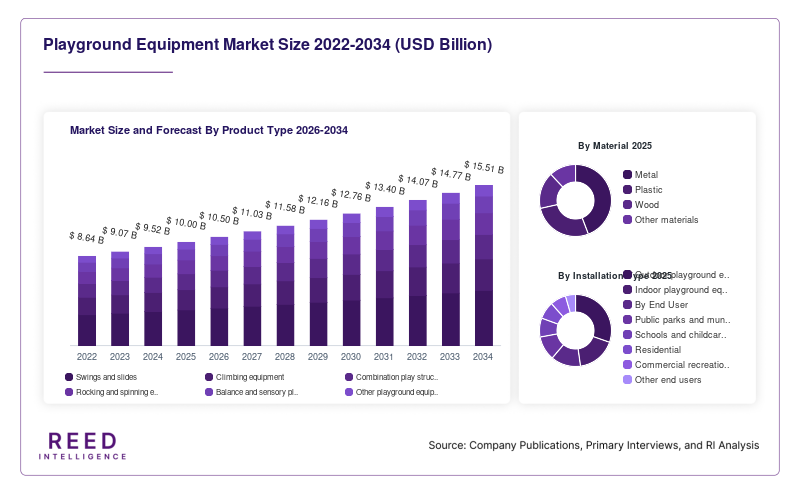
Methodology note: the shares and values below are internal analytical allocations rather than externally reported market statistics. The 2025 values use the supplied global market size of USD 10.00 billion. Each segmentation dimension sums to 100%. These allocations provide a structured view of the market and should be replaced by comparable product-level revenue data when available.
By Product Type
Combination play structures are modeled at 30% of the 2025 market, equivalent to approximately USD 3.00 billion. These systems combine several play elements within a coordinated structure and can be tailored to the age range, available space and budget of a project. Their modularity can help buyers create a broad play experience through one integrated installation. However, large structures can require more site preparation, installation work and protective surfacing, which can raise the total project cost.
Swings and slides represent an internal allocation of 25% of the 2025 market, or approximately USD 2.50 billion. These are familiar play features used across parks, schools, childcare facilities and residential communities. Their broad applicability supports demand across multiple end-user groups. Product selection remains sensitive to age suitability, structural design, surface requirements, durability and the space needed for safe use.
Climbing equipment accounts for a modeled 18% of the 2025 market, equivalent to approximately USD 1.80 billion. Climbing nets, frames, ladders and related structures provide progressively challenging physical play. Buyers must consider fall height, access, use zones, material strength and age-appropriate design. Suppliers that can provide a range of difficulty levels and integrate climbing features into larger systems may appeal to schools and public parks seeking varied play experiences.
Rocking and spinning equipment represents an internal allocation of 10% of the 2025 market, or approximately USD 1.00 billion. This category includes spring riders, seesaws and rotating play structures. These products can complement larger playground systems and provide movement-based activities in relatively compact areas. Their commercial performance depends on the suitability of the equipment for intended users, maintenance needs and compliance with relevant safety specifications.
Balance and sensory play equipment accounts for a modeled 9% of the 2025 market, equivalent to approximately USD 0.90 billion. This category includes balance elements, tactile activities and selected sensory play products. It can support varied play experiences and contribute to inclusive playground designs. Actual demand depends on project specifications, user needs and whether the products are purchased individually or incorporated into larger installations.
Other playground equipment makes up the remaining 8% of the 2025 market, or approximately USD 0.80 billion. This category includes specialized and emerging play products that do not fit neatly into the main groups. Its composition varies with supplier portfolios and local design preferences, so the allocation should be treated as a modeling assumption rather than a directly measured market share.
By Material
Metal is modeled at 40% of the 2025 market, equivalent to approximately USD 4.00 billion. Metal components are widely used in structural supports, frames, climbers and other equipment where strength and load-bearing performance are important. Surface treatments and appropriate material specifications help manage outdoor exposure, but corrosion protection, inspections and maintenance remain relevant to lifecycle cost.
Plastic represents an internal allocation of 30% of the 2025 market, or approximately USD 3.00 billion. Molded plastic components can support varied shapes, color choices and designs for slides, panels and selected structural features. Product performance depends on material formulation, ultraviolet resistance, impact characteristics and the intended application. Buyers must consider outdoor heat exposure and the long-term condition of components, not simply initial appearance or price.
Wood accounts for a modeled 20% of the 2025 market, equivalent to approximately USD 2.00 billion. Wood can support naturalistic playground designs and fit well with parks or landscape-led developments. Its lifecycle performance depends on species, treatment, moisture management, connection design and maintenance. Buyers need to evaluate the material’s suitability for local climatic conditions and the frequency of inspection or replacement that may be required.
Other materials account for the remaining 10% of the 2025 market, or approximately USD 1.00 billion. This group includes composite materials and other specialized components used for particular performance or design requirements. Because the category spans different materials and applications, the allocation is indicative and not a direct industry measurement.
By Installation Type
Outdoor playground equipment represents a modeled 80% of the 2025 market, equivalent to approximately USD 8.00 billion. Outdoor installations include public parks, school grounds, residential communities, childcare facilities and commercial recreation areas. These projects can involve substantial equipment packages and associated site work. Their procurement depends on available land, capital budgets, weather exposure, surfacing requirements and the long-term maintenance capacity of the owner.
Indoor playground equipment accounts for an internal allocation of 20% of the 2025 market, or approximately USD 2.00 billion. Indoor installations can serve childcare facilities, shopping centers, family entertainment venues, restaurants and other commercial locations. They may offer year-round use and provide a play amenity where outdoor space is limited. The market is constrained by floor area, building requirements, cleaning needs and the cost of installing and maintaining play systems indoors.
By End User
Public parks and municipalities are modeled at 30% of the 2025 market, equivalent to approximately USD 3.00 billion. Public agencies procure playground equipment for community parks, recreation spaces and other publicly accessible locations. Demand depends on municipal budgets, grant programs, refurbishment needs and public procurement schedules. Suppliers with experience in tendering, installation and safety documentation may have an advantage, although project timing can be affected by funding approvals and administrative delays.
Schools and childcare centers account for an internal allocation of 25% of the 2025 market, or approximately USD 2.50 billion. These buyers prioritize age-appropriate equipment, safe layouts, durability and the ability to supervise children. Playgrounds may be included in new school construction or purchased to replace aging equipment. Budget limits and school-calendar constraints can affect the timing of installations, while maintenance support is important for facilities that use the equipment frequently.
Residential applications represent a modeled 18% of the 2025 market, equivalent to approximately USD 1.80 billion. This category includes playgrounds in apartment complexes, housing communities and selected private residential developments. Equipment can serve as a shared amenity and help developers differentiate their properties. Procurement depends on project budgets, available space, resident demographics and the developer’s view of the amenity’s value to property appeal.
Commercial recreation facilities account for an internal allocation of 17% of the 2025 market, or approximately USD 1.70 billion. This segment includes indoor play centers, resorts, restaurants and other businesses using playground equipment to attract families or increase visitor engagement. Buyers may prioritize distinctive designs, compact layouts and service support. Commercial projects also need to consider cleaning, uptime, staffing and the return available from the space devoted to play.
By Sales Channel
Direct sales are modeled at 55% of the 2025 market, equivalent to approximately USD 5.50 billion. Large playground projects often require site-specific design, technical consultation, installation planning and coordination with contractors or public agencies. Direct engagement allows manufacturers to tailor equipment packages and manage complex projects. It can also require a larger sales and project-management organization, particularly when serving multiple regions.
Distributors and dealers represent an internal allocation of 40% of the 2025 market, or approximately USD 4.00 billion. Regional partners can provide local market knowledge, product access, installation coordination and service support. This model can help manufacturers reach smaller buyers or markets where they do not maintain a direct sales presence. Distributor margins and dependence on partner capabilities can, however, affect pricing and customer experience.
Online channels account for a modeled 5% of the 2025 market, equivalent to approximately USD 0.50 billion. Online channels can support product discovery, specification comparison and purchases of simpler or smaller equipment. Large public playground projects are less likely to be completed through a purely transactional online purchase because they may require site design, foundations, safety planning and installation. The channel’s role is therefore strongest for research, lead generation and selected standardized products.
Regional Analysis
North America Playground Equipment Market
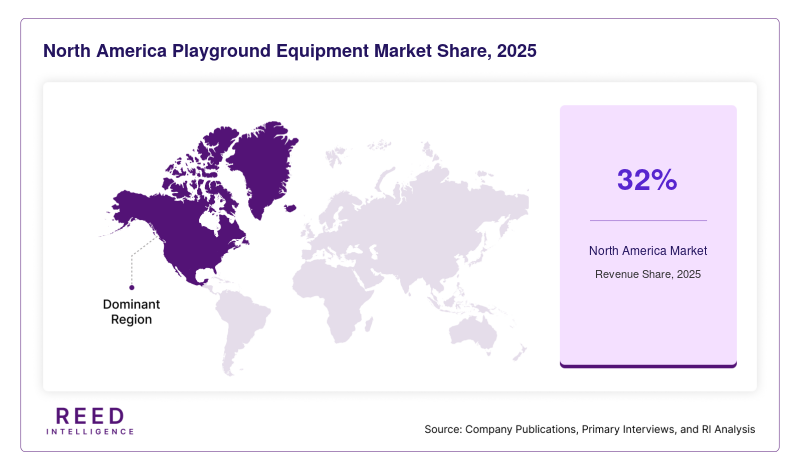
North America is modeled at 32% of the global market in 2025, equivalent to approximately USD 3.20 billion. Its modeled share is 31% in 2034, representing approximately USD 4.81 billion. The region has an established market for public playgrounds, school facilities, residential communities and commercial recreation installations. Buyers place importance on safety, accessibility, equipment durability and maintenance requirements.
The CPSC’s July 2025 Public Playground Safety Handbook provides guidance on the design, layout, use and maintenance of public playgrounds. ASTM F1487-25 specifies safety and performance requirements for public-use equipment, including clearances and use zones. These references are relevant to product selection and project planning, although applicable legal obligations vary by jurisdiction and project type.
Regional demand is influenced by municipal capital budgets, school renovation programs, residential construction and the replacement of aging equipment. Suppliers that can combine product engineering with design, installation and after-sales support may be well positioned for larger projects. Nevertheless, procurement timing remains sensitive to public funding, construction schedules and the total cost of installation.
Europe Playground Equipment Market
Europe is modeled at 27% of the global market in 2025, equivalent to approximately USD 2.70 billion. By 2034, its modeled share is 26%, or approximately USD 4.03 billion. The region includes public parks, school playgrounds, residential developments and commercial recreation facilities. Procurement decisions reflect local safety requirements, accessibility considerations, durability, design preferences and the need to maintain equipment in varied climates.
KOMPAN’s 2025 annual report recorded revenue of DKK 3,822.2 million, up 10.6% year over year, for a group whose activities include playgrounds, outdoor sports and fitness facilities, installation, surfacing and after-sales services. The results provide evidence of activity at one major supplier, but they cover a broader business than playground equipment alone and should not be interpreted as the growth rate of the European market.
The region’s commercial opportunity includes replacement projects, inclusive play design and integrated site packages. Buyers may favor suppliers that can document materials, safety performance and maintenance requirements. However, national procurement rules, construction costs and local budget cycles can make project demand uneven across countries.
Asia-Pacific Playground Equipment Market
Asia-Pacific is modeled at 23% of the global market in 2025, equivalent to approximately USD 2.30 billion. Its modeled share rises to 25% by 2034, representing approximately USD 3.88 billion. The region contains diverse markets with different levels of public recreation infrastructure, school construction, residential development and commercial leisure investment. Demand may come from new installations as well as replacement of equipment in established urban areas.
Suppliers can address different purchasing needs through modular systems, durable materials and price tiers suited to local budgets. Larger developments may require integrated design and installation, while smaller projects may favor standardized equipment packages. Product selection is also affected by climate, available land, maintenance capacity and local safety requirements.
The regional opportunity should not be treated as uniform. Government spending, construction activity and recreational priorities vary across countries, and market access can depend on local distribution, project specifications and installation capabilities. The modeled increase in APAC’s share is an analytical scenario, not a published regional forecast.
Middle East and Africa Playground Equipment Market
The Middle East and Africa region is modeled at 10% of the global market in 2025, equivalent to approximately USD 1.00 billion. Its modeled share increases to 11% by 2034, representing approximately USD 1.71 billion. Demand can arise from residential developments, public parks, schools, resorts, shopping centers and indoor recreation venues. In some markets, new development projects create opportunities for playground equipment suppliers to participate in larger landscape and public-space packages.
Product selection must account for climate and site conditions. High temperatures, ultraviolet exposure, dust and water availability can influence material choices, surface temperatures, cleaning and maintenance requirements. Suppliers that provide appropriate specifications and local service support may be better positioned to serve projects with demanding operating conditions.
The regional market is highly heterogeneous. New urban developments and tourism-related projects can create demand, but announced construction activity should not be treated as completed equipment orders. Procurement also depends on project financing, local approvals, supplier access and the ability to maintain equipment after installation.
Latin America Playground Equipment Market
Latin America is modeled at 8% of the global market in 2025, equivalent to approximately USD 0.80 billion. By 2034, its modeled share remains 7%, representing approximately USD 1.09 billion. Demand comes from municipal parks, schools, childcare centers, residential developments and commercial recreation venues. Equipment affordability and the ability to maintain installed structures are important purchasing considerations.
Suppliers can serve the region through modular designs, standardized product packages and distributor partnerships that provide local installation and maintenance. However, currency fluctuations, import costs, financing conditions and public procurement cycles can affect final prices and order timing. Products must also be suited to local climate conditions and the capabilities of the organization responsible for maintaining the site.
A country-level assessment is more reliable than treating the region as one market. The modeled regional share reflects an analytical allocation, not a direct measure of current equipment revenue or a forecast of public-sector spending.
Competitive Landscape
The playground equipment industry includes manufacturers of modular structures, swings, slides, climbing systems, indoor play products and accessible equipment, alongside companies providing site design, surfacing, installation and maintenance. Competition depends on product design, safety documentation, material durability, project customization, delivery capability and total lifecycle cost.
Larger suppliers can compete through broad product portfolios and integrated project services. KOMPAN’s annual report, for example, describes equipment sales alongside installation, surfacing, landscaping and after-sales services. This model allows a supplier to participate in multiple parts of a playground project, although it also requires project-management and service capabilities beyond manufacturing.
Smaller or specialized suppliers may compete through regional relationships, customized designs, particular materials or focused product lines. Distributors and dealers can be important where local installation and maintenance support are needed. Public-sector procurement often places emphasis on compliance documentation, warranties, service availability and the supplier’s ability to deliver a complete project within the specified budget.
Key Market Players
The following companies participate in playground equipment, play structures, surfacing or related recreation products. This is a representative list and is not a ranking by market share.
Recent Market Developments
- October 2026, KOMPAN announced several new product ranges in October 2026, including Northland, OrbitPlay, Infinity Towers and PlayBox. The company described PlayBox as a compact, enclosed play system for commercial settings such as pubs, clubs and quick-service restaurants, where play can be incorporated into an existing venue. Market implication: product development is addressing both traditional outdoor playgrounds and space-constrained commercial settings. The announcement indicates portfolio expansion but does not independently establish market-wide sales growth.
- June 2025, ASTM International listed F1487-25, the Standard Consumer Safety Performance Specification for Playground Equipment for Public Use, as an active standard updated on June 6, 2025. Its scope includes equipment performance, clearance and use zones, installation, structural integrity, maintenance and hazard identification. Market implication: manufacturers and purchasers should assess the applicable version of safety specifications when designing, tendering, installing or maintaining public playgrounds. The standard’s legal status and applicability depend on the jurisdiction and project requirements.
Playground Equipment Market Segments
By Product Type
- Swings and slides
- Climbing equipment
- Combination play structures
- Rocking and spinning equipment
- Balance and sensory play equipment
- Other playground equipment
By Material
- Metal
- Plastic
- Wood
- Other materials
By Installation Type
- Outdoor playground equipment
- Indoor playground equipment
- By End User
- Public parks and municipalities
- Schools and childcare centers
- Residential
- Commercial recreation facilities
- Other end users
By Sales Channel
- Direct sales
- Distributors and dealers
- Online channels
By Region
- North America
- Europe
- APAC
- Middle East and Africa
- LATAM