Playout Solutions Market Size, Share & Trends Analysis Report By Component (Playout Software & Platforms, Integration & Managed Services), By Deployment (On-Premise, Cloud, Hybrid), By Channel Type (Traditional Linear TV & Broadcast, FAST & CTV, OTT & DTC, Sports & Live Event, Specialty & Pop-Up Channels), By End User (Broadcasters, Content Owners & Publishers, Pay-TV Operators & MSOs, Sports & Live Event Organizations, Others) and By Region (North America, Europe, APAC, Middle East and Africa,
USD 3950
Playout Solutions Market Size
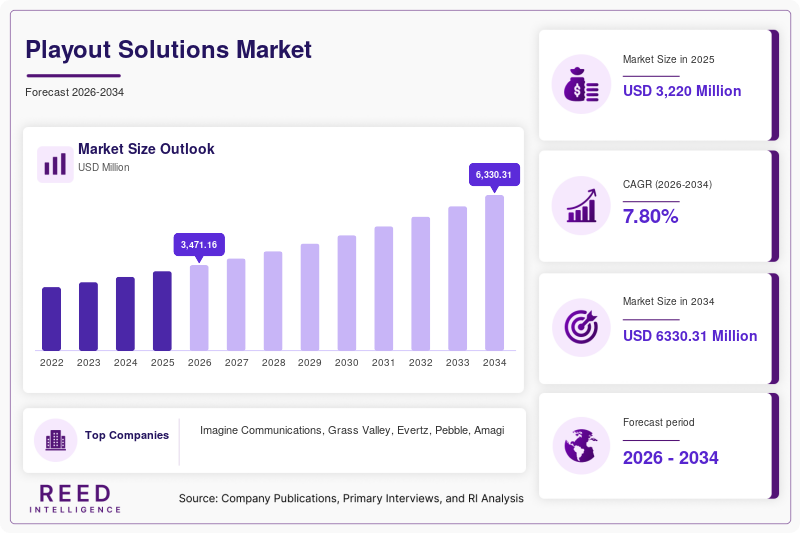
The global playout solutions market is valued at USD 3,220 Million in 2025 and USD 3,471.16 Million in 2026. The market is projected to reach USD 6,330.31 Million by 2034, registering a 7.80% CAGR during the forecast period.
The playout solutions market comprises the software, hardware and services used to schedule, assemble, automate, control, monitor and distribute television channels and other linear video services. Modern playout environments typically combine channel scheduling, media management, master-control functions, graphics, branding, ad signaling, captioning, live-event handling, monitoring, redundancy and delivery interfaces across broadcast, OTT, CTV and FAST distribution.
Traditional playout remains critical for linear television, but its architecture is changing rapidly. SMPTE ST 2110 defines an IP-based framework for professional media transport covering real-time production and playout, separating video, audio and ancillary-data streams while maintaining synchronized timing. The standard is increasingly used as broadcasters replace fixed SDI infrastructures with software-defined and IP-based facilities.
Playout Solutions Market Drivers
FAST, CTV and OTT channel expansion is increasing demand for scalable channel origination
The proliferation of digital linear channels is creating demand for platforms that can launch and manage services without building a separate hardware chain for every channel.
Omdia maintains a dedicated FAST channel distribution database and continues to treat FAST channels as a distinct and expanding component of the global video ecosystem. Amagi's June 2026 FAST analysis recorded 55% year-over-year growth in viewing hours across approximately 6,500 tracked channel deliveries.
Frequency's 2026 operating model illustrates how this translates into playout requirements. The company reported that its cloud-native platform powered more than 160 local-news FAST channels and was expected to deliver more than 100,000 live news events during 2026.
The economic logic favors highly automated systems because channel operators need to support larger portfolios, rights windows, localization, EPG metadata, ad breaks and distribution endpoints without expanding operating teams at the same rate.
Broadcasters are replacing fixed SDI infrastructure with IP and software-defined architectures
SMPTE ST 2110 has become a major technical foundation for IP-based professional media systems. It supports separated video, audio and data flows over managed IP networks and is explicitly designed for applications including real-time production and playout.
Major playout vendors are aligning their products with this transition. Imagine's 2026 activity includes continued ST 2110 migration work with France TV and Torneos, while Grass Valley's LNK deployment combines software-defined playout with an ST 2110 transition.
The architecture creates a stronger market for software-based channel origination because computing, switching and processing resources can be pooled rather than permanently assigned to a single SDI chain.
Monetization requirements are making playout a revenue-enablement layer
Playout systems increasingly sit directly in the path between programming and monetization. Ad markers, program boundaries, dynamic ad insertion, blackout rules, local substitutions and rights-aware scheduling all require precise integration between automation and downstream distribution.
Amagi's AdFlow Orchestrator was launched specifically to convert traditional broadcast commercial structures into FAST- and CTV-compatible advertising opportunities.
MediaKind's Personalization Suite uses schedule information from the playout-automation system to identify ad breaks and other placement opportunities precisely and pass that information into downstream dynamic-ad-insertion workflows.
As advertising becomes a larger part of streaming economics, playout platforms are increasingly evaluated not only on reliability but also on their ability to preserve revenue opportunities across multiple distribution paths.
Playout Solutions Market Restraints
Mission-critical reliability requirements make cloud migration more complex for flagship channels
Playout is an always-on operation. Broadcasters must maintain deterministic behavior, redundancy, monitoring and rapid recovery even during live sports, breaking news and major scheduled events.
The cloud reduces infrastructure barriers, but it does not eliminate operational complexity. DPP's cloud-for-playout work notes that while cloud technology is mature enough to support playout use cases, the economic and operational case can differ between simple thematic or FAST services and complex channels with significant reactive live programming.
This encourages many broadcasters to retain on-premise or hybrid environments for the most demanding services while using cloud infrastructure for secondary channels, disaster recovery, overflow and new digital services.
Skills, interoperability and legacy-system integration can slow modernization
Replacing legacy playout can affect scheduling, media asset management, graphics, traffic, advertising, captions, monitoring and distribution systems simultaneously.
Modern facilities must also manage standards and control-plane interoperability. SMPTE's ST 2110 ecosystem relies on associated timing, signaling and NMOS-based discovery and connection mechanisms, requiring specialized IP and media-network expertise.
The result is that many broadcasters prefer evolutionary migration rather than a complete replacement. Imagine's Torneos deployment illustrates this approach by preserving trusted workflows while providing a path toward UHD and ST 2110.
Playout Solutions Market Opportunities
AI-assisted channel operations can reduce manual scheduling and monitoring workloads
AI is becoming embedded in programming, monitoring, content preparation and channel operations.
Amagi's September 2026 IBC lineup includes AI-native capabilities designed to reduce the additional tools and personnel historically required to reach more audiences, formats and languages.
Imagine's 2026 XVR developments include AI-augmented playout, while Frequency's Studio platform uses intelligence and automation across programming, operations, distribution and monetization.
Potential use cases include automated playlist validation, anomaly detection, content replacement, scheduling assistance, metadata enrichment, rights-window checking, promo placement and operational alert prioritization.
Hybrid playout can provide a practical bridge between legacy broadcast infrastructure and cloud-native distribution
Many broadcasters need to preserve low-latency, highly resilient local operations while simultaneously launching new FAST, OTT, regional or pop-up services.
Pebble's 2026 roadmap explicitly addresses virtualization and cloud-based playout alongside hybrid deployment, while Veset has emphasized practical cloud adoption and SaaS-based channel scaling.
Grass Valley's LNK deployment provides a concrete hybrid architecture: software-defined on-premise playout at the primary site with cloud-based disaster recovery.
This creates opportunities for suppliers offering common operational interfaces across on-premise and cloud environments rather than forcing customers into a single architecture.
Component Analysis
Playout Software & Platforms remain the dominant component as channel origination moves toward software-defined infrastructure
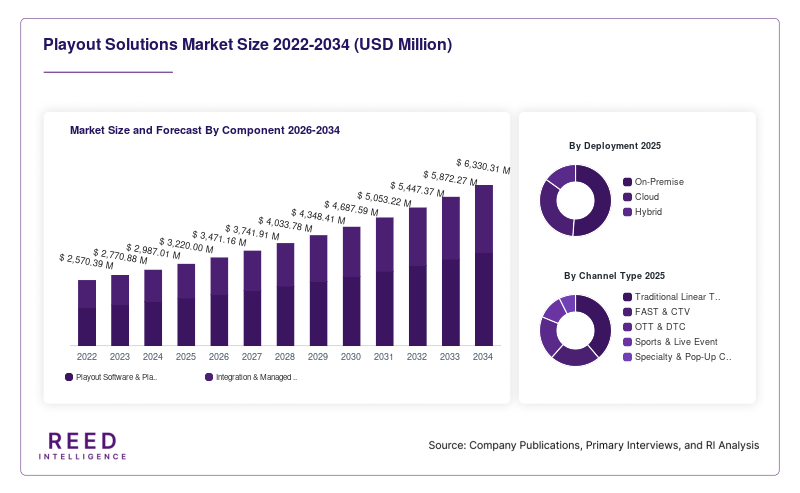
The Playout Software & Platforms segment accounts for 74% of the global market in 2026 and is projected to register a 7.60% CAGR.
Modern platforms combine scheduling, automation, channel branding, graphics, media handling, monitoring, ad signaling and multi-output delivery within software-defined environments. Imagine, Grass Valley, Evertz, Amagi, Pebble and Frequency all currently position software as the control layer for modern broadcast or streaming channel operations.
The shift toward IP and cloud infrastructure further increases the proportion of the value chain represented by software rather than fixed-purpose hardware.
Integration & Managed Services are the fastest-growing component category as migration projects require operational support
The Integration & Managed Services segment accounts for 26% of the global market in 2026 and is projected to register an 8.80% CAGR, making it the fastest-growing major component category.
Modernization projects often require system integration, cloud migration, workflow design, standards interoperability, channel launch support, disaster recovery, monitoring and managed operations.
Encompass Digital Media's Altitude Playout Plus illustrates this model by combining managed services, Media Cloud, workflow automation, Grass Valley AMPP and Playout X in a unified channel-origination service.
Deployment Analysis
On-Premise deployment remains the dominant architecture because flagship linear channels prioritize deterministic control and resilience
The On-Premise segment accounts for 46% of the global market in 2026 and is projected to register a 6.70% CAGR.
Large broadcasters continue to operate critical channels on dedicated infrastructure because of reliability, latency, control, sunk investment and the operational requirements of complex live programming.
Pebble's September 2026 Asharq deployment demonstrates continuing investment in enterprise on-premise playout. The Riyadh operation consolidated multiple channels and added sports services using redundant Pebble systems with native ST 2110, SDI and NDI support.
Cloud deployment is the fastest-growing major deployment model as channel launches shift toward SaaS and elastic infrastructure
The Cloud segment accounts for 31% of the global market in 2026 and is projected to register a 11.40% CAGR, making it the fastest-growing deployment category.
Amagi CLOUDPORT, Veset Nimbus, Grass Valley AMPP and evertz.io all demonstrate the market's movement toward cloud-native channel origination. Amagi's 2026 CLOUDPORT release emphasizes scalability across more than 100 concurrent feeds, while Veset continues to market Nimbus as a SaaS playout platform.
The model is particularly attractive for FAST, OTT, pop-up, regional and secondary channels that need to scale capacity without replicating a full broadcast facility.
Hybrid deployment remains central to staged modernization
The segment is projected to register a 8.60% CAGR.
Hybrid environments allow operators to retain on-premise resilience while using cloud infrastructure for disaster recovery, overflow, remote operations or digital-channel expansion.
Grass Valley's LNK deployment is a clear example of this model, combining on-premise primary playout with cloud-based disaster recovery during the broadcaster's ST 2110 transition.
Channel Type Analysis
Traditional Linear TV & Broadcast remains the dominant channel category because flagship services still require high-availability master control
The Traditional Linear TV & Broadcast segment accounts for 45% of the global market in 2026 and is projected to register a 6.90% CAGR.
Traditional broadcasters continue to depend on deterministic scheduling, live switching, redundancy, captions, regulatory compliance, channel branding and precise timing.
Imagine's September 2026 ELTA deployment demonstrates continued modernization of traditional playout for a major broadcaster preparing for high-volume sports coverage, while Pebble's Asharq expansion shows continued investment in resilient IP-based linear playout.
FAST & CTV is the fastest-growing channel category as content libraries are converted into continuously monetizable services
The FAST & CTV segment accounts for 23% of the global market in 2026 and is projected to register a 12.40% CAGR, making it the fastest-growing major channel category.
The growth is supported by expanding FAST channel portfolios, advertising-supported business models and the ability to transform existing content libraries into 24/7 linear services.
Amagi recorded 55% year-over-year growth in FAST viewing hours across its measured channel base in the April–June 2026 period, while Frequency reported more than 160 local FAST news channels on its platform.
OTT & DTC channels are expanding through unified linear-and-streaming distribution
The segment is projected to register a 9.00% CAGR.
OTT and DTC operators increasingly use linear channels alongside on-demand libraries to improve discovery, session duration and content monetization.
Amagi, Imagine and Evertz all support architectures that unify broadcast-style playout with streaming and DTC distribution.
Playout Solutions Market Regional Analysis
North America Playout Solutions Market
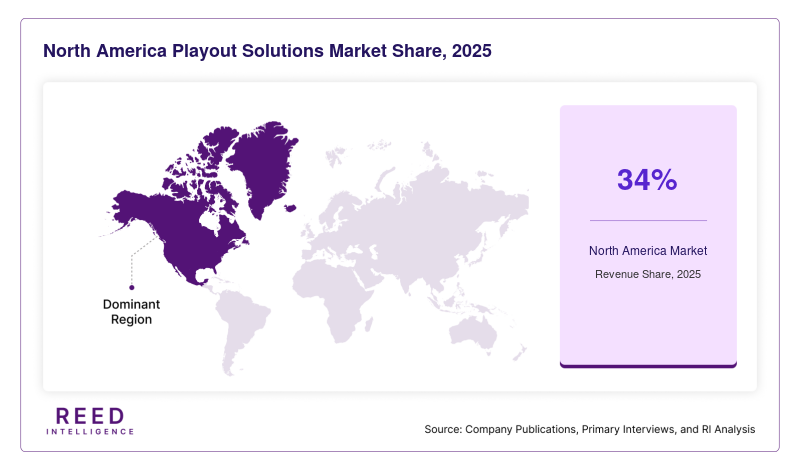
North America remains the dominant regional market because of its extensive broadcast infrastructure, mature CTV ecosystem, large FAST market and concentration of major media-technology suppliers.
The North America region accounts for 34% of the global market in 2026 and is projected to register a 7.10% CAGR.
The region is particularly important for FAST and streaming playout. Frequency reported more than 160 local news FAST channels reaching more than 70 million U.S. households in 2026, while Amagi reported that the U.S. and Canada accounted for 54% of tracked FAST viewing hours and 74% of ad impressions in its June 2026 analysis.
North America also has a dense supplier ecosystem spanning Imagine, Grass Valley, Evertz, MediaKind, Amagi and numerous specialist cloud-planning companies.
APAC Playout Solutions Market
APAC is the fastest-growing regional market as broadcasters, operators and content owners expand digital channels and modernize broadcast infrastructure.
The APAC region accounts for 27% of the global market in 2026 and is projected to register a 10.90% CAGR, making it the fastest-growing regional market.
Amagi's August 2026 partnership expansion with TV9 Network demonstrates growing use of cloud-based broadcast and CTV operations in India. The expanded engagement covers live feeds, distribution, CTV partnerships and monetization, with TV9 becoming the first Indian broadcaster to use Amagi's AdFlow Orchestrator.
Pebble's BroadcastAsia 2026 activity also emphasized hybrid IP infrastructure and regional playout deployments, while its 2026 cloud roadmap reflects growing interest in software-defined channel operations across Asia-Pacific.
Europe Playout Solutions Market
Europe is projected to register a 7.60% CAGR, supported by mature public and private broadcasters, strong IP migration activity and expanding streaming adoption.
The region is an important center for standards-based modernization. SMPTE ST 2110 is increasingly integrated into European broadcaster infrastructure, while LNK's five-network AMPP deployment demonstrates the adoption of software-defined playout combined with cloud disaster recovery.
Veset's European cloud infrastructure expansion, including Hetzner Cloud deployment options for Nimbus, also reflects the region's growing emphasis on data residency, cloud flexibility and regional infrastructure choices.
Middle East and Africa Playout Solutions Market
The Middle East and Africa market is projected to register an 8.50% CAGR, supported by expanding media portfolios, sports rights, regional content creation and investments in modern broadcast infrastructure.
Evertz expanded its Middle East playout and media-management presence in May 2026, while Pebble's Riyadh deployment consolidated multiple Asharq services and added three sports channels to support Saudi Premier League coverage.
These developments indicate a growing requirement for resilient playout systems capable of supporting news, sports, cultural programming and multiple digital outputs from regional facilities.
LATAM Playout Solutions Market
LATAM is projected to register an 8.00% CAGR, supported by sports media, pay television, regional broadcasters and increasing OTT distribution.
Imagine's May 2026 Torneos deployment demonstrates the importance of sports-focused playout in the region. The Argentine company is using Versio and ADC in a redundant multichannel environment while maintaining a migration path to UHD and ST 2110 for its DSports services.
Cloud-based playout is also increasing accessibility for regional media organizations seeking channel expansion without building large permanent infrastructure footprints.
Playout Solutions Market Competitive Landscape
The playout solutions market is characterized by competition among established broadcast infrastructure vendors, cloud-native channel platforms, automation specialists and integrated media-technology companies.
Imagine Communications provides integrated playout and channel-origination technology across broadcast, streaming, CTV, FAST, on-premise, cloud and hybrid environments. Its Versio platform and ADC automation remain important within traditional multichannel broadcast, while its XVR product line extends the company toward software-defined and AI-augmented playout.
Grass Valley competes through AMPP and Playout X, combining cloud-native and on-premise software-defined infrastructure. Its August 2026 Altitude Playout Plus deployment with Encompass shows the company's focus on channel origination across live, late-changing and complex programming.
Key Market Players
Recent Developments
September 2026 – Pebble expanded its Asharq deployment to consolidate channels in Riyadh and add three Thmanyah sports services. The operation moved Asharq's channels from Dubai to KAFD in Riyadh, added Asharq Culture and brought Thmanyah channels 1–3 onto Pebble Automation and Integrated Channel. The sports services went live on August 13, 2026, and the deployment supports native ST 2110 alongside SDI and NDI.
September 2026 – Grass Valley announced that LNK Group had moved five national television networks to AMPP. The Lithuanian broadcaster deployed Playout X and Framelight X on AMPP Local, combining on-premise software-defined playout with cloud disaster recovery while transitioning toward SMPTE ST 2110. Source: Grass Valley official press release, September 16, 2026.
Playout Solutions Market Segments
By Component
- Playout Software & Platforms
- Integration & Managed Services
By Deployment
- On-Premise
- Cloud
- Hybrid
By Channel Type
- Traditional Linear TV & Broadcast
- FAST & CTV
- OTT & DTC
- Sports & Live Event
- Specialty & Pop-Up Channels
By End User
- Broadcasters
- Content Owners & Publishers
- Pay-TV Operators & MSOs
- Sports & Live Event Organizations
- Others
By Region
- North America
- Europe
- APAC
- Middle East and Africa
- LATAM