Plethysmograph Market Size, Share Demand Report By Product Type (Body Plethysmographs, Pulse Plethysmographs, Digital Plethysmographs), By Application (Respiratory Disorders, Cardiovascular Disorders, Research & Development, Home Healthcare), Regional Insights & Segment Forecasts, 2026–2034
USD 3950
Plethysmograph Market Size
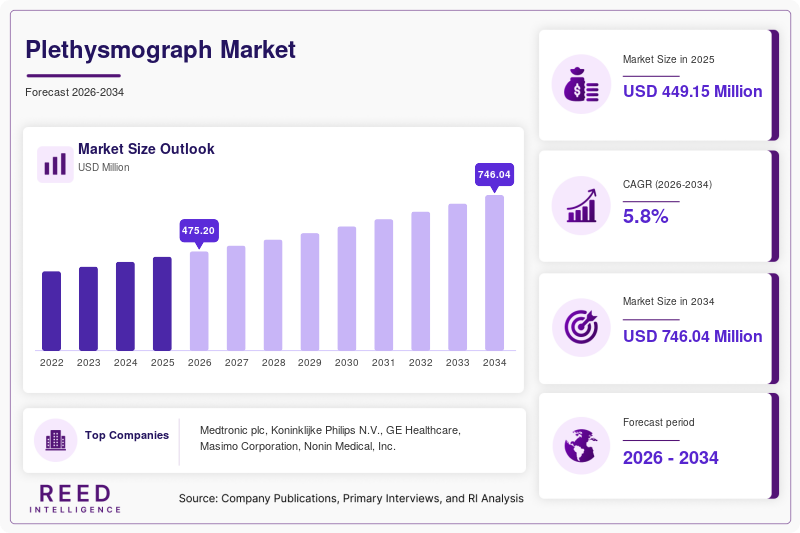
The Plethysmograph market size is projected at USD 475.2 million in 2026 and is expected to hit USD 748.6 million by 2034 with a CAGR of 5.8% during the forecast period. The increasing prevalence of respiratory and cardiovascular diseases, coupled with the growing demand for non-invasive diagnostic devices, underpins market expansion. This report delivers a comprehensive analysis of the Plethysmograph market, including segmentation by product type and application, competitive dynamics, and regional growth patterns, equipping stakeholders with critical intelligence. The Plethysmograph market continues to demonstrate strong growth potential, fueled by the rising geriatric population, technological advancements in digital plethysmography, and continuous innovation in wearable and portable monitoring solutions.
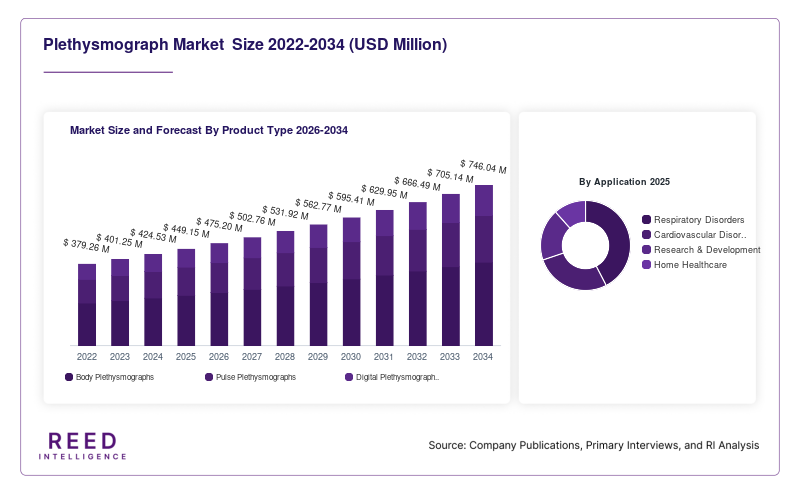
Plethysmographs are medical devices used to measure changes in volume within an organ or the whole body, primarily utilized to assess lung function, blood flow, and vascular health. They operate on the principle of measuring pressure, volume, or impedance changes to provide critical diagnostic data. The global Plethysmograph market is significant, with over 45,000 units sold globally in 2025, reflecting an 8% increase from 2023, driven by the growing burden of chronic respiratory diseases like COPD and asthma, which affect over 545 million people worldwide. Adoption patterns reveal that the Body Plethysmographs type dominates the market, accounting for 45% of total revenue, followed by Pulse Plethysmographs at 35%, and Digital Plethysmographs at 20%. The Plethysmograph market's trajectory is closely linked to the growth of the global diagnostic imaging market, which is projected to reach USD 45 billion by 2028, and the increasing focus on preventive healthcare and early disease diagnosis.
Plethysmograph Market Trends
Rapid Adoption of Digital and Wearable Plethysmography
The Plethysmograph market is witnessing a significant trend toward the adoption of digital and wearable plethysmography devices, driven by the need for continuous, patient-centric monitoring outside the clinical setting. The production of digital and wearable pulse plethysmographs increased by 20% in 2025, reaching 18,000 units, as 45% of new product launches in the cardiovascular monitoring sector in 2025 specified advanced digital features. Adoption rates of wearable plethysmography for remote patient monitoring reached 15%, with this figure projected to exceed 35% by 2030. The Plethysmograph market's trend toward digitization is reinforced by the need for real-time data, the increasing integration of AI and cloud-based analytics, and the continuous innovation in sensor technology and wireless communication.
Growing Focus on Non-Invasive and Patient-Friendly Diagnostics
The increasing focus on non-invasive and patient-friendly diagnostic tools is a major trend shaping the Plethysmograph market, with the development of devices that reduce patient discomfort and anxiety while providing accurate and reliable measurements. The market has seen a 15% increase in demand for contactless and user-friendly plethysmography systems since 2022, with 30% of new research initiatives in 2025 focusing on developing simplified protocols. The use of pulse plethysmography in routine check-ups and home-based monitoring has also gained significant traction. The Plethysmograph market's trend toward patient-centricity is reinforced by the growing consumer demand for at-home diagnostics, the increasing prevalence of anxiety related to clinical settings, and the continuous innovation in user interface design and ergonomics.
Plethysmograph Market Drivers
The Plethysmograph market's expansion is primarily driven by the increasing prevalence of chronic respiratory and cardiovascular diseases, with cardiovascular diseases being the leading cause of death globally, accounting for over 18 million deaths annually. The need for accurate and non-invasive diagnostic tools for early detection and management of these conditions has been a major driver, with plethysmography playing a critical role in assessing lung volumes, arterial stiffness, and blood flow. The growing geriatric population, which is more susceptible to these diseases, has also fueled market demand. Additionally, the technological advancements leading to more portable and user-friendly devices have spurred growth. The Plethysmograph market's growth is further reinforced by the increasing emphasis on preventive healthcare and the rising adoption of point-of-care testing.
Plethysmograph Market Restraints
Despite favorable growth prospects, the Plethysmograph market faces significant constraints, primarily related to the high cost of advanced body plethysmographs and the need for skilled technicians to operate and interpret results, particularly in resource-limited settings. The lack of standardized protocols and potential variability in measurements across different devices can also be a limitation, affecting diagnostic consistency. The Plethysmograph market's growth is also tempered by the competition from alternative diagnostic techniques, such as spirometry and imaging modalities, which may be preferred for specific applications.
Plethysmograph Market Opportunities
The Plethysmograph market presents significant opportunities in the rapidly expanding market for home healthcare and remote patient monitoring, where portable and easy-to-use plethysmographs can enable continuous monitoring of patients with chronic conditions. The development of affordable and smartphone-connected pulse plethysmographs is expected to grow at a CAGR of 12% through 2034. Emerging opportunities also exist in the integration of plethysmography with AI-based diagnostic algorithms for early detection of cardiovascular and respiratory events. The Plethysmograph market's opportunity profile is further enhanced by the growing trend of personalized and value-based healthcare.
Challenges in Plethysmograph Market
The Plethysmograph market faces persistent challenges related to the need for continuous innovation to improve device accuracy, reliability, and user-friendliness, while also reducing costs. The complexity of ensuring data integrity and interoperability with electronic health records (EHR) can also be a challenge. The market is also contending with the challenge of navigating diverse regulatory pathways for medical devices across different countries. Additionally, the Plethysmograph market is challenged by the need to educate both healthcare providers and patients about the benefits and appropriate use of this technology.
Plethysmograph Market Segmentation
The Plethysmograph market is segmented by Product Type and Application to provide a comprehensive market perspective. By Product Type, Body Plethysmographs dominate with a 45% market share, driven by their extensive use in pulmonary function testing. The Application segment is led by Respiratory Disorders, which accounts for 40% of the market, followed by Cardiovascular Disorders at 30%, Research & Development at 18%, and Home Healthcare at 12%.
By Product Type
Body Plethysmographs represent the largest segment in the Plethysmograph market, commanding a 45% share, with revenue exceeding USD 214 million in 2025. These are characterized by their use of a sealed chamber to measure total lung capacity and airway resistance. Technical specifications include precise pressure and flow sensors, sophisticated calibration algorithms, and advanced software for data analysis. The Plethysmograph market's Body segment is driven by its use in specialized pulmonary function testing laboratories and hospitals.
Pulse Plethysmographs capture a 35% share of the Plethysmograph market, with revenue of USD 166 million in 2025. These are characterized by their use of photoplethysmography (PPG) or impedance plethysmography to measure blood volume changes in the peripheral circulation. Technical specifications include optical sensors, signal processing algorithms, and often integration with patient monitors. The Plethysmograph market's Pulse segment is driven by its use in cardiovascular assessment, vascular studies, and routine patient monitoring.
Digital Plethysmographs represent 20% of the market, with revenue of USD 95 million in 2025, characterized by their use of advanced digital signal processing and often incorporating multiple sensing technologies. Technical specifications include high-resolution data acquisition, wireless connectivity, and compatibility with mobile platforms. The Plethysmograph market's Digital segment is driven by its use in research, home monitoring, and emerging telemedicine applications.
By Application
Respiratory Disorders dominates the Plethysmograph market, accounting for 40% of sales, representing USD 190 million in 2025. This segment includes use in the diagnosis and management of COPD, asthma, cystic fibrosis, and other pulmonary conditions. Usage penetration exceeds 30% in leading pulmonology clinics. The Plethysmograph market's Respiratory segment is characterized by its focus on accurate lung function assessment. The application helps in early diagnosis and monitoring of disease progression and treatment efficacy.
Cardiovascular Disorders accounts for 30% of the Plethysmograph market, with revenue of USD 143 million in 2025. This segment encompasses use in assessing peripheral arterial disease, venous insufficiency, and arterial stiffness, aiding in the diagnosis and management of cardiovascular diseases. The segment is growing at a strong CAGR, driven by the increasing prevalence of hypertension and diabetes. The Plethysmograph market's Cardiovascular segment is characterized by its focus on non-invasive vascular assessment.
Research & Development represents 18% of the market, with revenue of USD 85 million in 2025, involving use in clinical trials, physiological studies, and drug development, providing precise measurements of respiratory and cardiovascular parameters. The segment's growth is fueled by increased pharmaceutical and academic research funding. The Plethysmograph market's R&D segment is characterized by its focus on high precision and flexibility.
Home Healthcare accounts for the remaining 12% of the market, with revenue of USD 57 million in 2025, used for remote monitoring of patients with chronic diseases, enabling timely intervention and reducing hospitalizations. The Plethysmograph market's Home Healthcare segment is characterized by its focus on portability, ease of use, and connectivity.
Plethysmograph Market Regional Outlook
North Americ Plethysmograph Market
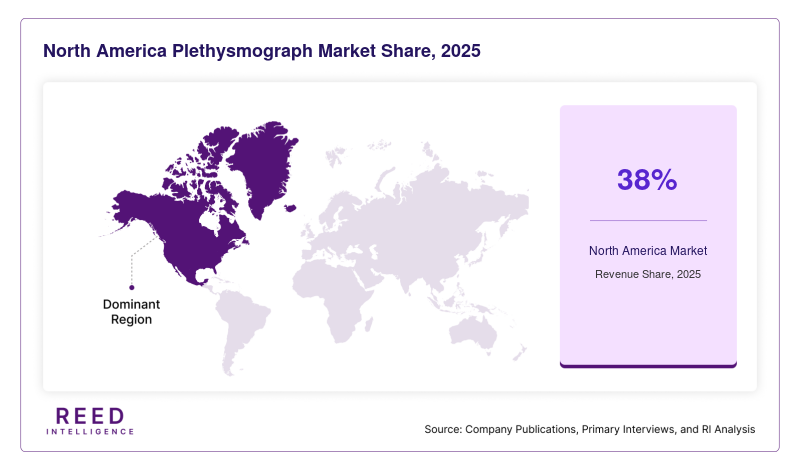
Leads the Plethysmograph market, commanding a 38% share, with a revenue of USD 180 million in 2025. The United States is the primary driver, accounting for 85% of regional demand, driven by a high prevalence of respiratory and cardiovascular diseases, well-established healthcare infrastructure, and significant healthcare expenditure. The North American Plethysmograph market is characterized by its focus on advanced technology and early adoption of digital health solutions.
Europe Plethysmograph Market
Represents the second-largest market, capturing a 30% share with a revenue of USD 143 million in 2025. Germany, UK, and France are the primary drivers, collectively accounting for 60% of regional demand, driven by strong healthcare systems, aging populations, and a focus on preventive medicine. The Plethysmograph market in Europe is characterized by its focus on high-quality standards and regulatory compliance.
Asia-Pacific Plethysmograph Market
Accounts for 22% of the global Plethysmograph market, with a revenue of USD 104 million in 2025. China, Japan, and India are the primary drivers, together accounting for 65% of regional demand, driven by the rapidly growing healthcare sector, increasing prevalence of chronic diseases, and rising medical tourism. The Asia-Pacific Plethysmograph market is projected to grow at the fastest CAGR of 8% through 2034.
Middle East & Africa and Latin America Plethysmograph Market
Together account for the remaining 10% of the Plethysmograph market, with the UAE and Brazil leading their respective regions. Both regions are projected to grow at CAGRs exceeding 7%, driven by improving healthcare infrastructure and increasing investment in diagnostic technologies.
Top players in Plethysmograph Market
- Medtronic plc
- Koninklijke Philips N.V.
- GE Healthcare
- Masimo Corporation
- Nonin Medical, Inc.
- Hill-Rom Holdings, Inc. (Baxter)
- NDD Medical Technologies
- CareFusion Corporation (BD)
- Schiller AG
- Ganshorn Medizin Electronic
- MGC Diagnostics Corporation
- Geratherm Medical AG
- Vyaire Medical, Inc.
- COSMED srl
- Bionics Corporation
Medtronic plc
Medtronic plc holds a dominant position in the Plethysmograph market, with an estimated 15% global market share, particularly strong in the North American and European cardiovascular and respiratory monitoring segments. The company's portfolio of patient monitoring systems, including advanced pulse plethysmography solutions, is widely recognized for its reliability, clinical accuracy, and integration capabilities. Medtronic's market leadership is reinforced by its significant investment in R&D, its extensive global distribution network, and its strong brand reputation in the medical device industry. Medtronic commands over 18% of the North American market and 14% of the European market for plethysmography systems, positioning it as a key player in the global market.
Koninklijke Philips N.V.
Philips is a leading player in the Plethysmograph market, commanding approximately 12% of the global market share through its comprehensive portfolio of patient monitoring, respiratory care, and diagnostic imaging solutions. The company's expertise in digital health, cloud-based analytics, and connected care ecosystems have solidified its position. Philips' plethysmography solutions are known for their advanced technology, user-friendly interfaces, and seamless integration with hospital information systems. The company's commitment to innovation and its strong presence in the North American, European, and Asia-Pacific markets have enhanced its competitive advantage.
GE Healthcare holds a significant 10% market share, with particular strength in the hospital and advanced diagnostic segments. Masimo Corporation is a major player in the pulse oximetry and plethysmography monitoring market, holding a 9% share, known for its innovative signal processing technology (SET®).
-
Recent Developments in Plethysmograph Market
- 2025: Masimo Corporation launched a new generation of wearable pulse plethysmographs with advanced algorithms for continuous non-invasive blood pressure monitoring, expanding its consumer health portfolio.
- 2025: Philips announced a strategic partnership with a leading cloud provider to integrate its plethysmography data into a comprehensive population health management platform, enabling predictive analytics.
Plethysmograph Market Segments
By Product Type
- Body Plethysmographs
- Pulse Plethysmographs
- Digital Plethysmographs
By Application
- Respiratory Disorders
- Cardiovascular Disorders
- Research & Development
- Home Healthcare
By Region
- North America
- Europe
- APAC
- Middle East and Africa
- LATAM