Pneumatic Positioner Market Size, Share Demand Report By Type (Single-Acting Pneumatic Positioners, Double-Acting Pneumatic Positioners), By Application (Control Valve Systems, Flow Control Systems, By End-Use Industry (Oil and Gas, Chemical Processing, Power Generation), By Valve Motion (Linear Valve Positioners, Rotary Valve Positioners), By Product Configuration (Analog Pneumatic Positioners), By Region & Segment Forecasts, 2026–2034
USD 3950
Market Overview
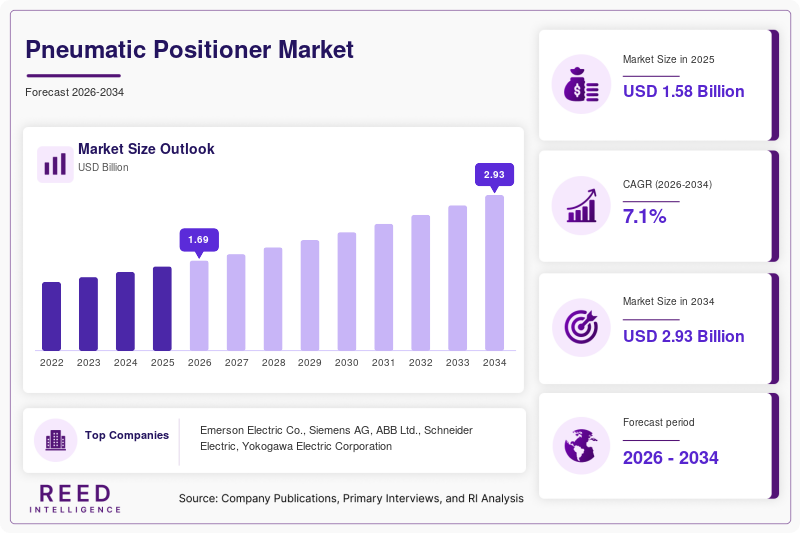
The global Pneumatic Positioner Market size was valued at USD 1.58 billion in 2026 and is projected to reach USD 2.74 billion by 2034, expanding at a CAGR of 7.1% during the forecast period (2026–2034). The market growth is being supported by rising demand for automated valve control systems across oil and gas, power generation, chemicals, water treatment, and process industries. Pneumatic positioners continue to remain critical components in industrial control loops where accurate valve positioning, process efficiency, and operational safety are required.
A major global factor supporting growth has been the increasing adoption of industrial automation in process industries. Manufacturers are integrating advanced control systems to improve operational precision, reduce downtime, and support energy-efficient plant operations. This trend has contributed to rising deployment of pneumatic positioners in both legacy systems and new industrial projects.
Key Highlights
- North America held the dominant market share of 33.6% in 2025, while Asia Pacific is projected to register the fastest CAGR of 8.3% through 2034.
- By type, single-acting pneumatic positioners accounted for 43.2% share in 2025, while smart pneumatic positioners are projected to grow at 8.8% CAGR.
- By application, control valves in process industries held 39.4% share in 2025, while power generation applications are expected to grow at 8.1% CAGR.
- By end use, oil and gas accounted for 35.7% share, while water and wastewater treatment is forecast to expand at 7.9% CAGR.
- The United States, the dominant country, recorded a market value of USD 381.5 million in 2024, rising to USD 403.8 million in 2025.
Market Trends
Smart Pneumatic Positioners with Digital Diagnostics
A major trend influencing the Pneumatic Positioner Market is the growing adoption of smart pneumatic positioners equipped with digital diagnostics. Industrial operators are increasingly deploying solutions capable of condition monitoring, valve performance analysis, and predictive maintenance support.
These systems help reduce unplanned shutdowns and improve control loop reliability. Integration with digital control platforms is supporting demand across advanced process environments.
Expansion of Retrofit Automation Projects
Another trend shaping the market is the rise in retrofit automation projects involving upgrades to existing valve control systems. Industrial facilities are modernizing aging infrastructure by replacing conventional devices with advanced pneumatic positioners.
This trend is creating demand for compact and adaptable systems compatible with existing process equipment while improving operational control performance.
Market Drivers
Increasing Automation in Process Industries
Rising automation across process industries is a major driver for the Pneumatic Positioner Market. Industries are adopting control systems that improve valve response, optimize process stability, and support production efficiency.
Pneumatic positioners remain widely used in environments where reliability and operational continuity are critical, supporting continued market demand.
Growing Demand for Precise Flow Control Systems
Increasing demand for precision flow control is another significant driver. Process industries require accurate valve positioning to maintain pressure, temperature, and flow parameters within defined operating ranges.
This requirement is supporting broader adoption of pneumatic positioners across applications requiring control accuracy and stable process performance.
Market Restraint
Maintenance Complexity in Harsh Industrial Environments
A major restraint in the Pneumatic Positioner Market is maintenance complexity in demanding industrial environments. Exposure to vibration, contamination, and variable pressure conditions can affect long-term performance and may increase maintenance requirements.
This can influence lifecycle costs and adoption decisions in some industrial settings.
Market Opportunities
Growth in Water Infrastructure Automation
An emerging opportunity lies in water infrastructure automation projects. Increasing investment in treatment facilities is creating demand for automated valve positioning systems that support process control efficiency.
This is expected to create growth opportunities for pneumatic positioner suppliers in municipal and industrial water applications.
Demand for Compact Positioners in Modular Plants
Another opportunity is rising demand for compact pneumatic positioners in modular process plants. Space-constrained and skid-mounted systems are driving interest in smaller control components designed for flexible install
Segmental Analysis
By Type
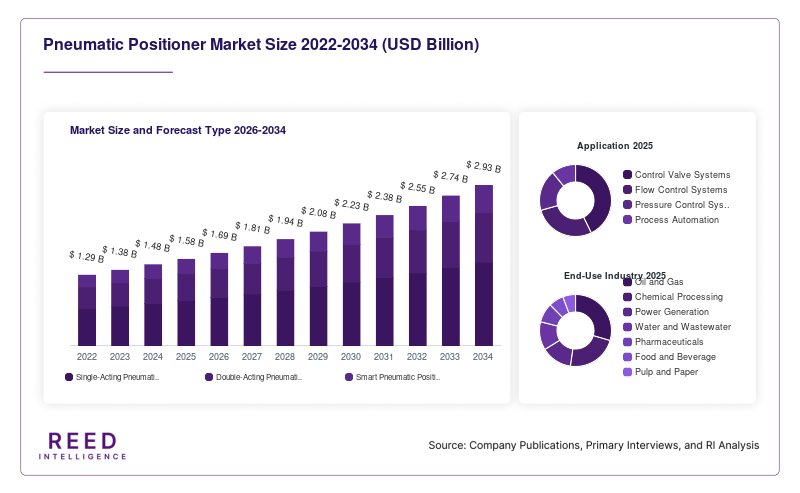
Single-Acting Pneumatic Positioners Dominated the Market: Single-acting pneumatic positioners accounted for 43.2% share in 2025 due to broad usage in standard control valve applications and established industrial adoption.
Smart Pneumatic Positioners Will Be the Fastest-Growing: Smart pneumatic positioners are projected to grow at 8.8% CAGR. Growth will be driven by rising demand for diagnostic-enabled systems and increasing use in digitally connected control environments.
By Valve Type
Linear Valve Positioners Held Leading Share: Linear valve positioners represented 46.1% share in 2025 due to widespread deployment in industrial control systems requiring stable linear motion control.
Rotary Valve Positioners Will Expand Faster: Rotary valve positioners are projected to expand at 8.2% CAGR, supported by increasing use in compact valve assemblies and specialized process applications.
By Application
Control Valves in Process Industries Dominated: Control valve applications accounted for 39.4% market share in 2025 due to broad demand for automated valve regulation systems.
Power Generation Applications Will Grow Rapidly: Power generation applications are projected to grow at 8.1% CAGR through 2034. Growth will be supported by increasing upgrades in turbine and steam control systems.
By End Use
Oil and Gas Led the Market: Oil and gas accounted for 35.7% share in 2025 due to continued demand for flow control and process regulation systems.
Water and Wastewater Treatment Will Be Fastest Growing: Water and wastewater treatment is projected to grow at 7.9% CAGR, supported by automation adoption in treatment process operations.
By Sales Channel
Direct OEM Sales Held Largest Share: Direct OEM sales represented 51.6% market share in 2025 due to high procurement volumes from industrial equipment suppliers.
Aftermarket Distribution Will Grow Faster: Aftermarket distribution is projected to expand at 7.7% CAGR as demand rises for retrofit solutions and replacement components.
Regional Analysis
North America
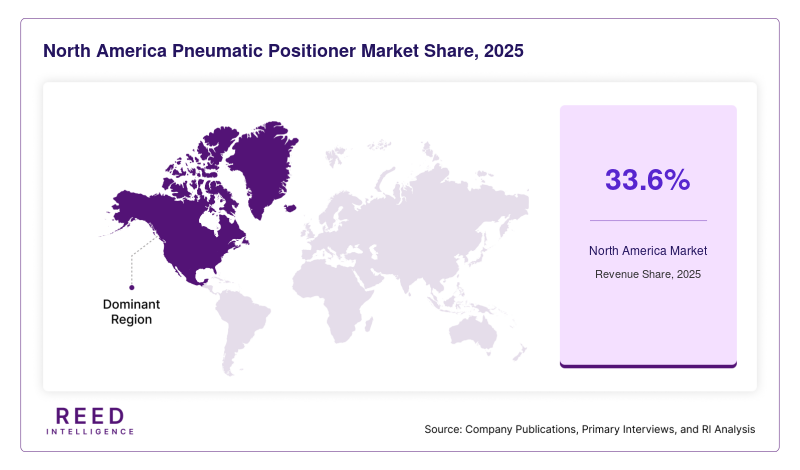
North America accounted for 33.6% of the Pneumatic Positioner Market in 2025. The region benefited from established process industries and demand for advanced valve automation systems.
The market in this region is projected to grow at 6.5% CAGR through 2034. The United States remained the dominant country, supported by increasing investment in industrial modernization and upgrades to control system infrastructure.
Europe
Europe held 28.4% market share in 2025. The region showed steady demand for pneumatic positioners across chemical processing and industrial automation applications.
The regional market is forecast to expand at 6.8% CAGR. Germany led the regional market due to growth in industrial automation engineering and adoption of advanced process control technologies.
Asia Pacific
Asia Pacific captured 24.8% share in 2025. The region showed rising demand from manufacturing and energy-related industries.
The market in Asia Pacific is expected to grow at 8.3% CAGR, making it the fastest-growing region. China is projected to remain dominant due to industrial expansion and increasing deployment of valve automation systems in process facilities.
Middle East & Africa
Middle East & Africa represented 7.4% of the global market in 2025. Demand was supported by investments in process industries and energy infrastructure.
The market is projected to register 6.2% CAGR through 2034. Saudi Arabia is expected to lead growth due to industrial development projects and increasing demand for automated flow control systems.
Latin America
Latin America accounted for 5.8% share in 2025. The region showed stable demand from industrial processing applications.
The market is forecast to expand at 6.1% CAGR over the forecast period. Brazil is expected to remain the dominant country due to growth in industrial operations and investment in plant automation technologies.
Competitive Landscape
The Pneumatic Positioner Market remains moderately consolidated, with established automation companies and valve control specialists competing through product performance, digital integration, and application-specific engineering. Market participants are focused on improving response accuracy, expanding smart positioner capabilities, and supporting retrofit demand.
Emerson Electric Co. maintained a leading market position through its broad control valve and positioner portfolio. A recent development involved expanded smart pneumatic positioner solutions designed to improve valve diagnostics and predictive maintenance capabilities.
Siemens AG, ABB Ltd., Flowserve Corporation, and Yokogawa Electric Corporation continued strengthening market presence through automation-focused product development and industrial partnerships. Competition is increasingly centered on compact product design, digital diagnostics, and improved compatibility with advanced control architectures.
Key Players List
- Emerson Electric Co.
- Siemens AG
- ABB Ltd.
- Flowserve Corporation
- Yokogawa Electric Corporation
- SAMSON AG
- Baker Hughes Company
- Rotork plc
- Azbil Corporation
- Metso Corporation
- Schneider Electric SE
- Spirax Group plc
- Bürkert Fluid Control Systems
- GEMÜ Group
- Neles Corporation
Recent Developments
- In 2025, manufacturers introduced advanced smart pneumatic positioners with expanded digital diagnostics and monitoring functions.
- Suppliers increased investments in compact pneumatic positioners designed for modular and skid-mounted process systems.
- Product launches focused on improved compatibility between pneumatic positioners and digital control architectures.
- Companies expanded retrofit-oriented solutions targeting upgrades of aging valve automation systems.
- Industrial automation firms strengthened partnerships to develop integrated control valve positioning platforms.
- Manufacturers increased production investments in Asia Pacific to support growing regional demand.
- Research initiatives focused on improving positioner durability in demanding industrial operating conditions.
Pneumatic Positioner Market Segments
Type
- Single-Acting Pneumatic Positioners
- Double-Acting Pneumatic Positioners
- Smart Pneumatic Positioners
Application
- Control Valve Systems
- Flow Control Systems
- Pressure Control Systems
- Process Automation
End-Use Industry
- Oil and Gas
- Chemical Processing
- Power Generation
- Water and Wastewater
- Pharmaceuticals
- Food and Beverage
- Pulp and Paper
Valve Motion
- Linear Valve Positioners
- Rotary Valve Positioners
Product Configuration
- Analog Pneumatic Positioners
- Digital Pneumatic Positioners
By Region
- North America
- Europe
- APAC
- Middle East and Africa
- LATAM