Pneumatic Tourniquet Market Size, Share, Demand Report By Product Type (Single-Cuff Pneumatic Tourniquets, Dual-Cuff Pneumatic Tourniquets), By Application (Orthopedic Surgery, Trauma & Emergency Care, Plastic & Reconstructive Surgery, Others), By End-Use (Hospitals, Ambulatory Surgical Centers, Specialty Clinics) – Global Industry Forecast, 2026–2034
USD 3950
Market Overview
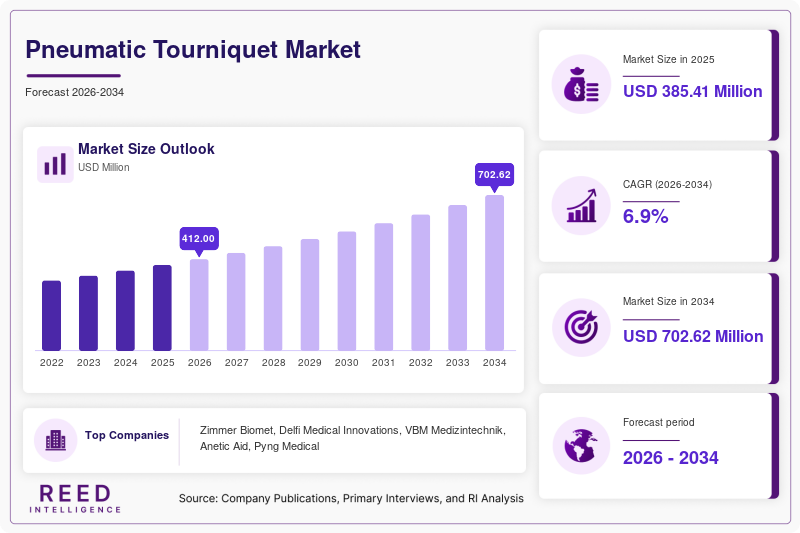
The Pneumatic Tourniquet Market size is estimated at approximately USD 412 million, and it is expected to reach nearly USD 712 million by 2034, growing at a CAGR of 6.9% during the forecast period. The demand for pneumatic tourniquets is closely linked to orthopedic, trauma, and reconstructive surgeries, where controlled blood flow significantly enhances surgical precision and patient outcomes.
A key global factor supporting market growth is the continuous expansion of healthcare infrastructure, particularly in emerging economies. Hospitals are increasingly investing in advanced surgical systems that ensure patient safety and procedural efficiency. Additionally, rising geriatric populations and sports-related injuries have contributed to higher surgical volumes, thereby boosting the adoption of pneumatic tourniquet systems across ambulatory surgical centers and hospitals.
Key Highlights
- North America dominated the market with a 34.2% share in 2025.
- Asia Pacific is expected to grow at the fastest CAGR of 11.2% during 2026–2034.
- By product type, single-cuff pneumatic tourniquets accounted for the largest share of 38.5%.
- while dual-cuff systems are projected to grow at a CAGR of 10.8%.
- By application, orthopedic surgeries led with a 41.7% share, whereas emergency trauma care is expected to expand at a CAGR of 11.5%.
- The United States remained the dominant country, with market values of USD 510 million in 2024 and USD 560 million in 2025.
Market Trends
Integration of Digital Pressure Monitoring Systems
One of the most significant trends shaping the Pneumatic Tourniquet Market is the integration of digital pressure monitoring and automated control systems. Modern pneumatic tourniquets are increasingly equipped with microprocessor-based controls that allow precise regulation of cuff pressure, minimizing the risk of complications such as nerve compression injuries. These systems also include real-time alerts and data logging capabilities, enabling surgical teams to track pressure variations throughout procedures. Hospitals are adopting these smart systems to improve surgical outcomes and ensure compliance with patient safety standards. The shift toward digitalization aligns with broader trends in operating room automation and smart surgical equipment adoption across advanced healthcare facilities globally.
Growing Adoption in Ambulatory Surgical Centers
Another important trend is the rising use of pneumatic tourniquet systems in ambulatory surgical centers (ASCs). ASCs are gaining popularity due to their cost efficiency and shorter patient recovery times compared to traditional hospital settings. As outpatient orthopedic and sports injury procedures increase, the demand for compact and portable tourniquet systems has grown significantly. Manufacturers are developing lightweight, battery-operated devices that are easier to deploy in small surgical environments. This trend is especially strong in urban healthcare systems where outpatient procedures are becoming the preferred choice for minor and medium-complexity surgeries.
Market Drivers
Rising Volume of Orthopedic and Trauma Surgeries
The increasing incidence of orthopedic conditions such as fractures, ligament injuries, and degenerative joint disorders is a major driver for the Pneumatic Tourniquet Market. Sports injuries and road accidents further contribute to the growing surgical volume globally. Pneumatic tourniquets are essential in these procedures as they provide a bloodless surgical field, improving visibility and precision for surgeons. Aging populations in developed regions also experience higher rates of musculoskeletal disorders, increasing demand for joint replacement and reconstructive surgeries. This consistent rise in surgical interventions directly supports market expansion across hospitals and specialty clinics.
Technological Advancements in Surgical Equipment
Continuous innovation in surgical devices is another strong growth driver. Manufacturers are introducing advanced pneumatic tourniquets with features such as dual-cuff systems, automatic pressure calibration, and integrated safety mechanisms. These advancements reduce the risk of complications and improve operational efficiency in operating rooms. Additionally, wireless connectivity and integration with hospital information systems allow better monitoring and documentation. The increasing focus on patient safety standards and regulatory compliance is encouraging healthcare providers to upgrade to modern tourniquet systems, thereby accelerating market growth.
Market Restraint
Risk of Clinical Complications and Usage Limitations
Despite their widespread adoption, pneumatic tourniquet systems present certain clinical risks that act as a restraint on market growth. Improper usage or excessive pressure application can lead to complications such as nerve injury, muscle damage, and post-operative pain. In some cases, prolonged use during complex surgeries increases the likelihood of ischemic damage. These risks require highly trained surgical staff and strict adherence to guidelines, limiting adoption in smaller or under-resourced healthcare facilities. Additionally, concerns over patient safety may slow down procurement in cost-sensitive regions, where alternative blood control techniques are sometimes preferred. This creates a barrier to full market penetration, particularly in developing healthcare systems.
Market Opportunities
Expansion in Emerging Healthcare Markets
Emerging economies in Asia Pacific, Latin America, and parts of Africa present significant opportunities for the Pneumatic Tourniquet Market. Rapid improvements in healthcare infrastructure, rising government investments, and increasing access to surgical care are driving demand for advanced medical devices. Hospitals in these regions are gradually upgrading their operating rooms with modern surgical equipment. Additionally, growing medical tourism in countries such as India, Thailand, and Mexico is boosting the number of elective surgeries performed annually. This creates a strong demand base for cost-effective and durable pneumatic tourniquet systems, offering manufacturers substantial growth potential.
Development of Portable and Battery-Operated Devices
Another key opportunity lies in the development of portable, battery-operated pneumatic tourniquets. These devices are particularly useful in emergency care, military medicine, and remote healthcare settings where access to stable power sources may be limited. Manufacturers are focusing on compact designs with extended battery life and enhanced durability. The growing demand for field-ready surgical equipment in disaster response and battlefield medical care further supports this trend. As healthcare delivery expands beyond traditional hospital environments, portable tourniquet systems are expected to gain significant traction.
Segmental Analysis
Product Type Segment
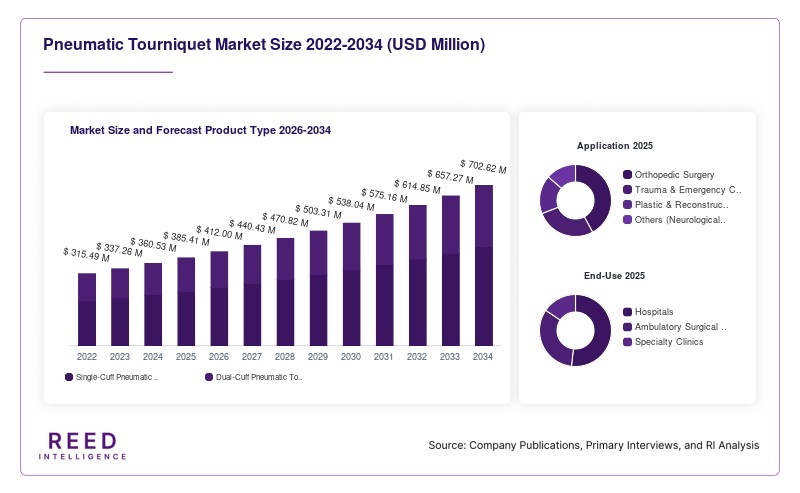
The product type segment of the Pneumatic Tourniquet Market is primarily divided into single-cuff and dual-cuff systems. Single-cuff tourniquets accounted for approximately 38.5% of the market share in 2025 due to their widespread use in standard orthopedic and minor surgical procedures. Their cost-effectiveness and ease of use make them the preferred choice in general hospital settings and outpatient centers. These systems continue to dominate in terms of installation base across both developed and developing healthcare markets.
Dual-cuff systems represent the fastest-growing subsegment, projected to expand at a CAGR of nearly 10.8% during the forecast period. These systems provide enhanced safety by allowing controlled pressure distribution, reducing the risk of nerve damage. Their adoption is increasing in complex surgical procedures such as total joint replacements and trauma surgeries, where precision and patient safety are critical factors.
Application Segment
Orthopedic surgeries represent the dominant application segment, accounting for approximately 41.7% of the total market share in 2025. The high prevalence of bone-related injuries, arthritis, and sports trauma significantly drives demand for pneumatic tourniquets in this segment. Hospitals frequently rely on these systems to maintain a clear surgical field during procedures involving limbs.
Emergency trauma care is emerging as the fastest-growing application segment, with a projected CAGR of around 11.5%. The rising number of road accidents, natural disasters, and battlefield injuries has increased the need for rapid blood control solutions. Portable tourniquet systems are increasingly used in emergency settings due to their quick deployment and effectiveness.
End-Use Segment
Hospitals accounted for the largest share of the Pneumatic Tourniquet Market, with approximately 52% share in 2025. Their dominance is attributed to high surgical volumes, availability of skilled professionals, and advanced infrastructure. Hospitals remain the primary centers for complex surgical procedures requiring reliable tourniquet systems.
Ambulatory surgical centers represent the fastest-growing end-use segment, expected to grow at a CAGR of approximately 10.2%. Their expansion is driven by cost-efficient surgical care models and increasing preference for outpatient procedures. ASCs are increasingly adopting compact pneumatic tourniquet systems suitable for short-duration surgeries.
Regional Analysis
North America
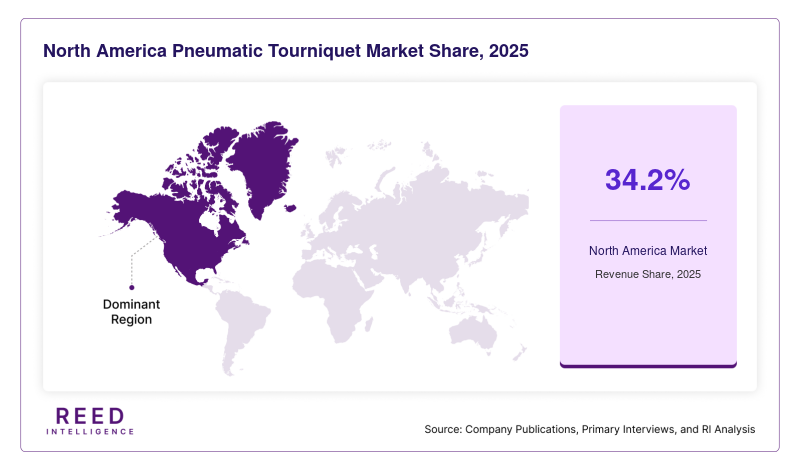
North America accounted for approximately 34.2% share of the Pneumatic Tourniquet Market in 2025 and is expected to maintain steady growth through 2034. The region benefits from advanced healthcare infrastructure, high surgical volumes, and early adoption of innovative medical devices. Growth is projected at a stable CAGR of around 6.5% during the forecast period.
The United States dominates the regional market due to its large number of orthopedic surgeries and strong presence of leading medical device manufacturers. Increased investment in ambulatory surgical centers and stringent patient safety regulations further support the adoption of advanced pneumatic tourniquet systems across hospitals and specialty clinics.
Europe
Europe holds a significant share of the global market, driven by well-established healthcare systems and increasing demand for minimally invasive surgical procedures. The region is expected to maintain moderate growth with a CAGR of approximately 6.2% through 2034.
Germany leads the European market due to its strong medical device manufacturing base and high surgical procedure rates. The country’s focus on healthcare modernization and adoption of digital operating room technologies contributes to sustained demand for advanced tourniquet systems.
Asia Pacific
Asia Pacific is the fastest-growing regional market, expected to register a CAGR of around 11.2% during the forecast period. The region is witnessing rapid healthcare infrastructure development and increasing surgical volumes.
China dominates the regional landscape due to large patient populations and expanding hospital networks. Rising investments in public healthcare systems and growing awareness of advanced surgical techniques are key factors driving market expansion in the country.
Middle East & Africa
The Middle East & Africa region is experiencing gradual growth in the Pneumatic Tourniquet Market, supported by improving healthcare infrastructure and increasing surgical capabilities. The region is projected to grow at a CAGR of approximately 7.1%.
Saudi Arabia leads the regional market, driven by government healthcare modernization programs and rising investment in advanced surgical equipment across tertiary hospitals and specialty clinics.
Latin America
Latin America holds a smaller yet steadily growing share of the global market, with a projected CAGR of around 7.4% through 2034. Growth is supported by increasing access to surgical care and gradual expansion of private healthcare facilities.
Brazil is the dominant country in the region, benefiting from a large population base, expanding hospital infrastructure, and increasing adoption of advanced orthopedic surgical procedures.
Competitive Landscape
The Pneumatic Tourniquet Market is moderately consolidated, with several global and regional players competing through product innovation and strategic partnerships. Key companies include Zimmer Biomet, Delfi Medical Innovations, VBM Medizintechnik, Anetic Aid, and Pyng Medical. These companies focus on improving device safety, portability, and integration with digital surgical systems.
Zimmer Biomet remains a prominent player, offering advanced tourniquet systems widely used in orthopedic surgeries. A recent development includes the enhancement of its smart pressure control technology to improve surgical safety and efficiency across hospital networks.
Key Players List
- Zimmer Biomet
- Delfi Medical Innovations
- VBM Medizintechnik
- Anetic Aid
- Pyng Medical
- Rudolf Riester GmbH
- Ulrich Medical
- Hammarplast Medical
- Hokanson Inc.
- D. E. Hokanson
- Smith & Nephew
- Stryker Corporation
- Medline Industries
- Becton Dickinson
- Cardinal Health
Recent Developments
- Introduction of AI-enabled pressure monitoring systems in pneumatic tourniquets to enhance surgical precision and reduce complications.
- Expansion of portable tourniquet product lines designed for military and emergency medical applications in remote environments.
- Strategic collaborations between medical device manufacturers and hospital networks to integrate smart surgical equipment into operating rooms.
Pneumatic Tourniquet Market Segments
Product Type
- Single-Cuff Pneumatic Tourniquets
- Dual-Cuff Pneumatic Tourniquets
Application
- Orthopedic Surgery
- Trauma & Emergency Care
- Plastic & Reconstructive Surgery
- Others (Neurological & Vascular Procedures)
End-Use
- Hospitals
- Ambulatory Surgical Centers
- Specialty Clinics
By Region
- North America
- Europe
- APAC
- Middle East and Africa
- LATAM