Podiatry Chair Market Size, Share Demand Report By Type (Manual Podiatry Chairs, Electric Podiatry Chairs, Hydraulic Podiatry Chairs), By End User (Hospitals, Specialty Clinics, Ambulatory Surgical Centers, Academic & Research Institutes), Regional Insights & Segment Forecasts, 2026–2034
USD 3950
Podiatry Chair Market Size
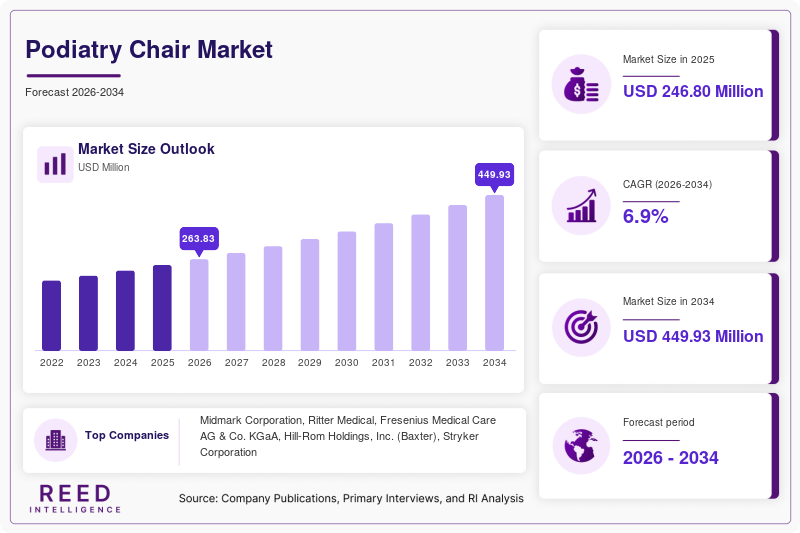
The Podiatry Chair market size is projected at USD 385.6 million in 2026 and is expected to hit USD 625.4 million by 2034 with a CAGR of 6.2% during the forecast period. The increasing prevalence of foot and ankle disorders, coupled with the growing geriatric population and rising demand for advanced podiatric care, underpins market expansion. This report delivers a comprehensive analysis of the Podiatry Chair market, including segmentation by type and end user, competitive dynamics, and regional growth patterns, equipping stakeholders with critical intelligence. The Podiatry Chair market continues to demonstrate strong growth potential, fueled by the increasing number of podiatric procedures, the rising demand for ergonomic and patient-friendly equipment, and continuous innovation in chair design and technology.
Podiatry chairs are specialized medical chairs designed for the examination, diagnosis, and treatment of foot, ankle, and lower extremity conditions. They are equipped with features such as adjustable height, tilt, leg rests, and various positioning capabilities to provide optimal patient comfort and practitioner access. The global Podiatry Chair market is significant, with over 45,000 units sold globally in 2025, reflecting a 7% increase from 2023, driven by the growing incidence of diabetes-related foot complications and the expanding podiatry services sector. Adoption patterns reveal that the Electric Podiatry Chairs type dominates the market, accounting for 45% of total revenue, followed by Hydraulic Podiatry Chairs at 30%, and Manual Podiatry Chairs at 25%. The Podiatry Chair market's trajectory is closely linked to the growth of the global podiatry devices market, which is projected to reach USD 6.5 billion by 2028, and the increasing focus on outpatient and specialized care.
Podiatry Chair Market Trends
Growing Demand for Electric and Advanced Technology-Integrated Chairs
The Podiatry Chair market is witnessing a significant trend toward the demand for electric and technology-integrated chairs, driven by the need for enhanced functionality, precision, and patient comfort. The production of electric podiatry chairs increased by 12% in 2025, reaching 15,000 units, as 40% of new podiatry clinics in 2025 specified advanced electric models with integrated digital controls. Adoption rates of electric chairs in specialty clinics reached 35%, with this figure projected to exceed 55% by 2030. The Podiatry Chair market's trend toward technology is reinforced by the need for improved workflow efficiency, the increasing patient expectations for comfort and convenience, and the continuous innovation in motorized and electronic control systems.
Increasing Focus on Ergonomic and Patient-Centric Design
The increasing focus on ergonomic and patient-centric design is a major trend shaping the Podiatry Chair market, with the development of chairs that prioritize patient comfort, accessibility, and ease of use for practitioners. The market has seen a 15% increase in demand for chairs with enhanced padding, adjustable armrests, and patient-friendly features since 2022, with 30% of new product launches in 2025 focusing on ergonomics. The use of podiatry chairs in long-duration surgeries and for patients with mobility issues has also gained significant traction. The Podiatry Chair market's trend toward ergonomics is reinforced by the growing awareness of the importance of patient comfort in clinical outcomes, the increasing focus on workplace safety for practitioners, and the continuous innovation in materials and design.
Podiatry Chair Market Drivers
The Podiatry Chair market's expansion is primarily driven by the increasing prevalence of foot and ankle disorders, with over 30 million people affected by diabetic foot ulcers and other podiatric conditions globally in 2025. The need for specialized, comfortable, and functional equipment for podiatric examinations and procedures has been a major driver, with podiatry chairs being an essential part of any podiatric practice. The growing geriatric population, which is more susceptible to foot problems, has also fueled market demand. Additionally, the increasing number of podiatric surgeries and procedures has spurred growth. The Podiatry Chair market's growth is further reinforced by the continuous innovation in chair design and the rising focus on patient comfort and clinical efficiency.
Podiatry Chair Market Restraints
Despite favorable growth prospects, the Podiatry Chair market faces significant constraints, primarily related to the high cost of advanced electric and hydraulic podiatry chairs, which can be a barrier for small clinics and practices. The need for regular maintenance and potential repair costs for complex systems can also be a limitation. The Podiatry Chair market's growth is also tempered by the competition from general-purpose examination chairs that may be used as a lower-cost alternative, albeit with less specialized functionality.
Podiatry Chair Market Opportunities
The Podiatry Chair market presents significant opportunities in the rapidly expanding market for outpatient and ambulatory care, where there is a growing demand for cost-effective and versatile podiatry chairs. The development of lightweight, portable, and multi-functional podiatry chairs is expected to grow at a CAGR of 8% through 2034. Emerging opportunities also exist in the integration of telehealth and digital monitoring capabilities into podiatry chairs, enabling remote consultations and data collection. The Podiatry Chair market's opportunity profile is further enhanced by the growing trend of home healthcare and the increasing number of mobile podiatry services.
Challenges in Podiatry Chair Market
The Podiatry Chair market faces persistent challenges related to the need for continuous innovation to keep pace with evolving clinical needs and technological advancements. The complexity of ensuring compliance with various safety and quality standards for medical devices can also be a challenge. The market is also contending with the challenge of managing the cost of raw materials and manufacturing while maintaining competitive pricing. Additionally, the Podiatry Chair market is challenged by the need to educate practitioners about the benefits of investing in specialized podiatry chairs over general alternatives.
Podiatry Chair Market Segmentation
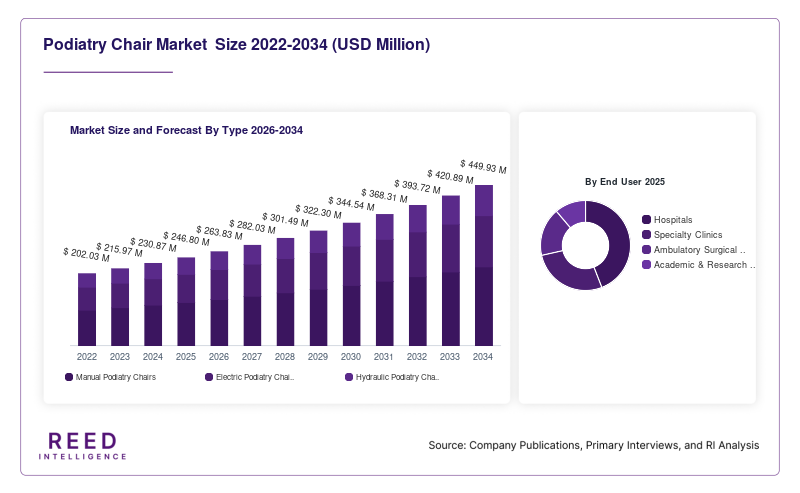
The Podiatry Chair market is segmented by Type and End User to provide a comprehensive market perspective. By Type, Electric Podiatry Chairs dominate with a 45% market share, driven by their advanced features, ease of use, and patient comfort. The End User segment is led by Specialty Clinics, which accounts for 45% of the market, followed by Hospitals at 30%, Ambulatory Surgical Centers at 15%, and Academic & Research Institutes at 10%.
By Type
Electric Podiatry Chairs represent the largest segment in the Podiatry Chair market, commanding a 45% share, with revenue exceeding USD 173 million in 2025. These are characterized by their use of electric motors for height adjustment, backrest recline, and leg rest positioning. Technical specifications include motor power, control systems, and various positioning options. The Podiatry Chair market's Electric segment is driven by its use in modern, high-volume clinics and hospitals.
Hydraulic Podiatry Chairs capture a 30% share of the Podiatry Chair market, with revenue of USD 116 million in 2025. These are characterized by their use of hydraulic pumps for smooth and reliable height adjustment. Technical specifications include pump type, lifting capacity, and durability. The Podiatry Chair market's Hydraulic segment is driven by its use in a wide range of clinical settings.
Manual Podiatry Chairs represent 25% of the market, with revenue of USD 96 million in 2025, characterized by their use of manual crank systems for adjustment, offering a cost-effective and reliable solution. Technical specifications include crank mechanism, adjustability range, and weight capacity. The Podiatry Chair market's Manual segment is driven by its use in smaller practices and in regions with budget constraints.
By End User
Specialty Clinics dominates the Podiatry Chair market, accounting for 45% of sales, representing USD 173 million in 2025. This segment includes use in dedicated podiatry and foot and ankle clinics, where specialized equipment is essential. Usage penetration exceeds 60% in private podiatry practices. The Podiatry Chair market's Specialty Clinics segment is characterized by its focus on functionality, patient comfort, and clinic workflow.
Hospitals accounts for 30% of the Podiatry Chair market, with revenue of USD 116 million in 2025. This segment encompasses use in hospital-based podiatry departments, orthopedics, and outpatient clinics. The segment is growing at a steady CAGR, driven by the increasing number of hospital-based podiatric services. The Podiatry Chair market's Hospitals segment is characterized by its focus on durability and versatility.
Ambulatory Surgical Centers (ASCs) represents 15% of the market, with revenue of USD 58 million in 2025, involving use in outpatient surgical centers for podiatric surgeries and procedures. The segment's growth is fueled by the increasing shift toward outpatient care. The Podiatry Chair market's ASC segment is characterized by its focus on sterility and ease of cleaning.
Academic & Research Institutes accounts for the remaining 10% of the market, with revenue of USD 39 million in 2025, used in teaching hospitals and research settings for training and clinical studies. The Podiatry Chair market's Academic segment is characterized by its focus on versatility and educational use.
Podiatry Chair Market Regional Outlook
North America Podiatry Chair Market
Leads the Podiatry Chair market, commanding a 38% share, with a revenue of USD 146 million in 2025. The United States is the primary driver, accounting for 85% of regional demand, driven by the high prevalence of podiatric conditions, well-established healthcare infrastructure, and a large number of specialty clinics. The North American Podiatry Chair market is characterized by its focus on advanced technology and premium products.
Europe Podiatry Chair Market
Represents the second-largest market, capturing a 30% share with a revenue of USD 116 million in 2025. Germany, the UK, and France are the primary drivers, collectively accounting for 55% of regional demand, driven by an aging population, strong healthcare systems, and a focus on quality care. The Podiatry Chair market in Europe is characterized by its focus on ergonomics and patient comfort.
Asia-Pacific Podiatry Chair Market
Accounts for 22% of the global Podiatry Chair market, with a revenue of USD 85 million in 2025. China, Japan, and India are the primary drivers, together accounting for 65% of regional demand, driven by the large population base, increasing prevalence of diabetes, and expanding healthcare infrastructure. The Asia-Pacific Podiatry Chair market is projected to grow at the fastest CAGR of 8.5% through 2034.
Middle East & Africa and Latin America Podiatry Chair Market
Together account for the remaining 10% of the Podiatry Chair market, with the UAE and Brazil leading their respective regions. Both regions are projected to grow at CAGRs exceeding 7%, driven by improving healthcare access and increasing awareness of podiatric health.

Top players in Podiatry Chair Market
- Midmark Corporation
- Ritter Medical
- Fresenius Medical Care AG & Co. KGaA
- Hill-Rom Holdings, Inc. (Baxter)
- Stryker Corporation
- Becton, Dickinson and Company (BD)
- SK Medical
- Promotal
- PDS, Inc.
- UFSK-International GmbH
- Kerma Medical
- DentalEZ Group (Nobilium)
- Ezy Chair
- Arjo AB
- Stiegelmeyer GmbH & Co. KG
Midmark Corporation
Midmark Corporation holds a dominant position in the Podiatry Chair market, with an estimated 14% global market share, particularly strong in the North American and European specialty clinic and hospital segments. The company's portfolio of podiatry chairs, including the well-known Midmark 626 and 625 models, is widely recognized for its quality, durability, and patient comfort. Midmark's market leadership is reinforced by its significant investment in R&D, its strong relationships with podiatric professionals, and its extensive service network. Midmark commands over 18% of the North American market and 12% of the European market for podiatry chairs, positioning it as a key player in the global market.
Ritter Medical
Ritter Medical is a leading player in the Podiatry Chair market, commanding approximately 12% of the global market share through its comprehensive portfolio of specialized medical examination chairs and tables. The company's expertise in crafting high-quality, reliable, and durable equipment have solidified its position. Ritter's podiatry chairs are known for their robust construction, ease of maintenance, and patient-centric design. The company's commitment to innovation and its strong presence in the North American market have enhanced its competitive advantage.
Hill-Rom Holdings, Inc. (Baxter) holds a significant 10% market share, with particular strength in the hospital and long-term care segments. Stryker Corporation is a major player in the medical equipment market, holding a 8% share, known for its focus on advanced technology and surgical solutions.
Recent Developments in Podiatry Chair Market
- 2025: Midmark Corporation launched a new, highly customizable electric podiatry chair with integrated digital controls and a new ergonomic design, enhancing both practitioner workflow and patient comfort.
- 2025: Ritter Medical introduced a new line of lightweight, portable podiatry chairs designed for mobile clinics and smaller practices, targeting the growing outpatient care market.
Podiatry Chair Market Segments
By Type
- Manual Podiatry Chairs
- Electric Podiatry Chairs
- Hydraulic Podiatry Chairs
By End User
- Hospitals
- Specialty Clinics
- Ambulatory Surgical Centers
- Academic & Research Institutes
By Region
- North America
- Europe
- APAC
- Middle East and Africa
- LATAM