Podiatry Lasers Market Size, Share Demand Report By Equipment Type (Diode Lasers, Nd:YAG Lasers, CO₂ Lasers), By Application (Fungal Nail Treatment, Pain Therapy, Wart Removal, Others), By End-Use (Hospitals, Specialty Clinics, Ambulatory Surgical Centers) By Region & Segment Forecasts, 2026–2034
USD 3950
Market Overview
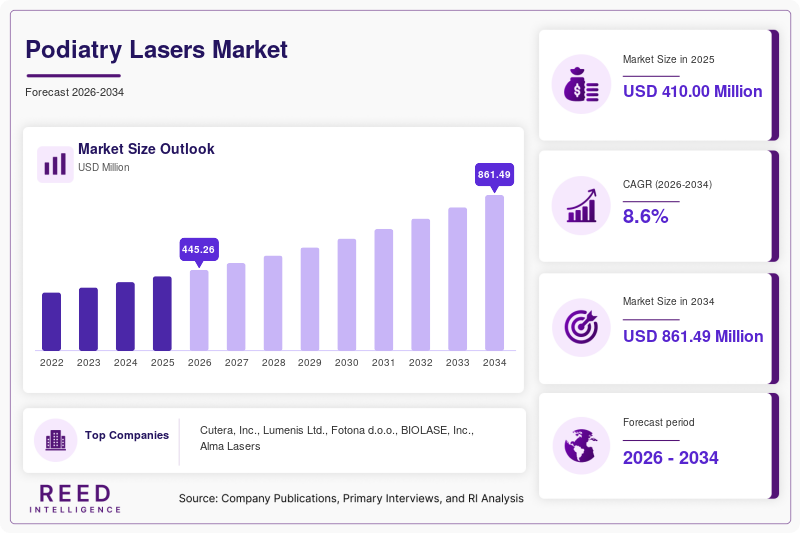
The Podiatry Lasers Market size was valued at approximately USD 410 million in 2026 and is projected to reach USD 790 million by 2034, expanding at a CAGR of 8.6% during the forecast period (2026–2034). The market is experiencing consistent growth due to increasing prevalence of foot-related disorders such as fungal nail infections, plantar warts, and diabetic foot complications. A significant global factor supporting market expansion is the growing aging population, which is more susceptible to chronic podiatric conditions requiring minimally invasive treatments. Laser-based podiatry solutions are increasingly preferred due to their precision, reduced recovery time, and lower risk of complications compared to traditional surgical approaches.
Technological advancements in laser systems, including diode lasers and CO₂ lasers, are improving treatment efficiency and safety. In addition, rising awareness among patients about non-invasive procedures and increasing adoption of outpatient care settings are strengthening market demand. Healthcare providers are also integrating advanced laser technologies into routine podiatric care, driven by favorable reimbursement scenarios in developed regions.
Key Highlights
- North America dominated the market with a 35.1% share in 2025.
- Asia Pacific is expected to grow at the fastest CAGR of 9.8% during 2026–2034.
- By equipment type, diode lasers accounted for the largest share of 42.3%.
- while Nd:YAG lasers are projected to grow at a CAGR of 9.5%.
- By application, fungal nail treatment led with a 46.7% share, whereas pain therapy is expected to expand at a CAGR of 9.2%.
- The United States remained the dominant country, with market values of USD 185 million in 2024 and USD 205 million in 2025.
Market Trends
Rising adoption of minimally invasive podiatric treatments
The shift toward minimally invasive procedures is becoming a defining trend in the Podiatry Lasers Market. Patients increasingly prefer treatments that reduce pain, minimize downtime, and avoid complications associated with conventional surgical techniques. Laser therapy offers targeted treatment with limited damage to surrounding tissues, making it suitable for a wide range of podiatric conditions. Clinics and ambulatory care centers are expanding their service portfolios to include laser-based treatments, driven by patient demand and improved clinical outcomes. This trend is further supported by technological innovations that enhance precision, reduce procedure time, and improve patient comfort, making laser treatments more accessible and widely accepted across healthcare systems.
Integration of advanced laser technologies with digital diagnostics
Another emerging trend is the integration of laser systems with advanced diagnostic tools and digital platforms. Healthcare providers are leveraging imaging technologies and AI-driven diagnostic systems to identify foot conditions with higher accuracy, enabling precise laser treatment planning. This integration enhances treatment effectiveness and reduces recurrence rates. Manufacturers are also developing portable and user-friendly laser devices that can be used in smaller clinics and remote settings. The combination of diagnostics and therapeutic capabilities is improving workflow efficiency for podiatrists, while also supporting better patient monitoring and follow-up care, thereby strengthening the overall adoption of podiatry lasers.
Market Drivers
Increasing prevalence of diabetic foot conditions
The rising global incidence of diabetes is a major driver for the Podiatry Lasers Market. Diabetic patients are highly prone to foot complications such as ulcers, infections, and neuropathy, which often require specialized treatment. Laser therapy is increasingly being used to manage these conditions due to its ability to promote tissue healing and reduce infection risks. Healthcare providers are adopting laser-based treatments as part of comprehensive diabetic care programs. The growing burden of diabetes, particularly in emerging economies, is significantly increasing the demand for effective and non-invasive podiatric treatments, thereby fueling market growth.
Growing awareness and acceptance of laser-based therapies
Awareness regarding the benefits of laser treatments in podiatry is expanding among both patients and healthcare professionals. Educational campaigns, clinical studies, and improved marketing strategies by manufacturers are contributing to this trend. Patients are becoming more informed about treatment options and are actively seeking alternatives to invasive procedures. At the same time, podiatrists are receiving specialized training in laser technologies, which enhances their confidence in adopting these systems. The growing acceptance of laser therapy as a standard treatment option is driving its widespread implementation across hospitals, clinics, and specialized podiatry centers.
Market Restraints
High cost of laser equipment and limited accessibility
One of the primary restraints in the Podiatry Lasers Market is the high cost associated with advanced laser systems. The initial investment required for purchasing and maintaining laser equipment can be substantial, particularly for small clinics and healthcare providers in developing regions. This financial barrier limits the adoption of laser technologies, especially in price-sensitive markets. Additionally, the cost of treatment may be higher for patients, reducing accessibility and uptake. In some regions, limited reimbursement coverage further compounds the issue, making it difficult for providers to justify the investment. As a result, the market faces challenges in achieving widespread adoption despite the clinical benefits of laser therapy.
Market Opportunities
Expansion in emerging healthcare markets
Emerging economies present significant growth opportunities for the Podiatry Lasers Market. Countries in Asia Pacific, Latin America, and parts of the Middle East are experiencing improvements in healthcare infrastructure and increased healthcare spending. Rising disposable incomes and growing awareness of advanced medical treatments are encouraging patients to seek better care options. Manufacturers are targeting these regions by introducing cost-effective laser systems and establishing distribution networks. Government initiatives to improve healthcare access and the expansion of private healthcare facilities are further supporting market growth, creating a favorable environment for the adoption of podiatry lasers.
Development of portable and cost-effective laser devices
The development of compact, portable, and affordable laser devices is opening new avenues for market expansion. These devices are designed to cater to smaller clinics and outpatient settings, making laser therapy more accessible. Technological advancements are enabling manufacturers to reduce production costs while maintaining performance and safety standards. Portable devices also support home-based care and telemedicine applications, particularly in remote areas. This innovation is expected to broaden the customer base and increase the penetration of laser technologies in podiatric care, thereby driving market growth during the forecast period.
Segmental Analysis
By Equipment Type
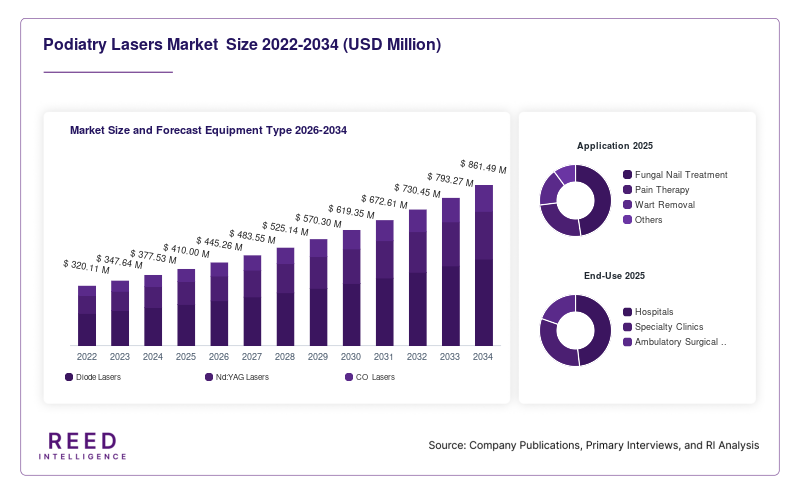
Diode lasers emerged as the dominant subsegment, accounting for approximately 42.3% of the market share in 2024. These lasers are widely used due to their efficiency, portability, and cost-effectiveness compared to other laser types. Diode lasers are particularly effective in treating fungal nail infections and soft tissue conditions, making them a preferred choice among podiatrists. Their compact design allows easy integration into outpatient clinics and smaller healthcare facilities. Additionally, advancements in diode laser technology have improved energy delivery and precision, enhancing treatment outcomes. The growing preference for minimally invasive procedures further supports the dominance of this subsegment in the market.
Nd:YAG lasers are expected to be the fastest-growing subsegment, with a projected CAGR of 9.5% during the forecast period. These lasers offer deeper tissue penetration and are highly effective in treating complex podiatric conditions such as vascular lesions and chronic infections. The increasing adoption of Nd:YAG lasers is driven by their versatility and ability to deliver targeted treatment with minimal damage to surrounding tissues. Healthcare providers are investing in advanced laser systems to expand their treatment capabilities and improve patient outcomes. The rising demand for high-performance medical devices is expected to drive the growth of this subsegment.
By Application
Fungal nail treatment dominated the application segment, accounting for 46.7% of the market share in 2024. The high prevalence of onychomycosis and the limitations of traditional treatment methods have driven the adoption of laser therapy in this area. Laser treatment offers a non-invasive and effective solution with minimal side effects, making it a preferred option for patients. The increasing awareness of laser-based treatments and the availability of advanced devices are further supporting the growth of this subsegment. Healthcare providers are also promoting laser therapy as a reliable alternative to oral medications, which often have adverse effects.
Pain therapy is expected to be the fastest-growing application segment, with a CAGR of 9.2% during the forecast period. Laser therapy is increasingly being used to manage chronic pain conditions associated with foot disorders. The ability of lasers to stimulate tissue repair and reduce inflammation makes them an effective treatment option. The growing demand for non-pharmacological pain management solutions is driving the adoption of laser therapy in this segment. Additionally, advancements in laser technology are improving treatment efficacy, further supporting the growth of pain therapy applications in the market.
By End-Use
Hospitals accounted for the largest share of the market in 2024, driven by their access to advanced medical technologies and skilled healthcare professionals. Hospitals are equipped to handle a wide range of podiatric conditions, making them a primary setting for laser treatments. The availability of reimbursement policies and the presence of multidisciplinary teams further support the adoption of laser technologies in hospitals. Additionally, hospitals often serve as training centers for medical professionals, contributing to the widespread use of advanced treatment methods.
Specialty clinics are expected to be the fastest-growing end-use segment, with a CAGR of 9.4% during the forecast period. These clinics focus exclusively on podiatric care and are increasingly adopting laser technologies to enhance their service offerings. The growing number of specialized clinics and the rising demand for outpatient treatments are driving this segment’s growth. Patients prefer specialty clinics for their personalized care and shorter waiting times. The expansion of private healthcare providers and the increasing availability of portable laser devices are further supporting the growth of this segment.
Regional Analysis
North America
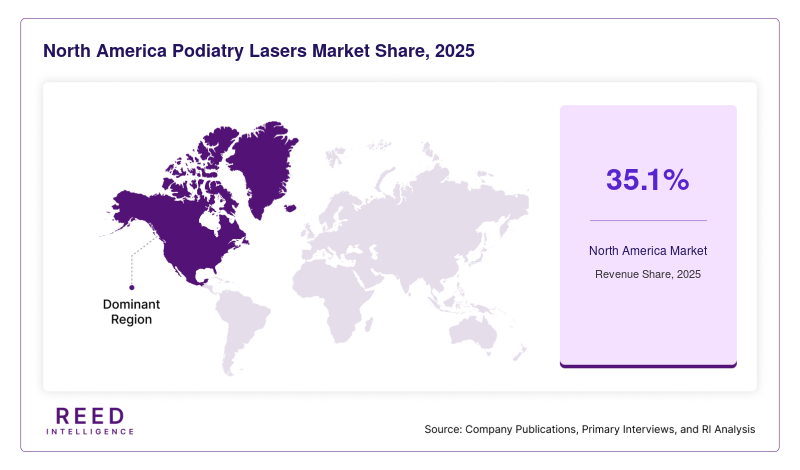
North America accounted for approximately 35.1% of the Podiatry Lasers Market share in 2025 and is expected to maintain steady growth at a CAGR of 7.9% through 2034. The region benefits from advanced healthcare infrastructure, high adoption of innovative medical technologies, and strong reimbursement frameworks. The presence of well-established healthcare providers and increasing patient awareness regarding minimally invasive treatments are contributing to sustained market demand across the region.
The United States remains the dominant country in North America, driven by a high prevalence of diabetic foot conditions and fungal infections. A key growth factor in the country is the strong focus on outpatient care and specialized podiatry clinics, which are increasingly adopting laser technologies to improve treatment outcomes and patient satisfaction.
Europe
Europe held a market share of around 27.4% in 2025 and is projected to grow at a CAGR of 7.6% during the forecast period. The region is characterized by a well-developed healthcare system and increasing adoption of advanced medical technologies. Government initiatives to promote early diagnosis and treatment of foot disorders are supporting market growth.
Germany leads the European market due to its strong healthcare infrastructure and emphasis on technological innovation. A unique growth factor in the country is the increasing collaboration between research institutions and medical device manufacturers, which is driving the development and adoption of advanced laser systems in podiatry.
Asia Pacific
Asia Pacific is expected to witness the fastest growth, with a CAGR of 9.8% from 2026 to 2034, and held a share of 21.6% in 2025. The region is experiencing rapid healthcare development, rising patient awareness, and increasing prevalence of chronic diseases. Expanding private healthcare sectors are also contributing to market growth.
China dominates the Asia Pacific market due to its large population base and growing healthcare investments. A key growth factor is the increasing availability of affordable medical devices, which is enabling wider adoption of laser treatments in both urban and semi-urban healthcare facilities.
Middle East & Africa
The Middle East & Africa region accounted for approximately 8.3% of the market share in 2025 and is expected to grow at a CAGR of 7.2%. The market is supported by improving healthcare infrastructure and increasing investments in medical technologies. Rising awareness of advanced treatment options is also contributing to market expansion.
Saudi Arabia leads the region, driven by government initiatives to modernize healthcare systems. A unique growth factor is the increasing focus on medical tourism, which is encouraging healthcare providers to adopt advanced technologies such as podiatry lasers to attract international patients.
Latin America
Latin America held a market share of around 7.6% in 2025 and is projected to grow at a CAGR of 7.4% during the forecast period. The region is witnessing gradual improvements in healthcare access and increasing adoption of modern medical technologies.
Brazil is the dominant country in the region, supported by a growing private healthcare sector. A key growth factor is the rising demand for aesthetic and non-invasive treatments, which is driving the adoption of laser-based therapies in podiatry clinics.
Competitive Landscape
The Podiatry Lasers Market is moderately fragmented, with several key players competing based on technology innovation, product quality, and pricing strategies. Leading companies are focusing on research and development to introduce advanced laser systems with improved performance and safety features. Strategic collaborations, partnerships, and product launches are common approaches adopted by market participants to strengthen their position.
One of the leading players in the market is Cutera, Inc., known for its advanced laser technologies and strong global presence. The company recently introduced an upgraded laser system designed specifically for podiatric applications, enhancing treatment precision and efficiency. Other major players are also investing in expanding their product portfolios and geographic reach to capture a larger market share. The competitive landscape is expected to remain dynamic, with continuous technological advancements shaping the market.
Key Players List
- Cutera, Inc.
- Lumenis Ltd.
- Fotona d.o.o.
- BIOLASE, Inc.
- Alma Lasers
- Candela Corporation
- Erchonia Corporation
- Multi Radiance Medical
- Gigaalaser
- Laseroptek Co., Ltd.
- El.En. S.p.A.
- Asclepion Laser Technologies GmbH
- IPG Photonics Corporation
- Shenzhen GSD Tech Co., Ltd.
- Bison Medical Co., Ltd.
Recent Developments
- Recent advancements in the market include the launch of portable laser devices designed for outpatient settings, improving accessibility and convenience for both patients and healthcare providers.
- Several companies have entered strategic partnerships with healthcare institutions to expand the adoption of laser technologies in podiatric care.
- Manufacturers are increasingly focusing on developing cost-effective laser systems to cater to emerging markets, enhancing their global presence and market reach.
Podiatry Lasers Market Segments
Equipment Type
- Diode Lasers
- Nd:YAG Lasers
- CO₂ Lasers
Application
- Fungal Nail Treatment
- Pain Therapy
- Wart Removal
- Others
End-Use
- Hospitals
- Specialty Clinics
- Ambulatory Surgical Centers
By Region
- North America
- Europe
- APAC
- Middle East and Africa
- LATAM