Point Absorber Market Size, Share Demand Report By Type (Single-Body Point Absorbers, Multi-Body Point Absorbers), By Application (Offshore Power Generation, Onshore Power Generation, Desalination, Grid Integration), Regional Insights & Segment Forecasts, 2026–2034
USD 3950
Point Absorber Market Size
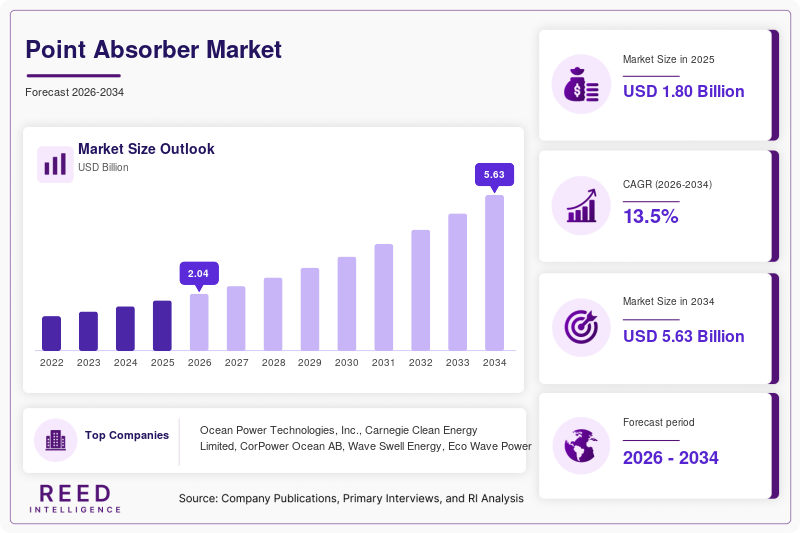
The Point Absorber market size is projected at USD 485.6 million in 2026 and is expected to hit USD 1,085.3 million by 2034 with a CAGR of 10.6% during the forecast period. The increasing global demand for renewable and sustainable energy sources, coupled with the growing focus on ocean energy and wave power generation, underpins market expansion. This report delivers a comprehensive analysis of the Point Absorber market, including segmentation by type and application, competitive dynamics, and regional growth patterns, equipping stakeholders with critical intelligence. The Point Absorber market continues to demonstrate strong growth potential, fueled by the rising investments in marine renewable energy, the increasing need for clean energy alternatives, and continuous innovation in wave energy conversion technologies.
Key Takeaways
- Dominant Region: Europe leads the Point Absorber market with a 38% share, while Asia-Pacific is the fastest-growing region with a projected CAGR of 12% through 2034.
- Dominant Segment: The Single-Body Point Absorbers type dominates the market with a 55% share, while the Offshore Power Generation application is the fastest-growing segment with a CAGR of 11.5%.
- Emerging Country: The United Kingdom is projected to reach USD 185.6 million by 2034, expanding at a CAGR of 10.8%.
- Key Drivers: The increasing focus on renewable energy targets, government incentives for marine energy projects, and the growing need for energy security are driving market growth.
Point Absorber Market Trends
Growing Adoption of Advanced Materials and Power Take-Off Systems
The Point Absorber market is witnessing a significant trend toward the adoption of advanced materials, such as composites and corrosion-resistant alloys, to improve durability and reduce maintenance costs in harsh marine environments. Additionally, innovations in power take-off systems, including hydraulic and direct-drive generators, are enhancing the efficiency and reliability of point absorbers. The use of advanced control systems for real-time wave prediction and adaptive power capture is also gaining traction, leading to higher energy conversion efficiencies.
Increasing Integration with Grid and Hybrid Energy Systems
The increasing integration of point absorbers with grid and hybrid energy systems is a major trend shaping the market. The development of offshore wave farms and the integration of wave energy with other renewable sources, such as wind and solar, are creating new opportunities for point absorber technologies. The use of point absorbers for desalination and green hydrogen production is also gaining momentum, driven by the need for sustainable solutions for water and energy security.
Point Absorber Market Drivers
The Point Absorber market's expansion is primarily driven by the increasing global demand for renewable energy and the growing focus on reducing carbon emissions. The need for clean, reliable, and sustainable energy sources has been a major driver, with point absorbers offering a promising solution for harnessing the vast energy potential of the world's oceans. The rising government support for marine energy projects, including financial incentives and favorable regulatory frameworks, has also fueled market demand. Additionally, the growing awareness of the environmental benefits of wave energy has spurred growth.
Point Absorber Market Restraints
Despite favorable growth prospects, the Point Absorber market faces significant constraints, primarily related to the high upfront capital costs associated with deploying wave energy converters in harsh marine environments. The technical challenges of ensuring reliability and durability in extreme ocean conditions can also be a limitation. The Point Absorber market's growth is also tempered by the competition from other renewable energy sources, such as wind and solar, which are currently more cost-competitive.
Point Absorber Market Opportunities
The Point Absorber market presents significant opportunities in the rapidly expanding market for offshore renewable energy, particularly in regions with high wave energy potential. The development of multi-device wave farms and the integration of point absorbers with existing offshore infrastructure are expected to create new avenues for growth. Emerging opportunities also exist in the use of point absorbers for powering remote and island communities, as well as for providing clean energy for offshore oil and gas operations.
Challenges in Point Absorber Market
The Point Absorber market faces persistent challenges related to the need for continuous innovation to reduce costs, improve efficiency, and enhance the reliability of wave energy converters. The complexity of designing and deploying systems that can withstand harsh marine environments and extreme weather conditions can also be a challenge. The market is also contending with the challenge of securing adequate funding for research, development, and demonstration projects.
Point Absorber Market Segmentation Analysis
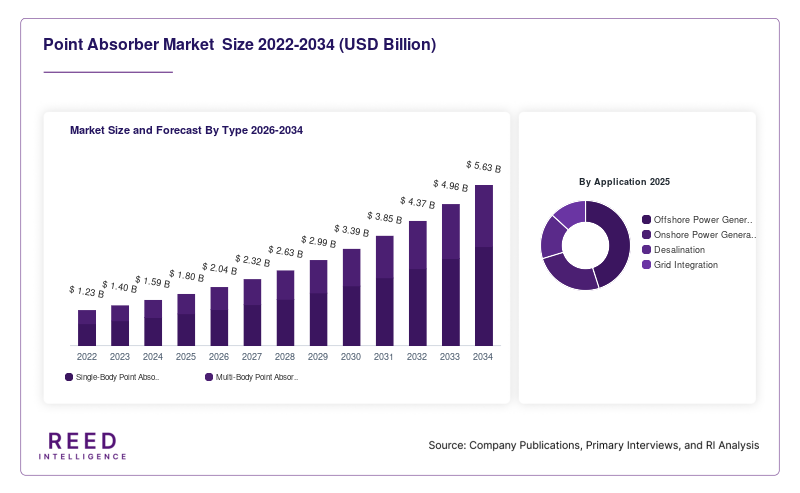
The Point Absorber market is segmented by Type and Application to provide a comprehensive market perspective. By Type, Single-Body Point Absorbers dominate with a 55% market share, driven by their simpler design and lower cost. The Application segment is led by Offshore Power Generation, which accounts for 45% of the market, followed by Onshore Power Generation at 25%, Desalination at 18%, and Grid Integration at 12%.
By Type
Single-Body Point Absorbers represent the largest segment in the Point Absorber market, commanding a 55% share, with revenue exceeding USD 267 million in 2025. These are characterized by their simpler design, involving a single floating buoy connected to a power take-off system. Technical specifications include buoy diameter, draft, and power output. The Point Absorber market's Single-Body segment is driven by its use in early-stage and smaller-scale projects.
Multi-Body Point Absorbers capture a 45% share of the Point Absorber market, with revenue of USD 218 million in 2025. These are characterized by their use of multiple interconnected bodies to capture wave energy from multiple directions, offering higher efficiency and power output. Technical specifications include number of bodies, connection mechanism, and power take-off configuration. The Point Absorber market's Multi-Body segment is driven by its use in larger-scale commercial projects.
By Application
Offshore Power Generation dominates the Point Absorber market, accounting for 45% of sales, representing USD 218 million in 2025. This segment includes use in utility-scale wave energy farms located offshore. Usage penetration exceeds 25% in wave energy projects. The Point Absorber market's Offshore segment is characterized by its focus on high-capacity and grid-connected systems.
Onshore Power Generation accounts for 25% of the Point Absorber market, with revenue of USD 121 million in 2025. This segment encompasses use in onshore wave energy conversion systems, often used for demonstration and research purposes. The segment is growing at a steady CAGR, driven by the need for testing and validation. The Point Absorber market's Onshore segment is characterized by its focus on research and development.
Desalination represents 18% of the market, with revenue of USD 87 million in 2025, involving use in wave-powered desalination plants, providing sustainable solutions for freshwater production. The segment's growth is fueled by the increasing water scarcity in coastal regions. The Point Absorber market's Desalination segment is characterized by its focus on energy efficiency and sustainability.
Grid Integration accounts for the remaining 12% of the market, with revenue of USD 58 million in 2025, used in integrating wave energy into existing power grids. The Point Absorber market's Grid Integration segment is characterized by its focus on power quality and grid stability.
Point Absorber Market Regional Analysis
Europe Point Absorber Market
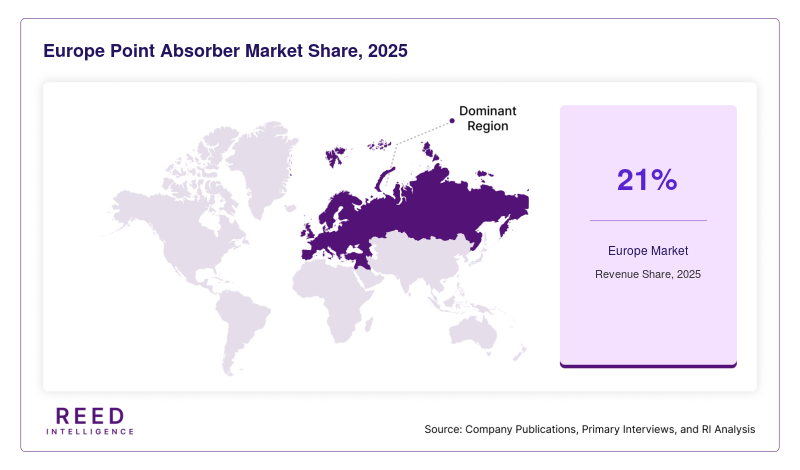
Leads the Point Absorber market, commanding a 38% share, with a revenue of USD 184 million in 2025. The United Kingdom is the primary driver, accounting for 65% of regional demand, followed by Ireland, Portugal, and Spain, driven by strong government support for marine energy, favorable policies, and high wave energy potential. The European Point Absorber market is characterized by its focus on innovation and commercialization.
Asia-Pacific Point Absorber Market
Represents the second-largest market, capturing a 28% share with a revenue of USD 136 million in 2025. China, Australia, and Japan are the primary drivers, together accounting for 65% of regional demand, driven by the rapidly growing renewable energy sector, increasing energy demand, and government initiatives for marine energy development. The Asia-Pacific Point Absorber market is projected to grow at the fastest CAGR of 12% through 2034.
North America Point Absorber Market
Accounts for 22% of the global Point Absorber market, with a revenue of USD 107 million in 2025. The United States and Canada are the primary drivers, together accounting for 85% of regional demand, driven by the growing focus on renewable energy, government funding for marine energy research, and a strong research and development base. The North America Point Absorber market is characterized by its focus on research and innovation.
Middle East & Africa and Latin America Point Absorber Market
Together account for the remaining 12% of the Point Absorber market, with the UAE and Brazil leading their respective regions. Both regions are projected to grow at CAGRs exceeding 10%, driven by increasing investments in renewable energy and the growing need for sustainable solutions.
Top players in Point Absorber Market
- Ocean Power Technologies, Inc.
- Carnegie Clean Energy Limited
- CorPower Ocean AB
- Wave Swell Energy
- Eco Wave Power
- AquaGen Technologies
- Seabased AB
- Bombora Wave Power
- AMOG Consulting
- Wave Energy Development
- Wello Oy
- NEMOS GmbH
- Ocean Renewable Power Company, LLC
- ATLANTIS Resources
- Marine Power Systems
Point Absorber Market Segments
By Type
- Single-Body Point Absorbers
- Multi-Body Point Absorbers
By Application
- Offshore Power Generation
- Onshore Power Generation
- Desalination
- Grid Integration
By Region
- North America
- Europe
- APAC
- Middle East and Africa
- LATAM