Polarographic Dissolved Oxygen Probes Market Size, Share & Demand Report By Type (Membrane-Covered Polarographic Probes, Hybrid/Optical-Enhanced Probes), By Application (Wastewater Treatment, Aquaculture, Industrial Processing, Environmental Monitoring), By End-Use Industry (Industrial, Environmental, Research & Laboratories), By Distribution Channel (Direct Sales, Distributors, Online Channels), By Region & Segment Forecasts, 2025–2034
USD 3950
Market Overview
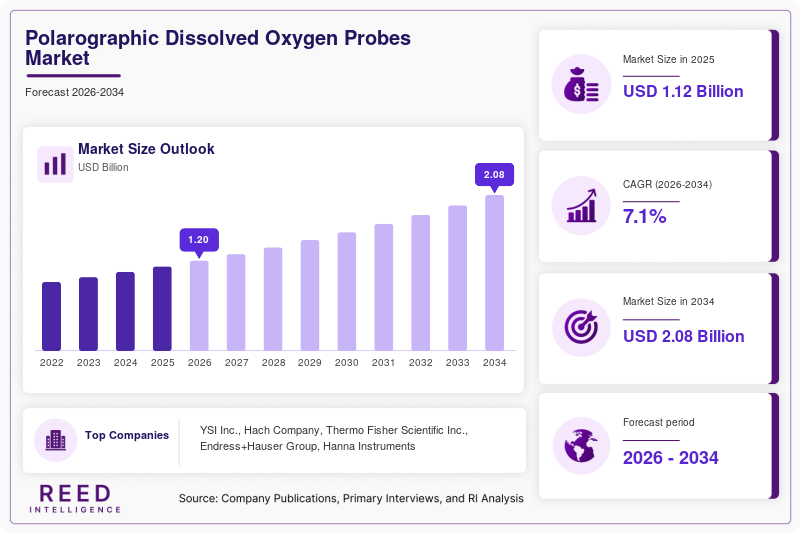
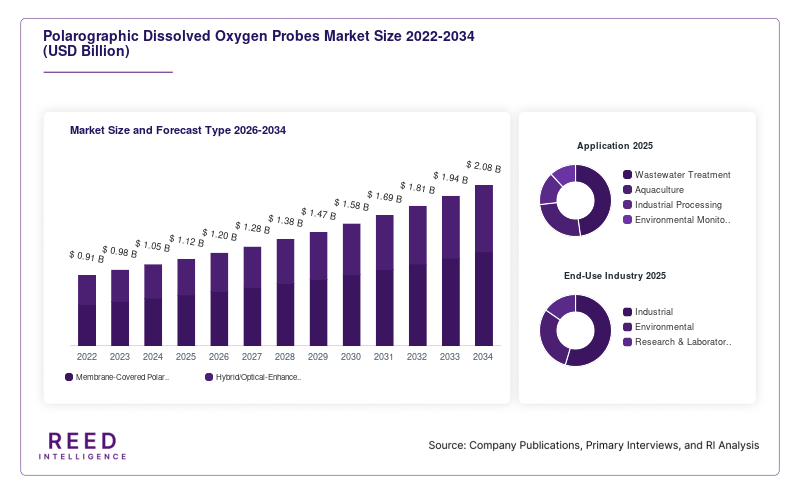
The global Polarographic Dissolved Oxygen Probes Market size was valued at approximately USD 1.12 billion in 2025 and is projected to reach USD 2.08 billion by 2034, expanding at a CAGR of 7.1% during the forecast period (2025–2034). The steady rise in demand for accurate dissolved oxygen measurement across water treatment, aquaculture, pharmaceuticals, and industrial processing has significantly contributed to market expansion. These probes, known for their reliability and precise electrochemical sensing, remain critical in environments requiring continuous oxygen monitoring.
A major global factor supporting the growth of the Polarographic Dissolved Oxygen Probes Market is the increasing emphasis on water quality monitoring and environmental sustainability. Governments and industries are investing in wastewater treatment infrastructure and regulatory compliance systems, which has driven the adoption of high-performance dissolved oxygen measurement devices.
Key Highlights
- North America dominated the market with a 34.6% share in 2025, while Asia Pacific is expected to grow at the fastest CAGR of 8.4%.
- By type, membrane-covered probes led with 62.3% share, while optical-hybrid probes are projected to grow fastest at a CAGR of 9.1%.
- In applications, wastewater treatment dominated with 38.7% share, while aquaculture is expected to grow fastest at 8.9% CAGR.
- The U.S. remained the dominant country, with a market value of USD 312 million in 2025 and projected to reach USD 333 million in 2026.
Market Trends
Integration with Smart Monitoring Systems
The integration of polarographic dissolved oxygen probes with IoT-enabled monitoring systems is transforming operational efficiency. Industries are increasingly deploying smart sensors that provide real-time data analytics, remote monitoring, and predictive maintenance capabilities. This trend is particularly prominent in wastewater treatment plants and industrial facilities, where continuous monitoring is essential. The shift toward digitalization is enhancing decision-making processes and reducing downtime, thereby strengthening the overall Polarographic Dissolved Oxygen Probes Market outlook.
Shift Toward Hybrid and Multi-Parameter Sensors
Another notable trend is the development of hybrid probes capable of measuring multiple parameters alongside dissolved oxygen. These advanced sensors reduce the need for multiple instruments, improving cost efficiency and operational convenience. Manufacturers are focusing on combining polarographic sensing with optical technologies to improve accuracy and reduce maintenance requirements. This trend is expected to gain traction across aquaculture and environmental monitoring sectors, where comprehensive water quality analysis is critical.
Market Drivers
Increasing Demand for Wastewater Treatment Solutions
The rising global demand for efficient wastewater treatment systems is a key driver of the Polarographic Dissolved Oxygen Probes Market. Industrialization and urbanization have increased wastewater generation, necessitating precise oxygen monitoring to optimize biological treatment processes. Polarographic probes play a vital role in maintaining optimal oxygen levels, ensuring regulatory compliance and operational efficiency.
Growth in Aquaculture Industry
The expansion of the aquaculture industry is significantly contributing to market growth. Dissolved oxygen levels directly impact aquatic life health and productivity, making accurate monitoring essential. Polarographic dissolved oxygen probes are widely used in fish farms and hatcheries to maintain optimal conditions. As global seafood demand rises, aquaculture operators are increasingly investing in reliable monitoring systems, thereby boosting market growth.
Market Restraint
High Maintenance and Calibration Requirements
One of the major challenges in the Polarographic Dissolved Oxygen Probes Market is the relatively high maintenance requirement associated with these devices. Polarographic probes rely on membranes and electrolytes that require periodic replacement and calibration to maintain accuracy. This increases operational costs and may deter adoption among small-scale users or facilities with limited technical expertise.
Additionally, the need for frequent servicing can lead to downtime, affecting process efficiency in critical applications such as industrial manufacturing and water treatment. While technological advancements are addressing some of these limitations, maintenance complexity remains a key barrier to widespread adoption, particularly in cost-sensitive markets.
Market Opportunities
Expansion in Emerging Economies
Emerging economies present significant growth opportunities for the Polarographic Dissolved Oxygen Probes Market. Rapid industrialization and increasing investments in water infrastructure are driving demand for advanced monitoring solutions. Governments in regions such as Asia Pacific and Latin America are implementing stricter environmental regulations, creating favorable conditions for market expansion.
Advancements in Probe Durability and Automation
Technological advancements aimed at improving probe durability and reducing maintenance requirements are creating new growth avenues. Innovations such as self-cleaning membranes and automated calibration systems are enhancing usability and reducing operational costs. These developments are expected to increase adoption across industries, particularly in remote and large-scale applications where manual maintenance is challenging.
Segmental Analysis
By Type
Membrane-covered polarographic probes dominated the Polarographic Dissolved Oxygen Probes Market in 2025, accounting for 62.3% of the total share. Their widespread adoption was attributed to their reliability, cost-effectiveness, and suitability for continuous monitoring applications. These probes have been extensively used in wastewater treatment and industrial processes.
Hybrid and optical-enhanced probes are expected to grow at the fastest CAGR of 9.1% during the forecast period. Their ability to reduce maintenance requirements and provide enhanced accuracy will drive their adoption. The integration of advanced sensing technologies will further support their growth.
By Application
Wastewater treatment emerged as the dominant application segment, holding 38.7% of the market share in 2025. The need for precise oxygen monitoring in biological treatment processes has driven the adoption of polarographic probes in this segment.
Aquaculture is projected to grow at the fastest CAGR of 8.9%. Increasing global demand for seafood and the need for efficient farm management will boost the adoption of dissolved oxygen monitoring systems.
By End-Use Industry
The industrial sector dominated the market in 2025, accounting for 41.2% of the total share. Industries such as chemicals, food & beverage, and pharmaceuticals rely on accurate oxygen measurement for process optimization.
The environmental monitoring sector is expected to grow at a CAGR of 8.2%. Rising awareness about environmental sustainability and regulatory compliance will drive demand in this segment.
By Distribution Channel
Direct sales accounted for the largest share of 55.6% in 2025, as manufacturers preferred direct engagement with large industrial clients. This approach allowed better customization and technical support.
Online distribution channels are expected to grow at the fastest CAGR of 9.4%, driven by increasing digitalization and ease of product accessibility. The availability of detailed product information and competitive pricing will attract more buyers.
Regional Analysis
North America
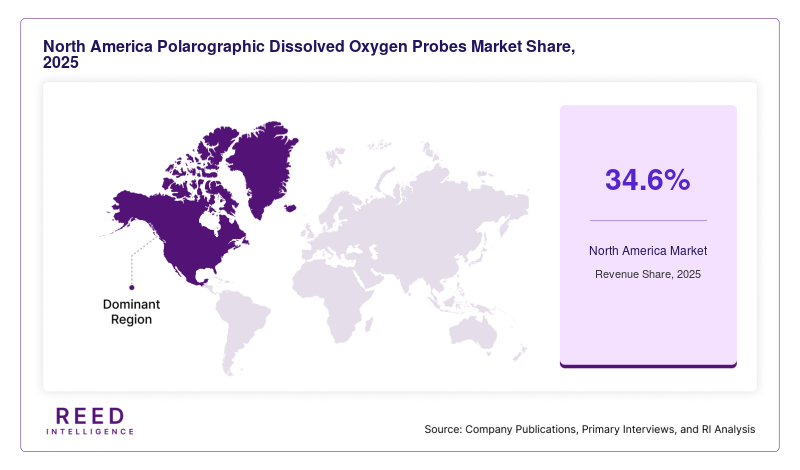
North America accounted for 34.6% of the Polarographic Dissolved Oxygen Probes Market share in 2025 and is expected to grow at a CAGR of 6.5% during the forecast period. The region’s mature industrial infrastructure and strong regulatory framework have historically supported market growth.
The United States dominated the regional market due to stringent environmental regulations and advanced wastewater treatment facilities. The presence of established industrial sectors and continuous investment in technological innovation has further strengthened market demand.
Europe
Europe held a 27.8% share of the Polarographic Dissolved Oxygen Probes Market in 2025 and is projected to expand at a CAGR of 6.8%. The region has been characterized by strong environmental policies and sustainability initiatives.
Germany emerged as the leading country, driven by its advanced manufacturing sector and focus on environmental compliance. The adoption of high-precision monitoring systems in industrial processes has contributed to steady market growth.
Asia Pacific
Asia Pacific accounted for 22.4% of the market in 2025 and is anticipated to grow at the fastest CAGR of 8.4%. Rapid industrialization and urbanization have significantly influenced market expansion.
China dominated the region, supported by large-scale investments in wastewater treatment infrastructure. The country’s growing aquaculture industry has also increased demand for dissolved oxygen monitoring solutions.
Middle East & Africa
The Middle East & Africa region held a 8.1% market share in 2025 and is expected to grow at a CAGR of 7.3%. Increasing focus on water resource management has driven demand for monitoring technologies.
Saudi Arabia led the regional market due to its investments in water desalination and treatment projects. The need for efficient water management in arid environments has accelerated the adoption of advanced probes.
Latin America
Latin America captured 7.1% of the market share in 2025 and is projected to grow at a CAGR of 7.0%. The region has experienced growing demand for water treatment solutions due to urban expansion.
Brazil dominated the market, driven by its expanding industrial base and increasing environmental awareness. Investments in wastewater infrastructure have supported the adoption of dissolved oxygen probes.
Competitive Landscape
The Polarographic Dissolved Oxygen Probes Market is moderately consolidated, with key players focusing on product innovation and strategic partnerships. Leading companies are investing in R&D to enhance probe performance and durability.
The market leader, YSI Inc., has maintained its position through continuous innovation and a strong global distribution network. The company recently introduced advanced probes with improved membrane technology, enhancing measurement accuracy and reducing maintenance requirements.
Other prominent players such as Hach Company, Thermo Fisher Scientific Inc., and Endress+Hauser Group are focusing on expanding their product portfolios and strengthening their presence in emerging markets. Competitive strategies include mergers, acquisitions, and collaborations to gain market share and improve technological capabilities.
Key Players List
- YSI Inc.
- Hach Company
- Thermo Fisher Scientific Inc.
- Endress+Hauser Group
- Hanna Instruments
- Horiba Ltd.
- Mettler-Toledo International Inc.
- Xylem Inc.
- Emerson Electric Co.
- ABB Ltd.
- Yokogawa Electric Corporation
- Jenco Instruments Inc.
- Atlas Scientific
- Knick Elektronische Messgeräte GmbH & Co. KG
- Apera Instruments
Recent Developments
- YSI Inc. launched a new generation of low-maintenance polarographic probes with extended membrane life.
- Thermo Fisher Scientific introduced integrated dissolved oxygen monitoring systems with digital connectivity features.
- Endress+Hauser expanded its product portfolio with multi-parameter sensors combining polarographic technology.
- Hach Company developed automated calibration solutions to reduce maintenance complexity.
- ABB Ltd. invested in smart sensor technologies to enhance real-time monitoring capabilities.
Polarographic Dissolved Oxygen Probes Market Segments
Type
- Membrane-Covered Polarographic Probes
- Hybrid/Optical-Enhanced Probes
Application
- Wastewater Treatment
- Aquaculture
- Industrial Processing
- Environmental Monitoring
End-Use Industry
- Industrial
- Environmental
- Research & Laboratories
Distribution Channel
- Direct Sales
- Distributors
- Online Channels
By Region
- North America
- Europe
- APAC
- Middle East and Africa
- LATAM