Pole Saw Tree Trimmer Market Size, Share & Demand Report By Type (Electric Pole Saw, Gas-Powered Pole Saw, Battery-Powered Pole Saw), By Power Source (Corded, Cordless), By End-Use (Residential, Commercial Landscaping, Municipal Services), By Distribution Channel (Online Retail, Offline Retail), By Region & Segment Forecasts, 2026–2034
USD 3950
Market Overview
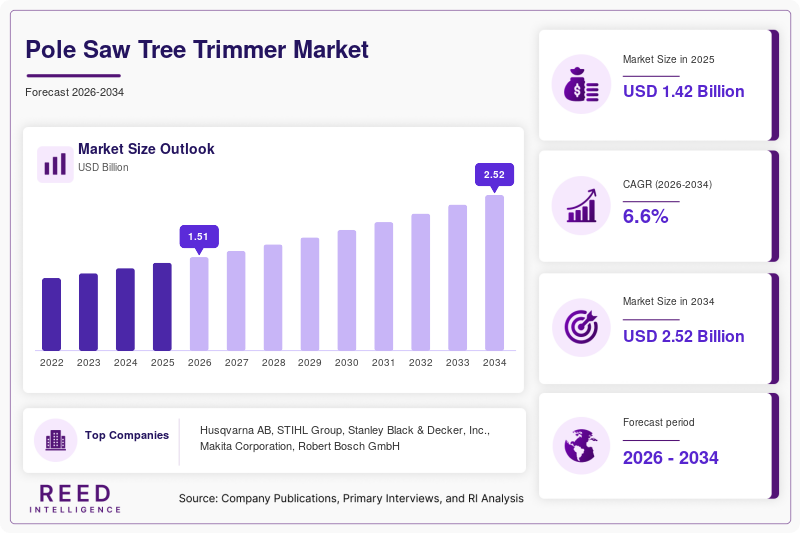
The global Pole Saw Tree Trimmer Market size was valued at USD 1.42 billion in 2026 and is projected to reach USD 2.36 billion by 2034, expanding at a CAGR of 6.6% during the forecast period (2026–2034). The steady expansion of landscaping activities across residential and commercial sectors, combined with rising demand for efficient tree maintenance tools, has supported consistent market growth worldwide.
One of the key global factors contributing to the market’s expansion is the increasing emphasis on urban greenery and sustainable landscaping. Municipal authorities and private property owners are investing in tree maintenance solutions to enhance environmental aesthetics and safety, thereby driving demand for pole saw tree trimmers.
Key Highlights
- North America dominated the market with 34.8% share in 2025, while Asia Pacific is expected to grow at the fastest CAGR of 7.8% (2026–2034).
- The electric pole saw segment led by type with 41.2% share in 2025, while battery-powered pole saws are projected to grow at a CAGR of 8.4%.
- The residential end-use segment dominated with 52.6% share, while the commercial landscaping segment is expected to expand at a CAGR of 7.5%.
- The United States remained the dominant country, with market values of USD 420 million in 2024 and USD 448 million in 2025.
Market Trends
Rising Adoption of Battery-Powered Equipment
Battery-powered pole saw tree trimmers are gaining traction due to advancements in lithium-ion battery technology. These tools offer portability, lower noise levels, and reduced emissions compared to gas-powered alternatives. As environmental awareness increases, both residential users and professional landscapers are shifting toward cordless solutions, making this a defining trend in the Pole Saw Tree Trimmer Market.
Integration of Ergonomic and Safety Features
Manufacturers are focusing on product innovation by incorporating ergonomic designs, adjustable shafts, anti-vibration systems, and enhanced safety mechanisms. These improvements reduce user fatigue and enhance operational efficiency. The trend is particularly important for professional users who rely on extended usage periods, thereby influencing purchasing decisions and overall market growth.
Market Drivers
Growing Landscaping and Gardening Activities
The expansion of residential gardening and commercial landscaping services has significantly increased demand for pole saw tree trimmers. Homeowners are investing in tools that allow safe trimming of high branches without ladders, while landscaping firms require efficient equipment to manage large-scale operations. This dual demand continues to drive the Pole Saw Tree Trimmer Market.
Increasing Urbanization and Infrastructure Development
Rapid urbanization has led to the development of parks, green belts, and roadside plantations. Governments and municipal bodies are investing in tree maintenance to ensure safety and aesthetic appeal. This has resulted in higher adoption of pole saw tree trimmers for routine pruning and maintenance tasks.
Market Restraint
High Maintenance and Operational Costs of Gas-Powered Tools
Gas-powered pole saws, while powerful, require regular maintenance, fuel, and servicing. These factors increase operational costs and discourage adoption among cost-sensitive users. Additionally, emissions regulations in several regions further limit their usage, posing a restraint to overall market expansion.
Market Opportunities
Expansion of E-Commerce Distribution Channels
Online retail platforms are creating new growth avenues for manufacturers by offering wider product accessibility and competitive pricing. Consumers can easily compare features and prices, which is expected to boost product adoption, particularly in emerging markets.
Technological Advancements in Lightweight Materials
The use of advanced lightweight materials such as aluminum alloys and reinforced plastics is improving product usability. These innovations enhance durability while reducing user fatigue, creating opportunities for manufacturers to differentiate their offerings and capture new customer segments.
Segmental Analysis
By Type
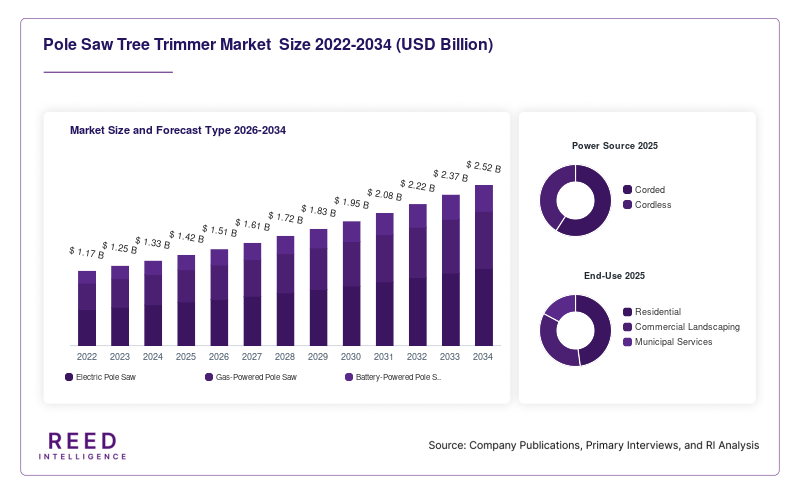
The electric pole saw segment dominated the Pole Saw Tree Trimmer Market with a 41.2% share in 2025, owing to its ease of use, lower maintenance, and suitability for residential applications.
The battery-powered pole saw segment will grow at the fastest CAGR of 8.4%, driven by advancements in battery efficiency and portability. The ability to operate without cords or fuel will continue to attract both residential and commercial users.
By Power Source
The corded segment held the dominant share of 38.5% in 2025, benefiting from consistent power supply and affordability.
The cordless segment is projected to grow at a CAGR of 8.1%, supported by increasing demand for mobility and convenience in outdoor equipment.
By End-Use
The residential segment accounted for 52.6% of the market share in 2025, driven by rising interest in home gardening and DIY landscaping projects.
The commercial landscaping segment will expand at a CAGR of 7.5%, fueled by the growth of professional landscaping services and maintenance contracts.
By Distribution Channel
The offline retail segment dominated with 63.4% share in 2025, as consumers preferred in-store demonstrations and immediate product availability.
The online retail segment is expected to grow at a CAGR of 7.9%, driven by increasing internet penetration and convenience of doorstep delivery.
Regional Analysis
North America
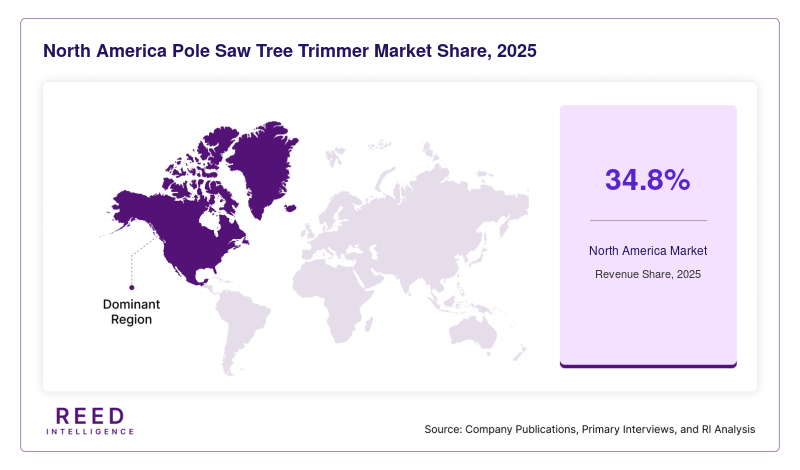
North America accounted for 34.8% of the Pole Saw Tree Trimmer Market share in 2025. The region will expand at a CAGR of 6.1% during the forecast period. The United States dominated due to the strong presence of professional landscaping services and high consumer spending on home improvement tools. The growth is supported by widespread adoption of advanced gardening equipment.
Europe
Europe held 26.3% market share in 2025 and is expected to grow at a CAGR of 6.0% from 2026 to 2034. Germany led the region, driven by a strong culture of garden maintenance and increasing demand for eco-friendly tools. Regulatory emphasis on reducing emissions has encouraged the adoption of electric and battery-powered pole saws.
Asia Pacific
Asia Pacific captured 22.7% share in 2025 and will grow at the fastest CAGR of 7.8%. China dominated the region due to rapid urbanization and large-scale infrastructure projects. The rising middle-class population and increasing interest in home gardening are key factors supporting market growth.
Middle East & Africa
The Middle East & Africa region accounted for 8.1% share in 2025 and is projected to grow at a CAGR of 5.7%. The UAE emerged as a leading country due to investments in urban landscaping and tourism infrastructure. The demand for efficient tree maintenance tools is increasing in commercial sectors.
Latin America
Latin America held 8.1% market share in 2025 and is anticipated to grow at a CAGR of 5.9%. Brazil dominated the region, supported by expanding agricultural and landscaping activities. Increasing awareness about proper tree maintenance is driving product adoption.
Competitive Landscape
The Pole Saw Tree Trimmer Market is moderately fragmented, with several global and regional players competing through product innovation, pricing strategies, and distribution expansion. Key companies are focusing on lightweight designs, battery efficiency, and ergonomic features to strengthen their market position.
A leading player in the market is Husqvarna AB, which has maintained a strong presence through continuous innovation and a broad product portfolio. The company recently introduced advanced battery-powered pole saws with extended runtime and improved safety features, reinforcing its competitive edge.
Other major players such as STIHL Group, Stanley Black & Decker, Inc., and Makita Corporation are investing in research and development to introduce energy-efficient and user-friendly products. Strategic partnerships and expansion into emerging markets are common approaches adopted by these companies to enhance their global footprint.
Key Players List
- Husqvarna AB
- STIHL Group
- Stanley Black & Decker, Inc.
- Makita Corporation
- Robert Bosch GmbH
- ECHO Incorporated
- Greenworks Tools
- Ryobi Limited
- Oregon Tool, Inc.
- WORX (Positec Tool Corporation)
- HiKOKI (Hitachi Power Tools)
- Einhell Germany AG
- AL-KO Gardentech
- Snow Joe, LLC
- Craftsman (Stanley Black & Decker)
Recent Developments
- In 2025, Husqvarna AB launched a new range of high-performance battery-powered pole saws with enhanced cutting efficiency and longer battery life.
- STIHL Group expanded its product portfolio with lightweight pole saws designed for residential users.
- Makita Corporation introduced advanced brushless motor technology to improve durability and energy efficiency.
- Greenworks Tools strengthened its online distribution network to expand its presence in emerging markets.
- Stanley Black & Decker, Inc. focused on integrating smart features into its outdoor power equipment lineup.
Pole Saw Tree Trimmer Market Segments
Type
- Electric Pole Saw
- Gas-Powered Pole Saw
- Battery-Powered Pole Saw
Power Source
- Corded
- Cordless
End-Use
- Residential
- Commercial Landscaping
- Municipal Services
Distribution Channel
- Online Retail
- Offline Retail
By Region
- North America
- Europe
- APAC
- Middle East and Africa
- LATAM