Political Campaign Software Market Size, Share & Trends Analysis Report By Component (Software, Services), By Deployment (Cloud-Based, On-Premise), By Application (Campaign Management, Voter Engagement, Fundraising & Donation Management, Compliance & Reporting, Data Analytics), By End User (Political Parties, Candidates, Political Action Committees, Advocacy Organizations) and By Region (North America, Europe, APAC, Middle East and Africa, LATAM) Forecasts, 2026–2034
USD 3950
Political Campaign Software Market Size
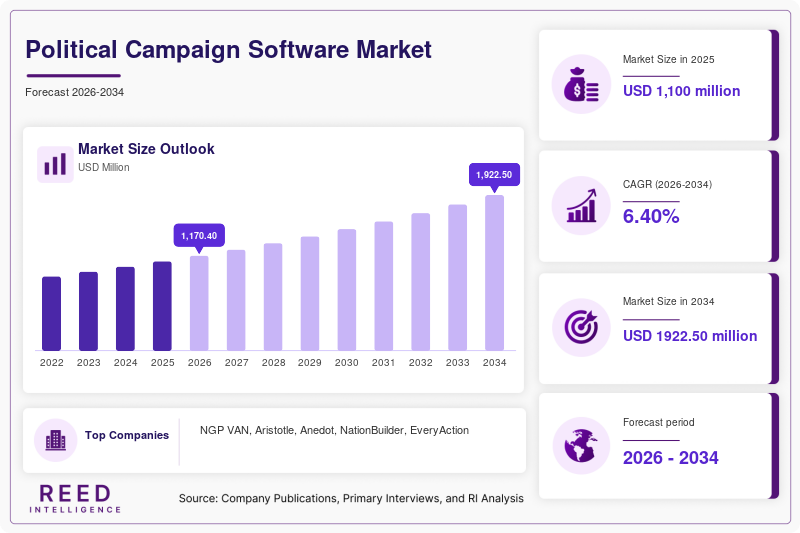
The global political campaign software market size was valued at USD 1,100 million in 2025 and is projected to grow from USD 1,170 million in 2026 to USD 1,922.50 million by 2034, registering a CAGR of 6.40% during the forecast period from 2026 to 2034.
The market is supported by the increasing volume and complexity of campaign finance, donor, voter-contact, compliance, event, and communication data. In the U.S., for example, congressional candidates reported USD 2,127.4 million in receipts and USD 1,345.2 million in disbursements between January 2025 and March 2026, while PACs reported USD 6,300.4 million in receipts and USD 4,784.2 million in disbursements.
Political campaign software has shifted from basic contact databases and reporting tools toward integrated platforms covering campaign management, fundraising, compliance, voter-contact operations, analytics, and digital engagement. The underlying commercial requirement is increasingly linked to handling large volumes of structured and unstructured campaign information while maintaining reporting accuracy and controlled access.
Regulatory reporting is one of the clearest software-demand mechanisms. The U.S. Federal Election Commission maintains campaign-finance datasets across congressional candidates, political parties, PACs, and communication filings, with reporting requirements varying by filer and election period. This creates recurring demand for software capable of organizing financial records, generating reports, checking compliance data, and maintaining audit trails.
Political Campaign Software Market Drivers
Rising Campaign Finance and Reporting Complexity
The volume of financial activity creates a direct requirement for campaign finance management and compliance software. During the first 15 months of the 2025–2026 U.S. election cycle, congressional candidates reported more than USD 2.1 billion in receipts, while PACs reported USD 6.3 billion. Campaign committees also operate under recurring filing deadlines, including quarterly and pre- and post-election reporting requirements.
The mechanism is straightforward: more transactions, donors, committees, filing categories, and reporting deadlines increase the administrative burden on campaign treasurers and staff. Software therefore moves from being an optional productivity tool toward infrastructure for organizing financial records, identifying reporting issues, preparing disclosures, and maintaining consistent data. Aristotle, for example, offers compliance reports, limit checks, data-integrity checks, and FEC reporting functionality within its campaign platform.
Expansion of Integrated Campaign Data Platforms
Campaign organizations increasingly need financial, donor, contact, event, volunteer, and communication data to operate within connected workflows. Separate systems can create duplicate records and require manual movement of information between applications.
This is encouraging vendors to integrate CRM, fundraising, accounting, compliance, and engagement capabilities. Aristotle combines these functions in Campaign Manager, while Anedot provides online fundraising, payment processing, events, donor management, integrations, and reporting capabilities. The commercial impact is higher demand for platforms that reduce data fragmentation and simplify workflows across campaign departments.
AI Integration into Campaign Software
AI is becoming a product feature rather than a separate analytics tool. In June 2026, NGP VAN introduced Inbox Insights, an AI-enhanced dashboard for email deliverability analysis. In August 2026, the company launched NGP VAN Interface, an MCP-based system designed to connect AI tools with campaign data while maintaining authentication, permissions, and security controls.
This creates demand for software capable of converting large datasets into natural-language queries, workflow actions, and operational insights. However, the opportunity depends on data governance, authorization, privacy, and user controls because campaign databases can contain sensitive personal and financial information.
Political Campaign Software Market Restraints
Data Security and Privacy Requirements
Campaign platforms manage donor information, contact records, financial transactions, and organizational data, increasing the consequences of weak security controls. The FEC's FY2025–2026 IT strategy specifically identifies security, privacy, authentication, credential management, and data protection as technology priorities while addressing growing campaign-finance data volumes.
For commercial vendors, this increases development and compliance costs. Cloud providers must invest in authentication, permissions, encryption, monitoring, backup, and access management. AI integration adds another control layer because organizations need to determine which data AI systems can access and what actions those systems can perform.
Fragmented Regulatory Environment
Political campaign software providers operate across jurisdictions with different election-finance rules, reporting formats, privacy requirements, and filing schedules. A feature designed for one regulatory environment may not transfer directly to another.
This fragmentation increases localization costs and can make smaller vendors less competitive when compared with established providers that already maintain compliance databases and regulatory workflows. Customers may also require specialized services alongside software, supporting continued demand for implementation, consulting, compliance, and managed services.
Political Campaign Software Market Opportunities
AI-Assisted Campaign Data Management
AI creates an opportunity to make campaign databases easier to query and operate without requiring users to navigate multiple technical interfaces. NGP VAN's Interface demonstrates this direction by connecting AI tools with campaign data through natural-language workflows, while its current closed-beta product supports functions including contact searches, list creation, imports, activist codes, events, notes, and authentication management.
The commercial opportunity extends beyond chat interfaces. AI can be incorporated into data-quality checks, reporting workflows, email diagnostics, fundraising dashboards, administrative support, and database management. Vendors that combine AI functionality with granular permissions and audit controls can address the operational requirement without treating AI as an independent system.
Integrated Fundraising and Payment Infrastructure
Digital fundraising continues to create demand for payment processing, recurring donations, donor records, transaction reporting, and CRM integration. Anedot supports multiple payment methods, recurring giving, donor fee coverage, events, donation pages, and integrations, while also providing payment processing infrastructure.
This creates an opportunity for campaign software providers to connect fundraising activity directly with donor records, accounting systems, and compliance workflows. The resulting integration can reduce manual reconciliation and improve the consistency of financial information across systems.
Segmental Analysis
By Component
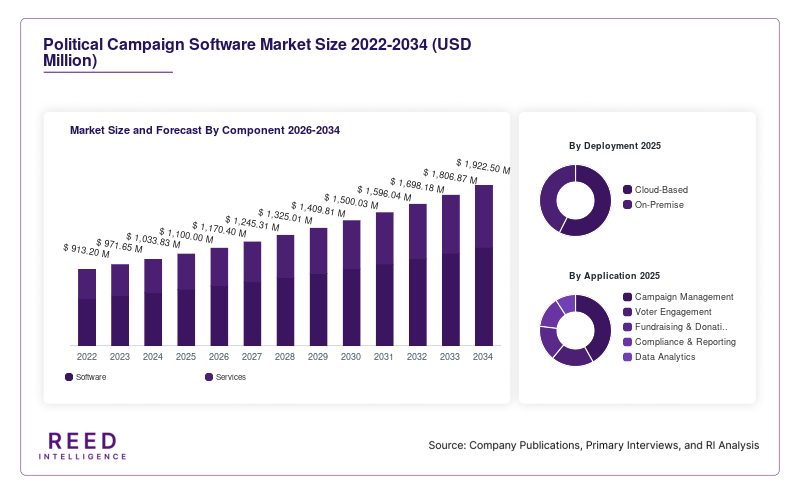
Software represented approximately 64% of the global market in 2025, equivalent to USD 704 million. The segment includes campaign CRM platforms, voter databases, fundraising systems, compliance applications, communication tools, analytics dashboards, and integrated campaign-management platforms. Demand is supported by the need to centralize campaign data and automate recurring administrative workflows. Platforms such as Aristotle Campaign Manager combine campaign management, fundraising, accounting, data management, donor insight, and compliance functions, illustrating the movement toward broader software suites.
Services accounted for approximately 36% of the market in 2025, equivalent to USD 396 million. Services include implementation, consulting, technical support, data management, integration, compliance assistance, and managed technology services. Demand remains relevant because campaign organizations often operate under tight election-cycle timelines and require configuration of software around jurisdiction-specific reporting and organizational requirements.
By Deployment
Cloud-based deployment represented approximately 68% of the market in 2025, equivalent to USD 748 million. Cloud platforms allow distributed campaign teams to access centralized databases, financial information, communication tools, and dashboards without maintaining local infrastructure. Aristotle describes Campaign Manager as a cloud-based CRM integrating campaign management, compliance, fundraising, accounting, and data management.
On-premise deployment represented approximately 32%, equivalent to USD 352 million in 2025. These systems remain relevant where organizations prioritize local infrastructure control, legacy integrations, or specific data-management requirements. However, the need for infrastructure maintenance and software administration can increase operating costs compared with hosted systems.
By Application
Campaign management represented approximately 27% of the market in 2025, equivalent to USD 297 million. These systems coordinate campaign databases, contacts, events, volunteers, activities, workflows, and reporting. Their value comes from consolidating multiple operational functions into a common data environment.
Voter engagement represented approximately 23%, equivalent to USD 253 million. The category includes contact management, communication workflows, canvassing information, event participation, and supporter records. NGP VAN's MiniVAN enhancements demonstrate continued investment in capturing structured and qualitative information from field interactions.
Fundraising and donation management accounted for approximately 21%, equivalent to USD 231 million. Online donations, recurring giving, payment processing, donor records, and transaction reporting are core functions. Anedot, for example, supports cards, bank drafts, Apple Pay, Google Pay, PayPal, recurring giving, donor fee coverage, and event transactions.
Compliance and reporting represented approximately 17%, equivalent to USD 187 million. This segment is supported by recurring filing requirements and the need to maintain accurate financial records. FEC reporting schedules create repeated operational requirements for committees during election cycles.
Data analytics accounted for approximately 12%, equivalent to USD 132 million. Analytics tools convert donor, contact, financial, communication, and operational information into dashboards and reports. AI-enabled analytics are expanding the segment by allowing users to interpret data through natural-language interfaces.
Regional Analysis
North America Political Campaign Software Market
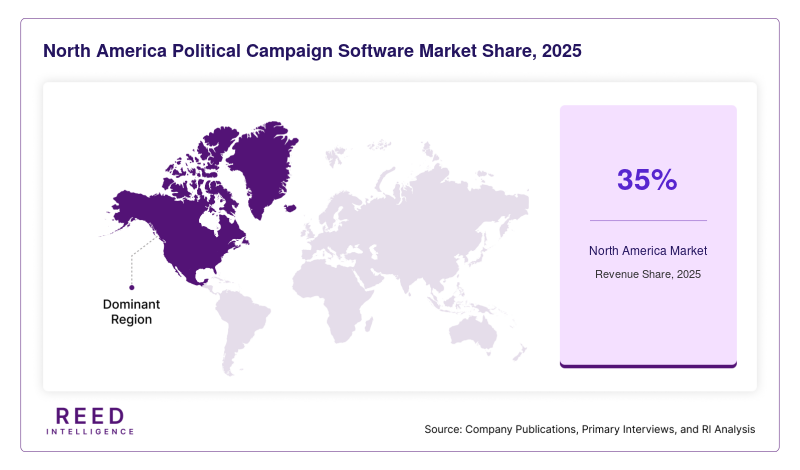
North America accounted for about 35% of the global market in 2025, or USD 385 million, making it the largest regional market. The region benefits from a mature political technology ecosystem and substantial campaign-finance activity. In the U.S., congressional candidates reported USD 2.1 billion in receipts during the first 15 months of the 2025–2026 cycle, while PACs reported USD 6.3 billion.
The regulatory environment creates recurring demand for compliance and financial reporting software. FEC reporting schedules require committees to submit periodic financial reports, with additional pre-election and post-election filings in applicable circumstances.
The region is also a major testing ground for AI-enabled campaign technology. NGP VAN has introduced AI-powered email analytics and an MCP-based interface for connecting AI tools with campaign databases. Aristotle provides another example of an integrated platform combining compliance, fundraising, accounting, and data management.
North America's market is projected to grow at approximately 5.8% CAGR, reaching about USD 638 million by 2034. The principal constraint is the cost of maintaining secure, compliant systems across increasingly complex data environments.
Europe Political Campaign Software Market
Europe accounted for approximately 25% of the market in 2025, equivalent to USD 275 million. Demand is supported by political-party administration, campaign finance management, donor databases, digital communications, and regulatory reporting across individual national markets.
The region differs from North America because political financing and data-management requirements vary considerably between countries. This increases the need for localized compliance functionality, configurable reporting, and privacy-conscious data management.
Cloud-based deployment is increasingly relevant because political organizations operate with distributed teams and require centralized access to campaign information. At the same time, privacy and cybersecurity requirements can increase vendor compliance costs and influence purchasing decisions.
Europe is projected to register approximately 5.5% CAGR, reaching about USD 445 million by 2034. Vendors able to combine campaign management with localized regulatory and data-protection capabilities are positioned to address the region's fragmented operating environment.
APAC Political Campaign Software Market
APAC represented approximately 22% of the global market in 2025, equivalent to USD 242 million. The region is projected to record the fastest regional growth at approximately 8.0% CAGR, reaching about USD 484 million by 2034.
Market development is linked to the increasing use of digital campaign infrastructure, online fundraising, voter databases, communication platforms, and data analytics across politically active economies. Large and digitally connected populations provide a substantial user base for software vendors, although political systems and campaign-finance frameworks differ substantially between countries.
The main commercial challenge is localization. Vendors need to adapt language, data structures, election calendars, reporting requirements, payment systems, and privacy practices to individual markets. As a result, regional expansion is likely to favor providers with modular platforms and integration capabilities rather than one fixed software configuration.
Middle East and Africa Political Campaign Software Market
The Middle East and Africa represented approximately 8% of the market in 2025, equivalent to USD 88 million. Demand is associated with the gradual digitization of political organizations, campaign databases, fundraising processes, communication management, and administrative reporting.
Cloud infrastructure can lower the need for local IT investment, making SaaS-based solutions relevant for organizations with limited technology infrastructure. However, differences in election systems, regulatory frameworks, digital infrastructure, and payment ecosystems create barriers to standardized deployment.
The region is projected to grow at approximately 6.8% CAGR, reaching about USD 159 million by 2034. Market expansion will depend on localized software, secure data handling, affordable subscription structures, and integration with region-specific communication and payment systems.
LATAM Political Campaign Software Market
LATAM accounted for approximately 10% of the global market in 2025, equivalent to USD 110 million. The market is supported by demand for campaign databases, digital fundraising, financial reporting, communications, event management, and voter-contact tools.
The region has increasing scope for cloud-based systems because centralized platforms can support campaign teams operating across multiple locations. However, economic volatility, different national regulatory frameworks, and varying digital-payment infrastructure can affect software purchasing and deployment.
LATAM is projected to grow at approximately 7.0% CAGR, reaching about USD 202 million by 2034. Localization, multilingual interfaces, flexible pricing, secure payment integration, and regulatory reporting capabilities will remain important commercial requirements.
Competitive Landscape
The political campaign software market contains specialized campaign-management companies alongside broader political technology, fundraising, CRM, and compliance providers. Competition is increasingly based on the breadth of integrated functionality rather than a single application.
Aristotle competes through an integrated platform covering compliance, fundraising, accounting, data management, and donor insight. Its Campaign Manager reports 10.2 thousand FEC reports filed and USD 1.4 billion in donations raised and tracked in its 2026 company-reported statistics.
NGP VAN is expanding beyond traditional campaign databases into AI-enabled analytics and AI connectivity. Its June 2026 Inbox Insights product focuses on email deliverability analytics, while the August 2026 NGP VAN Interface connects AI tools with campaign databases through an MCP framework and permission controls.
Key Market Players
Recent Market Developments
August 2026 – NGP VAN launched NGP VAN Interface, an MCP-based connection between AI tools and NGP VAN campaign data. The system is designed around natural-language workflows while retaining authentication, permissions, and security controls. The development indicates that AI is moving into the operational layer of campaign-management software rather than remaining limited to standalone analytics.
July 2025 – The FEC reported that congressional candidates collected USD 2.1 billion, parties received USD 1.1 billion, and PACs raised USD 6.3 billion during January 2025–March 2026. The scale of activity supports continued demand for software handling financial records, reporting, compliance, and data management.
Political Campaign Software Market Segments
By Component
- Software
- Services
By Deployment
- Cloud-Based
- On-Premise
By Application
- Campaign Management
- Voter Engagement
- Fundraising & Donation Management
- Compliance & Reporting
- Data Analytics
By End User
- Political Parties
- Candidates
- Political Action Committees
- Advocacy Organizations
By Region
- North America
- Europe
- APAC
- Middle East and Africa
- LATAM