Polyarylate Market Size, Share & Demand Report By Type (Amorphous Polyarylate, Copolymer Polyarylate), By Application (Electrical & Electronics Components, Medical Devices, Optical Components, Industrial Parts), By End-Use Industry (Industrial Manufacturing, Electronics Industry, Healthcare & Medical Equipment, Optical Equipment), By Region & Segment Forecasts, 2025–2034
USD 3950
Market Overview
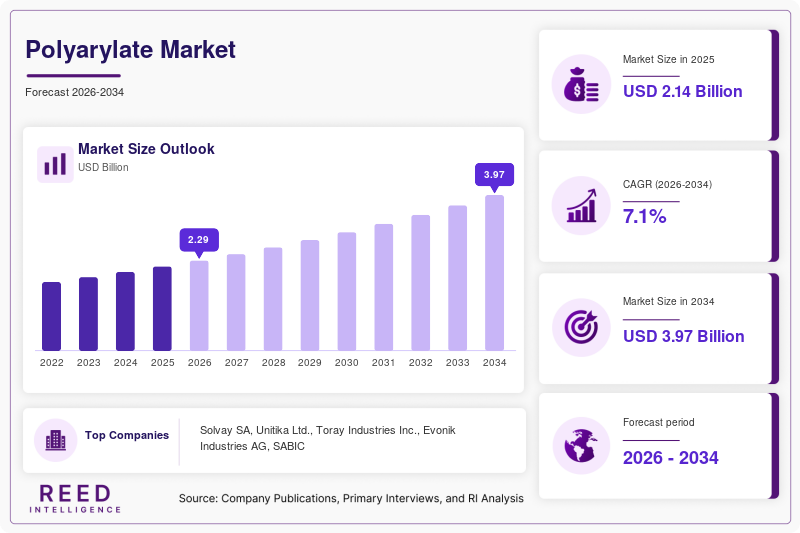
The global Polyarylate Market size was valued at USD 2.14 billion in 2025 and is projected to reach USD 3.96 billion by 2034, expanding at a CAGR of 7.1% during 2025–2034. Polyarylate is a high-performance aromatic polyester known for its excellent thermal stability, chemical resistance, and mechanical strength. These properties have positioned the material as a suitable option for advanced engineering applications across electronics, automotive components, and industrial manufacturing.
Growing demand for high-temperature-resistant engineering plastics across industrial applications supported the market expansion in 2025. Polyarylate materials have been increasingly used in environments where conventional plastics struggle to maintain performance. Industries such as electrical and electronics manufacturing require polymers capable of withstanding elevated temperatures and prolonged operational stress. As a result, manufacturers have adopted polyarylate to replace conventional engineering plastics in several structural and insulating components.
Key Highlights
- Asia Pacific dominated the market with 41.8% share in 2025, while Latin America is projected to grow fastest at 8.4% CAGR during the forecast period.
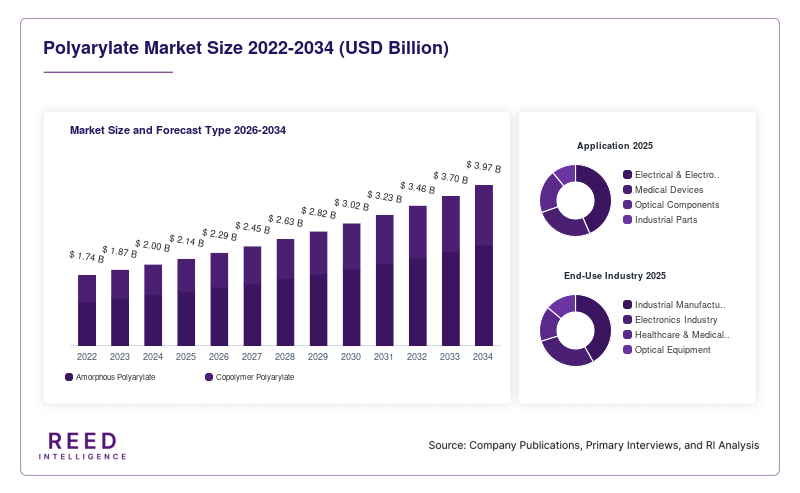
- By type, amorphous polyarylate accounted for 62.5% share in 2025, while copolymer polyarylate will grow fastest at 7.9% CAGR.
- By application, electrical & electronics components held 38.6% share, while medical devices are projected to expand at 8.1% CAGR.
- China remained the dominant country, with market values of USD 428 million in 2025 and USD 456 million in 2026.
Market Trends
Expansion of High-Performance Engineering Plastics in Electronics
One notable trend shaping the Polyarylate Market is the rising use of high-performance engineering plastics in electronics manufacturing. Modern electronic devices require components capable of operating under elevated temperatures while maintaining dimensional stability. Polyarylate materials offer strong heat resistance and dielectric properties, making them suitable for connectors, insulation components, and precision electronic parts.
As electronics manufacturers develop more compact devices with higher energy density, material requirements have shifted toward polymers capable of maintaining structural integrity under demanding operating conditions. This shift has encouraged the adoption of polyarylate resins in printed circuit board components, sensor housings, and electronic connectors.
Development of Specialized Polymer Formulations
Another trend influencing the Polyarylate Market involves the development of specialized polymer formulations tailored for industrial applications. Manufacturers are introducing customized polyarylate grades with enhanced chemical resistance, improved transparency, and higher mechanical strength.
These innovations are helping polyarylate materials penetrate new application areas including medical devices, laboratory equipment, and precision optical components. Advanced compounding techniques allow manufacturers to integrate additives and reinforcement materials that enhance overall polymer performance.
As industries demand materials that can meet highly specific operational requirements, specialized polyarylate grades are expected to gain broader adoption in advanced manufacturing sectors.
Market Drivers
Rising Demand for Heat-Resistant Engineering Plastics
The increasing demand for heat-resistant engineering plastics across manufacturing industries has supported growth in the Polyarylate Market. Industrial machinery, electrical equipment, and advanced manufacturing systems require materials capable of performing in high-temperature environments without losing structural stability.
Polyarylate polymers exhibit strong thermal resistance and dimensional stability compared with several conventional thermoplastics. This property makes them suitable for components that operate under constant mechanical stress and elevated temperatures. As industrial systems continue to become more complex and performance-driven, the requirement for reliable engineering materials has grown steadily.
Growth in Precision Manufacturing Industries
Another factor supporting the Polyarylate Market growth is the expansion of precision manufacturing industries such as electronics assembly, laboratory equipment production, and optical component manufacturing. These industries rely on materials with consistent mechanical performance and resistance to chemical degradation.
Polyarylate resins provide a balance between strength, transparency, and durability. This combination of properties allows manufacturers to produce high-precision parts while maintaining dimensional accuracy during production. As precision manufacturing processes continue to evolve, the demand for specialized polymer materials like polyarylate is expected to remain stable.
Market Restraint
High Production Costs of Specialty Polymers
One major restraint affecting the Polyarylate Market is the relatively high production cost associated with specialty polymer manufacturing. Polyarylate resins require advanced polymerization processes and high-purity raw materials, which increases overall production expenses compared with conventional engineering plastics.
Manufacturing polyarylate also involves complex synthesis techniques that demand specialized equipment and strict quality control procedures. These requirements add to operational costs and limit the number of manufacturers capable of producing the material at scale.
In price-sensitive industries, manufacturers may opt for alternative engineering plastics that offer moderate performance at lower costs. This substitution can limit the broader adoption of polyarylate in certain applications where high-performance characteristics are not strictly necessary.
Additionally, fluctuations in raw material prices used in aromatic polyester synthesis can influence production economics. Cost variations may affect profit margins and slow capacity expansion among manufacturers.
Although polyarylate offers strong performance advantages, cost considerations remain a challenge for market expansion in applications where alternative materials can meet minimum performance standards.
Market Opportunities
Expansion in Medical Device Manufacturing
An emerging opportunity for the Polyarylate Market lies in the growing medical device manufacturing sector. Polyarylate materials exhibit high chemical resistance, sterilization compatibility, and mechanical stability, which make them suitable for medical equipment and laboratory instruments.
Healthcare manufacturers increasingly require polymers capable of maintaining performance during repeated sterilization cycles. Polyarylate can meet these requirements while maintaining dimensional accuracy. As the medical device industry continues to expand globally, demand for specialized polymers is expected to increase.
Increasing Use in Optical and Precision Components
Another opportunity in the Polyarylate Market is the increasing adoption of polyarylate in optical and precision components. Certain grades of polyarylate provide transparency and dimensional stability required for advanced optical equipment and high-precision instruments.
These materials can be used in components such as optical housings, sensor enclosures, and high-accuracy mechanical parts. Industries involved in imaging technologies, analytical equipment, and precision instrumentation are gradually adopting materials that combine mechanical durability with optical clarity.
As these industries expand, demand for specialty polymers capable of meeting strict dimensional and optical requirements is likely to create new growth opportunities for polyarylate manufacturers.
Segmental Analysis
By Type
Amorphous polyarylate represented the dominant subsegment with 62.5% share of the Polyarylate Market in 2025. This type of polyarylate has been widely used due to its excellent transparency, dimensional stability, and resistance to heat. Manufacturers have adopted amorphous polyarylate in applications where optical clarity and consistent mechanical performance are essential. The material has been commonly used in precision components, electrical housings, and optical equipment due to its ability to maintain structural integrity under varying environmental conditions.
Copolymer polyarylate is expected to be the fastest-growing subsegment with a projected CAGR of 7.9% between 2025 and 2034. This segment will expand due to the ability of copolymer formulations to offer tailored material properties. Manufacturers will increasingly develop customized copolymer polyarylate grades to meet specific performance requirements across industrial sectors. The flexibility of copolymer formulations will allow producers to enhance characteristics such as impact resistance, thermal stability, and chemical durability. As industries continue to demand specialized polymer materials for unique operating conditions, copolymer polyarylate is likely to experience steady demand.
By Application
Electrical and electronics components held the largest share of 38.6% in the Polyarylate Market in 2025. Polyarylate materials have been widely used in connectors, insulation components, and electrical housings due to their strong dielectric properties and heat resistance. These characteristics allow electronic components to maintain operational stability even under elevated temperatures. As electronics manufacturing continues to evolve toward more compact and high-performance devices, materials capable of maintaining reliability under thermal stress have gained significant importance.
The medical devices segment will expand at the fastest CAGR of 8.1% during the forecast period. Growth in this segment will be driven by increasing demand for durable materials used in surgical instruments, diagnostic equipment, and laboratory devices. Polyarylate polymers provide chemical resistance and compatibility with sterilization processes, making them suitable for repeated use in medical environments. As healthcare equipment manufacturers continue to seek materials capable of maintaining performance under rigorous cleaning and sterilization procedures, the adoption of polyarylate in medical devices will increase.
By End-Use Industry
The industrial manufacturing sector accounted for 34.2% of the Polyarylate Market in 2025, making it the dominant end-use segment. Polyarylate has been utilized in industrial equipment components due to its durability, mechanical strength, and resistance to harsh operating environments. Manufacturers producing machinery and precision instruments have incorporated polyarylate components to enhance reliability and reduce maintenance requirements.
The optical equipment industry is expected to grow fastest at a CAGR of 7.8% during the forecast period. The expansion of imaging technologies and analytical instruments will increase the need for materials capable of maintaining optical clarity and dimensional accuracy. Polyarylate materials will increasingly be used in optical housings and precision structural components. The combination of transparency, strength, and chemical stability will support adoption in advanced optical equipment manufacturing.
Regional Analysis
North America
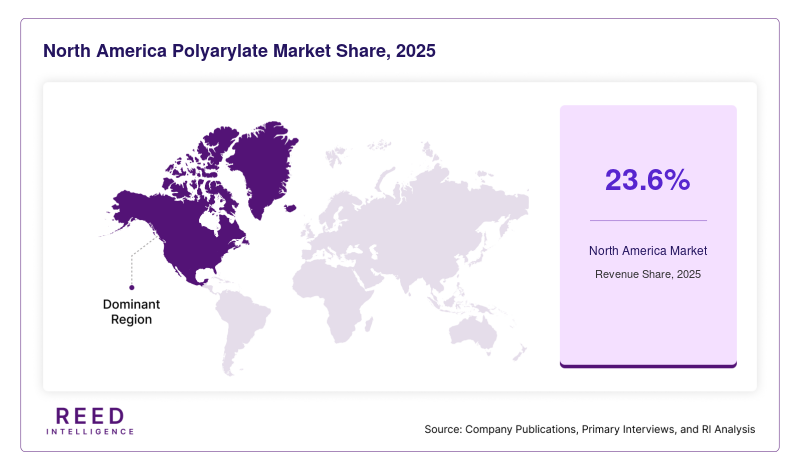
North America accounted for 23.6% of the global Polyarylate Market share in 2025. The region is expected to expand at a CAGR of 6.4% from 2025 to 2034. Market growth in the region has been associated with the presence of advanced manufacturing industries and well-established polymer research infrastructure. Several companies operating in engineering plastics have developed specialized polymer grades to support industrial applications across electronics, laboratory equipment, and high-precision instruments.
The United States represented the dominant country within the regional market. A key factor supporting growth in the country is the strong research and development ecosystem in polymer science and advanced materials engineering. Universities and research laboratories continue to develop improved polymer synthesis methods and advanced compounding technologies. These innovations contribute to the commercialization of specialty polymers such as polyarylate for industrial and scientific applications.
Europe
Europe held 21.9% share of the Polyarylate Market in 2025 and is projected to grow at a CAGR of 6.1% during the forecast period. The region’s polymer industry has focused on advanced material innovation and high-quality manufacturing processes. Engineering plastics manufacturers in the region have developed materials tailored for precision manufacturing and industrial equipment.
Germany remained the dominant country within the European market. The country’s industrial manufacturing sector has long emphasized high-performance materials for precision engineering. German manufacturers involved in industrial machinery and precision instrumentation have adopted advanced polymers to improve product durability and operational efficiency. This focus on high-precision manufacturing has supported the continued demand for specialized engineering plastics including polyarylate.
Asia Pacific
Asia Pacific represented the largest regional share of 41.8% in 2025 and is expected to expand at a CAGR of 7.6% between 2025 and 2034. The region has become a major manufacturing hub for electronics, industrial equipment, and polymer processing. Large-scale production capacity and growing domestic demand for engineering plastics have contributed to market expansion.
China emerged as the dominant country in the Asia Pacific Polyarylate Market. The country’s electronics manufacturing sector has continued to expand, producing a wide range of consumer electronics and industrial components. The presence of large-scale electronics assembly operations has increased demand for high-temperature-resistant materials used in connectors, housings, and electrical components. As manufacturing capacity continues to expand in China, the demand for advanced polymers is expected to remain stable.
Middle East & Africa
The Middle East & Africa accounted for 6.7% share of the Polyarylate Market in 2025 and will likely grow at a CAGR of 6.8% during the forecast period. The region has been gradually developing its advanced materials and polymer manufacturing capabilities to support industrial diversification strategies.
Saudi Arabia represented the dominant country within the regional market. The country has invested in petrochemical and advanced materials industries to diversify its industrial base. The presence of integrated petrochemical facilities and polymer production units has created opportunities for the development of specialty polymers. As local manufacturing capabilities expand, demand for engineering plastics such as polyarylate is expected to grow gradually.
Latin America
Latin America held 6.0% share of the Polyarylate Market in 2025 and is expected to expand at a CAGR of 8.4% through 2034, making it the fastest-growing region. Market expansion in the region has been associated with increasing industrial manufacturing and polymer processing activities.
Brazil emerged as the dominant country within the regional market. The country has been expanding its industrial manufacturing capabilities across electronics assembly, laboratory equipment production, and industrial components manufacturing. As domestic industries adopt more advanced materials to improve product quality and durability, demand for engineering polymers such as polyarylate is expected to increase.
Competitive Landscape
The Polyarylate Market includes several international polymer manufacturers focusing on specialty engineering plastics and advanced polymer materials. Companies compete through product innovation, research investments, and expansion of polymer processing capabilities.
Among the leading participants, Solvay SA has maintained a prominent position due to its expertise in specialty polymers and advanced material technologies. The company has continued to expand its high-performance polymer portfolio to support applications in electronics and industrial manufacturing.
Other companies including Unitika Ltd., Toray Industries Inc., Evonik Industries AG, and SABIC are also active participants in the market. These organizations focus on developing advanced polymer formulations designed to meet the requirements of modern manufacturing industries.
Strategic collaborations with research institutions and industrial manufacturers have allowed companies to improve product performance and expand their presence in emerging application areas.
Key Players
- Solvay SA
- Unitika Ltd.
- Toray Industries Inc.
- Evonik Industries AG
- SABIC
- Mitsubishi Chemical Group
- Teijin Limited
- Sumitomo Chemical Co. Ltd.
- Kuraray Co. Ltd.
- Arkema SA
- BASF SE
- Celanese Corporation
- LG Chem Ltd.
- Covestro AG
- Ensinger GmbH
Recent Developments
- 2024: A specialty polymer manufacturer introduced a new grade of transparent polyarylate designed for optical components and laboratory equipment.
- 2024: A major chemical company expanded its engineering plastics production facility to increase output of high-performance aromatic polyesters.
- 2023: A polymer research collaboration between a chemical manufacturer and a university developed an advanced polyarylate formulation with improved chemical resistance.
- 2023: A global materials company introduced a new polyarylate compound designed for electronic connectors and precision mechanical components.
Polyarylate Market Segments
Type
- Amorphous Polyarylate
- Copolymer Polyarylate
Application
- Electrical & Electronics Components
- Medical Devices
- Optical Components
- Industrial Parts
End-Use Industry
- Industrial Manufacturing
- Electronics Industry
- Healthcare & Medical Equipment
- Optical Equipment
By Region
- North America
- Europe
- APAC
- Middle East and Africa
- LATAM