Polybenzoxazole Fibers Market Size, Share & Demand Report By Product Type (Continuous Filament, Staple Fiber), By Form (Woven, Non-Woven), By Application (Protective Clothing, Aerospace Composites, Ropes & Cables, Sports Equipment), By End-Use Industry (Defense, Aerospace, Industrial Manufacturing, Others), By Region & Segment Forecasts, 2025–2034
USD 3950
Market Overview
The global Polybenzoxazole Fibers Market size was valued at approximately USD 1.2 billion in 2025 and is projected to reach USD 2.6 billion by 2034, expanding at a compound annual growth rate (CAGR) of 8.9% from 2025 to 2034. Polybenzoxazole (PBO) fibers are known for their exceptional tensile strength, thermal stability, and resistance to chemicals, making them a preferred material in high-performance applications such as aerospace, defense, and industrial safety equipment.
A key global factor supporting market growth is the rising demand for advanced high-performance materials in extreme environments, particularly in aerospace and defense sectors. Increasing investments in lightweight, durable materials for next-generation aircraft, ballistic protection systems, and high-temperature industrial applications have significantly contributed to the expansion of the Polybenzoxazole Fibers Market.
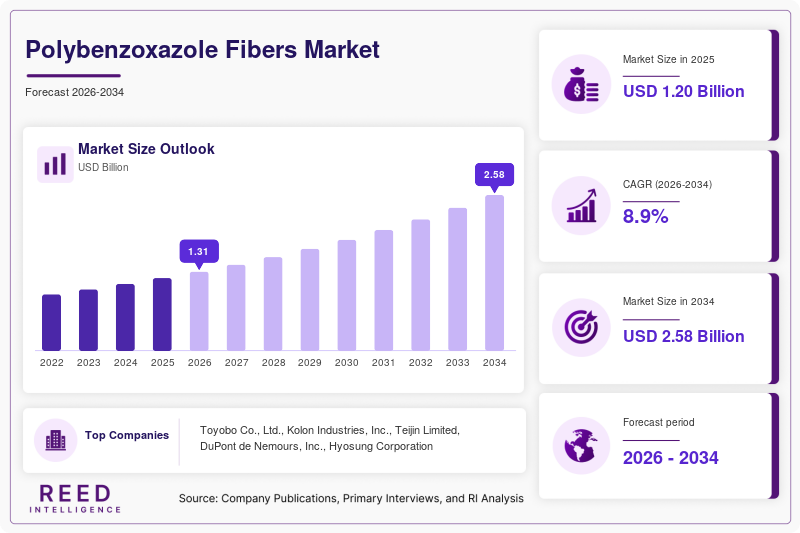
Key Highlights:
- North America dominated the market with a 36.5% share in 2025, while Asia Pacific is expected to register the fastest growth at a CAGR of 10.4%.
- By application, protective clothing led the market with a 31.2% share in 2024, while aerospace composites are projected to grow at the fastest CAGR of 9.8%.
- By end-use, the defense sector accounted for the largest share, whereas industrial manufacturing is anticipated to grow at a CAGR of 9.5%.
- The United States remained the dominant country, with market values of USD 380 million in 2024 and USD 410 million in 2025.
Market Trends
Increasing Adoption in Aerospace Composites
The Polybenzoxazole Fibers Market is witnessing a growing shift toward aerospace-grade composite materials. PBO fibers offer superior strength-to-weight ratios compared to conventional fibers such as aramid and carbon, making them suitable for structural reinforcement in aircraft and spacecraft components. Manufacturers are focusing on integrating PBO fibers into advanced composite systems to enhance performance while reducing overall weight. This trend is further supported by the rising production of commercial and defense aircraft globally.
Expansion of High-Performance Protective Textiles
Another notable trend shaping the Polybenzoxazole Fibers Market is the increasing use of PBO fibers in high-performance protective textiles. These fibers are being widely adopted in firefighting gear, military uniforms, and industrial safety apparel due to their flame resistance and durability. Technological advancements in textile engineering have enabled the development of lighter and more comfortable protective clothing without compromising safety standards, thereby driving demand across multiple industries.
Market Drivers
Growing Demand for Lightweight and High-Strength Materials
The increasing need for materials that combine low weight with high mechanical strength is a significant driver of the Polybenzoxazole Fibers Market. Industries such as aerospace, automotive, and defense require materials that enhance efficiency and performance while reducing structural weight. PBO fibers meet these requirements, making them a preferred choice for advanced engineering applications.
Rising Investment in Defense and Security Infrastructure
Global defense spending has been steadily increasing, leading to higher demand for advanced protective materials. Polybenzoxazole fibers are extensively used in ballistic protection systems, including body armor and helmets. Governments and defense organizations are investing in next-generation protective solutions, which is accelerating the adoption of PBO fibers in security applications.
Market Restraint
High Production Costs and Limited Commercial Availability
One of the primary challenges facing the Polybenzoxazole Fibers Market is the high cost associated with production and processing. The complex manufacturing process of PBO fibers requires specialized equipment and controlled conditions, resulting in higher costs compared to alternative materials such as aramid fibers. Additionally, limited production capacity and supply chain constraints restrict large-scale adoption across cost-sensitive industries. These factors collectively hinder market penetration, particularly in emerging economies where price sensitivity is a key consideration.
Market Opportunities
Emerging Applications in Renewable Energy
The increasing focus on renewable energy systems presents new opportunities for the Polybenzoxazole Fibers Market. PBO fibers are being explored for use in wind turbine components and high-performance cables due to their durability and resistance to environmental stress. As renewable energy infrastructure expands globally, demand for advanced materials like PBO fibers is expected to rise.
Advancements in Smart Textiles
The development of smart and functional textiles offers significant growth potential for the Polybenzoxazole Fibers Market. Integration of PBO fibers into wearable technologies and sensor-based fabrics can enhance durability and performance. These innovations are gaining traction in sectors such as healthcare, defense, and sports, creating new avenues for market expansion.
Segmental Analysis
By Application
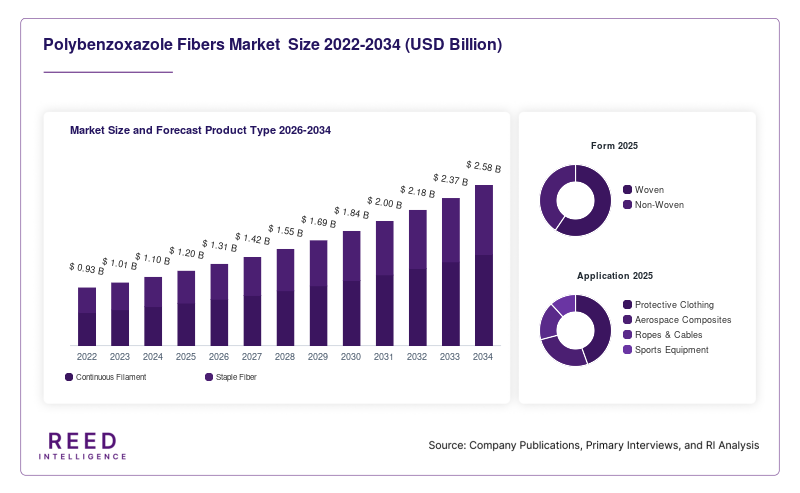
Protective clothing was the dominant subsegment, accounting for 31.2% of the market share in 2024. The widespread use of PBO fibers in firefighting suits, military uniforms, and industrial safety gear contributed to its leading position.
Aerospace composites are expected to be the fastest-growing subsegment, with a projected CAGR of 9.8%. The increasing demand for lightweight and high-strength materials in aircraft manufacturing will drive growth in this segment.
By End-Use Industry
The defense sector held the largest share of 34.6% in 2024, driven by extensive use of PBO fibers in ballistic protection systems.
Industrial manufacturing is anticipated to grow at the fastest CAGR of 9.5%, supported by rising demand for durable materials in high-temperature and high-stress environments.
By Product Type
Continuous filament fibers dominated the market with a 58.3% share in 2024, owing to their superior mechanical properties and suitability for high-performance applications.
Staple fibers are projected to grow at a CAGR of 8.7%, driven by their increasing use in textile and blended fabric applications.
By Form
Woven fabrics accounted for the largest share of 46.1% in 2024, as they are widely used in protective clothing and industrial applications.
Non-woven forms are expected to grow at a CAGR of 9.2%, supported by advancements in material processing technologies.
Regional Analysis
North America
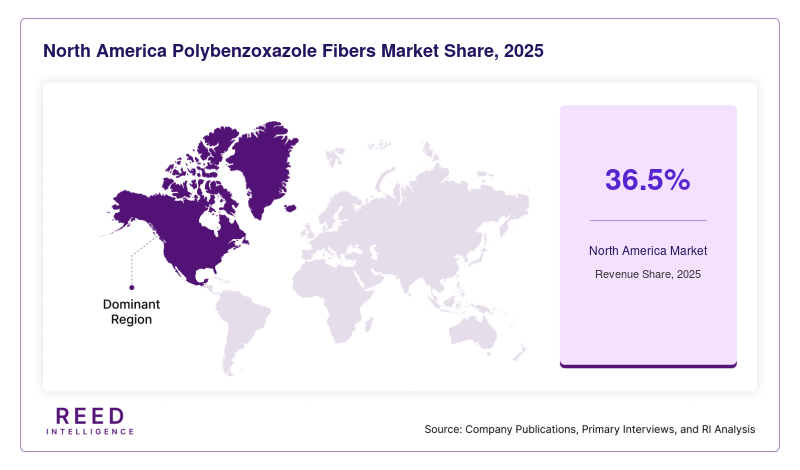
North America accounted for 36.5% of the Polybenzoxazole Fibers Market share in 2025 and is expected to grow at a CAGR of 8.1% through 2034. The region’s established aerospace and defense industries contributed to its leading position.
The United States dominated the regional market due to strong investments in advanced material research and defense modernization programs. The presence of leading aerospace manufacturers and continuous innovation in composite materials supported sustained demand for PBO fibers.
Europe
Europe held approximately 24.2% of the market share in 2025 and is projected to expand at a CAGR of 7.8% during the forecast period. The region’s focus on sustainability and advanced manufacturing technologies played a key role in market development.
Germany emerged as the dominant country, driven by its robust industrial base and emphasis on high-performance engineering materials. The automotive and industrial sectors contributed to increased adoption of PBO fibers for specialized applications.
Asia Pacific
Asia Pacific represented around 22.8% of the Polybenzoxazole Fibers Market share in 2025 and is anticipated to grow at the fastest CAGR of 10.4%. Rapid industrialization and expanding manufacturing capabilities supported regional growth.
China led the market in this region, driven by its large-scale production capacity and increasing investments in aerospace and defense sectors. The country’s focus on technological advancements and infrastructure development further boosted demand for PBO fibers.
Middle East & Africa
The Middle East & Africa accounted for 9.1% of the market share in 2025 and is expected to grow at a CAGR of 7.2%. The region’s growth was supported by increasing investments in industrial and defense sectors.
Saudi Arabia dominated the regional market, driven by government initiatives aimed at diversifying the economy and strengthening defense capabilities. The adoption of advanced materials in infrastructure and industrial projects contributed to market expansion.
Latin America
Latin America held approximately 7.4% of the Polybenzoxazole Fibers Market share in 2025 and is projected to grow at a CAGR of 7.5%. The region’s growth was influenced by increasing industrialization and infrastructure development.
Brazil emerged as the leading country, supported by its growing manufacturing sector and investments in industrial safety solutions. The demand for high-performance fibers in protective applications contributed to market growth.
Competitive Landscape
The Polybenzoxazole Fibers Market is characterized by a moderate level of competition, with a mix of global and regional players focusing on product innovation and strategic collaborations. Companies are investing in research and development to enhance fiber performance and expand application areas.
Toyobo Co., Ltd. is a leading player in the market, known for its advanced PBO fiber products. The company has recently focused on expanding its production capacity and developing next-generation fibers with improved durability and performance characteristics.
Other key players are adopting strategies such as mergers, partnerships, and technological advancements to strengthen their market position and meet evolving industry demands.
Key Players
- Toyobo Co., Ltd.
- Kolon Industries, Inc.
- Teijin Limited
- DuPont de Nemours, Inc.
- Hyosung Corporation
- Kureha Corporation
- Toray Industries, Inc.
- Mitsubishi Chemical Group
- SABIC
- Royal DSM
Recent Developments
- 2025: Toyobo Co., Ltd. expanded its PBO fiber production capacity to meet growing global demand.
- 2024: Teijin Limited introduced a new range of high-performance fibers for aerospace applications.
- 2024: DuPont announced research initiatives focused on advanced protective materials.
- 2023: Toray Industries invested in developing next-generation composite materials.
- 2023: Kolon Industries expanded its footprint in the high-performance fiber segment.
Polybenzoxazole Fibers Market Segments
Product Type
- Continuous Filament
- Staple Fiber
Form
- Woven
- Non-Woven
Application
- Protective Clothing
- Aerospace Composites
- Ropes & Cables
- Sports Equipment
End-Use Industry
- Defense
- Aerospace
- Industrial Manufacturing
- Others
By Region
- North America
- Europe
- APAC
- Middle East and Africa
- LATAM