Polycaprolactone Market Size, Share & Demand Report By Form (Pellets, Powder, Microspheres, Nanospheres), By Application (Healthcare and Biomedical, Packaging, 3D Printing, Thermoplastic Polyurethane, Coatings and Adhesives), By End-Use Industry (Healthcare, Packaging, Automotive, Construction, Consumer Goods, Electronics) By Region & Segment Forecasts, 2026–2034
USD 3950
Market Overview
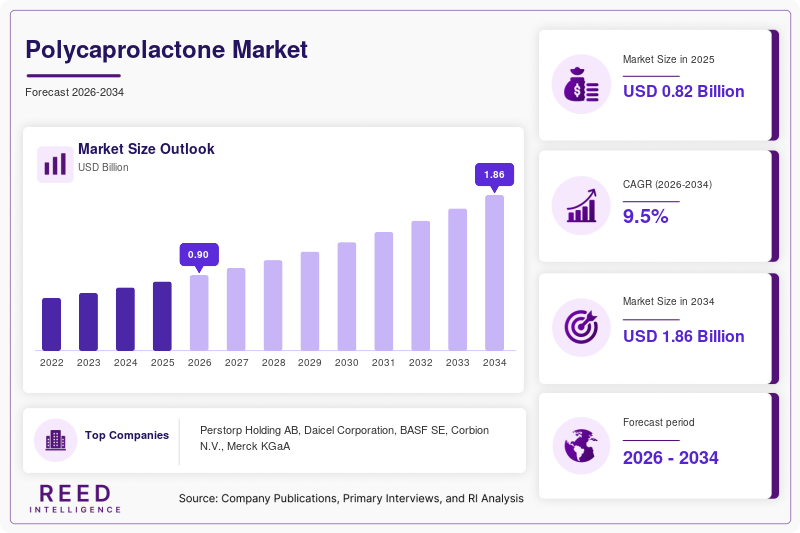
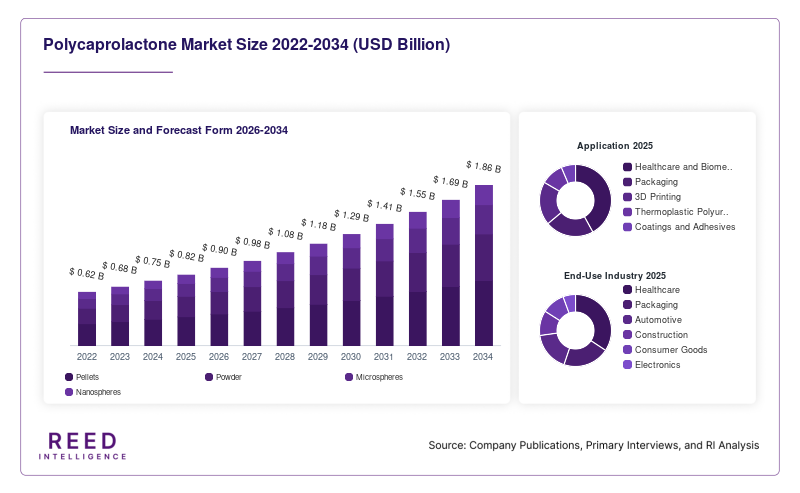
The global Polycaprolactone Market size was valued at USD 0.815 billion in 2026 and is projected to reach USD 1.68 billion by 2034, expanding at a CAGR of 9.5% during the forecast period from 2026 to 2034. Polycaprolactone is gaining wider commercial acceptance due to its biodegradable properties, compatibility with multiple polymers, and increasing use across healthcare, packaging, automotive, and additive manufacturing industries. The material is widely utilized in thermoplastic polyurethane production, medical implants, drug delivery systems, and sustainable packaging applications because of its low melting point and strong flexibility profile. Growing environmental regulations regarding conventional plastics are encouraging manufacturers to invest in biodegradable alternatives, which continues to support market expansion across developed and emerging economies.
The increasing focus on sustainable material innovation has emerged as a major global factor driving the market. Governments and private organizations are promoting the use of biodegradable polymers to reduce landfill waste and carbon emissions. Polycaprolactone manufacturers are expanding production capacities and developing customized formulations for biomedical engineering, tissue scaffolding, and 3D printing applications. The healthcare sector, particularly in North America and Europe, has shown strong demand for bioresorbable polymers for advanced wound care and orthopedic procedures. In addition, rising industrial investments in eco-friendly coatings and adhesives are creating additional revenue opportunities for market participants.
Key Highlights
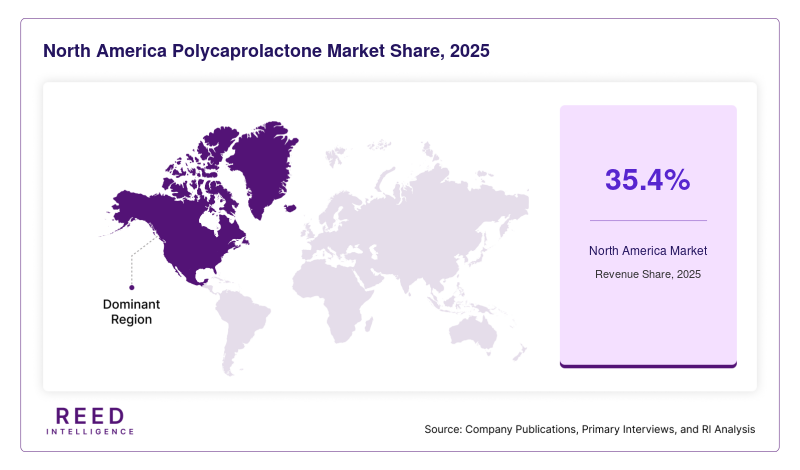
- North America dominated the market with a 35.4% share in 2025, while Asia Pacific is expected to grow at the fastest CAGR of 10.8% during 2026–2034.
- By form, pellets accounted for the largest share of 44.1%, while nanosphere formulations are projected to grow at a CAGR of 11.6%.
- By application, healthcare and biomedical applications led with a 39.3% share, whereas 3D printing applications are expected to expand at a CAGR of 12.1%.
- The United States remained the dominant country, with market values of USD 228 million in 2024 and USD 251 million in 2025.
Market Trends
Rising Adoption of Polycaprolactone in 3D Printing Applications
The growing adoption of additive manufacturing technologies is creating strong demand for polycaprolactone materials across industrial and healthcare sectors. Polycaprolactone offers low-temperature processing capabilities and excellent moldability, making it suitable for advanced 3D printing applications. Manufacturers are increasingly utilizing the polymer in customized prosthetics, tissue engineering models, and educational medical prototypes. The material also supports complex geometric printing with improved structural flexibility compared to traditional thermoplastics. In industrial settings, demand for biodegradable prototype materials is increasing as companies aim to reduce environmental impact during product development cycles. Research institutions and universities are also expanding investments in bio-based printing materials, which continues to improve product innovation and application diversity in the market.
Expanding Use of Biodegradable Materials in Sustainable Packaging
The shift toward sustainable packaging materials is influencing the adoption of biodegradable polymers such as polycaprolactone across consumer goods and food packaging industries. Packaging manufacturers are seeking alternatives that provide durability while meeting regulatory expectations related to waste reduction and environmental sustainability. Polycaprolactone blends are increasingly used in compostable films, specialty coatings, and flexible packaging structures. Companies operating in Europe and Asia Pacific are introducing sustainable packaging programs to comply with stricter environmental guidelines. Consumer preference for eco-friendly products is also encouraging brand owners to integrate biodegradable materials into product packaging strategies. Continuous advancements in polymer blending technologies are improving moisture resistance and mechanical strength, enabling wider commercial adoption in packaging applications.
Market Drivers
Increasing Demand from Biomedical and Healthcare Industries
The healthcare sector continues to be one of the most important growth drivers for the Polycaprolactone Market. The polymer is widely used in drug delivery systems, sutures, tissue engineering scaffolds, wound care products, and orthopedic implants due to its biocompatibility and biodegradability. Hospitals and research laboratories are increasing investments in advanced biomaterials that support regenerative medicine applications. Polycaprolactone provides slow degradation characteristics, making it suitable for long-term therapeutic use and controlled drug release systems. Rising healthcare spending in developed economies and growing research activities related to bioresorbable implants are supporting market expansion. Medical device manufacturers are also partnering with polymer producers to develop customized healthcare-grade formulations that improve patient outcomes and procedural efficiency.
Regulatory Support for Sustainable and Bio-Based Polymers
Environmental regulations focused on reducing conventional plastic waste are accelerating the demand for biodegradable polymers globally. Governments across Europe, North America, and parts of Asia Pacific are implementing stricter sustainability standards for packaging materials, industrial products, and consumer goods. These policies are encouraging manufacturers to invest in environmentally friendly polymer alternatives such as polycaprolactone. Several industries are transitioning toward bio-based raw materials to achieve corporate sustainability targets and reduce carbon emissions. In addition, increasing public awareness regarding plastic pollution is influencing purchasing behavior and encouraging businesses to adopt biodegradable materials. Financial incentives for sustainable manufacturing projects and investments in green chemistry technologies are further strengthening the long-term growth outlook for the market.
Market Restraint
High Production Costs and Limited Commercial Scalability
The relatively high production cost of polycaprolactone compared to conventional petroleum-based plastics remains a significant challenge for market growth. Manufacturing biodegradable polymers requires specialized processing technologies and raw material sourcing, which increases overall production expenses. Small and medium-scale manufacturers often face difficulties in achieving cost competitiveness, particularly in price-sensitive industries such as packaging and consumer goods. In addition, fluctuations in raw material availability can influence production stability and profit margins for suppliers. The limited large-scale commercialization infrastructure for biodegradable polymers also restricts rapid adoption in developing regions. For example, several packaging companies continue to rely on traditional plastics because of established supply chains and lower material costs. These economic challenges may slow market penetration despite increasing environmental awareness and regulatory support.
Market Opportunities
Growing Potential in Regenerative Medicine and Tissue Engineering
Regenerative medicine and tissue engineering applications are creating substantial opportunities for polycaprolactone manufacturers. The polymer’s biodegradability and compatibility with human tissue make it suitable for scaffolds, cartilage repair, and advanced wound healing products. Healthcare providers and research institutions are increasing investments in bioengineered medical solutions to address chronic injuries and age-related health conditions. Polycaprolactone-based biomaterials are being explored for long-term therapeutic applications because of their controlled degradation properties. The increasing number of clinical studies involving biodegradable implants is expected to strengthen product demand during the forecast period. Emerging economies are also investing in healthcare research infrastructure, which could expand the commercialization of advanced biomedical applications for polycaprolactone products.
Expansion of Eco-Friendly Consumer and Industrial Products
The transition toward sustainable manufacturing practices is generating new opportunities for polycaprolactone across industrial and consumer product segments. Companies are integrating biodegradable materials into adhesives, coatings, agricultural films, and specialty textiles to meet sustainability objectives and comply with environmental regulations. The construction and automotive sectors are also evaluating bio-based polymers to reduce carbon footprints associated with industrial production processes. In addition, rising consumer awareness regarding environmentally responsible products is encouraging brands to develop biodegradable packaging and disposable products. Technological advancements in polymer blending and material engineering are improving product performance, making polycaprolactone suitable for broader commercial applications. These developments are expected to create long-term growth opportunities for global manufacturers and raw material suppliers.
Segmental Analysis
By Form
Pellets represented the dominant subsegment within the Polycaprolactone Market and accounted for 44.1% of the market share in 2024. Pellet-based polycaprolactone materials are widely used because they offer easier processing compatibility for extrusion, molding, and blending applications. Manufacturers across packaging, automotive, and healthcare industries prefer pellet forms due to their efficient handling and adaptability with existing industrial equipment. The segment also benefits from increasing demand for biodegradable thermoplastics in sustainable product manufacturing. In healthcare applications, pellet formulations are utilized in producing controlled-release medical products and bioresorbable implants. Rising production activities among polymer manufacturers and the growing need for industrial-scale biodegradable material processing continue to support the strong market position of this segment.
Nanosphere formulations are projected to witness the fastest CAGR of 11.6% during the forecast period due to growing applications in targeted drug delivery and advanced biomedical research. These formulations provide enhanced surface functionality and improved compatibility with therapeutic compounds, making them suitable for modern pharmaceutical applications. Research institutions are increasing investments in nanotechnology-based healthcare solutions, particularly for cancer treatment and regenerative medicine. In addition, pharmaceutical companies are exploring polycaprolactone nanospheres for long-duration drug release systems that improve treatment efficiency. Technological advancements in nano-encapsulation processes and increasing funding for precision medicine development are expected to create substantial opportunities for this rapidly expanding subsegment.
By Application
Healthcare and biomedical applications accounted for the largest share of 39.3% in 2024 due to extensive utilization of polycaprolactone in tissue engineering, sutures, orthopedic implants, and drug delivery systems. The polymer’s biocompatibility and biodegradable characteristics make it suitable for advanced medical applications requiring controlled degradation properties. Hospitals and medical research organizations are increasing investments in regenerative medicine technologies, which continues to support segment growth. Polycaprolactone is also widely used in wound healing products and scaffold manufacturing for tissue regeneration procedures. The expansion of healthcare infrastructure, growing demand for minimally invasive medical devices, and rising research activities in biomedical engineering are further strengthening the dominance of this application segment.
3D printing applications are expected to register the fastest CAGR of 12.1% during the forecast period due to increasing adoption of additive manufacturing technologies across industrial and healthcare sectors. Polycaprolactone’s low melting point and excellent moldability support efficient 3D printing processes for customized medical devices, industrial prototypes, and educational models. Manufacturers are integrating biodegradable printing materials into production cycles to reduce environmental impact and improve sustainability performance. The healthcare sector is also using 3D-printed polycaprolactone structures for personalized implants and tissue engineering research. Continuous advancements in additive manufacturing technologies and increasing investments in customized product development are expected to accelerate growth within this segment.
By End-Use Industry
The healthcare industry dominated the Polycaprolactone Market with a 36.8% share in 2024 because of increasing demand for biodegradable polymers in medical technologies and pharmaceutical applications. Polycaprolactone materials are extensively used in surgical devices, controlled drug release systems, and bioresorbable implants. The industry benefits from rising healthcare expenditure, expanding geriatric populations, and increasing focus on regenerative medicine solutions. Medical device manufacturers are continuously developing advanced biomaterials that enhance patient recovery and reduce long-term complications. Regulatory support for biodegradable medical materials and growing investments in biomedical research infrastructure are also contributing to the strong position of the healthcare segment in the global market.
The packaging industry is anticipated to grow at the fastest CAGR of 10.9% during the forecast period due to rising environmental concerns and increasing demand for biodegradable packaging materials. Food and consumer goods companies are actively seeking sustainable alternatives to traditional plastics to comply with evolving environmental regulations and consumer expectations. Polycaprolactone-based blends are increasingly utilized in compostable films, flexible packaging, and specialty coatings. Packaging manufacturers are also investing in material innovation to improve moisture resistance and mechanical durability of biodegradable products. The expansion of e-commerce activities and increasing emphasis on eco-friendly packaging solutions are expected to create significant growth opportunities for this end-use segment.
Regional Analysis
North America
North America accounted for 35.4% of the global Polycaprolactone Market share in 2025 and is expected to maintain a stable growth trajectory with a CAGR of 8.7% during the forecast period. The region benefits from advanced healthcare infrastructure, strong biomedical research activities, and growing investments in sustainable packaging materials. Demand for biodegradable polymers is increasing across the United States and Canada due to environmental regulations and corporate sustainability programs. Major medical device manufacturers are also expanding the use of bioresorbable polymers in regenerative medicine applications, supporting regional market development.
The United States remained the dominant country in North America due to strong investments in healthcare innovation and advanced polymer research. The country has a well-established biomedical manufacturing ecosystem that supports the commercialization of tissue engineering products and drug delivery systems. Government funding for sustainable material research and the presence of leading polymer manufacturers are contributing to market growth. In addition, rising adoption of biodegradable materials in specialty packaging and additive manufacturing applications is supporting demand expansion across industrial sectors.
Europe
Europe represented 28.6% of the global market share in 2025 and is projected to grow at a CAGR of 8.9% through 2034. The region has implemented strict environmental regulations aimed at reducing plastic waste and encouraging sustainable material adoption. Countries across Western Europe are investing in biodegradable packaging technologies and green manufacturing practices. Polycaprolactone demand is increasing in healthcare, automotive, and industrial coating applications due to its environmentally friendly properties. Research collaborations between universities and polymer companies are also contributing to technological advancements and product innovation in the region.
Germany emerged as the leading country within the European market because of its advanced manufacturing sector and strong focus on industrial sustainability. The country is investing heavily in biodegradable materials for automotive coatings, medical technologies, and packaging applications. German chemical manufacturers are actively developing polymer blends with enhanced thermal and mechanical performance. In addition, the expansion of circular economy initiatives across the country is encouraging companies to adopt bio-based materials in production processes. These factors continue to strengthen Germany’s position in the regional market.
Asia Pacific
Asia Pacific held 23.8% of the global Polycaprolactone Market share in 2025 and is expected to record the fastest CAGR of 10.8% during the forecast period. Rapid industrialization, increasing healthcare expenditure, and expanding manufacturing activities are supporting regional market growth. Countries such as China, Japan, South Korea, and India are witnessing rising demand for biodegradable polymers across packaging and medical applications. Growing awareness regarding environmental sustainability is also encouraging regional manufacturers to invest in eco-friendly material technologies and biodegradable product development.
China dominated the Asia Pacific market due to its large-scale manufacturing capabilities and expanding investments in biodegradable polymer production. The country has become a major hub for packaging, electronics, and healthcare manufacturing, creating strong demand for sustainable materials. Government initiatives promoting environmentally friendly industrial practices are accelerating the use of biodegradable polymers across multiple sectors. In addition, the growing popularity of 3D printing technologies in healthcare and industrial prototyping is creating new application opportunities for polycaprolactone manufacturers operating in the country.
Middle East & Africa
The Middle East & Africa region accounted for 6.5% of the global market share in 2025 and is projected to expand at a CAGR of 7.8% during the forecast period. Market growth is supported by increasing awareness regarding sustainable materials and rising investments in healthcare infrastructure. Several countries are introducing environmental programs aimed at reducing plastic waste and encouraging biodegradable product adoption. Industrial diversification initiatives in Gulf countries are also promoting investments in specialty chemicals and advanced material manufacturing, creating opportunities for biodegradable polymer suppliers.
Saudi Arabia emerged as the dominant country within the Middle East & Africa market due to ongoing industrial modernization initiatives and healthcare sector expansion. The country is investing in advanced manufacturing technologies and sustainable industrial practices under long-term economic diversification programs. Demand for biodegradable materials is increasing in medical packaging, healthcare devices, and industrial applications. In addition, partnerships between regional petrochemical companies and international polymer manufacturers are supporting product development and improving the availability of specialty biodegradable materials across the market.
Latin America
Latin America captured 5.7% of the global Polycaprolactone Market share in 2025 and is expected to grow at a CAGR of 7.5% through 2034. The region is gradually adopting biodegradable polymers due to increasing environmental awareness and regulatory changes focused on waste reduction. Countries across the region are promoting sustainable packaging solutions for food, agriculture, and consumer goods industries. Healthcare investments and industrial modernization initiatives are also supporting demand for advanced biodegradable materials in medical and industrial applications.
Brazil remained the dominant country in the Latin American market due to its expanding packaging industry and growing emphasis on sustainable manufacturing practices. The country has introduced several environmental policies encouraging the use of biodegradable materials in packaging and agricultural applications. Rising investments in healthcare infrastructure and medical device production are also supporting polycaprolactone demand. Additionally, the presence of a large agricultural sector is creating opportunities for biodegradable films and specialty polymer products designed for environmentally responsible farming practices.
Competitive Landscape
The Polycaprolactone Market is moderately consolidated, with several global chemical and specialty polymer companies competing through product innovation, strategic partnerships, and production capacity expansion. Leading companies are focusing on developing high-performance biodegradable polymer formulations for healthcare, packaging, and industrial applications. Market participants are also investing in research and development activities to improve thermal stability, biodegradability, and mechanical performance characteristics of polycaprolactone products.
Perstorp Holding AB remains one of the leading companies in the market due to its strong product portfolio and extensive focus on specialty chemical innovation. The company has expanded its biodegradable polymer production capabilities to meet rising demand from healthcare and industrial customers. In recent developments, several manufacturers announced collaborations with biomedical research organizations to develop advanced tissue engineering materials and drug delivery systems. Companies are also increasing investments in Asia Pacific manufacturing facilities to strengthen regional supply chains and improve commercial scalability. Competitive differentiation is increasingly based on customized product development, sustainability performance, and application-specific material engineering capabilities.
Key Players
- Perstorp Holding AB
- Daicel Corporation
- BASF SE
- Corbion N.V.
- Merck KGaA
- Shenzhen Esun Industrial Co., Ltd.
- PolySciences Inc.
- Haihang Industry Co., Ltd.
- Otto Chemie Pvt. Ltd.
- CD Bioparticles
- Sigma-Aldrich Corporation
- Durect Corporation
- Zhejiang Double Arrow Rubber Co., Ltd.
- Evonik Industries AG
- Ingevity Corporation
Recent Developments
- In February 2026, Perstorp Holding AB expanded its biodegradable polymer manufacturing capacity in Europe to support rising demand from healthcare and sustainable packaging industries.
- In August 2025, Daicel Corporation introduced an advanced polycaprolactone formulation designed for high-performance biomedical scaffolding and regenerative medicine applications.
- In November 2025, BASF SE announced a collaborative research initiative with medical technology companies to develop biodegradable materials for next-generation drug delivery systems.
- In April 2026, Corbion N.V. launched a new sustainable polymer blending platform focused on improving the durability and compostability of biodegradable packaging materials.
Polycaprolactone Market Segments
Form
- Pellets
- Powder
- Microspheres
- Nanospheres
Application
- Healthcare and Biomedical
- Packaging
- 3D Printing
- Thermoplastic Polyurethane
- Coatings and Adhesives
End-Use Industry
- Healthcare
- Packaging
- Automotive
- Construction
- Consumer Goods
- Electronics
By Region
- North America
- Europe
- APAC
- Middle East and Africa
- LATAM