Polycythemia Vera Market Size, Share & Demand Report By Drug Class (JAK Inhibitors, Interferon Therapies, Hydroxyurea, Others), By Treatment Type (Pharmacological Therapy, Phlebotomy, Combination Therapy), By End-Use (Hospitals, Specialty Clinics, Ambulatory Care Centers), By Region & Segment Forecasts, 2026–2034
USD 3950
Market Overview
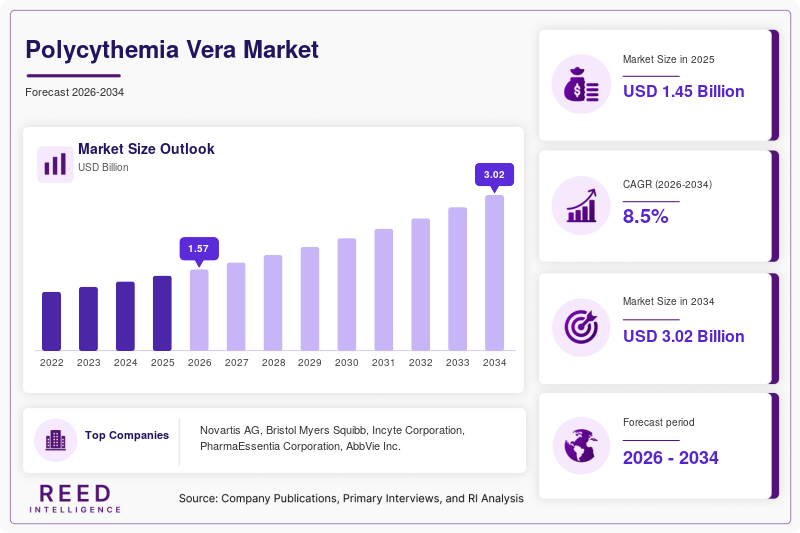
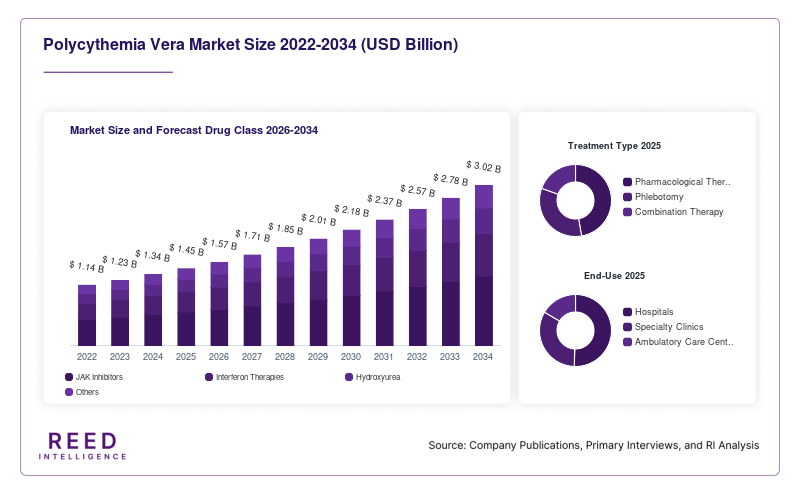
The global Polycythemia Vera Market was valued at approximately USD 1.45 billion in 2026 and is projected to reach USD 2.78 billion by 2034, expanding at a CAGR of 8.5% during the forecast period (2026–2034). The market growth is primarily supported by the increasing prevalence of myeloproliferative neoplasms and the rising demand for targeted therapies aimed at managing rare hematological disorders. Polycythemia vera, a chronic blood cancer characterized by excessive red blood cell production, has gained greater clinical attention due to improved diagnostic capabilities and increased disease awareness among healthcare providers.
One of the major global factors driving market expansion is the continuous advancement in precision medicine. Pharmaceutical companies are focusing on developing novel JAK inhibitors and combination therapies that offer better disease control and improved patient outcomes. Additionally, favorable regulatory frameworks for orphan drugs have accelerated drug approvals and encouraged investment in research and development activities.
Key Highlights
- North America dominated the market with a 36.8% share in 2025.
- Asia Pacific is expected to grow at the fastest CAGR of 10.9% during 2026–2034.
- By drug class, JAK inhibitors accounted for the largest share of 44.6%.
- while interferon therapies are projected to grow at a CAGR of 9.8%.
- By treatment type, pharmacological therapy led with a 71.3% share, whereas combination therapy is expected to expand at a CAGR of 10.4%.
- The United States remained the dominant country, with market values of USD 520 million in 2024 and USD 575 million in 2025.
Market Trends
Increasing Adoption of Targeted Therapies
A prominent trend shaping the Polycythemia Vera Market is the growing adoption of targeted therapies, particularly JAK inhibitors. These therapies specifically target genetic mutations such as JAK2 V617F, which is present in a majority of polycythemia vera patients. Unlike traditional treatments such as phlebotomy or hydroxyurea, targeted therapies provide more precise disease control with fewer systemic side effects. Pharmaceutical companies are actively investing in next-generation inhibitors and combination regimens to improve efficacy and reduce resistance. The trend is further supported by increasing clinical trial activity and regulatory approvals, enabling faster commercialization of advanced therapies.
Shift Toward Personalized Medicine and Biomarker-Based Treatment
Another significant trend is the shift toward personalized medicine, driven by advancements in molecular diagnostics and biomarker identification. Healthcare providers are increasingly using genetic profiling to tailor treatment plans based on individual patient characteristics. This approach enhances treatment outcomes and reduces the risk of adverse reactions. The integration of digital health tools and AI-driven diagnostics is also supporting this trend by enabling more accurate disease monitoring. As a result, pharmaceutical companies are focusing on developing therapies that align with precision medicine frameworks, contributing to improved patient adherence and long-term disease management.
Market Drivers
Rising Prevalence of Myeloproliferative Disorders
The increasing prevalence of myeloproliferative neoplasms, including polycythemia vera, is a key driver of market growth. Aging populations across developed and developing regions have contributed to a higher incidence of hematological disorders. Polycythemia vera is more commonly diagnosed in individuals above 60 years of age, and the global rise in elderly populations has led to a steady increase in patient pools. Additionally, improved diagnostic techniques have enhanced detection rates, further contributing to market expansion. Healthcare systems are also prioritizing early diagnosis and disease management, which has increased the demand for effective treatment options.
Advancements in Drug Development and Regulatory Support
Continuous advancements in drug development have significantly influenced the growth of the Polycythemia Vera Market. Pharmaceutical companies are focusing on innovative drug formulations, including long-acting interferons and next-generation JAK inhibitors. Regulatory agencies have also introduced supportive frameworks for orphan diseases, enabling faster approval processes and extended market exclusivity. These incentives have encouraged investments in research and development, resulting in a robust pipeline of novel therapies. Furthermore, collaborations between biotechnology firms and academic institutions have accelerated clinical trials, enhancing the availability of new treatment options.
Market Restraint
High Cost of Treatment and Limited Accessibility
One of the major restraints impacting the Polycythemia Vera Market is the high cost associated with advanced therapies. Targeted treatments such as JAK inhibitors and interferon-based therapies often come with significant price tags, making them less accessible to patients in low- and middle-income countries. Despite the availability of reimbursement policies in developed regions, out-of-pocket expenses remain a concern for many patients. This financial burden can lead to delayed treatment initiation or discontinuation, negatively affecting patient outcomes.
Additionally, limited healthcare infrastructure in certain regions restricts access to specialized diagnostic and treatment facilities. For instance, genetic testing required for precise diagnosis is not widely available in rural areas, leading to underdiagnosis and undertreatment. The high cost of clinical trials and drug development also contributes to elevated pricing of therapies. As a result, market growth is somewhat constrained, particularly in emerging economies where healthcare budgets are limited. Addressing these challenges requires collaborative efforts between governments, pharmaceutical companies, and healthcare providers to improve affordability and accessibility.
Market Opportunities
Expansion in Emerging Markets
Emerging economies present significant growth opportunities for the Polycythemia Vera Market due to improving healthcare infrastructure and rising awareness of rare diseases. Countries in Asia Pacific and Latin America are witnessing increased investments in healthcare systems, enabling better diagnosis and treatment of hematological disorders. Government initiatives aimed at expanding insurance coverage and subsidizing treatment costs are further supporting market growth. Pharmaceutical companies are also focusing on strategic partnerships and local manufacturing to reduce costs and improve distribution networks. These developments are expected to enhance patient access to advanced therapies and drive market expansion.
Development of Combination Therapies
The development of combination therapies offers a promising opportunity for market growth. Combining different drug classes, such as JAK inhibitors with interferons or other targeted agents, can improve treatment efficacy and reduce disease progression. Clinical studies have shown that combination approaches can achieve better hematological control and minimize side effects compared to monotherapy. This has encouraged pharmaceutical companies to invest in research and development of innovative treatment regimens. As a result, the adoption of combination therapies is expected to increase, providing new avenues for market growth and improving patient outcomes.
Segmental Analysis
By Drug Class
JAK inhibitors emerged as the dominant subsegment in the Polycythemia Vera Market, accounting for approximately 44.6% of the market share in 2024. These drugs have become a standard treatment option due to their ability to target specific genetic mutations associated with the disease. The high adoption rate is attributed to their effectiveness in controlling hematocrit levels and reducing symptoms. Additionally, ongoing research and development activities have led to the introduction of improved formulations with enhanced efficacy and safety profiles. Healthcare providers increasingly prefer JAK inhibitors due to their proven clinical outcomes and patient compliance.
Interferon therapies are expected to be the fastest-growing subsegment, with a projected CAGR of 9.8% during the forecast period. The growth is driven by the increasing use of pegylated interferons, which offer longer duration of action and improved tolerability. These therapies are particularly suitable for younger patients and those who cannot tolerate traditional treatments. Advances in drug delivery systems and ongoing clinical trials are further supporting the adoption of interferon-based therapies. As a result, this subsegment is expected to gain significant traction in the coming years.
By Treatment Type
Pharmacological therapy dominated the Polycythemia Vera Market in 2024, accounting for a share of 71.3%. This segment includes various drug-based treatments such as JAK inhibitors, interferons, and cytoreductive agents. The dominance of pharmacological therapy is attributed to its effectiveness in managing disease symptoms and preventing complications. Increasing patient preference for non-invasive treatment options and the availability of a wide range of drugs have further supported segment growth. Additionally, continuous advancements in drug formulations have improved treatment outcomes, reinforcing the segment’s leading position.
Combination therapy is expected to be the fastest-growing subsegment, with a CAGR of 10.4% during the forecast period. The growth is driven by the increasing adoption of multi-drug regimens that offer improved efficacy and reduced side effects. Combination therapies are particularly beneficial for patients with advanced disease stages or those who do not respond to monotherapy. Ongoing research and clinical trials are exploring new combinations, further supporting segment growth. This approach is expected to enhance patient outcomes and drive market expansion.
By End-Use
Hospitals accounted for the largest share of the Polycythemia Vera Market in 2024, holding approximately 52.8% of the market. The dominance of this segment is attributed to the availability of advanced diagnostic and treatment facilities, as well as the presence of skilled healthcare professionals. Hospitals are often the primary point of care for patients with complex conditions, including polycythemia vera. Additionally, the integration of advanced technologies and access to clinical trials have further supported segment growth.
Specialty clinics are projected to be the fastest-growing subsegment, with a CAGR of 9.6% during the forecast period. The growth is driven by the increasing demand for specialized care and personalized treatment approaches. Specialty clinics offer focused expertise in hematology, enabling better disease management and improved patient outcomes. The growing trend of outpatient care and the expansion of specialized healthcare facilities are further supporting the growth of this segment.
Regional Analysis
North America
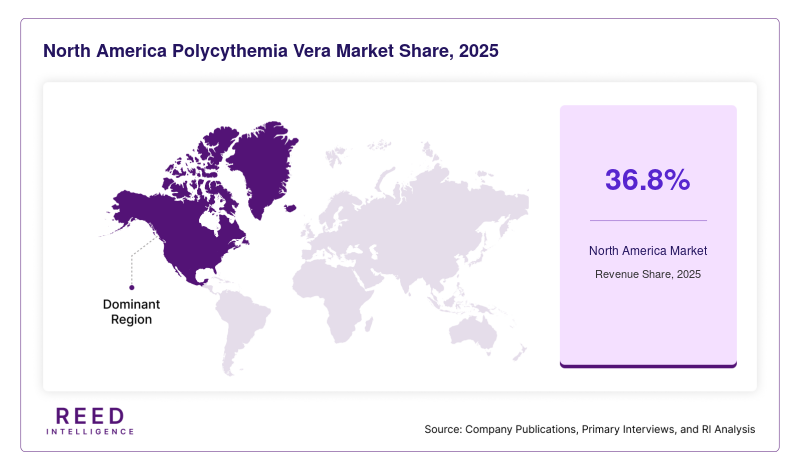
North America held the largest share of the Polycythemia Vera Market in 2025, accounting for approximately 36.8% of the global revenue. The region is expected to maintain its dominance throughout the forecast period, with a steady CAGR of 7.9% from 2026 to 2034. The presence of advanced healthcare infrastructure, high awareness levels, and strong reimbursement frameworks has contributed to the region’s leading position. Additionally, significant investments in research and development and early adoption of innovative therapies have supported sustained market growth.
The United States dominates the North American market due to its well-established healthcare system and high prevalence of polycythemia vera. One unique growth factor in the country is the strong presence of biotechnology companies actively engaged in clinical trials and drug innovation. This has led to faster approval and commercialization of new therapies, enhancing treatment availability and improving patient outcomes.
Europe
Europe accounted for a substantial share of the Polycythemia Vera Market in 2025, contributing around 28.4% of global revenue. The region is projected to grow at a CAGR of 8.1% during the forecast period. Favorable government policies, increasing healthcare expenditure, and rising awareness of rare diseases have supported market growth. Countries in Western Europe have particularly benefited from well-structured healthcare systems and access to advanced treatment options.
Germany is the dominant country in the European market, driven by its strong healthcare infrastructure and high adoption of innovative therapies. A unique growth factor in Germany is the emphasis on early diagnosis and patient management through specialized hematology centers. This approach has improved treatment outcomes and increased demand for advanced therapies, contributing to market expansion.
Asia Pacific
Asia Pacific is expected to witness the fastest growth in the Polycythemia Vera Market, with a projected CAGR of 10.9% during 2026–2034. The region accounted for approximately 18.7% of the market share in 2025. Rapid economic development, improving healthcare infrastructure, and increasing awareness of rare diseases have driven market growth. Additionally, government initiatives aimed at expanding healthcare access have further supported the adoption of advanced treatments.
China leads the Asia Pacific market due to its large population and increasing prevalence of hematological disorders. A unique growth factor in China is the rapid expansion of domestic pharmaceutical manufacturing, which has reduced treatment costs and improved accessibility. This has enabled a larger patient population to receive appropriate care, supporting market growth.
Middle East & Africa
The Middle East & Africa region held a smaller share of the Polycythemia Vera Market in 2025, accounting for around 8.2%. However, the market is expected to grow at a CAGR of 8.7% during the forecast period. Increasing healthcare investments and rising awareness of rare diseases are key factors driving growth in the region. Governments are focusing on improving healthcare infrastructure and expanding access to advanced treatments.
Saudi Arabia is the leading country in the region, supported by its strong healthcare initiatives and investments in medical research. A unique growth factor is the government’s focus on modernizing healthcare facilities and adopting advanced diagnostic technologies. This has improved early detection rates and increased demand for effective treatment options.
Latin America
Latin America accounted for approximately 7.9% of the Polycythemia Vera Market in 2025 and is projected to grow at a CAGR of 8.4% during the forecast period. The region’s growth is driven by improving healthcare systems and increasing awareness of hematological disorders. Governments are implementing policies to enhance healthcare access and reduce treatment costs, supporting market expansion.
Brazil dominates the Latin American market due to its large population and growing healthcare sector. A unique growth factor in Brazil is the increasing collaboration between public and private healthcare providers to improve treatment accessibility. This has led to better patient outcomes and increased adoption of advanced therapies, contributing to market growth.
Competitive Landscape
The Polycythemia Vera Market is characterized by moderate competition, with several key players focusing on innovation and strategic collaborations to strengthen their market positions. Leading companies are investing in research and development to introduce novel therapies and improve existing treatment options. The market also witnesses partnerships between pharmaceutical firms and research institutions to accelerate drug development.
One of the leading players in the market is Novartis AG, which has established a strong presence through its portfolio of JAK inhibitors. The company continues to focus on expanding its product offerings and enhancing its global reach. A recent development includes the advancement of clinical trials for next-generation therapies aimed at improving treatment outcomes.
Other major players are actively engaged in mergers, acquisitions, and product launches to gain a competitive edge. The focus on personalized medicine and combination therapies is expected to intensify competition in the coming years.
Key Players List
- Novartis AG
- Bristol Myers Squibb
- Incyte Corporation
- PharmaEssentia Corporation
- AbbVie Inc.
- Pfizer Inc.
- Roche Holding AG
- Merck & Co., Inc.
- Teva Pharmaceutical Industries Ltd.
- Sanofi S.A.
- AstraZeneca plc
- Johnson & Johnson
- Takeda Pharmaceutical Company Limited
- Amgen Inc.
- Bayer AG
Recent Developments
- A leading pharmaceutical company announced positive Phase III trial results for a next-generation JAK inhibitor targeting polycythemia vera patients resistant to standard therapies.
- A biotechnology firm introduced a novel interferon-based therapy with improved dosing convenience, enhancing patient adherence.
- Strategic collaboration between two major companies aimed at developing combination therapies for improved disease management and long-term outcomes.
Polycythemia Vera Market Segments
Drug Class
- JAK Inhibitors
- Interferon Therapies
- Hydroxyurea
- Others
Treatment Type
- Pharmacological Therapy
- Phlebotomy
- Combination Therapy
End-Use
- Hospitals
- Specialty Clinics
- Ambulatory Care Centers
By Region
- North America
- Europe
- APAC
- Middle East and Africa
- LATAM