Polyester Forming Fabric Market Size, Share & Demand Report By Fabric Type (Single-Layer Fabrics, Double-Layer Fabrics, Triple-Layer Fabrics, Others), By Application (Packaging Paper, Tissue Paper, Printing & Writing Paper, Specialty Paper, Industrial Paper), By End Use (Paper Mills, Tissue Manufacturers, Specialty Paper Manufacturers, Industrial Paper Producers), By Region & Segment Forecasts, 2026–2034
USD 3950
Market Overview
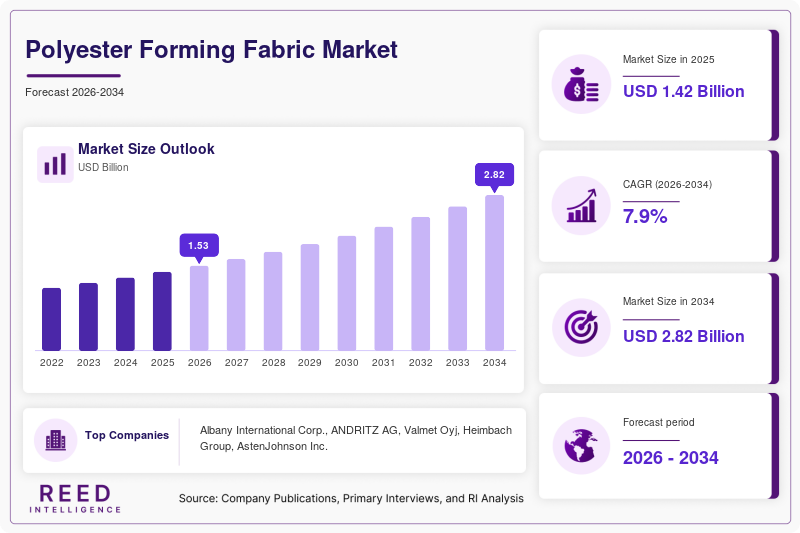
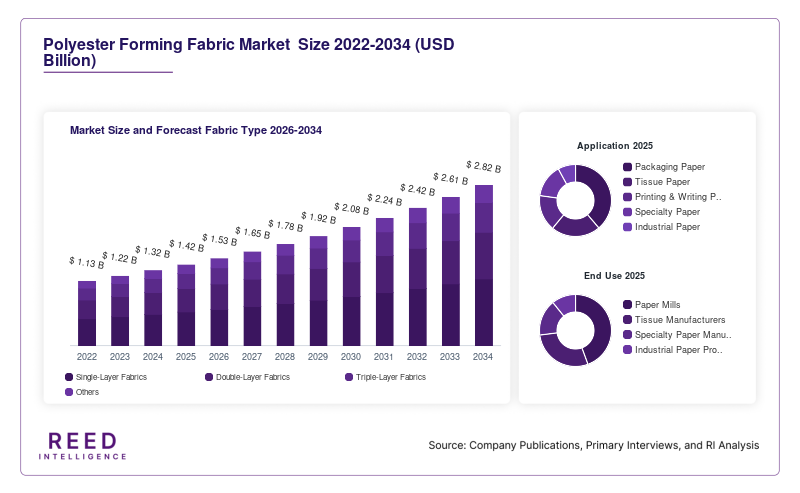
The global Polyester Forming Fabric Market size was valued at USD 1.42 billion in 2026 and is projected to reach USD 2.61 billion by 2034, expanding at a CAGR of 7.9% during the forecast period from 2026 to 2034. Polyester forming fabrics are widely used in paper manufacturing processes, where they support sheet formation, water drainage, and production efficiency. The market continues to benefit from the growing demand for packaging paper, tissue paper, and specialty paper products across industrial and consumer applications. Increasing automation in paper mills and the transition toward high-speed paper machines have also encouraged paper manufacturers to invest in durable and high-performance forming fabrics with extended operational life.
One of the major global factors supporting market growth is the rising consumption of sustainable packaging materials. Governments and packaging companies are reducing dependence on plastic packaging and increasing investments in recyclable paper-based solutions. This shift has accelerated the demand for paper production equipment and associated consumables such as polyester forming fabrics. In addition, advancements in monofilament yarn technology, improved wear resistance, and energy-efficient fabric structures are contributing to higher adoption among paper manufacturers seeking operational efficiency and lower maintenance costs.
Key Highlights
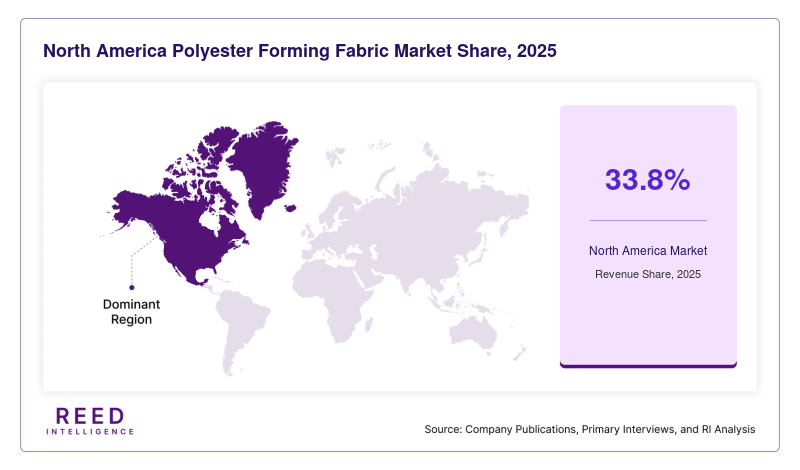
- North America dominated the market with a 33.8% share in 2025.
- Asia Pacific is expected to grow at the fastest CAGR of 9.8% during 2026–2034.
- By fabric type, single-layer fabrics accounted for the largest share of 39.4%, while triple-layer fabrics are projected to grow at a CAGR of 10.1%.
- By application, packaging paper production led with a 44.7% share, whereas tissue paper applications are expected to expand at a CAGR of 9.6%.
- By end use, paper mills represented the dominant share of 68.5%, while specialty paper manufacturers are projected to grow at a CAGR of 8.9%.
- The United States remained the dominant country, with market values of USD 312 million in 2024 and USD 338 million in 2025.
Market Trends
Growing Adoption of Multilayer Polyester Forming Fabrics
Paper manufacturers are increasingly adopting multilayer polyester forming fabrics to improve sheet quality, drainage efficiency, and machine speed performance. Double-layer and triple-layer fabrics are becoming more common in high-speed paper machines because they provide better fiber support and improved dimensional stability compared to conventional single-layer variants. These fabrics also help reduce paper defects and improve uniformity, which is important for packaging paper and specialty paper applications. Manufacturers are focusing on innovative weaving technologies and advanced monofilament structures that enhance wear resistance and extend product lifespan. As paper mills continue to modernize their production facilities, demand for technologically advanced polyester forming fabrics is expected to rise steadily across developed and emerging economies.
Expansion of Sustainable Paper Packaging Production
The increasing global demand for sustainable paper packaging solutions is creating strong growth momentum for the Polyester Forming Fabric Market. Food and beverage companies, e-commerce retailers, and consumer goods manufacturers are shifting toward recyclable paper-based packaging materials to align with environmental regulations and consumer preferences. This transition has encouraged investments in containerboard, kraft paper, and corrugated packaging production facilities. Polyester forming fabrics play a critical role in supporting efficient paper formation and high-volume manufacturing processes within these facilities. Additionally, governments in several countries are implementing restrictions on single-use plastics, which is encouraging further expansion of paper production capacity. This trend is expected to support consistent replacement demand for polyester forming fabrics during the forecast period.
Market Drivers
Rising Demand for Packaging and Industrial Paper Products
The growing use of packaging paper and industrial paper products is one of the major drivers supporting the Polyester Forming Fabric Market. Rapid expansion of e-commerce activities, food delivery services, and consumer goods distribution networks has significantly increased the demand for corrugated boxes, kraft paper, and carton packaging. Paper manufacturers are scaling up production capacities to meet this rising demand, resulting in greater utilization of high-performance forming fabrics. Polyester forming fabrics are essential for maintaining paper machine productivity and ensuring efficient drainage during the paper formation process. The replacement cycle for these fabrics also contributes to recurring revenue generation in the market. Furthermore, industrial packaging manufacturers are increasingly prioritizing product quality consistency, which supports the adoption of premium polyester forming fabric solutions.
Increasing Modernization of Paper Manufacturing Facilities
Paper manufacturers across several regions are investing in advanced production technologies and machine upgrades to improve operational efficiency and reduce downtime. Modern paper machines operate at higher speeds and require durable forming fabrics capable of withstanding continuous mechanical stress and chemical exposure. Polyester forming fabrics are gaining strong demand because of their dimensional stability, resistance to abrasion, and long service life. Manufacturers are also integrating automated monitoring systems and predictive maintenance technologies into paper mills, which is increasing the preference for premium-quality consumables. In developing economies, rising industrialization and expansion of tissue paper production facilities are further driving investments in modern paper manufacturing infrastructure, creating long-term growth opportunities for polyester forming fabric suppliers.
Market Restraint
Volatility in Raw Material Prices and Competitive Pricing Pressure
Fluctuating prices of polyester yarns and synthetic raw materials continue to create challenges for manufacturers operating in the Polyester Forming Fabric Market. Polyester monofilaments used in forming fabrics are derived from petrochemical products, making production costs sensitive to changes in crude oil prices and global supply chain disruptions. Sudden increases in raw material costs can affect profit margins for manufacturers, particularly in highly competitive regional markets where pricing pressure remains intense. Smaller suppliers often struggle to maintain stable pricing contracts with paper mills while also managing rising production expenses.
The market is also characterized by strong competition among regional and international suppliers, leading to aggressive pricing strategies. Paper manufacturers frequently negotiate long-term procurement agreements and seek cost-effective alternatives to reduce operating expenses. This environment can limit profitability for premium product manufacturers despite investments in research and development. Additionally, supply chain disruptions related to transportation costs, energy shortages, and geopolitical uncertainties may impact the timely delivery of forming fabrics to paper mills. These challenges could restrain market expansion, particularly for smaller companies with limited manufacturing capacity and weaker distribution networks.
Market Opportunities
Expansion of Tissue Paper Manufacturing in Emerging Economies
The rapid growth of tissue paper manufacturing in emerging economies presents a strong opportunity for the Polyester Forming Fabric Market. Rising urbanization, improving hygiene awareness, and increasing disposable income levels are supporting higher consumption of tissue products such as paper towels, facial tissues, and toilet paper. Countries across Asia Pacific, Latin America, and the Middle East are witnessing investments in new tissue paper plants and modernization of existing paper mills. Polyester forming fabrics designed for tissue applications help improve sheet formation quality and production efficiency while reducing energy consumption. As tissue paper manufacturers focus on increasing production output and maintaining product consistency, demand for advanced forming fabrics is expected to rise significantly during the forecast period.
Technological Advancements in High-Performance Fabric Design
Continuous innovation in polyester forming fabric design is creating new growth opportunities for manufacturers focused on high-performance solutions. Companies are developing fabrics with enhanced permeability, better fiber support, and improved resistance to contamination and abrasion. These innovations help paper mills achieve longer operating cycles and lower maintenance requirements. Advanced weaving technologies and customized fabric structures are also enabling suppliers to address specific production requirements across packaging paper, specialty paper, and fine paper applications. In addition, increasing adoption of energy-efficient paper manufacturing processes is encouraging the use of lightweight and durable forming fabrics that improve drainage performance and reduce machine energy consumption. This technological evolution is expected to strengthen premium product demand in developed and developing markets alike.
Segmental Analysis
By Fabric Type
Single-layer polyester forming fabrics accounted for the largest market share of 39.4% in 2024 due to their widespread use in conventional paper manufacturing processes and cost-effective performance characteristics. These fabrics are commonly used in low-to-medium speed paper machines where manufacturers prioritize affordability and operational reliability. Single-layer fabrics offer stable drainage performance and are suitable for packaging paper, writing paper, and industrial paper applications. Many small and medium-sized paper mills in developing economies continue to rely on single-layer fabrics because of their lower replacement costs and easy installation process. Manufacturers are also improving yarn quality and weave patterns to enhance durability and extend product lifespan. The broad availability of single-layer fabrics across global distribution channels further contributes to their strong market presence.
Triple-layer polyester forming fabrics are expected to register the fastest CAGR of 10.1% during the forecast period due to increasing adoption in high-speed paper machines and premium paper manufacturing applications. These fabrics provide superior sheet support, improved fiber retention, and enhanced drainage efficiency compared to conventional alternatives. Paper manufacturers producing tissue paper, specialty paper, and high-quality packaging materials are increasingly investing in triple-layer forming fabrics to achieve better product consistency and machine performance. In addition, the growing trend toward machine modernization in developed and emerging markets is supporting the transition toward advanced multilayer fabrics. Manufacturers are introducing lightweight and high-strength triple-layer designs that improve operational efficiency while reducing maintenance frequency, further accelerating market growth.
By Application
Packaging paper production represented the dominant application segment with a market share of 44.7% in 2024. The rapid growth of e-commerce, retail distribution, and food packaging industries has significantly increased global demand for corrugated packaging and kraft paper products. Polyester forming fabrics are essential in packaging paper manufacturing because they support efficient water drainage and stable paper sheet formation during high-speed production processes. Paper manufacturers are focusing on increasing production capacity and improving machine uptime to meet rising demand from industrial and commercial packaging sectors. In addition, environmental regulations promoting recyclable and biodegradable packaging materials are encouraging further expansion of packaging paper manufacturing facilities. The strong replacement cycle associated with packaging paper production also contributes to continuous demand for polyester forming fabrics.
Tissue paper applications are projected to grow at the fastest CAGR of 9.6% during the forecast period due to rising hygiene awareness and increasing consumption of household tissue products worldwide. Demand for toilet paper, facial tissues, paper towels, and napkins has increased steadily across residential, commercial, and hospitality sectors. Polyester forming fabrics designed for tissue applications help manufacturers improve softness, absorbency, and sheet uniformity while maintaining high production efficiency. Emerging economies are witnessing substantial investments in tissue paper production facilities as urban populations and disposable incomes continue to rise. In addition, manufacturers are adopting advanced tissue production technologies and premium forming fabrics to reduce energy consumption and improve product quality, supporting rapid segment growth.
By End Use
Paper mills accounted for the largest end-use segment with a market share of 68.5% in 2024 due to the extensive utilization of polyester forming fabrics in paper manufacturing operations. Large-scale paper mills require durable forming fabrics capable of operating continuously under demanding production conditions. These facilities frequently replace forming fabrics to maintain machine productivity, improve sheet quality, and minimize downtime. Packaging paper mills, fine paper producers, and industrial paper manufacturers represent major consumers within this segment. The growing global demand for paper-based packaging materials and tissue products continues to encourage capacity expansions and machine upgrades across paper manufacturing facilities. Furthermore, increasing adoption of automated monitoring systems in paper mills is driving demand for premium polyester forming fabrics with longer operational lifespans.
Specialty paper manufacturers are expected to witness the fastest CAGR of 8.9% during the forecast period because of rising demand for decorative paper, filtration paper, release liners, and technical paper products. Specialty paper production requires advanced forming fabrics that provide precise fiber distribution and high-quality sheet formation. Manufacturers operating in this segment are increasingly investing in customized fabric solutions tailored to specific production requirements. The growth of automotive, healthcare, electronics, and industrial filtration sectors is also contributing to higher demand for specialty paper products. Additionally, increasing emphasis on sustainable and lightweight industrial materials is supporting the expansion of specialty paper applications. These factors are expected to create substantial opportunities for suppliers offering technologically advanced polyester forming fabrics.
Regional Analysis
North America
North America accounted for 33.8% of the global Polyester Forming Fabric Market share in 2025 and is expected to maintain stable growth during the forecast period with a CAGR of 6.7% from 2026 to 2034. The region benefits from the presence of advanced paper manufacturing facilities and strong demand for packaging paper products. Increasing investments in recyclable packaging production and modernization of tissue paper manufacturing plants continue to support market expansion. Paper mills across the United States and Canada are also adopting high-speed machines that require durable and high-performance forming fabrics.
The United States remained the dominant country in North America due to its established pulp and paper industry and strong demand for containerboard products. The country continues to witness investments in sustainable packaging production driven by e-commerce growth and environmental regulations. Paper manufacturers are focusing on improving machine efficiency and reducing operational downtime, which supports the adoption of advanced polyester forming fabrics. In addition, the growing replacement demand for multilayer fabrics across industrial paper applications contributes to long-term market growth in the country.
Europe
Europe represented 27.1% of the global Polyester Forming Fabric Market in 2025 and is projected to grow at a CAGR of 6.4% during the forecast period. The region benefits from stringent environmental regulations encouraging the use of recyclable paper products and sustainable manufacturing practices. Countries such as Germany, France, and Italy have established paper production industries with strong demand for specialty paper and packaging applications. Paper mills in the region are increasingly investing in automation technologies and energy-efficient production systems, which is creating consistent demand for advanced forming fabrics.
Germany emerged as the dominant country within the European market due to its large industrial paper manufacturing sector and focus on technological innovation. German paper manufacturers are emphasizing production efficiency, product quality, and energy optimization, leading to greater adoption of high-performance polyester forming fabrics. The country also benefits from strong export demand for packaging materials and specialty paper products. Furthermore, research initiatives related to sustainable paper processing technologies continue to encourage upgrades in paper machine components and consumables.
Asia Pacific
Asia Pacific held 24.6% of the global Polyester Forming Fabric Market share in 2025 and is expected to register the fastest CAGR of 9.8% from 2026 to 2034. Rapid industrialization, rising paper consumption, and expanding packaging industries are major factors supporting regional growth. Countries across the region are investing heavily in new pulp and paper manufacturing facilities to meet rising domestic demand for packaging paper, tissue products, and printing paper. The increasing adoption of modern paper machines is also driving demand for durable and high-efficiency polyester forming fabrics.
China remained the dominant country in Asia Pacific because of its large-scale paper production capacity and strong packaging industry expansion. The rapid growth of e-commerce and food delivery services has significantly increased demand for corrugated packaging and industrial paper products. Chinese paper manufacturers are investing in advanced production technologies and high-speed paper machines to improve output quality and efficiency. In addition, government initiatives supporting sustainable packaging materials and recycling infrastructure are contributing to long-term market opportunities for polyester forming fabric suppliers.
Middle East & Africa
The Middle East & Africa region accounted for 7.2% of the global Polyester Forming Fabric Market in 2025 and is projected to grow at a CAGR of 7.3% during the forecast period. The region is experiencing gradual growth in paper manufacturing activities, supported by rising urbanization and increasing demand for hygiene paper products. Investments in packaging industries and industrial diversification programs are also encouraging the establishment of local paper production facilities. Polyester forming fabric suppliers are targeting the region due to growing opportunities in tissue paper and packaging paper manufacturing.
Saudi Arabia emerged as the dominant country within the Middle East & Africa market because of its ongoing industrial development initiatives and expanding packaging sector. Rising investments in food processing, retail distribution, and consumer goods manufacturing are supporting demand for paper packaging products. Local paper manufacturers are upgrading production facilities to reduce dependence on imports and improve domestic supply capabilities. Additionally, increasing awareness regarding sustainable packaging and recycling practices is encouraging paper producers to adopt modern manufacturing technologies and high-quality forming fabrics.
Latin America
Latin America captured 7.3% of the global Polyester Forming Fabric Market share in 2025 and is anticipated to expand at a CAGR of 7.1% during the forecast period. The region is benefiting from rising demand for tissue paper products, packaging materials, and industrial paper applications. Growth in the food and beverage sector and expansion of retail distribution networks are supporting investments in paper production capacity. Several countries are modernizing existing paper mills to improve productivity and reduce energy consumption, creating demand for advanced polyester forming fabrics.
Brazil remained the leading country in the Latin American market due to its strong pulp and paper manufacturing base and abundant raw material availability. The country continues to attract investments in packaging paper production driven by export-oriented industries and domestic consumer demand. Brazilian paper manufacturers are increasingly focusing on operational efficiency and cost optimization through machine modernization projects. Additionally, rising adoption of recyclable packaging materials across food processing and agricultural sectors is contributing to sustained demand for polyester forming fabrics in the country.
Competitive Landscape
The Polyester Forming Fabric Market is moderately consolidated, with several international and regional manufacturers competing on the basis of product quality, technological innovation, pricing strategies, and distribution capabilities. Leading companies are focusing on expanding manufacturing capacity, improving fabric durability, and developing customized solutions for high-speed paper machines. Strategic partnerships with paper mills and investments in research and development remain important competitive strategies across the market.
Albany International Corp. continues to hold a strong market position due to its broad product portfolio and advanced forming fabric technologies. The company has focused on improving multilayer fabric performance and enhancing operational efficiency for paper manufacturers. Other major companies such as ANDRITZ AG, Valmet Oyj, and Heimbach Group are investing in product innovation and regional expansion strategies to strengthen their market presence. Manufacturers are also increasing investments in sustainable production practices and energy-efficient fabric solutions to address changing customer requirements.
Key Players
- Albany International Corp.
- ANDRITZ AG
- Valmet Oyj
- Heimbach Group
- AstenJohnson Inc.
- Nippon Filcon Co. Ltd.
- Voith Group
- Sichuan Vanov New Material Co. Ltd.
- Anping County PFM Screen Co. Ltd.
- Jiangsu Jinni Engineered Fabric Co. Ltd.
- Hebei Defeng Polyester Fiber Co. Ltd.
- Huafeng Fabric Industry Co. Ltd.
- Taian Songyuan Industrial Fabrics Co. Ltd.
- Huyck Wangner
- Henan Hengfeng Industrial Co. Ltd.
Recent Developments
- In March 2026, ANDRITZ AG expanded its industrial fabric manufacturing operations in Asia to support growing demand from packaging paper producers.
- In November 2025, Albany International Corp. introduced an advanced triple-layer polyester forming fabric designed for high-speed tissue paper machines.
- In July 2025, Valmet Oyj partnered with a European paper manufacturer to develop energy-efficient forming fabric solutions for sustainable packaging production.
- In January 2026, Heimbach Group launched a new contamination-resistant forming fabric platform aimed at improving operational life in recycled paper applications.
- In September 2025, AstenJohnson Inc. invested in automated weaving technology to enhance precision manufacturing and reduce production lead times for industrial fabrics.
Polyester Forming Fabric Market Segments
Fabric Type
- Single-Layer Fabrics
- Double-Layer Fabrics
- Triple-Layer Fabrics
- Others
Application
- Packaging Paper
- Tissue Paper
- Printing & Writing Paper
- Specialty Paper
- Industrial Paper
End Use
- Paper Mills
- Tissue Manufacturers
- Specialty Paper Manufacturers
- Industrial Paper Producers
By Region
- North America
- Europe
- APAC
- Middle East and Africa
- LATAM