Polyester Synthetic Paper Market Size, Share & Demand Report By Type (Biaxially Oriented Polyester (BOPET), Coated Polyester Synthetic Paper, Uncoated Polyester Synthetic Paper), By Application (Labels & Tags, Packaging, Commercial Printing, Industrial Documentation), By End-Use Industry (Industrial, Healthcare, Retail & Consumer Goods, Logistics & Transportation), By Printing Technology (Conventional Printing, Digital Printing, UV Printing) By Region & Segment Forecasts, 2026–2034
USD 3950
Market Overview
The Polyester Synthetic Paper Market was valued at approximately USD 1.35 billion in 2026 and is projected to reach USD 2.45 billion by 2034, expanding at a CAGR of 7.7% during 2026–2034. The market growth is being supported by the increasing demand for durable, water-resistant, and tear-resistant printing substrates across industries such as packaging, labeling, and commercial printing. Polyester synthetic paper, known for its superior dimensional stability and resistance to environmental factors, has gained traction as a viable alternative to traditional cellulose-based paper.
A significant global factor supporting market expansion is the rising adoption of sustainable and recyclable materials across manufacturing and packaging industries. Polyester-based synthetic paper can be reused and recycled in specific applications, aligning with global sustainability goals and reducing reliance on wood-based paper products. Additionally, advancements in printing technologies, including UV and digital printing, are enhancing compatibility with polyester synthetic paper, further boosting its adoption.
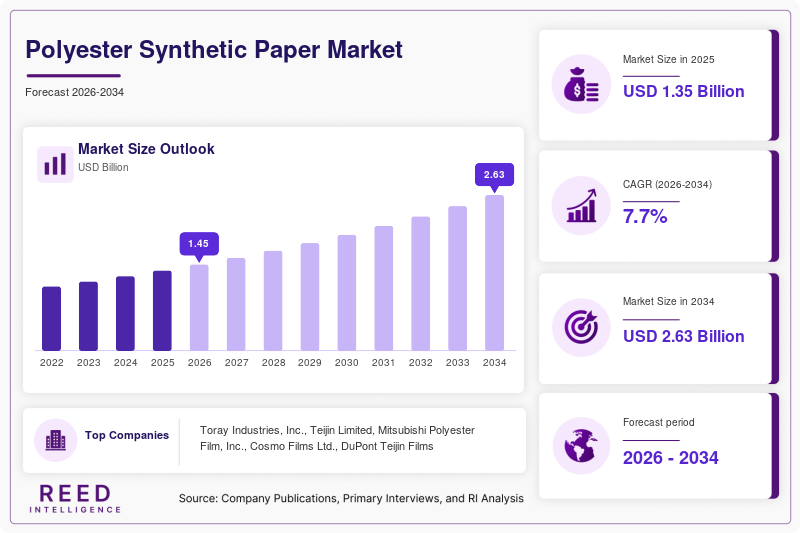
Key Highlights:
- Asia Pacific dominated the market with 38.5% share, while Latin America is expected to register the fastest growth at a CAGR of 8.9%.
- By type, Biaxially Oriented Polyester (BOPET) held the leading share at 56.2%, while coated polyester paper is projected to grow at a CAGR of 8.4%.
- In applications, labels and tags dominated with 34.7% share, while packaging is anticipated to grow at a CAGR of 8.6%.
- The United States remained the dominant country, with market values of USD 310 million in 2024 and USD 328 million in 2025.
Market Trends
Increasing Adoption in High-Performance Labeling
The Polyester Synthetic Paper Market is experiencing growing demand from high-performance labeling applications. Industries such as pharmaceuticals, chemicals, and logistics require labels that can withstand extreme conditions, including moisture, heat, and abrasion. Polyester synthetic paper offers superior durability compared to traditional paper, making it suitable for barcode labels, industrial tags, and asset tracking systems. The increasing adoption of automated labeling systems and stringent regulatory requirements for labeling accuracy are further supporting this trend.
Shift Toward Digital and UV Printing Compatibility
Another notable trend shaping the Polyester Synthetic Paper Market is the rising compatibility with advanced printing technologies. Manufacturers are focusing on enhancing surface coatings to support high-resolution digital and UV printing. This development allows for improved ink adhesion, vibrant color output, and faster printing speeds. As businesses transition toward short-run and customized printing solutions, polyester synthetic paper is becoming a preferred substrate due to its consistency and performance across various printing methods. This trend is particularly evident in the commercial printing and advertising sectors.
Market Drivers
Growing Demand for Durable Printing Materials
The increasing need for long-lasting and high-strength printing materials is a major driver of the Polyester Synthetic Paper Market. Unlike traditional paper, polyester synthetic paper is resistant to tearing, water, and chemicals, making it ideal for applications in harsh environments. Industries such as logistics, manufacturing, and outdoor advertising rely on durable substrates to ensure longevity and readability. The expansion of these industries is directly contributing to the rising demand for polyester-based synthetic paper.
Expansion of Packaging and Labeling Industries
The rapid growth of the global packaging and labeling industries is another key driver. With the rise of e-commerce, food delivery services, and consumer goods packaging, there is an increasing need for reliable labeling solutions. Polyester synthetic paper provides excellent print quality and durability, making it suitable for packaging labels, product tags, and branding materials. Additionally, the growing emphasis on product traceability and anti-counterfeiting measures is further boosting the adoption of synthetic paper solutions.
Market Restraint
High Production Costs Compared to Conventional Paper
One of the major challenges limiting the growth of the Polyester Synthetic Paper Market is the relatively high production cost associated with polyester-based materials. The manufacturing process involves specialized equipment and raw materials, which increases the overall cost compared to traditional paper. This cost difference can be a barrier for small and medium-sized enterprises that operate with limited budgets.
Furthermore, price sensitivity in developing regions restricts widespread adoption, especially in applications where cost efficiency is a primary concern. While polyester synthetic paper offers superior performance characteristics, its higher price point may discourage its use in low-value applications such as disposable packaging or basic printing tasks.
In addition, fluctuations in raw material prices, particularly petroleum-based inputs, can impact production costs and market pricing. These factors collectively pose a restraint on the market's growth, especially in price-competitive environments.
Market Opportunities
Rising Demand in Emerging Economies
Emerging economies present significant growth opportunities for the Polyester Synthetic Paper Market. Rapid industrialization, urbanization, and increasing consumer spending are driving demand for advanced packaging and labeling solutions. Countries in Asia Pacific, Latin America, and Africa are witnessing increased adoption of synthetic paper in retail, logistics, and manufacturing sectors. As infrastructure improves and awareness of product quality increases, the demand for durable and high-performance materials is expected to rise.
Technological Advancements in Coating and Recycling
Technological innovations in coating technologies and recycling processes are creating new opportunities in the market. Manufacturers are developing eco-friendly coatings that enhance printability while reducing environmental impact. Additionally, advancements in recycling methods for polyester materials are improving sustainability, making synthetic paper a more attractive option for environmentally conscious industries. These developments are expected to expand the application scope and improve market acceptance across various sectors.
Segmental Analysis
By Type
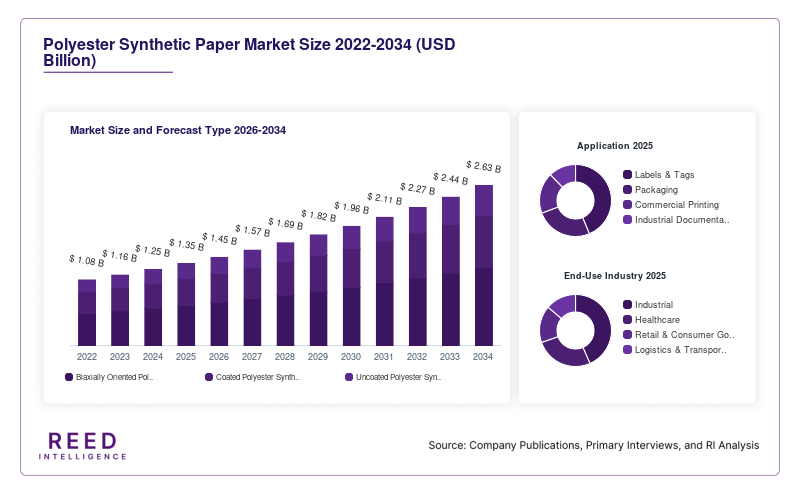
Biaxially Oriented Polyester (BOPET) dominated the Polyester Synthetic Paper Market with a 56.2% share in 2025. Its superior mechanical strength, clarity, and resistance to environmental factors made it widely used across various applications.
Coated polyester synthetic paper is expected to be the fastest-growing subsegment, registering a CAGR of 8.4%. Enhanced printability and compatibility with advanced printing technologies will drive its growth.
By Application
Labels and tags held the largest share at 34.7% in 2025, driven by their widespread use in logistics, retail, and industrial applications. The demand for durable and high-quality labels contributed to this dominance.
Packaging applications are projected to grow at a CAGR of 8.6%, supported by increasing demand for robust packaging materials in e-commerce and consumer goods industries.
By End-Use Industry
The industrial sector accounted for the largest share of 31.5% in 2025, due to its need for durable labeling and documentation materials.
The healthcare sector is expected to grow at a CAGR of 8.3%, driven by the demand for reliable labeling in pharmaceuticals and medical devices.
By Printing Technology
Conventional printing dominated with a 52.1% share in 2025, as it remains widely used across industries.
Digital printing is anticipated to grow at a CAGR of 9.1%, fueled by the increasing demand for customization and short-run printing solutions.
Regional Analysis
North America
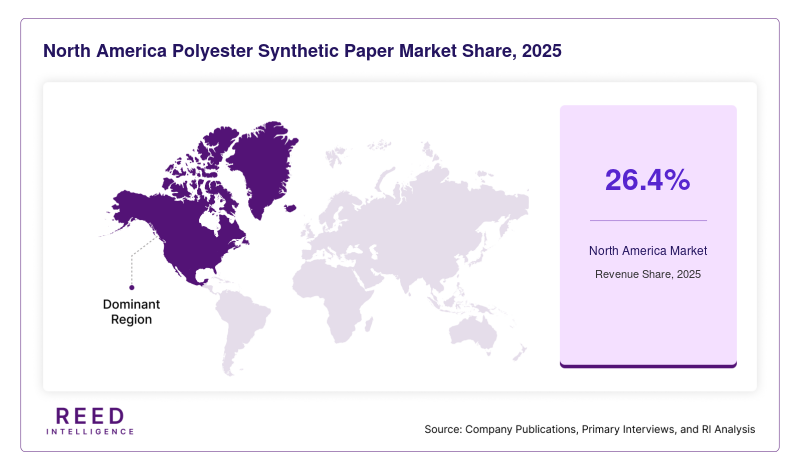
North America accounted for 26.4% of the Polyester Synthetic Paper Market in 2025 and is expected to grow at a CAGR of 7.1% during 2026–2034. The region’s market growth will be supported by the presence of advanced printing technologies and a strong demand for durable labeling solutions across industrial sectors.
The United States dominated the regional market due to its well-established packaging and logistics industries. The increasing adoption of automated labeling systems and stringent compliance standards for product labeling are contributing to market expansion.
Europe
Europe held 22.8% market share in 2025 and is projected to grow at a CAGR of 6.8% over the forecast period. The region’s growth will be driven by regulatory emphasis on sustainable materials and efficient packaging solutions.
Germany emerged as the dominant country, supported by its strong manufacturing base and focus on high-quality printing standards. The demand for durable labeling materials in automotive and industrial applications is contributing to steady market growth.
Asia Pacific
Asia Pacific led the market with a 38.5% share in 2025 and is expected to grow at a CAGR of 8.2%. Rapid industrialization and expansion of the packaging industry will drive regional growth.
China dominated the region due to its large-scale manufacturing sector and increasing demand for labeling and packaging materials. The growth of e-commerce and export-oriented industries is further supporting market expansion.
Middle East & Africa
The Middle East & Africa region accounted for 6.3% share in 2025 and is anticipated to grow at a CAGR of 7.5%. Increasing investments in infrastructure and logistics will support market growth.
The United Arab Emirates led the regional market, driven by its role as a logistics hub and growing demand for high-quality labeling materials in trade and transportation sectors.
Latin America
Latin America held 6.0% market share in 2025 and is expected to grow at the fastest CAGR of 8.9%. Expanding retail and packaging industries will drive demand for synthetic paper.
Brazil dominated the region due to its growing consumer goods sector and increasing demand for durable packaging solutions.
Competitive Landscape
The Polyester Synthetic Paper Market is characterized by the presence of several global and regional players focusing on product innovation and expansion strategies. The market leader, Toray Industries, Inc., continues to strengthen its position through advancements in high-performance polyester films and synthetic paper products.
Companies are investing in research and development to improve product quality, enhance printability, and expand application areas. Strategic collaborations, mergers, and capacity expansions are common approaches adopted by key players to maintain competitiveness.
Other major players are focusing on sustainability initiatives and developing eco-friendly products to align with evolving regulatory requirements and customer preferences.
Key Players List
- Toray Industries, Inc.
- Teijin Limited
- Mitsubishi Polyester Film, Inc.
- Cosmo Films Ltd.
- DuPont Teijin Films
- Kolon Industries, Inc.
- Nan Ya Plastics Corporation
- Polyplex Corporation Ltd.
- Jindal Poly Films Ltd.
- Uflex Ltd.
- Arjobex SAS
- Yupo Corporation
- Seiko Epson Corporation
- Agfa-Gevaert Group
- Transcendia Inc.
Recent Developments
- Toray Industries introduced an advanced polyester synthetic paper with improved UV printing compatibility in 2025.
- Cosmo Films expanded its production capacity for specialty films in Asia to meet rising demand.
- Polyplex Corporation announced investments in sustainable polyester film technologies.
- Jindal Poly Films launched a new range of high-durability synthetic paper products.
- Uflex Ltd. enhanced its product portfolio with recyclable polyester-based materials.
Polyester Synthetic Paper Market Segments
Type
- Biaxially Oriented Polyester (BOPET)
- Coated Polyester Synthetic Paper
- Uncoated Polyester Synthetic Paper
Application
- Labels & Tags
- Packaging
- Commercial Printing
- Industrial Documentation
End-Use Industry
- Industrial
- Healthcare
- Retail & Consumer Goods
- Logistics & Transportation
Printing Technology
- Conventional Printing
- Digital Printing
- UV Printing
By Region
- North America
- Europe
- APAC
- Middle East and Africa
- LATAM