Polyether Modified Silicone Market Size, Share & Demand Report By Type (Water-Soluble Polyether Modified Silicone, Oil-Soluble Polyether Modified Silicone, Silicone Polyether Copolymers, Reactive Polyether Modified Silicone), By Application (Personal Care Formulations, Agricultural Adjuvants, Industrial Coatings, Textile Processing, Polyurethane Foam, Lubricants and Defoamers), By End Use (Cosmetics and Personal Care, Agriculture, Construction, Automotive, Textile Industry, Industrial Manufactur
USD 3950
Market Overview
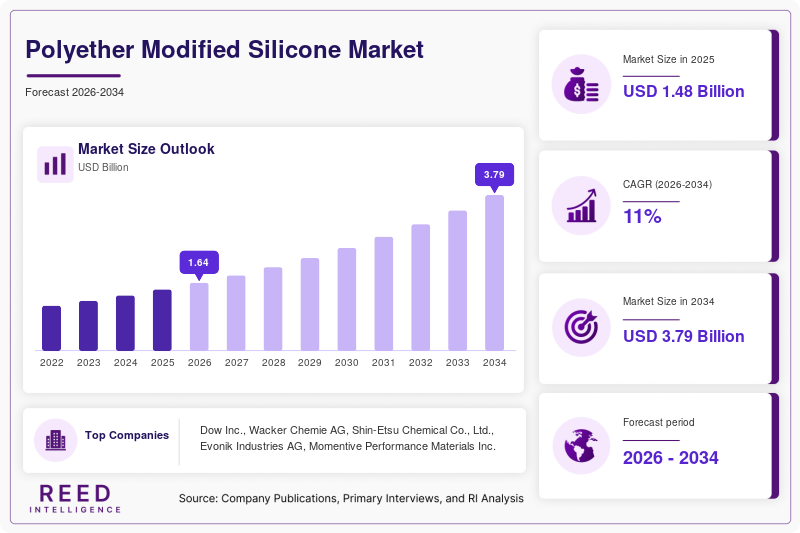
The global Polyether Modified Silicone Market size was valued at USD 1.48 billion in 2026 and is projected to reach USD 3.41 billion by 2034, expanding at a CAGR of 11.0% during the forecast period. Polyether modified silicones are specialty surfactants and wetting agents widely used across personal care, agriculture, textiles, coatings, construction chemicals, and industrial processing applications. Their ability to improve spreadability, lubrication, foam control, surface tension reduction, and water repellency has supported increasing adoption across multiple manufacturing industries. Demand has accelerated as formulators continue to prioritize multifunctional additives that improve product efficiency while supporting lower formulation costs and enhanced performance characteristics.
One of the major global factors supporting market growth is the rising demand for advanced formulation additives in personal care and industrial coatings. Manufacturers are increasingly shifting toward high-performance silicone-based additives that offer improved compatibility with waterborne systems and low volatile organic compound formulations. The transition toward premium skincare products, efficient agrochemical spray adjuvants, and high-durability industrial coatings has further strengthened the consumption of polyether modified silicone products in developed and emerging economies.
Key Highlights
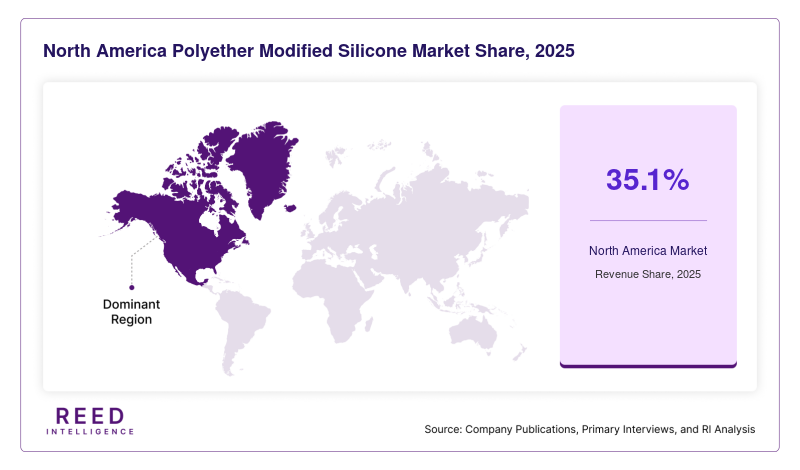
- North America dominated the market with a 35.1% share in 2025, while Asia Pacific is expected to grow at the fastest CAGR of 12.3% during 2026–2034.
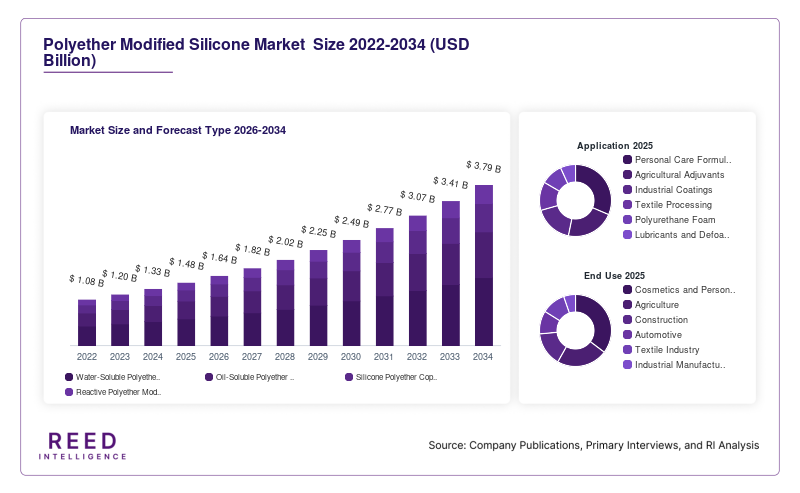
- By type, water-soluble polyether modified silicone accounted for the largest share of 43.8%, while silicone polyether copolymers are projected to grow at a CAGR of 12.8%.
- By application, personal care formulations led with a 39.4% share, whereas agricultural adjuvants are expected to expand at a CAGR of 13.1%.
- By end use, cosmetics and personal care accounted for the largest share of 31.6%, while industrial coatings are anticipated to grow at a CAGR of 12.5%.
- The United States remained the dominant country, with market values of USD 412 million in 2024 and USD 455 million in 2025.
Market Trends
Rising Preference for Waterborne and Low-VOC Formulations
The increasing use of waterborne coatings and low-VOC industrial formulations is emerging as a significant trend in the Polyether Modified Silicone Market. Manufacturers in the paints, coatings, and construction sectors are focusing on additives that improve wetting, leveling, anti-crater performance, and surface smoothness while complying with environmental standards. Polyether modified silicones are gaining traction because they provide excellent substrate penetration and compatibility in water-based systems. This trend is especially visible in automotive coatings, furniture coatings, and architectural paints, where producers are replacing conventional additives with silicone-based alternatives to enhance finish quality and durability. Growing environmental regulations in Europe and North America are also encouraging the use of high-efficiency specialty surfactants.
Increasing Utilization in Premium Personal Care Products
Demand for premium skincare, haircare, and cosmetic formulations is contributing to a steady rise in the use of polyether modified silicones. Cosmetic manufacturers are incorporating these additives into creams, lotions, shampoos, and sunscreens to improve sensory feel, spreadability, and moisture retention. Consumers are increasingly seeking multifunctional beauty products with lightweight textures and improved performance, encouraging formulators to adopt advanced silicone technologies. The trend is particularly strong in Asia Pacific, where rising disposable income and urbanization are expanding demand for premium cosmetics. In addition, clean beauty trends are pushing suppliers to develop modified silicone products with improved biodegradability and reduced environmental impact, creating new product development opportunities.
Market Drivers
Expanding Demand from Agricultural Spray Adjuvant Applications
The increasing adoption of advanced agricultural spray technologies is driving demand for polyether modified silicones across the global agrochemical industry. These materials are widely used as super-spreading adjuvants that improve pesticide coverage, penetration, and rainfastness. Farmers are increasingly utilizing precision agriculture methods to maximize crop productivity and minimize chemical wastage, supporting demand for high-performance surfactants. Polyether modified silicones help agrochemical formulations spread more effectively across plant surfaces, improving absorption efficiency and reducing overall chemical consumption. Rising food demand, shrinking arable land, and the growing use of high-value crops in countries such as China, India, Brazil, and the United States are contributing to long-term market expansion.
Growth in Specialty Chemical Manufacturing Activities
The rapid expansion of specialty chemical production capacities is another major driver supporting market growth. Industrial manufacturers are increasingly adopting multifunctional additives that can improve product quality, production efficiency, and process stability across multiple applications. Polyether modified silicones are used in textile finishing, polyurethane foam production, inks, lubricants, and industrial cleaners due to their defoaming and wetting characteristics. Growing investments in chemical manufacturing hubs across Asia Pacific and the Middle East are increasing the availability of silicone intermediates and supporting supply chain development. In addition, research initiatives focused on customized silicone formulations are enabling manufacturers to develop industry-specific products with enhanced compatibility and performance.
Market Restraint
Volatility in Raw Material Prices and Regulatory Compliance Challenges
Fluctuations in silicone raw material prices continue to restrain the growth of the Polyether Modified Silicone Market. The production of polyether modified silicones depends on petrochemical derivatives and silicone intermediates that are exposed to changing crude oil prices, energy costs, and supply chain disruptions. Sudden increases in feedstock prices can reduce manufacturer profit margins and create pricing pressure for end users. Small and medium-sized formulators often face challenges in maintaining stable procurement costs, especially during periods of global supply imbalance.
In addition to raw material volatility, regulatory scrutiny related to chemical safety and environmental impact remains a concern for market participants. Regulatory authorities in Europe and North America are tightening restrictions on specialty chemical formulations associated with environmental persistence and toxicity concerns. Manufacturers are required to invest in product testing, certification, and reformulation activities to comply with changing standards. These additional compliance costs may slow product launches and limit adoption among cost-sensitive industries. For example, smaller coating and textile manufacturers may continue using lower-cost conventional surfactants instead of transitioning to premium silicone-based additives.
Market Opportunities
Growing Potential in Sustainable Textile Processing
The textile industry is creating significant opportunities for polyether modified silicone manufacturers as mills increasingly shift toward sustainable finishing technologies. These additives are used in textile softeners, lubricants, and finishing agents to improve fabric smoothness, softness, and water repellency. Textile producers are under pressure to reduce water consumption, energy use, and chemical waste while maintaining fabric quality standards. Polyether modified silicones support low-temperature processing and improved chemical efficiency, making them suitable for modern textile manufacturing operations. Expanding apparel exports from countries such as Bangladesh, Vietnam, India, and Indonesia are expected to support demand for advanced textile finishing additives throughout the forecast period.
Increasing Demand for High-Performance Industrial Coatings
Industrial coating manufacturers are generating new growth opportunities for the market through increasing demand for advanced surface modification additives. Polyether modified silicones are widely utilized in metal coatings, marine coatings, protective coatings, and automotive refinishing products due to their leveling and anti-foam properties. Infrastructure modernization projects, rising industrial production, and increasing investments in renewable energy installations are supporting the demand for durable coatings with longer service life. Wind turbine components, industrial pipelines, and heavy machinery require high-performance coatings capable of resisting corrosion and environmental exposure. As coating formulators continue focusing on durability and application efficiency, demand for silicone-based additives is expected to increase steadily.
Segmental Analysis
By Type
Water-soluble polyether modified silicone accounted for the largest share of the global market in 2024, representing 43.8% of total revenue. These products are widely utilized in personal care formulations, industrial coatings, and agricultural adjuvants due to their excellent compatibility with water-based systems. Manufacturers prefer water-soluble variants because they improve wetting performance, spreading efficiency, and formulation stability without significantly increasing production complexity. Demand is particularly high in cosmetic and skincare products where smooth texture and enhanced moisture retention are essential. Industrial users also favor these formulations because they support environmentally compliant waterborne coatings and reduce volatile organic compound emissions. The increasing transition toward sustainable manufacturing practices across developed markets has further strengthened the adoption of water-soluble silicone additives.
Silicone polyether copolymers are expected to witness the fastest CAGR of 12.8% during the forecast period due to their multifunctional performance characteristics and broad industrial compatibility. These copolymers are increasingly used in advanced coating systems, textile treatments, polyurethane foam production, and agrochemical formulations. Their ability to provide effective defoaming, lubrication, and substrate wetting in complex industrial processes is supporting rising demand. Manufacturers are investing in customized copolymer technologies designed for industry-specific applications with improved stability and low dosage requirements. Growth is also being driven by increasing research and development activities aimed at producing high-performance specialty silicones for automotive coatings, renewable energy infrastructure, and industrial maintenance products.
By Application
Personal care formulations held the largest share of the Polyether Modified Silicone Market in 2024, accounting for 39.4% of global revenue. The segment includes skincare creams, hair conditioners, shampoos, sunscreens, and color cosmetics that rely on silicone additives to improve texture, spreadability, and moisture retention. Consumers are increasingly demanding premium beauty products with lightweight and non-greasy characteristics, encouraging manufacturers to incorporate advanced silicone technologies. Polyether modified silicones also improve sensory performance and formulation stability, making them suitable for multifunctional cosmetic products. The expansion of e-commerce beauty platforms and rising consumer spending on personal grooming products have significantly supported demand in developed and emerging markets alike.
Agricultural adjuvants are projected to expand at the fastest CAGR of 13.1% during the forecast period due to increasing adoption of precision farming practices and high-efficiency crop protection solutions. Polyether modified silicones improve the spreading and penetration of pesticides, herbicides, and fungicides, enabling better crop coverage and lower chemical wastage. Farmers are increasingly prioritizing technologies that enhance productivity while minimizing environmental impact and operational costs. Demand is especially strong in regions with large-scale commercial agriculture activities such as North America, Latin America, and Asia Pacific. Rising concerns regarding food security and sustainable farming practices are expected to accelerate the adoption of advanced spray additive technologies over the coming years.
By End Use
Cosmetics and personal care represented the dominant end-use segment in 2024 with a market share of 31.6%. The segment continues to benefit from rising consumer awareness regarding skincare quality, anti-aging formulations, and multifunctional beauty products. Polyether modified silicones are extensively utilized in creams, lotions, makeup products, and haircare solutions because they provide smooth application characteristics and improve overall product aesthetics. Cosmetic brands are increasingly introducing premium formulations with advanced sensory performance, especially in Asia Pacific and North America. The shift toward high-value skincare products and expanding male grooming trends are also contributing to sustained growth across the segment.
Industrial coatings are expected to register the fastest CAGR of 12.5% during the forecast period due to increasing demand for high-performance protective surfaces in automotive, construction, marine, and energy applications. Polyether modified silicones improve coating leveling, substrate wetting, anti-crater properties, and foam control, making them valuable additives in industrial formulations. Infrastructure modernization projects and growing investments in renewable energy systems are supporting demand for durable protective coatings with long operational life. Manufacturers are also developing advanced low-VOC coating technologies to comply with environmental standards, creating additional opportunities for silicone-based additives. Expanding industrial production capacities in Asia Pacific and the Middle East are expected to further accelerate segment growth.
Regional Analysis
North America
North America accounted for 35.1% of the global Polyether Modified Silicone Market in 2025 and maintained a leading position due to strong demand from personal care, agriculture, and industrial coatings industries. The region is projected to expand at a CAGR of 9.7% during the forecast period. Stable specialty chemical manufacturing infrastructure and increasing investments in high-performance industrial formulations continue to support regional demand. The United States and Canada are witnessing rising adoption of silicone-based surfactants in waterborne coatings and premium cosmetic products. Growth in agricultural productivity initiatives is also supporting the utilization of spray adjuvant technologies.
The United States remained the dominant contributor to the regional market due to its large specialty chemicals industry and advanced product development capabilities. Increasing consumer demand for premium skincare and haircare formulations is a major factor driving domestic consumption. Manufacturers are investing in multifunctional ingredients that improve texture, spreadability, and durability in cosmetic products. In addition, the growing adoption of precision agriculture technologies across large-scale farming operations has increased demand for silicone-based adjuvants that improve pesticide efficiency and crop coverage.
Europe
Europe represented 26.4% of the global market in 2025 and is expected to register a CAGR of 8.9% during the forecast period. Demand across the region is supported by strong environmental regulations encouraging the use of low-VOC and waterborne industrial formulations. Germany, France, Italy, and the United Kingdom are major consumers of polyether modified silicones across automotive coatings, textile finishing, and personal care manufacturing. The presence of advanced chemical processing infrastructure and research-driven innovation ecosystems continues to strengthen regional market development.
Germany dominated the European market due to its extensive industrial coatings and specialty chemicals sectors. The country is witnessing increasing demand for sustainable coating additives that improve efficiency while complying with environmental standards. Automotive manufacturers are also adopting advanced silicone additives in coating and polishing formulations to improve surface quality and durability. Another important growth factor is the region’s focus on circular economy initiatives, which is encouraging the development of resource-efficient specialty chemicals with improved environmental profiles.
Asia Pacific
Asia Pacific accounted for 24.7% of the global Polyether Modified Silicone Market in 2025 and is anticipated to expand at the fastest CAGR of 12.3% through 2034. Rapid industrialization, expanding manufacturing activity, and rising demand for personal care products are contributing to regional growth. Countries including China, India, Japan, and South Korea are increasing investments in specialty chemicals production and downstream industrial applications. The region is also experiencing rising consumption of agrochemicals and industrial coatings, which is increasing the demand for silicone-based surfactants and wetting agents.
China emerged as the leading country in the region due to its large manufacturing base and strong presence in personal care, textile, and coatings industries. Rapid urbanization and rising disposable income levels are supporting increased demand for cosmetics and skincare products. Domestic chemical manufacturers are also expanding silicone production capacities to reduce import dependency and strengthen export competitiveness. Another major growth factor is the increasing use of advanced agricultural technologies aimed at improving crop yields and reducing chemical waste through efficient spray formulations.
Middle East & Africa
The Middle East & Africa held 7.2% of the global market share in 2025 and is projected to grow at a CAGR of 9.1% during the forecast period. Demand is being supported by infrastructure development projects, rising industrial coatings consumption, and increasing investment in regional chemical production capabilities. Countries in the Gulf region are focusing on diversifying industrial output beyond oil and gas activities, creating opportunities for specialty chemical suppliers. Polyether modified silicones are increasingly used in construction coatings, lubricants, and industrial process chemicals across the region.
Saudi Arabia remained the dominant market within the region due to its growing petrochemical and industrial manufacturing sectors. Government-backed industrial diversification programs are encouraging investments in downstream chemical processing and specialty materials production. The country is also witnessing increasing demand for durable industrial coatings used in energy infrastructure and construction projects. Another unique growth factor is the expansion of water treatment and desalination infrastructure, where specialty surfactants and defoaming agents are gaining wider utilization.
Latin America
Latin America captured 6.6% of the global Polyether Modified Silicone Market in 2025 and is expected to register a CAGR of 8.7% over the forecast period. Rising agricultural activity and expanding industrial manufacturing sectors are supporting regional demand. Brazil, Mexico, and Argentina are among the leading markets for silicone-based adjuvants and industrial additives. Increased use of crop protection chemicals and modernization of industrial coating operations are contributing to steady market expansion. Regional manufacturers are also increasing imports of specialty silicone additives to improve product quality and process efficiency.
Brazil dominated the Latin American market due to its large agricultural economy and expanding agrochemical consumption. Farmers are increasingly adopting advanced spray adjuvants to improve pesticide coverage and reduce input costs. The country’s growing soybean, sugarcane, and corn cultivation activities continue to support the use of polyether modified silicone formulations in crop protection products. Another important growth factor is the increasing development of automotive and industrial manufacturing activities, which is driving demand for high-performance coatings and specialty lubricants.
Competitive Landscape
The Polyether Modified Silicone Market is moderately consolidated, with leading specialty chemical manufacturers focusing on product innovation, regional expansion, and strategic collaborations to strengthen market presence. Companies are investing in advanced silicone chemistry research to develop multifunctional additives with improved environmental compatibility and application efficiency. Product customization and long-term supply agreements remain key competitive strategies among major participants.
Dow maintained a leading market position due to its diversified silicone product portfolio and strong global distribution network. The company recently expanded its specialty silicone manufacturing capabilities to support growing demand from personal care and industrial applications. Other major companies including Wacker Chemie AG, Shin-Etsu Chemical Co., Ltd., Evonik Industries AG, and Momentive Performance Materials are also strengthening their presence through new product launches and capacity expansions.
Market participants are increasingly focusing on sustainable formulations and low-emission technologies to align with evolving environmental regulations. Several manufacturers are investing in regional production facilities across Asia Pacific to reduce supply chain dependency and improve customer responsiveness. Competitive intensity is expected to increase further as emerging regional producers enter the market with cost-competitive specialty silicone products.
Key Players
- Dow Inc.
- Wacker Chemie AG
- Shin-Etsu Chemical Co., Ltd.
- Evonik Industries AG
- Momentive Performance Materials Inc.
- Elkem ASA
- Siltech Corporation
- Innospec Inc.
- KCC Corporation
- BRB International BV
- AB Specialty Silicones
- Jiangxi New JiaYi New Materials Co., Ltd.
- Supreme Silicones India Pvt. Ltd.
- Silicone Solutions
- Guangzhou Tinci Materials Technology Co., Ltd.
Recent Developments
- In February 2026, Dow announced the expansion of its specialty silicone additives production facility in the United States to meet increasing demand from personal care and coatings manufacturers.
- In September 2025, Wacker Chemie AG introduced a new range of polyether modified silicone surfactants designed for low-VOC industrial coating applications.
- In June 2025, Evonik Industries AG partnered with a regional agrochemical manufacturer in Asia Pacific to develop advanced silicone-based spray adjuvant solutions for precision farming applications.
- In November 2025, Shin-Etsu Chemical Co., Ltd. expanded its silicone research center in Japan to accelerate development of environmentally compatible specialty silicone formulations.
- In March 2026, Momentive Performance Materials launched a new silicone additive portfolio focused on textile finishing and water-repellent applications for industrial fabrics.
Polyether Modified Silicone Market Segments
Type
- Water-Soluble Polyether Modified Silicone
- Oil-Soluble Polyether Modified Silicone
- Silicone Polyether Copolymers
- Reactive Polyether Modified Silicone
Application
- Personal Care Formulations
- Agricultural Adjuvants
- Industrial Coatings
- Textile Processing
- Polyurethane Foam
- Lubricants and Defoamers
End Use
- Cosmetics and Personal Care
- Agriculture
- Construction
- Automotive
- Textile Industry
- Industrial Manufacturing
By Region
- North America
- Europe
- APAC
- Middle East and Africa
- LATAM