Polyethylene Furanoate Film Market Size, Share & Demand Report By Product Type (Flexible Films, Rigid Films, Specialty Films), By Application (Packaging, Electronics, Industrial, Others), By End-Use Industry (Food & Beverage, Electronics, Automotive, Pharmaceuticals, Others), By Thickness Type (Thin Films, Thick Films), By Region & Segment Forecasts, 2025–2034
USD 3950
Market Overview
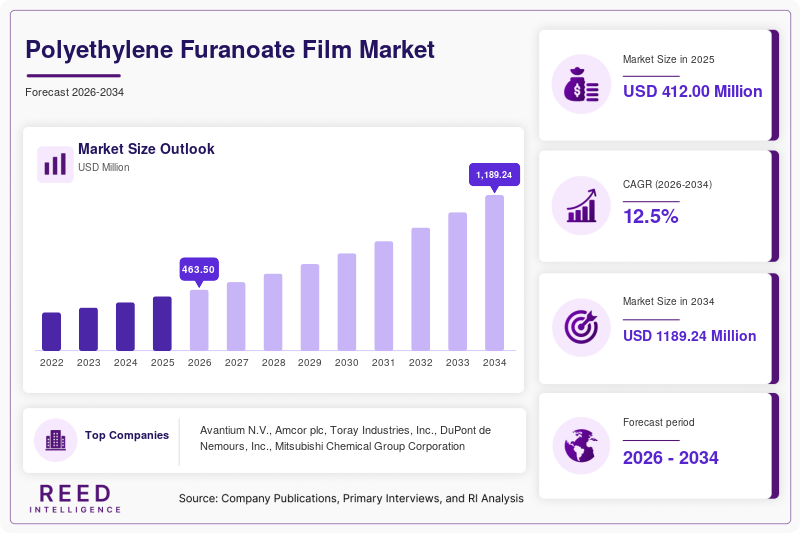
The global Polyethylene Furanoate Film Market size was valued at approximately USD 412 million in 2025 and is projected to reach USD 1.18 billion by 2034, expanding at a CAGR of 12.5% during the forecast period (2025–2034). The market is witnessing steady expansion due to increasing adoption of sustainable and bio-based polymer alternatives across packaging, electronics, and industrial sectors.
A key global factor supporting the growth of the Polyethylene Furanoate Film Market is the rising regulatory emphasis on reducing plastic waste and carbon emissions. Governments and environmental agencies worldwide are encouraging the use of renewable materials, which has accelerated demand for polyethylene furanoate (PEF) films as a bio-based substitute for conventional polyethylene terephthalate (PET) films. PEF films offer superior barrier properties, recyclability, and lower environmental impact, making them suitable for next-generation packaging solutions.
Key Highlights:
- Europe dominated the market with a share of 34.2% in 2025, while Asia Pacific is expected to register the fastest CAGR of 14.1%.
- Packaging application was the leading segment with 46.8% share, while electronics films are projected to grow fastest at a CAGR of 13.6%.
- Bottles & flexible films represented the dominant product type, while specialty films will grow fastest at 13.9% CAGR.
- Germany remained the dominant country, with market values of USD 78 million in 2024 and USD 86 million in 2025.
Market Trends
Rising Adoption of Bio-Based Packaging Solutions
The Polyethylene Furanoate Film Market is increasingly influenced by the transition toward bio-based packaging materials. Companies are shifting from fossil-based plastics to renewable alternatives due to environmental concerns and consumer awareness. PEF films offer better oxygen and carbon dioxide barrier properties compared to PET, which enhances shelf life in food and beverage packaging. This trend is particularly strong in developed economies where sustainability regulations are stricter.
Integration of High-Performance Films in Electronics
Another notable trend shaping the Polyethylene Furanoate Film Market is the growing use of advanced films in electronics and electrical applications. PEF films exhibit strong thermal stability and mechanical strength, making them suitable for flexible electronics, display films, and insulation layers. The increasing demand for compact and efficient electronic devices is driving innovation in high-performance materials, positioning PEF films as a viable alternative to traditional polymers.
Market Drivers
Increasing Demand for Sustainable Materials
The global shift toward eco-friendly materials is a significant driver for the Polyethylene Furanoate Film Market. Industries are under pressure to reduce their carbon footprint, leading to higher adoption of bio-based polymers. PEF films, derived from renewable resources such as plant-based sugars, offer a lower environmental impact and are recyclable. This aligns with corporate sustainability goals and regulatory mandates, boosting market demand.
Superior Barrier Properties Enhancing Application Scope
PEF films provide enhanced barrier performance against oxygen, moisture, and carbon dioxide compared to conventional materials. This property makes them highly suitable for food packaging, pharmaceuticals, and industrial applications. The ability to extend product shelf life and maintain quality is driving manufacturers to adopt PEF films. As industries prioritize efficiency and product integrity, the demand for high-performance films continues to rise.
Market Restraints
High Production Costs and Limited Commercial Scale
One of the major restraints in the Polyethylene Furanoate Film Market is the relatively high production cost associated with bio-based polymers. The manufacturing process of PEF films requires advanced technologies and specialized raw materials, which increases overall costs compared to traditional plastics. Additionally, the market is still in a semi-commercial stage, with limited large-scale production facilities.
This cost disparity restricts widespread adoption, especially in price-sensitive markets. Small and medium enterprises often hesitate to transition from conventional materials due to budget constraints. Furthermore, supply chain limitations and dependence on specific feedstocks create challenges in ensuring consistent production volumes.
Until economies of scale are achieved and production technologies become more cost-efficient, the Polyethylene Furanoate Film Market may face slower adoption rates in certain regions. However, ongoing research and investments are expected to gradually reduce these barriers.
Market Opportunities
Expansion in Food and Beverage Packaging Sector
The growing demand for sustainable packaging in the food and beverage industry presents a significant opportunity for the Polyethylene Furanoate Film Market. PEF films offer excellent barrier properties that help in preserving freshness and extending shelf life. As consumer demand for eco-friendly packaging increases, manufacturers are likely to adopt PEF films for various applications such as wraps, pouches, and bottle linings.
Advancements in Bio-Refinery Technologies
Technological advancements in bio-refinery processes are opening new avenues for the Polyethylene Furanoate Film Market. Innovations in feedstock processing and polymer synthesis are expected to reduce production costs and improve material properties. These advancements will enable large-scale manufacturing and broaden the application scope of PEF films across industries such as automotive, textiles, and electronics.
Segmental Analysis
By Product Type
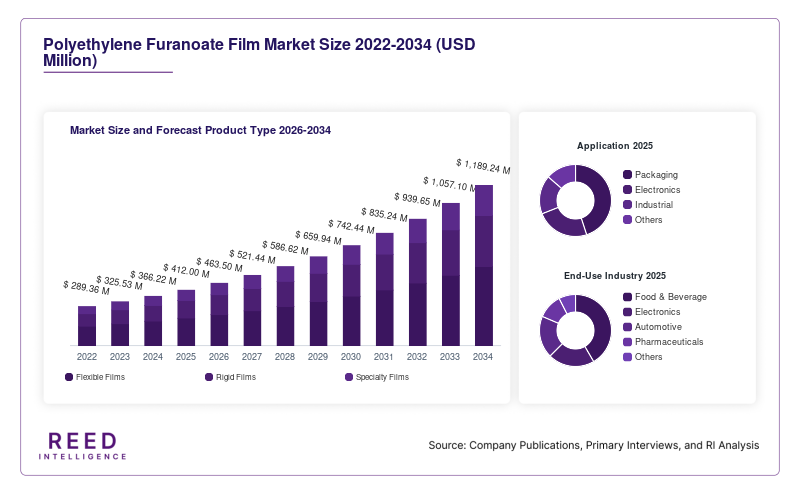
Flexible films dominated the Polyethylene Furanoate Film Market with a share of 52.4% in 2024, driven by their widespread use in packaging applications. Their adaptability and superior barrier properties made them a preferred choice for manufacturers.
Specialty films are expected to grow at the fastest CAGR of 13.9% due to increasing demand in high-performance applications such as electronics and industrial uses. Their enhanced mechanical and thermal properties will drive adoption.
By Application
Packaging applications held the largest share of 46.8% in 2024, supported by the growing demand for sustainable packaging solutions. The use of PEF films in food and beverage packaging contributed significantly to this dominance.
Electronics applications are projected to grow at a CAGR of 13.6%, driven by increasing demand for high-performance materials in flexible devices. The need for durable and efficient components will support growth.
By End-Use Industry
The food & beverage industry dominated the market with a share of 39.5% in 2024 due to rising demand for eco-friendly packaging materials. PEF films’ barrier properties made them ideal for preserving food quality.
The electronics industry is expected to grow at the fastest CAGR of 13.4% as demand for advanced materials in electronic devices increases. The trend toward miniaturization and efficiency will drive adoption.
By Thickness Type
Thin films accounted for the largest share of 57.2% in 2024 due to their cost efficiency and suitability for flexible packaging.
Thick films are projected to grow at a CAGR of 12.9%, driven by their use in industrial and high-strength applications.
Regional Analysis
North America
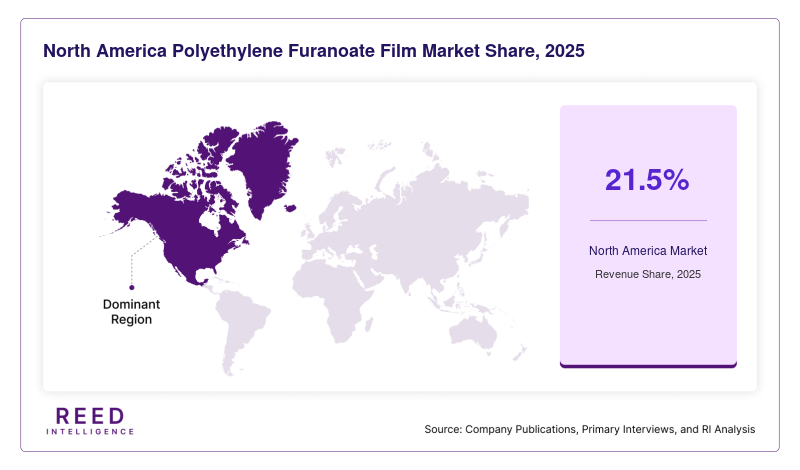
North America accounted for 21.5% of the Polyethylene Furanoate Film Market share in 2025 and is projected to grow at a CAGR of 11.8% during the forecast period. The region benefited from strong research and development activities and early adoption of sustainable materials.
The United States dominated the regional market due to increasing investments in bio-based polymers and advanced packaging solutions. The presence of innovation-driven industries and strong environmental regulations supported the adoption of PEF films.
Europe
Europe held the largest share of 34.2% in 2025 and is expected to grow at a CAGR of 12.2%. The region’s strict environmental policies and focus on circular economy initiatives contributed to its dominance.
Germany emerged as the leading country, driven by strong manufacturing capabilities and sustainability initiatives. The country’s focus on reducing plastic waste and promoting renewable materials significantly boosted demand for PEF films.
Asia Pacific
Asia Pacific represented 26.8% of the market in 2025 and is anticipated to register the fastest CAGR of 14.1%. Rapid industrialization and growing awareness of sustainable materials fueled regional growth.
China dominated the region due to expanding packaging and electronics industries. The country’s large consumer base and increasing investments in eco-friendly technologies supported market expansion.
Middle East & Africa
The Middle East & Africa held a market share of 9.3% in 2025 and is expected to grow at a CAGR of 10.6%. The region experienced gradual adoption of bio-based materials driven by sustainability initiatives.
The United Arab Emirates led the market, supported by infrastructure development and increasing focus on environmental sustainability in packaging applications.
Latin America
Latin America accounted for 8.2% of the market in 2025 and is projected to grow at a CAGR of 11.2%. The region showed steady adoption of sustainable packaging solutions.
Brazil dominated the regional market due to its expanding food and beverage industry and increasing demand for eco-friendly materials. The country’s focus on reducing environmental impact contributed to market growth.
Competitive Landscape
The Polyethylene Furanoate Film Market is moderately competitive, with key players focusing on innovation and sustainability. Leading companies are investing in research and development to enhance product performance and expand application areas.
Avantium N.V. is considered a market leader, actively advancing PEF technology and scaling up production capabilities. The company recently announced progress in commercial-scale production facilities, strengthening its market position.
Other prominent players are focusing on strategic partnerships, product launches, and capacity expansion to gain a competitive edge. The market is expected to witness increased competition as new entrants explore opportunities in bio-based materials.
Key Players
- Avantium N.V.
- Amcor plc
- Toray Industries, Inc.
- DuPont de Nemours, Inc.
- Mitsubishi Chemical Group Corporation
- SK Chemicals Co., Ltd.
- Toyobo Co., Ltd.
- Teijin Limited
- Kuraray Co., Ltd.
- SABIC
Recent Developments
- 2025: Avantium N.V. expanded its PEF production capacity to support commercial demand.
- 2024: Amcor plc introduced sustainable packaging solutions incorporating PEF films.
- 2024: Toray Industries developed advanced PEF-based films for electronics applications.
- 2025: BASF SE collaborated with packaging firms to explore bio-based polymer applications.
- 2024: Mitsubishi Chemical Group launched new high-performance PEF film products.
Polyethylene Furanoate Film Market Segments
Product Type
- Flexible Films
- Rigid Films
- Specialty Films
Application
- Packaging
- Electronics
- Industrial
- Others
End-Use Industry
- Food & Beverage
- Electronics
- Automotive
- Pharmaceuticals
- Others
Thickness Type
- Thin Films
- Thick Films
By Region
- North America
- Europe
- APAC
- Middle East and Africa
- LATAM