Polyethylene Terephthalate Additive Market Size, Share Demand Report By Type (Stabilizers, Plasticizers, Impact Modifiers, Barrier Additives), By Application (Packaging, Automotive, Textiles, Electronics), By End-Use Industry (Food & Beverage, Automotive, Consumer Goods, Electronics) By Region & Segment Forecasts, 2026–2034
USD 3950
Market Overview
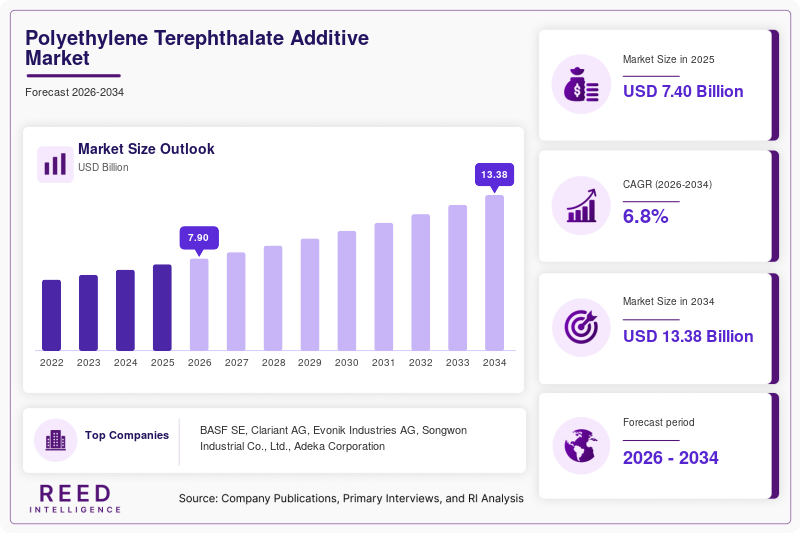
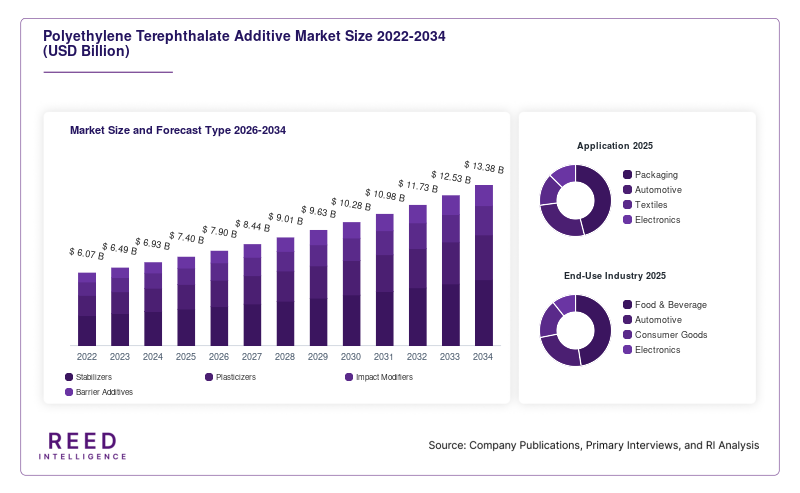
The global Polyethylene Terephthalate Additive Market size was valued at approximately USD 7.4 billion in 2026 and is projected to reach USD 12.6 billion by 2034, expanding at a CAGR of 6.8% during the forecast period (2026–2034). The market reflects steady expansion driven by the increasing use of PET materials in packaging, automotive, and textile applications. Additives play a vital role in enhancing the performance characteristics of PET, including durability, UV resistance, barrier properties, and recyclability, making them essential across multiple industries.
A key global factor supporting market growth is the rising demand for sustainable and high-performance packaging solutions. Governments and corporations are increasingly focusing on lightweight, recyclable, and cost-effective materials, where PET continues to gain traction. Additives enable manufacturers to improve PET’s lifecycle, mechanical strength, and aesthetic appeal, further reinforcing its adoption across consumer goods and industrial sectors.
Key Highlights
- Asia Pacific accounted for the dominant regional share of 41.5% in 2025.
- the same region is expected to register the fastest CAGR of 7.6% through 2034.
- Among segments, stabilizers held the leading share within the type category, while barrier enhancement additives are projected to grow at the fastest CAGR of 7.9%.
- Packaging applications dominated the market, whereas automotive applications are expected to expand rapidly with a CAGR of 7.4%.
- China remained the dominant country, with market values estimated at USD 1.6 billion in 2024 and USD 1.7 billion in 2025.
Market Trends
Rising focus on sustainable and recyclable PET formulations
The increasing emphasis on sustainability has led to a shift toward eco-friendly PET formulations enhanced by advanced additives. Manufacturers are investing in additives that improve recyclability and reduce environmental impact without compromising material performance. Additives such as chain extenders, impact modifiers, and UV stabilizers are being optimized to support closed-loop recycling systems. This trend aligns with global regulatory frameworks aimed at reducing plastic waste and increasing recycled content in packaging materials.
The trend is further supported by brand owners seeking to meet sustainability targets and reduce carbon footprints. Additives that enable multiple recycling cycles without degradation are gaining traction. As recycled PET (rPET) demand rises, additive innovation plays a critical role in maintaining quality consistency. This has encouraged collaborations between chemical companies and packaging manufacturers to develop customized additive solutions that cater to evolving environmental standards and consumer expectations.
Technological advancements in additive formulation
Continuous advancements in polymer science are driving innovation in PET additive formulations. Modern additives are being engineered to deliver multifunctional properties, such as improved thermal stability, enhanced clarity, and better processability. This trend is particularly relevant in high-performance applications like electronics, automotive components, and food-grade packaging, where stringent performance standards must be met.
Nanotechnology and advanced compounding techniques are also influencing the market. Nano-additives are increasingly used to enhance barrier properties and mechanical strength without increasing material weight. Additionally, digital manufacturing and simulation tools are enabling precise formulation of additive blends, reducing production costs and improving efficiency. These technological developments are helping manufacturers differentiate their products and cater to specialized application requirements, thereby expanding the scope of PET additives across industries.
Market Drivers
Expanding demand from the packaging industry
The growing demand for PET in the packaging industry serves as a primary driver for the polyethylene terephthalate additive market. PET is widely used in food and beverage packaging due to its lightweight nature, transparency, and strength. Additives enhance these properties by improving shelf life, UV resistance, and oxygen barrier capabilities. As consumer demand for packaged goods continues to rise globally, the need for advanced PET materials is increasing.
E-commerce growth and changing consumption patterns have further accelerated the demand for durable and protective packaging. Additives enable PET to withstand varying environmental conditions during transportation and storage. Moreover, the push toward reducing packaging weight without compromising strength has led to the increased use of performance-enhancing additives. This driver is expected to remain strong as packaging innovation continues to evolve across both developed and emerging markets.
Growth in automotive and industrial applications
The automotive and industrial sectors are increasingly adopting PET materials due to their lightweight properties and cost efficiency. Additives are essential in making PET suitable for these applications by improving heat resistance, impact strength, and durability. In automotive manufacturing, PET with specialized additives is used in interior components, electrical housings, and under-the-hood applications.
The shift toward lightweight vehicles to improve fuel efficiency and reduce emissions has significantly boosted demand for engineered plastics like PET. Additives play a key role in ensuring these materials meet safety and performance standards. Similarly, industrial applications such as machinery components and electrical insulation benefit from enhanced PET formulations. This growing adoption across non-packaging sectors is contributing to the steady expansion of the market.
Market Restraint
Volatility in raw material prices and regulatory challenges
Fluctuations in raw material prices present a significant restraint for the polyethylene terephthalate additive market. The production of PET additives relies heavily on petrochemical derivatives, which are subject to price volatility due to changes in crude oil markets and supply chain disruptions. These fluctuations can increase production costs and impact profit margins for manufacturers, making it difficult to maintain consistent pricing strategies.
In addition, stringent environmental regulations related to plastic usage and chemical additives pose challenges for market players. Governments are increasingly implementing policies that restrict the use of certain additives due to health and environmental concerns. Compliance with these regulations often requires additional investment in research and development, as well as modifications to existing formulations. For example, restrictions on certain stabilizers or plasticizers can limit their application scope, forcing manufacturers to develop alternative solutions. These combined factors can slow market growth and create uncertainty for industry participants.
Market Opportunities
Increasing adoption of recycled PET and circular economy initiatives
The growing emphasis on circular economy practices presents a significant opportunity for the PET additive market. As industries move toward sustainable production models, the use of recycled PET is gaining momentum. Additives that enhance the quality and performance of recycled PET are becoming essential, enabling manufacturers to maintain product standards while reducing environmental impact.
This opportunity is further supported by government regulations mandating higher recycled content in packaging materials. Additives such as compatibilizers and stabilizers are being developed to address issues related to degradation and contamination in recycled PET. This trend is expected to drive innovation and create new revenue streams for additive manufacturers, particularly those focusing on eco-friendly solutions.
Expansion in emerging economies and industrial sectors
Emerging economies in Asia, Latin America, and Africa offer substantial growth opportunities for the PET additive market. Rapid urbanization, rising disposable incomes, and expanding industrial activities are driving demand for PET-based products in these regions. Additives are essential in meeting the performance requirements of these applications, particularly in packaging, construction, and automotive sectors.
Infrastructure development and increasing investments in manufacturing are further boosting demand. Local production facilities are being established to cater to regional needs, creating opportunities for additive suppliers to expand their presence. Additionally, the growing middle-class population in these regions is increasing consumption of packaged goods, thereby driving the demand for high-quality PET materials and associated additives.
Segmental Analysis
By Type
Stabilizers emerged as the dominant subsegment in 2024, accounting for approximately 34.2% of the market share. These additives are widely used to enhance the thermal and UV stability of PET materials, making them suitable for various applications. Stabilizers play a critical role in preventing degradation during processing and extending the lifespan of PET products. Their widespread use in packaging, automotive, and industrial applications contributes to their leading position in the market.
Barrier enhancement additives are expected to be the fastest-growing subsegment, with a projected CAGR of 7.9% during the forecast period. These additives improve the resistance of PET materials to gases and moisture, making them ideal for food and beverage packaging. The increasing demand for longer shelf life and improved product quality is driving the adoption of barrier additives. Technological advancements in additive formulation are further supporting their growth.
By Application
Packaging dominated the application segment in 2024, holding a share of 46.8%. PET is extensively used in packaging due to its lightweight, durability, and transparency. Additives enhance these properties, making PET suitable for a wide range of packaging applications, including bottles, containers, and films. The growth of the food and beverage industry is a key factor driving demand in this segment.
Automotive applications are expected to register the fastest growth, with a CAGR of 7.4% during the forecast period. The increasing use of lightweight materials in vehicle manufacturing is driving demand for PET with specialized additives. These additives improve mechanical strength and heat resistance, making PET suitable for various automotive components. The shift toward fuel-efficient and electric vehicles is further boosting this segment.
By End-Use Industry
The food and beverage industry dominated the end-use segment in 2024, accounting for 38.6% of the market share. PET is widely used for packaging beverages and food products due to its safety and durability. Additives enhance barrier properties and extend shelf life, making them essential for this industry. The increasing demand for packaged food products is driving growth in this segment.
The electronics industry is projected to be the fastest-growing end-use segment, with a CAGR of 7.5%. PET materials with advanced additives are used in electronic components due to their insulating properties and durability. The rapid growth of consumer electronics and technological advancements are driving demand for high-performance materials, creating opportunities for additive manufacturers.
Regional Analysis
North America
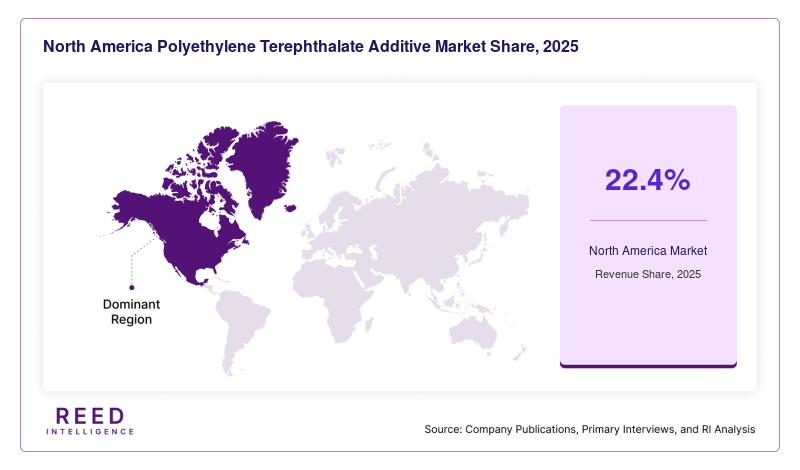
North America held a significant share of 22.4% in the polyethylene terephthalate additive market in 2025 and is projected to grow at a CAGR of 5.9% during the forecast period. The region’s growth is supported by advanced manufacturing infrastructure and high demand for PET in packaging and automotive applications. Technological innovation and strong R&D capabilities contribute to the development of high-performance additives, ensuring steady market expansion.
The United States dominates the regional market, driven by its large packaging industry and focus on sustainable materials. A unique growth factor is the increasing adoption of recycled PET in consumer goods packaging, supported by regulatory frameworks encouraging sustainability. This has led to higher demand for additives that enhance the quality and durability of recycled materials.
Europe
Europe accounted for approximately 20.1% of the market share in 2025 and is expected to grow at a CAGR of 5.7% through 2034. The region’s growth is influenced by strict environmental regulations and a strong emphasis on sustainability. PET additives that improve recyclability and reduce environmental impact are in high demand, particularly in the packaging and automotive sectors.
Germany leads the European market due to its robust industrial base and advanced automotive sector. A key growth factor is the region’s commitment to circular economy initiatives, which has accelerated the adoption of recycled PET. Additive manufacturers are focusing on developing eco-friendly solutions to meet regulatory standards and industry requirements.
Asia Pacific
Asia Pacific dominated the market with a 41.5% share in 2025 and is projected to grow at the fastest CAGR of 7.6% during the forecast period. Rapid industrialization, urbanization, and population growth are driving demand for PET products across various applications. The region’s strong manufacturing base and increasing investments in infrastructure further support market growth.
China remains the dominant country, driven by its large-scale production capabilities and high demand for packaging materials. A unique growth factor is the expansion of the e-commerce sector, which has significantly increased the demand for durable and lightweight packaging solutions. This, in turn, is boosting the adoption of advanced PET additives.
Middle East & Africa
The Middle East & Africa region held a market share of 8.3% in 2025 and is expected to grow at a CAGR of 6.2% through 2034. Growth in this region is supported by increasing investments in industrial development and infrastructure projects. The demand for PET in packaging and construction applications is steadily rising, driving the need for performance-enhancing additives.
Saudi Arabia leads the regional market, supported by its expanding petrochemical industry. A key growth factor is the availability of raw materials and government initiatives to diversify the economy. This has encouraged the development of local manufacturing capabilities, boosting demand for PET additives across various sectors.
Latin America
Latin America accounted for 7.7% of the market share in 2025 and is projected to grow at a CAGR of 6.1% during the forecast period. The region’s growth is driven by increasing consumption of packaged goods and expanding industrial activities. PET additives are widely used to enhance material performance in packaging and consumer products.
Brazil dominates the regional market, supported by its large consumer base and growing manufacturing sector. A unique growth factor is the increasing demand for sustainable packaging solutions, driven by changing consumer preferences and regulatory policies. This is encouraging the adoption of advanced PET additives that improve recyclability and performance.
Competitive Landscape
The polyethylene terephthalate additive market is characterized by the presence of several key players focusing on innovation and strategic partnerships. The market is moderately consolidated, with leading companies investing in research and development to enhance product performance and sustainability. Companies are also expanding their global footprint to cater to growing demand in emerging markets.
BASF SE is considered a leading player in the market, known for its extensive product portfolio and strong R&D capabilities. A recent development includes the launch of advanced additive solutions designed to improve the recyclability of PET materials. Other major players are focusing on mergers, acquisitions, and collaborations to strengthen their market position and expand their product offerings.
Key Players
- BASF SE
- Clariant AG
- Evonik Industries AG
- Songwon Industrial Co., Ltd.
- Adeka Corporation
- Albemarle Corporation
- Croda International Plc
- Solvay SA
- Dow Inc.
- Lanxess AG
- Arkema S.A.
- Eastman Chemical Company
- SABIC
- Mitsubishi Chemical Group
- Sumitomo Chemical Co., Ltd.
Recent Developments
- BASF SE introduced a new range of PET additives aimed at improving recyclability and reducing environmental impact.
- Clariant AG expanded its production capacity for specialty additives to meet rising demand in Asia Pacific.
- Evonik Industries AG launched advanced barrier additives designed for high-performance packaging applications.
Polyethylene Terephthalate Additive Market Segments
Type
- Stabilizers
- Plasticizers
- Impact Modifiers
- Barrier Additives
Application
- Packaging
- Automotive
- Textiles
- Electronics
End-Use Industry
- Food & Beverage
- Automotive
- Consumer Goods
- Electronics
By Region
- North America
- Europe
- APAC
- Middle East and Africa
- LATAM