Polyethylene Vapor Barrier Films Under-Slab Market Size, Share & Demand Report By Thickness Type (Up to 10 mil, 10–15 mil, Above 15 mil), By Application (Residential Construction, Commercial Construction, Industrial Construction), By End-Use (Construction Contractors, DIY/Home Improvement, Infrastructure Projects), By Region & Segment Forecasts, 2026–2034
USD 3950
Market Overview
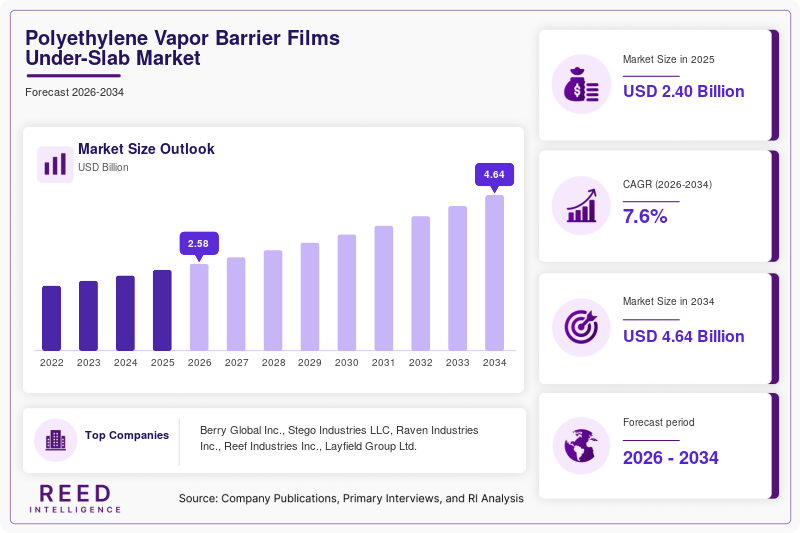
The Polyethylene Vapor Barrier Films Under-Slab Market was valued at approximately USD 2.4 billion in 2026 and is projected to reach USD 4.3 billion by 2034, expanding at a CAGR of 7.6% during 2026–2034. The market reflects steady growth driven by increasing construction activities, particularly in residential and commercial infrastructure, where moisture protection solutions are essential. Under-slab polyethylene vapor barrier films are widely used to prevent water vapor transmission from the ground into concrete slabs, helping to enhance structural durability and indoor air quality.
A key global factor supporting market growth is the rising emphasis on sustainable and long-lasting construction practices. Governments and developers are increasingly adopting building materials that reduce long-term maintenance costs and improve energy efficiency. Polyethylene vapor barrier films play a crucial role in mitigating moisture-related damage such as mold formation, flooring degradation, and insulation failure, which has made them a preferred choice in modern construction projects.
Key Highlights
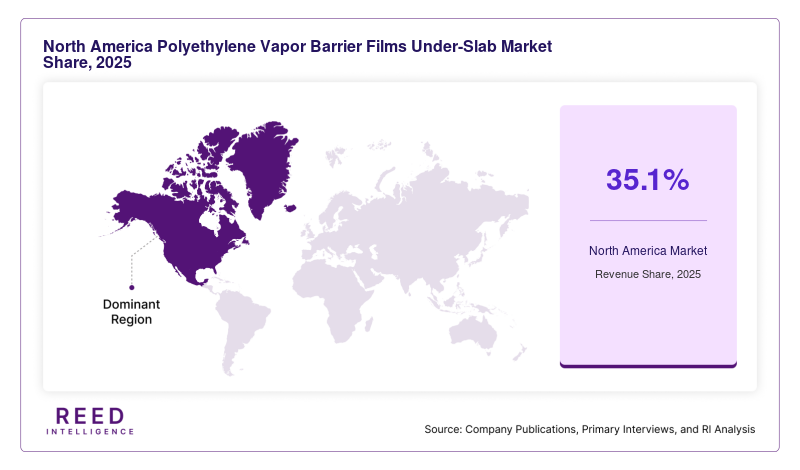
- North America dominated the market with a 35.1% share in 2025.
- Asia Pacific is expected to grow at the fastest CAGR of 9.2% during 2026–2034.
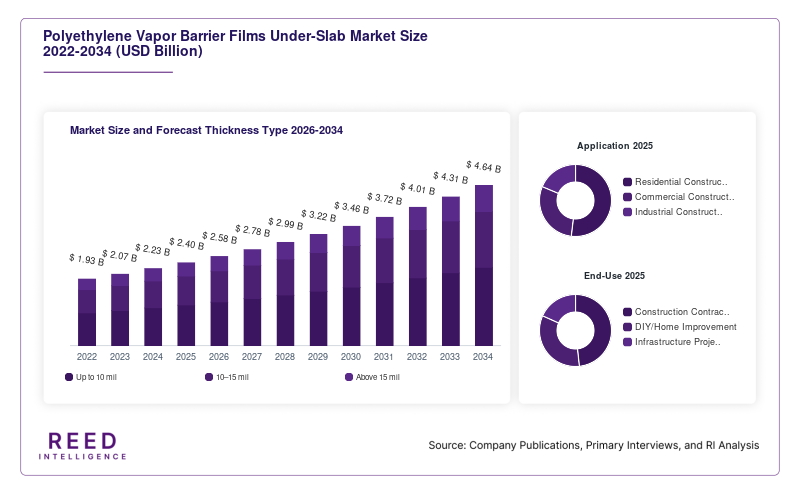
- By thickness type, films above 15 mil accounted for the largest share of 42.8%, while 10–15 mil films are projected to grow at a CAGR of 8.5%.
- By application, residential construction led with a 46.3% share, whereas commercial construction is expected to expand at a CAGR of 8.1%.
- The United States remained the dominant country, with market values of USD 610 million in 2024 and USD 670 million in 2025.
Market Trends
Increasing Adoption of High-Performance Multi-Layer Films
The market is witnessing a shift toward high-performance, multi-layer polyethylene vapor barrier films designed to offer enhanced durability and puncture resistance. These advanced films incorporate multiple layers of polyethylene with reinforced cores, improving tensile strength and moisture resistance. Construction companies are increasingly favoring these materials for large-scale commercial and industrial projects where structural integrity is critical. Additionally, stricter building codes and standards in developed regions are pushing manufacturers to innovate and offer products with superior permeability ratings. This trend is also supported by rising awareness among contractors about the long-term cost benefits of investing in premium-grade vapor barriers.
Integration of Sustainable and Recyclable Materials
Sustainability has become a defining trend in the Polyethylene Vapor Barrier Films Under-Slab Market. Manufacturers are focusing on producing films using recyclable polyethylene and incorporating post-consumer recycled content without compromising performance. Green building certifications such as LEED are encouraging the use of environmentally responsible materials, driving demand for eco-friendly vapor barriers. Furthermore, construction firms are prioritizing materials that contribute to reduced carbon footprints and improved indoor air quality. This trend is particularly prominent in Europe and North America, where environmental regulations are stringent, and consumer awareness regarding sustainable construction practices continues to grow steadily.
Market Drivers
Growth in Residential and Commercial Construction Activities
Rapid urbanization and population growth are driving significant investments in residential and commercial infrastructure globally. Emerging economies in Asia Pacific, Latin America, and the Middle East are witnessing increased construction of housing units, shopping complexes, and industrial facilities. This surge in construction activities directly fuels the demand for polyethylene vapor barrier films under slabs, as moisture protection is a fundamental requirement in modern buildings. Additionally, rising disposable income and improved living standards are encouraging consumers to invest in durable housing solutions, further boosting market demand. Governments are also supporting infrastructure development through favorable policies and funding, which contributes to consistent market expansion.
Increasing Awareness of Moisture-Related Structural Issues
The growing awareness of moisture-related problems such as mold growth, flooring damage, and compromised indoor air quality is a major driver for the market. Builders and contractors are increasingly recognizing the importance of installing effective vapor barriers to prevent long-term structural damage. This awareness is further reinforced by industry guidelines and building standards that emphasize moisture control in construction. In regions with high humidity levels, the adoption of polyethylene vapor barrier films has become essential. Moreover, insurance companies and property developers are also advocating for moisture prevention solutions to reduce repair costs and enhance building lifespan.
Market Restraint
Volatility in Raw Material Prices and Environmental Concerns
One of the key restraints impacting the Polyethylene Vapor Barrier Films Under-Slab Market is the fluctuation in raw material prices, particularly polyethylene resins derived from petrochemicals. Price volatility in crude oil directly affects production costs, leading to uncertainty for manufacturers and potential price increases for end users. This can discourage adoption, especially in price-sensitive markets where cost efficiency is a primary concern. Additionally, environmental concerns related to plastic usage pose challenges for market growth. Regulatory bodies are increasingly scrutinizing the use of non-biodegradable materials, which may result in stricter compliance requirements for manufacturers. For example, certain regions in Europe are implementing policies that limit the use of conventional plastics, encouraging alternatives that may not yet match the performance or cost-effectiveness of polyethylene films. These factors collectively create barriers to widespread adoption and may slow market growth in the long term.
Market Opportunities
Expansion in Emerging Economies
Emerging economies present significant growth opportunities for the Polyethylene Vapor Barrier Films Under-Slab Market. Countries in Asia Pacific, Africa, and Latin America are undergoing rapid urbanization, leading to increased demand for residential and commercial construction. Governments in these regions are investing heavily in infrastructure projects, including affordable housing and smart city initiatives. This creates a favorable environment for the adoption of vapor barrier films. Additionally, the lack of stringent building regulations in some developing regions allows manufacturers to introduce cost-effective solutions tailored to local market needs. As awareness of moisture protection benefits grows, the demand for these products is expected to rise steadily.
Technological Advancements and Product Innovation
Technological innovation offers substantial opportunities for market expansion. Manufacturers are developing advanced polyethylene films with enhanced properties such as improved tensile strength, UV resistance, and lower permeability rates. The integration of nanotechnology and advanced polymer formulations is enabling the production of thinner yet more durable films. These innovations not only improve product performance but also reduce material usage, contributing to cost efficiency and sustainability. Furthermore, the development of smart vapor barriers with moisture detection capabilities could open new avenues in the construction industry. Such innovations are likely to attract significant investments and drive market growth over the forecast period.
Segmental Analysis
By Thickness Type
Films above 15 mil dominated the market, accounting for 42.8% of the total share in 2024. These thicker films are preferred for heavy-duty applications, particularly in commercial and industrial construction, where higher durability and puncture resistance are required. Contractors favor these films due to their ability to withstand harsh site conditions and provide long-term moisture protection. Additionally, thicker films offer lower permeability rates, making them suitable for projects requiring stringent moisture control standards. Their widespread use in developed regions with strict building codes further supports their dominance.
The 10–15 mil segment is expected to be the fastest-growing, with a CAGR of 8.5% during the forecast period. This growth is driven by the increasing demand for cost-effective solutions that balance performance and affordability. These films are widely used in residential construction, where moderate durability is sufficient. Advancements in material technology are also enhancing the performance of thinner films, making them more competitive with thicker alternatives.
By Application
Residential construction held the largest share of 46.3% in 2024, driven by the growing demand for housing and increased awareness of moisture protection. The use of vapor barrier films in residential projects helps prevent issues such as mold growth and flooring damage, improving indoor air quality and structural integrity. Government initiatives promoting affordable housing are also contributing to the dominance of this segment.
Commercial construction is expected to grow at the fastest CAGR of 8.1% during 2026–2034. The growth is attributed to increasing investments in office spaces, retail complexes, and industrial facilities. These projects require high-performance vapor barrier films to ensure durability and compliance with building standards. The rising trend of sustainable and energy-efficient buildings further supports the growth of this segment.
By End-Use
The construction contractors segment dominated the market, accounting for 51.7% of the share in 2024. Contractors are the primary users of vapor barrier films, as they are responsible for selecting and installing materials during construction. Their preference for reliable and high-quality products drives demand for established brands and advanced solutions. The increasing number of construction projects globally further supports the growth of this segment.
The DIY/home improvement segment is projected to grow at a CAGR of 7.9% during the forecast period. This growth is driven by the rising trend of home renovation and improvement activities. Consumers are increasingly investing in moisture protection solutions to enhance the durability of their properties. The availability of easy-to-install vapor barrier films is also encouraging adoption among DIY users.
Regional Analysis
North America
North America accounted for approximately 35.1% of the global market share in 2025 and is projected to grow at a CAGR of 6.8% during 2026–2034. The region’s growth is driven by stringent building codes and increasing adoption of advanced construction materials. The presence of well-established construction industries in the United States and Canada further supports market expansion. Additionally, rising investments in residential remodeling and renovation projects are contributing to sustained demand for under-slab vapor barrier films.
The United States dominates the North American market due to its robust construction sector and high awareness of moisture protection solutions. A unique growth factor in this region is the enforcement of strict building standards that mandate the use of vapor barriers in construction. This regulatory framework ensures consistent demand and encourages innovation among manufacturers.
Europe
Europe held a 24.3% market share in 2025 and is expected to grow at a CAGR of 6.5% during the forecast period. The region’s growth is influenced by increasing adoption of sustainable construction practices and stringent environmental regulations. Countries such as Germany, the UK, and France are leading the adoption of eco-friendly building materials, including recyclable polyethylene films.
Germany is the dominant country in the European market, driven by its strong construction industry and focus on energy-efficient buildings. A unique growth factor is the widespread implementation of green building certifications, which promote the use of high-quality vapor barrier films to enhance building performance and sustainability.
Asia Pacific
Asia Pacific is the fastest-growing region, with a projected CAGR of 9.2% from 2026 to 2034, and accounted for 22.7% of the market share in 2025. Rapid urbanization, population growth, and increasing infrastructure development are key factors driving market growth in this region. Countries such as China, India, and Japan are investing heavily in residential and commercial construction projects.
China dominates the Asia Pacific market due to its large-scale construction activities and government initiatives supporting infrastructure development. A unique growth factor is the expansion of smart city projects, which require advanced construction materials, including high-performance vapor barrier films.
Middle East & Africa
The Middle East & Africa region held a 9.6% share in 2025 and is expected to grow at a CAGR of 7.4% during the forecast period. Growth in this region is driven by increasing investments in infrastructure and real estate development, particularly in the Gulf Cooperation Council (GCC) countries. The demand for moisture protection solutions is rising due to harsh climatic conditions.
Saudi Arabia leads the market in this region, supported by large-scale construction projects and government initiatives such as Vision 2030. A unique growth factor is the need for durable construction materials that can withstand extreme environmental conditions, driving demand for high-quality vapor barrier films.
Latin America
Latin America accounted for 8.3% of the market share in 2025 and is projected to grow at a CAGR of 6.9% during 2026–2034. The region’s growth is supported by increasing urbanization and infrastructure development in countries such as Brazil and Mexico. Rising investments in residential construction are also contributing to market expansion.
Brazil is the dominant country in Latin America, driven by its growing construction industry and government housing initiatives. A unique growth factor is the increasing adoption of modern construction practices, which include the use of vapor barrier films to improve building durability and performance.
Competitive Landscape
The Polyethylene Vapor Barrier Films Under-Slab Market is moderately fragmented, with several global and regional players competing based on product quality, pricing, and innovation. Key companies are focusing on expanding their product portfolios and investing in research and development to introduce advanced vapor barrier solutions. Strategic partnerships, mergers, and acquisitions are also common strategies adopted to strengthen market presence.
One of the leading players in the market is Berry Global Inc., known for its extensive range of polyethylene films and strong distribution network. The company recently introduced a new line of high-performance vapor barrier films with enhanced durability and sustainability features, catering to the growing demand for eco-friendly construction materials. Other major players are also investing in technological advancements to improve product performance and meet evolving customer requirements.
Key Players
- Berry Global Inc.
- Stego Industries LLC
- Raven Industries Inc.
- Reef Industries Inc.
- Layfield Group Ltd.
- Poly-America LP
- Fortifiber Corporation
- Plastika Kritis S.A.
- RKW Group
- Inteplast Group
- Cover-Tech Inc.
- Insulfoam
- W.R. Meadows Inc.
- Americover Inc.
- Raven Engineered Films
Recent Developments
- In 2025, Berry Global Inc. launched a new recyclable polyethylene vapor barrier film with enhanced tensile strength.
- In 2024, Stego Industries introduced an advanced multi-layer vapor barrier designed for high-moisture environments.
- In 2025, Raven Industries expanded its production capacity to meet rising demand in North America and Asia Pacific.
Polyethylene Vapor Barrier Films Under-Slab Market Segments
Thickness Type
- Up to 10 mil
- 10–15 mil
- Above 15 mil
Application
- Residential Construction
- Commercial Construction
- Industrial Construction
End-Use
- Construction Contractors
- DIY/Home Improvement
- Infrastructure Projects
By Region
- North America
- Europe
- APAC
- Middle East and Africa
- LATAM