Polyethyleneimine Market Size, Share, Demand Report By Type (Branched Polyethyleneimine, Linear Polyethyleneimine), By Application (Water Treatment, Adhesives & Coatings, Paper Processing, Biomedical Applications, Detergents & Dispersants, Others), By End-Use Industry (Chemical & Industrial Processing, Healthcare & Biotechnology, Packaging, Automotive, Electronics), By Region & Segment Forecasts, 2026–2034
USD 3950
Market Overview
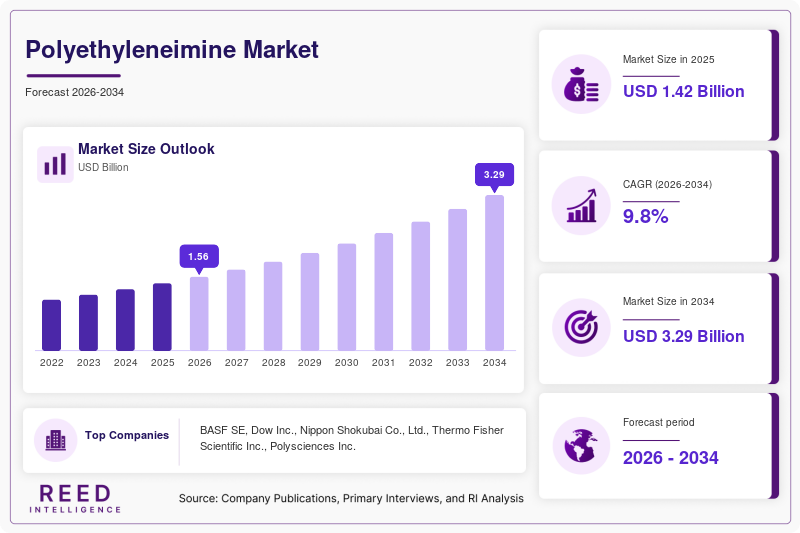
The global Polyethyleneimine Market size was valued at USD 1.42 billion in 2026 and is projected to reach USD 3.01 billion by 2034, expanding at a CAGR of 9.8% during the forecast period from 2026 to 2034. Polyethyleneimine, commonly used as a cationic polymer in water treatment, paper processing, adhesives, coatings, detergents, and biomedical formulations, continues to gain commercial importance across industrial manufacturing sectors. The growing demand for high-performance polymers in wastewater treatment and surface modification applications has supported consistent market expansion across developed and emerging economies.
One of the major factors contributing to market growth is the increasing focus on industrial water recycling and environmental treatment infrastructure. Polyethyleneimine offers excellent binding, dispersing, and flocculation properties, making it suitable for wastewater treatment facilities, industrial effluent management, and municipal water purification systems. In addition, the rapid expansion of the packaging, automotive, and electronics industries has increased the consumption of functional coatings and adhesives where polyethyleneimine is widely utilized. The polymer’s compatibility with multiple substrates and its chemical stability further support its commercial adoption.
Key Highlights
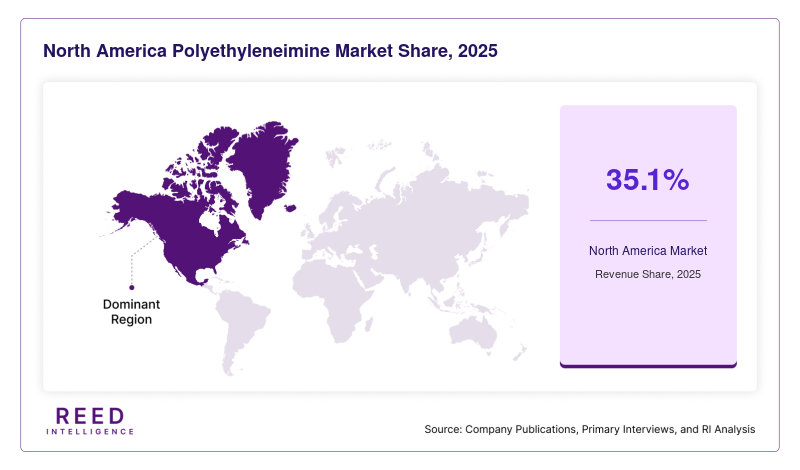
- North America dominated the market with a 35.1% share in 2025.
- Asia Pacific is expected to grow at the fastest CAGR of 11.4% during 2026–2034.
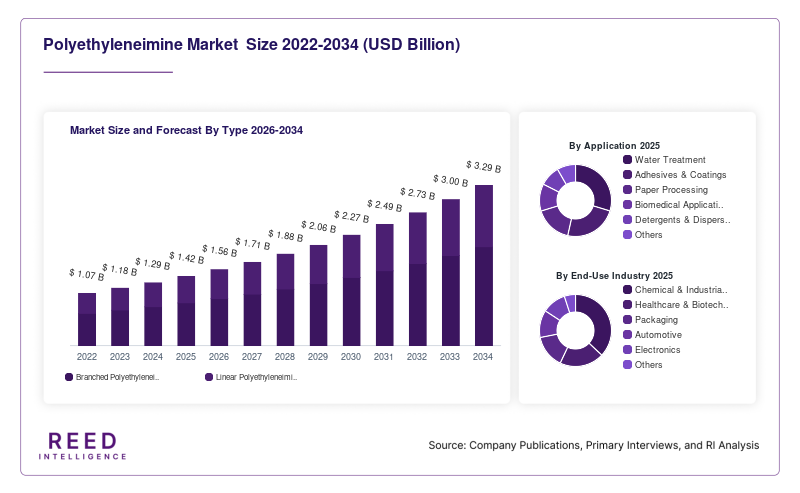
- By type, branched polyethyleneimine accounted for the largest share of 62.8%.
- while linear polyethyleneimine is projected to grow at a CAGR of 10.9%.
- By application, water treatment led with a 39.6% share.
- whereas biomedical applications are expected to expand at a CAGR of 12.1%.
- The United States remained the dominant country, with market values of USD 402 million in 2024 and USD 438 million in 2025.
Market Trends
Rising Adoption in Gene Delivery and Biomedical Research
The Polyethyleneimine Market is witnessing increasing adoption in biotechnology and pharmaceutical research due to the polymer’s effectiveness in gene transfection applications. Polyethyleneimine demonstrates strong nucleic acid binding capacity, enabling efficient delivery of genetic material into target cells. Research laboratories and pharmaceutical developers are increasingly using linear polyethyleneimine formulations in non-viral gene delivery systems because of their cost efficiency and adaptability. This trend has accelerated with the growth of precision medicine, advanced therapeutics, and molecular biology research activities worldwide. Biotechnology companies are also investing in safer and low-toxicity polymer modifications to improve clinical compatibility and regulatory acceptance across therapeutic applications.
In addition, academic institutions and medical research centers are expanding investments in cell engineering and vaccine development technologies. Polyethyleneimine-based carriers are being studied extensively for RNA and DNA transport systems, especially in oncology and regenerative medicine applications. Demand for advanced biomedical polymers has therefore increased steadily in North America, Europe, and parts of Asia Pacific. The growing integration of biotechnology manufacturing with polymer science is expected to create new commercial opportunities for polyethyleneimine suppliers over the coming years.
Expansion of Sustainable Water Treatment Technologies
The increasing implementation of sustainable water management systems has become another important trend shaping the Polyethyleneimine Market. Governments and industries are prioritizing water recycling and wastewater treatment infrastructure to address industrial pollution and water scarcity concerns. Polyethyleneimine is widely used as a flocculating and chelating agent due to its strong cationic properties and high adsorption efficiency. Industrial operators across chemical manufacturing, mining, textiles, and paper processing sectors are adopting polyethyleneimine-based treatment solutions to improve water purification efficiency and reduce environmental discharge levels.
Growing industrialization in emerging economies has intensified the need for advanced water treatment chemicals capable of handling complex contaminants. Manufacturers are introducing high-purity polyethyleneimine grades that improve process stability and reduce operational costs in large-scale treatment plants. In addition, stricter environmental regulations across Europe and North America are encouraging industrial facilities to adopt advanced treatment polymers with improved sustainability profiles. This trend is expected to continue as global industries focus on achieving regulatory compliance and operational efficiency through enhanced wastewater management technologies.
Market Drivers
Growing Demand from Water Treatment Applications
The increasing global demand for industrial and municipal water treatment systems is a major growth driver for the Polyethyleneimine Market. Polyethyleneimine is extensively used in coagulation, flocculation, and heavy metal removal applications because of its strong cationic charge density and chemical stability. Rapid industrialization and urbanization have increased wastewater generation across manufacturing sectors such as chemicals, textiles, food processing, and mining. Governments worldwide are implementing stricter wastewater discharge regulations, compelling industries to invest in advanced treatment chemicals and technologies. This regulatory pressure has significantly increased the adoption of polyethyleneimine-based formulations in water purification operations.
Municipal authorities are also expanding investments in wastewater recycling and desalination projects to address growing water scarcity concerns. Polyethyleneimine improves contaminant removal efficiency while reducing sludge generation and treatment costs. The polymer’s compatibility with multiple treatment systems supports widespread commercial usage across industrial facilities. As environmental sustainability becomes a central focus of industrial policy, demand for efficient water treatment polymers is expected to rise steadily throughout the forecast period.
Increasing Usage in Adhesives and Surface Coatings
The expanding use of polyethyleneimine in adhesives, inks, coatings, and surface treatment applications is supporting market growth across industrial manufacturing sectors. Polyethyleneimine improves adhesion properties, chemical resistance, and coating durability on different substrates including plastics, metals, and paper products. Packaging manufacturers increasingly use polyethyleneimine formulations in multilayer films and laminates to enhance bonding strength and product stability. The growth of flexible packaging and industrial coating applications has therefore contributed significantly to market expansion.
Automotive and electronics manufacturers are also utilizing polyethyleneimine in specialty coatings designed for corrosion resistance and conductivity enhancement. Rapid advancements in electronic device manufacturing and lightweight automotive components have increased the need for high-performance surface treatment materials. Furthermore, ongoing infrastructure development and construction activities in emerging economies are increasing the demand for industrial coatings and specialty adhesives. Manufacturers are responding by developing customized polyethyleneimine grades tailored for specific end-use industries, which is expected to strengthen long-term market penetration.
Market Restraint
Regulatory and Toxicity Concerns Associated with Polymer Usage
Regulatory scrutiny regarding the toxicity and environmental impact of synthetic polymers remains a significant restraint for the Polyethyleneimine Market. Certain polyethyleneimine formulations, particularly high molecular weight variants, may exhibit cytotoxicity and environmental persistence when improperly handled or discharged. Regulatory agencies across North America and Europe are tightening chemical safety standards related to industrial polymer production and disposal practices. Compliance with these regulations often requires manufacturers to invest heavily in product reformulation, safety testing, and environmental monitoring systems, increasing operational costs and development timelines.
The challenge is particularly relevant in biomedical and pharmaceutical applications where product safety standards are highly stringent. Healthcare manufacturers require low-toxicity and biocompatible polymer variants, which increases research and production complexity. Smaller companies may face difficulties in meeting evolving regulatory expectations due to limited technological capabilities and financial resources. In addition, concerns regarding worker exposure during large-scale industrial processing may create adoption barriers in certain manufacturing environments. These factors could limit market expansion in price-sensitive regions and slow the commercialization of new polyethyleneimine products across regulated industries.
Market Opportunities
Expansion of Advanced Biomedical Applications
The rapid evolution of biomedical technologies presents substantial growth opportunities for the Polyethyleneimine Market. Researchers are increasingly utilizing polyethyleneimine in drug delivery systems, tissue engineering, biosensors, and gene therapy applications because of its strong molecular binding capabilities. The development of targeted therapeutics and personalized medicine has increased demand for functional polymers capable of efficient nucleic acid transport and controlled release mechanisms. Polyethyleneimine-based nanocarriers are gaining attention in pharmaceutical research due to their adaptability and scalable manufacturing potential.
Pharmaceutical companies are expanding investments in non-viral delivery systems to reduce manufacturing complexity and improve therapeutic safety profiles. This has encouraged polymer manufacturers to develop modified polyethyleneimine structures with enhanced biocompatibility and reduced toxicity. Emerging healthcare markets in Asia Pacific and Latin America are also increasing investments in biotechnology infrastructure, creating additional demand for specialty biomedical polymers. As research in regenerative medicine and advanced therapeutics progresses, polyethyleneimine suppliers are expected to benefit from growing commercialization opportunities in healthcare innovation.
Rising Industrial Investments Across Emerging Economies
Industrial expansion in emerging economies is creating favorable growth opportunities for polyethyleneimine manufacturers. Countries across Asia Pacific, the Middle East, and Latin America are witnessing increasing investments in chemical processing, water treatment infrastructure, packaging production, and electronics manufacturing. These industries require functional polymers with strong dispersing, adhesion, and treatment properties, supporting higher polyethyleneimine consumption. Government initiatives focused on industrial modernization and manufacturing capacity expansion are further contributing to market development.
The growing establishment of industrial parks and export-oriented manufacturing facilities has increased the need for advanced specialty chemicals and process materials. Polyethyleneimine suppliers are expanding regional production capabilities to improve supply chain efficiency and reduce operational costs in high-growth markets. In addition, rising awareness regarding industrial wastewater management is driving demand for advanced treatment chemicals across developing economies. Local manufacturers are increasingly collaborating with global polymer producers to enhance product quality and technological capabilities, which is expected to accelerate market penetration during the forecast period.
Segmental Analysis
By Type
Branched polyethyleneimine dominated the Polyethyleneimine Market and accounted for 62.8% of the total market share in 2024. The segment benefits from strong commercial adoption across water treatment, detergents, adhesives, and coatings applications due to its high cationic charge density and excellent binding properties. Branched polyethyleneimine demonstrates superior adsorption efficiency and chemical interaction capabilities, making it highly suitable for industrial purification and dispersion processes. Manufacturers prefer branched structures because they offer improved performance in flocculation and surface modification applications. The growing use of industrial water recycling systems and specialty coatings has further strengthened segment demand across developed and emerging economies.
In addition, branched polyethyleneimine is extensively utilized in paper processing and packaging industries where enhanced adhesion and coating uniformity are critical. Industrial manufacturers continue to prioritize high-performance polymers capable of improving operational efficiency and reducing processing costs. Increasing investments in environmental treatment infrastructure have therefore contributed to the segment’s dominant market position. The availability of multiple molecular weight grades and processing flexibility also supports widespread commercial adoption across diverse industrial applications.
By Application
Water treatment emerged as the leading application segment and held 39.6% of the global Polyethyleneimine Market share in 2024. The segment’s dominance is primarily driven by increasing industrial wastewater generation and stringent environmental regulations related to water discharge management. Polyethyleneimine is widely utilized as a flocculant, dispersant, and chelating agent in municipal and industrial treatment facilities due to its strong contaminant binding capabilities. Rapid urbanization and industrial expansion have significantly increased demand for advanced treatment chemicals across manufacturing industries including textiles, chemicals, food processing, and mining.
Governments worldwide are investing heavily in wastewater recycling infrastructure and sustainable water management systems to address water scarcity concerns. Polyethyleneimine-based formulations improve contaminant removal efficiency while reducing treatment complexity and operational costs. The growing focus on industrial sustainability and environmental compliance has therefore strengthened segment demand across developed and developing economies. In addition, technological advancements in water purification systems are increasing the utilization of high-performance polymer additives capable of handling complex wastewater streams efficiently.
By End-Use Industry
The chemical and industrial processing segment accounted for the largest share of the Polyethyleneimine Market in 2024, representing 44.3% of total revenue. The segment benefits from extensive polyethyleneimine usage in coatings, adhesives, detergents, paper processing, and industrial treatment operations. Chemical manufacturers utilize polyethyleneimine due to its dispersing, binding, and surface modification properties that improve product performance and manufacturing efficiency. Increasing industrial production activities across Asia Pacific and North America have contributed significantly to segment growth over recent years.
Industrial operators are also adopting polyethyleneimine-based chemicals to improve wastewater treatment efficiency and support environmental compliance initiatives. The expansion of specialty chemical manufacturing and industrial automation has increased demand for high-performance polymers capable of functioning in complex processing environments. In addition, the growth of flexible packaging and industrial coatings applications continues to strengthen polyethyleneimine consumption within manufacturing industries. Ongoing investments in industrial infrastructure modernization are expected to support stable segment growth during the forecast period.
Regional Analysis
North America
North America accounted for 35.1% of the global Polyethyleneimine Market share in 2025 and is expected to maintain steady growth at a CAGR of 8.7% during the forecast period. The region benefits from advanced industrial infrastructure, established water treatment systems, and significant investments in specialty chemical manufacturing. Demand for polyethyleneimine remains strong across coatings, adhesives, and wastewater treatment applications. The presence of major biotechnology companies and pharmaceutical research institutions also supports growing usage in gene delivery and biomedical applications throughout the region.
The United States remained the dominant country in North America due to its strong chemical manufacturing base and high industrial consumption of functional polymers. Increasing investments in wastewater recycling projects and environmental sustainability programs have strengthened domestic demand for polyethyleneimine-based treatment chemicals. In addition, the expansion of biotechnology research and advanced healthcare manufacturing has increased the adoption of specialty polymer formulations in pharmaceutical applications. Government support for industrial modernization and environmental compliance initiatives continues to support long-term market growth.
Europe
Europe represented 27.3% of the global Polyethyleneimine Market in 2025 and is projected to grow at a CAGR of 8.3% through 2034. The region has established regulatory frameworks focused on environmental protection and industrial wastewater management, which continue to drive polyethyleneimine demand. Industrial sectors such as automotive manufacturing, packaging, and paper processing are significant consumers of polyethyleneimine-based coatings and treatment formulations. European manufacturers are also investing in sustainable polymer technologies to improve environmental performance and meet evolving regulatory standards.
Germany dominated the regional market due to its strong industrial chemicals sector and extensive manufacturing infrastructure. The country’s focus on sustainable industrial operations has encouraged widespread adoption of advanced water treatment chemicals and specialty polymers. Germany also benefits from substantial investments in research and development related to biomedical materials and advanced coatings technologies. Continuous innovation in industrial processing systems and increasing demand for eco-efficient production methods are supporting polyethyleneimine consumption across multiple industries within the country.
Asia Pacific
Asia Pacific held 24.8% of the global Polyethyleneimine Market share in 2025 and is anticipated to register the fastest CAGR of 11.4% during the forecast period. Rapid industrialization, urban infrastructure development, and increasing manufacturing investments are supporting strong market growth throughout the region. Countries such as China, India, South Korea, and Japan are expanding wastewater treatment infrastructure and specialty chemical production capabilities. Rising consumption of adhesives, packaging materials, and industrial coatings has further accelerated polyethyleneimine demand across multiple end-use industries.
China emerged as the dominant country in the Asia Pacific market because of its extensive chemical manufacturing sector and growing industrial output. Government initiatives focused on pollution control and industrial wastewater treatment have increased the use of advanced polymer-based treatment chemicals. The rapid growth of electronics manufacturing and flexible packaging production has also contributed to higher polyethyleneimine consumption. In addition, increasing investments in biotechnology and pharmaceutical research are creating new application opportunities for specialty polymer suppliers across the Chinese market.
Middle East & Africa
The Middle East & Africa accounted for 6.4% of the global Polyethyleneimine Market in 2025 and is expected to expand at a CAGR of 8.9% through 2034. Industrial diversification initiatives and increasing investments in water treatment infrastructure are contributing to regional market growth. Countries across the Gulf Cooperation Council are focusing on wastewater recycling and desalination technologies to address water scarcity challenges. Polyethyleneimine demand is rising steadily in industrial treatment systems, coatings, and specialty chemical applications across the region.
Saudi Arabia remained the leading country within the regional market due to ongoing industrial infrastructure expansion and government-backed manufacturing initiatives. Investments in petrochemical production and industrial wastewater management systems have increased the need for high-performance treatment chemicals. The country’s growing construction sector has also supported the demand for specialty coatings and adhesives utilizing polyethyleneimine formulations. Furthermore, industrial sustainability goals and environmental compliance requirements are encouraging greater adoption of advanced polymer technologies throughout the country.
Latin America
Latin America captured 6.4% of the global Polyethyleneimine Market share in 2025 and is forecast to grow at a CAGR of 8.5% during the study period. The region is witnessing increasing investments in industrial processing, mining operations, and municipal water treatment infrastructure. Demand for polyethyleneimine-based flocculants and dispersants has increased significantly across wastewater treatment facilities and industrial manufacturing plants. Economic recovery and expanding industrial output in several countries are expected to support steady market growth over the coming years.
Brazil dominated the Latin American market due to its large industrial base and expanding environmental management initiatives. Investments in water treatment modernization and mining sector operations have contributed to growing polyethyleneimine demand across the country. The packaging and coatings industries are also expanding steadily due to increasing consumer goods production and urbanization trends. In addition, government programs focused on industrial sustainability and wastewater reduction are encouraging broader adoption of advanced treatment polymers within Brazilian industrial facilities.
Competitive Landscape
The Polyethyleneimine Market remains moderately consolidated with the presence of several international and regional manufacturers competing through product innovation, capacity expansion, and strategic collaborations. Companies are focusing on developing high-purity and low-toxicity polyethyleneimine formulations to strengthen their presence across biomedical, industrial, and water treatment applications. Manufacturers are also investing in regional production facilities to improve supply chain efficiency and meet growing demand from emerging economies.
BASF SE continues to maintain a leading market position due to its extensive specialty chemicals portfolio and strong global distribution network. The company has expanded investments in sustainable polymer technologies and advanced industrial treatment solutions to strengthen its market presence. Nippon Shokubai Co., Ltd., Dow Inc., and Thermo Fisher Scientific are also actively focusing on research-driven product development for biotechnology and healthcare applications.
Several companies are pursuing strategic partnerships with pharmaceutical and water treatment firms to expand application capabilities and commercial reach. In 2025, BASF SE announced the expansion of its specialty polymer production facility in Asia Pacific to support rising regional demand for industrial and biomedical polymers. Market participants are increasingly emphasizing customized product offerings and environmentally compliant manufacturing processes to improve competitiveness within the global polyethyleneimine industry.
Key Players
- BASF SE
- Dow Inc.
- Nippon Shokubai Co., Ltd.
- Thermo Fisher Scientific Inc.
- Polysciences Inc.
- Wuhan Sunrise Technology Development Co., Ltd.
- Shanghai Demao Chemical Technology Co., Ltd.
- Sigma-Aldrich Corporation
- Celanese Corporation
- Arkema S.A.
- Alfa Aesar
- Acuro Organics Limited
- Kemira Oyj
- SERVA Electrophoresis GmbH
- Tosoh Corporation
Recent Developments
- In March 2025, BASF SE expanded its specialty polymer production capacity in China to support growing demand from water treatment and biomedical sectors.
- In September 2024, Nippon Shokubai Co., Ltd. introduced a new low-toxicity linear polyethyleneimine grade designed for pharmaceutical research applications.
- In January 2025, Thermo Fisher Scientific Inc. launched an advanced polyethyleneimine transfection reagent targeting gene therapy and molecular biology laboratories.
Polyethyleneimine Market Segments
By Type
- Branched Polyethyleneimine
- Linear Polyethyleneimine
By Application
- Water Treatment
- Adhesives & Coatings
- Paper Processing
- Biomedical Applications
- Detergents & Dispersants
- Others
By End-Use Industry
- Chemical & Industrial Processing
- Healthcare & Biotechnology
- Packaging
- Automotive
- Electronics
- Others
By Region
- North America
- Europe
- APAC
- Middle East and Africa
- LATAM