Polyferric Sulfate Market Size, Share & Demand Report By Type (Liquid, Solid), By Application (Water Treatment, Industrial Wastewater Treatment, Others), By End-Use (Municipal, Industrial) & Regional Forecasts, 2025–2034
USD 3950
Market Overview
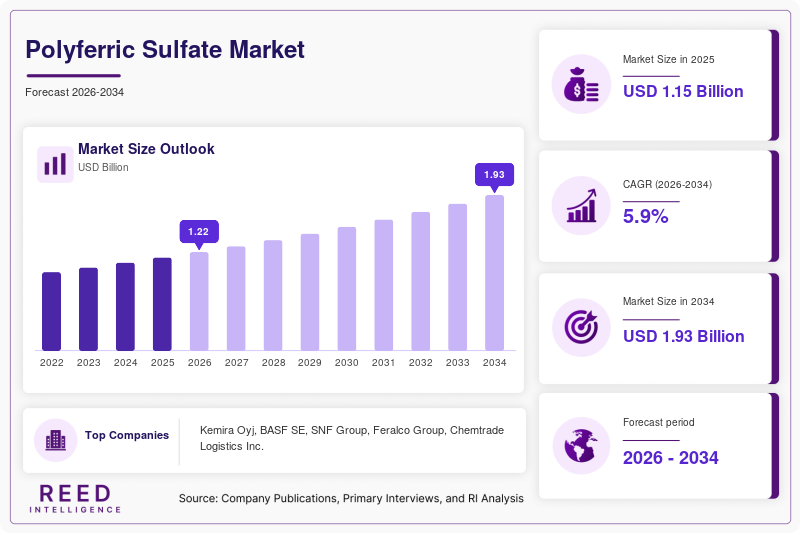
The Polyferric Sulfate Market size is witnessing steady expansion due to its increasing application in water treatment, wastewater management, and industrial processes. Polyferric sulfate (PFS) is widely used as a coagulant owing to its high efficiency, low cost, and eco-friendly properties compared to traditional chemicals. In 2025, the global Polyferric Sulfate Market size is estimated to reach approximately USD 1.15 billion, with further growth expected to USD 1.23 billion in 2026. The market is projected to reach USD 2.05 billion by 2034, registering a CAGR of 5.9% during the forecast period (2025–2034).
Several growth factors are contributing to this upward trajectory. First, the rising global demand for clean and safe water is accelerating the adoption of efficient water treatment chemicals such as polyferric sulfate. Governments and municipalities are investing heavily in water purification infrastructure, which directly boosts market demand. Second, stringent environmental regulations regarding wastewater discharge are compelling industries to adopt advanced treatment solutions, including PFS. Third, rapid industrialization in emerging economies is increasing the need for effective effluent treatment systems, further supporting market expansion.
Key Highlights
- Market size projected to grow from USD 1.15 billion (2025) to USD 2.05 billion (2034)
- CAGR of 5.9% during 2025–2034
- Strong demand from water and wastewater treatment sectors
- Increasing regulatory pressure on industrial effluent management
- Rising adoption in emerging economies
Market Trends
Rising Adoption of Eco-Friendly Water Treatment Chemicals
The Polyferric Sulfate Market is experiencing a shift toward environmentally sustainable water treatment solutions. Industries and municipalities are increasingly adopting eco-friendly coagulants that minimize environmental impact. Polyferric sulfate is gaining preference due to its lower toxicity, reduced sludge generation, and enhanced removal efficiency compared to traditional aluminum-based coagulants. Governments across developed and developing regions are enforcing stricter environmental standards, pushing industries to transition toward greener alternatives. This trend is particularly evident in urban wastewater treatment plants where efficiency and sustainability are critical. As awareness about environmental sustainability grows, the demand for polyferric sulfate is expected to expand significantly.
Technological Advancements in Production Processes
Technological innovation is playing a key role in shaping the Polyferric Sulfate Market. Manufacturers are investing in advanced production techniques to improve product consistency, purity, and performance. Modern synthesis processes are enabling the development of high-performance PFS variants with enhanced coagulation properties. These innovations are also reducing production costs and improving scalability, making polyferric sulfate more accessible to a wider range of industries. Additionally, automation and digital monitoring systems are being integrated into manufacturing processes to ensure quality control. This trend is expected to support market growth by enhancing product efficiency and expanding its application scope across industries.
Market Drivers
Increasing Demand for Clean Water and Wastewater Treatment
The growing global need for clean water is a major driver of the Polyferric Sulfate Market. Rapid population growth, urbanization, and industrial expansion are putting immense pressure on water resources. Governments are investing in water treatment infrastructure to ensure access to safe drinking water and proper wastewater management. Polyferric sulfate is widely used in these applications due to its high coagulation efficiency and cost-effectiveness. Municipalities are increasingly adopting PFS for treating drinking water and sewage. This rising demand for water purification solutions is expected to drive consistent growth in the market over the forecast period.
Stringent Environmental Regulations on Industrial Discharge
Environmental regulations aimed at controlling industrial pollution are significantly driving the Polyferric Sulfate Market. Governments worldwide are implementing strict guidelines to limit the discharge of untreated wastewater into natural water bodies. Industries such as chemicals, textiles, and paper manufacturing are required to treat effluents before disposal. Polyferric sulfate is widely used in industrial wastewater treatment due to its ability to remove contaminants effectively. Compliance with environmental standards is compelling industries to adopt advanced treatment chemicals, thereby boosting market demand. This regulatory pressure is expected to remain a key growth driver in the coming years.
Market Restraints
High Dependency on Raw Material Availability and Price Fluctuations
One of the key restraints in the Polyferric Sulfate Market is the dependency on raw material availability and price volatility. The production of polyferric sulfate requires iron-based compounds and sulfuric acid, both of which are subject to fluctuations in supply and pricing. Any disruption in the supply chain can lead to increased production costs, affecting profit margins for manufacturers. For instance, fluctuations in iron ore prices or supply shortages can significantly impact manufacturing operations. Additionally, transportation and logistics challenges can further increase costs, especially in regions with limited infrastructure. These factors can hinder market growth by limiting the affordability and availability of polyferric sulfate products.
Market Opportunities
Expansion in Emerging Economies
Emerging economies present significant growth opportunities for the Polyferric Sulfate Market. Countries in Asia Pacific, Latin America, and Africa are experiencing rapid industrialization and urbanization, leading to increased demand for water treatment solutions. Governments in these regions are investing in infrastructure development, including water and wastewater treatment facilities. Polyferric sulfate is gaining traction due to its cost-effectiveness and efficiency. The growing focus on improving sanitation and access to clean water is expected to drive demand in these markets. This expansion offers lucrative opportunities for manufacturers to establish a strong presence and increase market share.
Growing Applications in Industrial Sectors
The expanding application of polyferric sulfate across various industrial sectors is creating new growth opportunities. Industries such as paper and pulp, textiles, and food processing are increasingly using PFS for wastewater treatment and process optimization. Its ability to remove impurities and improve water quality makes it suitable for diverse applications. Additionally, the rising focus on sustainable industrial practices is encouraging the adoption of efficient treatment chemicals. As industries continue to prioritize environmental compliance and resource efficiency, the demand for polyferric sulfate is expected to grow significantly.
Segmental Analysis
By Type
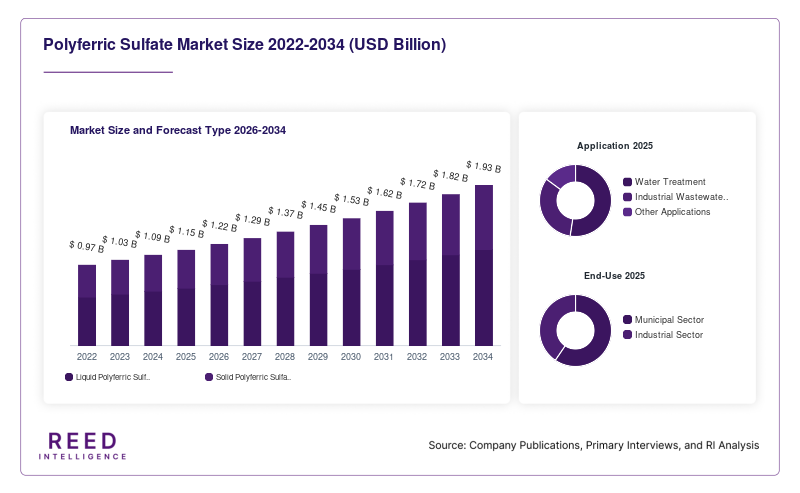
The liquid polyferric sulfate segment dominated the market in 2024, accounting for approximately 62% of the total share. Liquid PFS is widely preferred due to its ease of handling, uniform distribution, and high efficiency in water treatment processes. Municipal water treatment facilities and industrial plants favor liquid formulations because they can be easily dosed and mixed with water. Additionally, liquid polyferric sulfate offers faster reaction times and better coagulation performance compared to solid forms. The growing demand for efficient and user-friendly treatment solutions is driving the dominance of this segment in the market.
The solid polyferric sulfate segment is expected to be the fastest-growing, with a CAGR of 6.4% during the forecast period. The growth of this segment is driven by its longer shelf life, ease of transportation, and suitability for regions with limited infrastructure. Solid PFS is gaining popularity in emerging markets where storage and transportation conditions are challenging. Additionally, advancements in formulation technologies are improving the performance of solid variants, making them more competitive with liquid forms.
By Application
Water treatment is the dominant application segment, accounting for approximately 55% of the market share in 2024. Polyferric sulfate is extensively used in municipal water treatment plants for coagulation and removal of impurities. The increasing demand for clean drinking water and the expansion of urban infrastructure are driving the growth of this segment. Governments are investing in water treatment facilities to ensure safe water supply, which is further boosting demand for polyferric sulfate.
Industrial wastewater treatment is the fastest-growing application segment, with a projected CAGR of 6.7%. Industries are facing increasing pressure to comply with environmental regulations, leading to higher adoption of advanced treatment solutions. Polyferric sulfate is widely used in industries such as textiles, chemicals, and paper for treating effluents. The rising focus on sustainable industrial practices is driving the growth of this segment.
By End-Use
The municipal sector dominated the market in 2024, accounting for approximately 48% of the total share. Municipalities are the largest consumers of polyferric sulfate due to its widespread use in drinking water and sewage treatment. The growing urban population and increasing demand for clean water are driving the growth of this segment. Governments are investing in infrastructure development to improve water quality and sanitation.
The industrial sector is expected to be the fastest-growing segment, with a CAGR of 6.5%. Industries are increasingly adopting polyferric sulfate for wastewater treatment to comply with environmental regulations. The expansion of industrial activities in emerging economies is further driving demand. Additionally, the focus on reducing environmental impact and improving operational efficiency is encouraging industries to adopt advanced treatment solutions.
Regional Analysis
North America
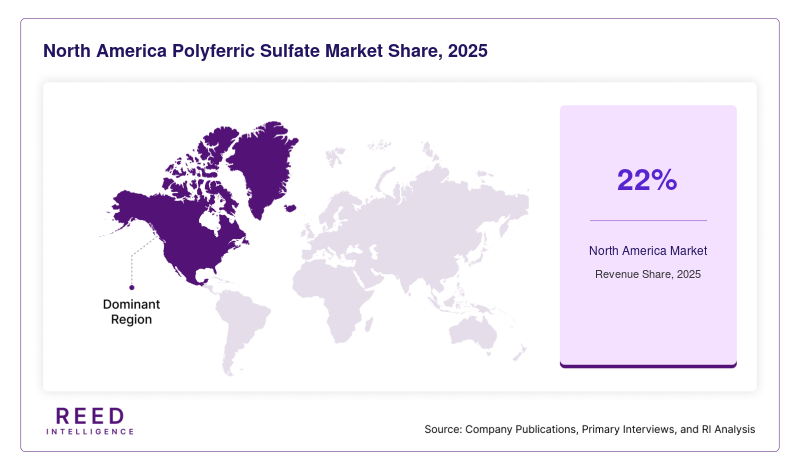
North America accounted for approximately 22% of the Polyferric Sulfate Market share in 2025 and is expected to grow at a CAGR of 5.2% during the forecast period. The region’s growth is driven by well-established water treatment infrastructure and stringent environmental regulations. The United States and Canada are focusing on upgrading aging water systems, which is increasing demand for efficient coagulants like polyferric sulfate. The presence of advanced industrial sectors further contributes to market growth.
The United States dominates the regional market due to its strong regulatory framework and high investment in water treatment technologies. A unique growth factor in this region is the increasing adoption of advanced wastewater recycling systems. Industries are focusing on water reuse to reduce operational costs and comply with environmental standards, thereby boosting the demand for polyferric sulfate.
Europe
Europe held around 20% of the global Polyferric Sulfate Market share in 2025 and is projected to grow at a CAGR of 5.0%. The region is characterized by strict environmental regulations and a strong emphasis on sustainability. Countries such as Germany, France, and the UK are investing in advanced water treatment technologies to meet regulatory requirements. The demand for eco-friendly chemicals is further supporting market growth.
Germany leads the European market due to its advanced industrial base and commitment to environmental protection. A unique growth factor in this region is the increasing focus on circular economy practices. Industries are adopting sustainable water management solutions, including efficient coagulants like polyferric sulfate, to reduce environmental impact and improve resource efficiency.
Asia Pacific
Asia Pacific dominated the Polyferric Sulfate Market with a share of approximately 38% in 2025 and is expected to grow at the highest CAGR of 6.8%. Rapid industrialization, urbanization, and population growth are driving demand for water treatment solutions in the region. Governments are investing heavily in infrastructure development to address water scarcity and pollution issues.
China is the dominant country in the Asia Pacific region due to its large industrial base and significant investments in water treatment infrastructure. A unique growth factor is the government’s focus on reducing industrial pollution through strict regulations. This is encouraging industries to adopt efficient treatment chemicals such as polyferric sulfate, driving market growth.
Middle East & Africa
The Middle East & Africa region accounted for around 10% of the Polyferric Sulfate Market share in 2025 and is projected to grow at a CAGR of 5.6%. Water scarcity is a major issue in this region, driving the demand for water treatment solutions. Governments are investing in desalination and wastewater treatment projects to address water shortages.
Saudi Arabia is a key market in this region due to its significant investments in water infrastructure. A unique growth factor is the increasing adoption of desalination technologies. Polyferric sulfate is used in pre-treatment processes, supporting the growth of the market in the region.
Latin America
Latin America held approximately 10% of the Polyferric Sulfate Market share in 2025 and is expected to grow at a CAGR of 5.4%. The region is witnessing increasing investments in water treatment infrastructure due to growing urbanization and industrialization. Countries are focusing on improving sanitation and water quality.
Brazil dominates the Latin American market due to its large population and industrial base. A unique growth factor is the government’s focus on improving wastewater treatment facilities. This is driving the adoption of efficient coagulants like polyferric sulfate in the region.
Competitive Landscape
The Polyferric Sulfate Market is moderately fragmented, with several global and regional players competing for market share. The leading companies are focusing on product innovation, capacity expansion, and strategic partnerships to strengthen their market position. One of the key leaders in the market is Kemira Oyj, known for its strong presence in water treatment chemicals. The company has been actively investing in research and development to enhance product performance and expand its product portfolio.
Other major players are also focusing on expanding their production capacities and improving distribution networks to meet growing demand. Recent developments include the launch of advanced polyferric sulfate formulations and collaborations with municipal authorities for large-scale water treatment projects. The competitive landscape is expected to remain dynamic, with companies focusing on innovation and sustainability to gain a competitive edge.
Key Players List
- Kemira Oyj
- BASF SE
- SNF Group
- Feralco Group
- Chemtrade Logistics Inc.
- Solenis LLC
- Kurita Water Industries Ltd.
- Ixom Operations Pty Ltd
- Gulbrandsen Chemicals
- Aditya Birla Chemicals
- Pencco Inc.
- Accepta Ltd.
- GEO Specialty Chemicals
- USALCO LLC
- Aries Chemical Inc.
Recent Developments
- In 2024, Kemira Oyj expanded its production capacity for water treatment chemicals to meet increasing global demand.
- In 2023, BASF SE introduced a new high-efficiency polyferric sulfate product designed for industrial wastewater treatment.
- In 2024, Kurita Water Industries Ltd. partnered with municipal authorities to implement advanced water treatment solutions using polyferric sulfate.
Polyferric Sulfate Market Segments
Type
- Liquid Polyferric Sulfate
- Solid Polyferric Sulfate
Application
- Water Treatment
- Industrial Wastewater Treatment
- Other Applications
End-Use
- Municipal Sector
- Industrial Sector
By Region
- North America
- Europe
- APAC
- Middle East and Africa
- LATAM