Polyglycerol Sebacate Market Size, Share & Demand Report By Application (Biomedical Applications, Drug Delivery Systems, Tissue Engineering, Others), By End-Use Industry (Healthcare, Research Laboratories, Industrial Applications), By Form (Solid, Liquid), By Synthesis Method (Thermal Polycondensation, Enzymatic Synthesis), By Region & Segment Forecasts, 2025–2034
USD 3950
Market Overview
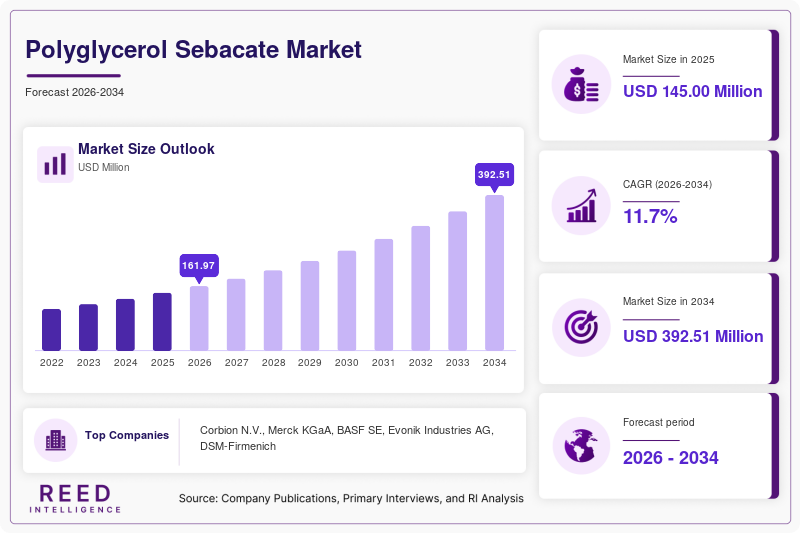
The global Polyglycerol Sebacate Market size was valued at approximately USD 145 million in 2025 and is projected to reach USD 392 million by 2034, expanding at a CAGR of 11.7% during the forecast period (2025–2034). The market is gaining momentum due to increasing demand for biodegradable elastomers in biomedical, tissue engineering, and advanced material applications. Polyglycerol sebacate (PGS), known for its tunable mechanical properties, biocompatibility, and biodegradability, has emerged as a promising material across diverse high-value industries.
A key global factor supporting market growth is the accelerating shift toward sustainable and bio-based polymers. Regulatory pressure to reduce reliance on petrochemical-based materials, combined with advancements in green chemistry, has driven innovation in polymer synthesis. This trend is particularly evident in healthcare and medical device manufacturing, where PGS is being increasingly adopted for scaffolds, drug delivery systems, and soft tissue engineering applications.
Key Highlights
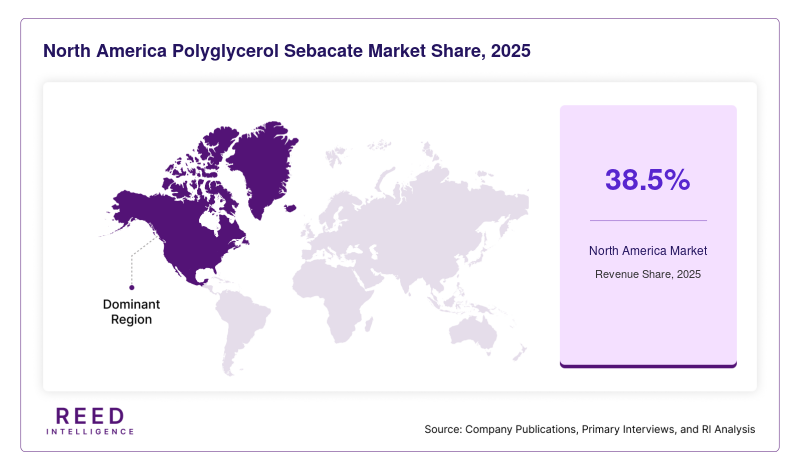
- North America dominated the market with a 38.5% share in 2025, while Asia Pacific is expected to register the fastest CAGR of 13.2%.
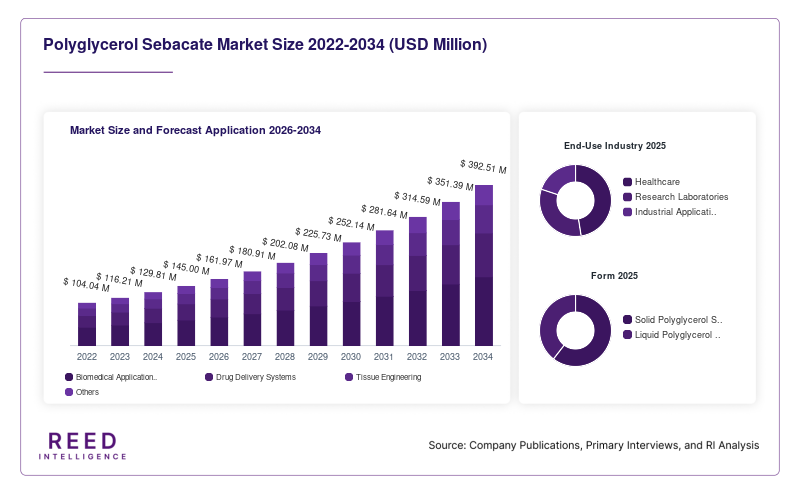
- In application, biomedical applications led with a 46% share, while drug delivery systems are projected to grow fastest at a CAGR of 12.8%.
- By end-use, healthcare dominated with 52% share, whereas research laboratories are expected to grow fastest at 13.5% CAGR.
- The United States remained the dominant country, with market values of USD 52 million in 2025 and USD 57 million in 2026.
Market Trends
Rising Adoption in Tissue Engineering
The use of polyglycerol sebacate in tissue engineering has expanded due to its elasticity and compatibility with biological tissues. Researchers are increasingly leveraging PGS for creating scaffolds that mimic natural extracellular matrices. This has improved outcomes in regenerative medicine, particularly for cardiovascular and soft tissue repair. The trend is further supported by ongoing advancements in 3D bioprinting, where PGS serves as a flexible and bioresorbable material.
Integration with Advanced Manufacturing Technologies
The integration of PGS with emerging manufacturing processes such as microfabrication and additive manufacturing is shaping the market. These technologies enable precise control over polymer structure and functionality, enhancing application-specific performance. This trend is driving demand in microfluidics, wearable devices, and implantable sensors, where customized polymer properties are essential. As industries move toward high-performance biomaterials, PGS is gaining recognition as a versatile candidate for next-generation applications.
Market Drivers
Increasing Demand for Biodegradable Polymers
Growing environmental concerns and regulatory mandates have led to a surge in demand for biodegradable materials. Polyglycerol sebacate offers an eco-friendly alternative to conventional polymers, as it degrades into non-toxic byproducts. Industries such as healthcare and packaging are increasingly adopting such materials to align with sustainability goals, thereby driving market expansion.
Expansion of Biomedical Applications
The rapid growth of the biomedical sector is significantly contributing to the Polyglycerol Sebacate Market. Its unique combination of elasticity, strength, and biocompatibility makes it suitable for a wide range of medical applications. From wound healing to implantable devices, PGS is being extensively studied and utilized. Continuous research funding and innovation in biomaterials are further accelerating its adoption.
Market Restraint
High Production Complexity and Cost
One of the primary challenges in the Polyglycerol Sebacate Market is the complexity associated with its synthesis and processing. The production of PGS involves controlled polycondensation reactions and curing processes that require specialized equipment and expertise. This increases manufacturing costs and limits large-scale commercialization.
Additionally, maintaining consistent quality and performance across batches remains a concern for manufacturers. Variability in raw materials and process conditions can affect polymer properties, leading to challenges in standardization. These factors create barriers for new entrants and slow down market penetration, particularly in cost-sensitive regions. Addressing these challenges through process optimization and technological advancements will be critical for sustained market growth.
Market Opportunities
Growth in Regenerative Medicine
The expanding field of regenerative medicine presents significant opportunities for the Polyglycerol Sebacate Market. As demand for advanced therapies increases, PGS-based scaffolds and implants are gaining traction. Their ability to support cell growth and degrade naturally aligns well with regenerative treatment approaches. Continued research in stem cell therapy and organ regeneration is expected to further boost demand.
Emerging Applications in Wearable Electronics
The rise of wearable and flexible electronics is opening new avenues for PGS. Its elasticity and biocompatibility make it suitable for skin-contact devices and sensors. As consumer demand for health monitoring devices grows, manufacturers are exploring PGS for developing comfortable and durable wearable solutions. This emerging application area is expected to create new revenue streams for market participants.
Segmental Analysis
By Application
Biomedical applications dominated the Polyglycerol Sebacate Market in 2025, accounting for 46% of the total share. This dominance was attributed to the material’s compatibility with biological tissues and its widespread use in scaffolds, implants, and wound healing solutions. The increasing demand for advanced biomaterials in healthcare significantly contributed to this segment’s leadership.
Drug delivery systems are expected to be the fastest-growing subsegment, projected to expand at a CAGR of 12.8%. The ability of PGS to degrade in a controlled manner makes it suitable for targeted drug release. Future growth will be driven by innovations in controlled-release technologies and personalized medicine.
By End-Use Industry
The healthcare sector held the largest share of 52% in 2025. This dominance was due to extensive use of PGS in medical devices, implants, and tissue engineering applications. The sector’s continuous demand for safe and effective biomaterials reinforced its leading position.
Research laboratories are projected to grow at the fastest CAGR of 13.5%. Increasing academic and institutional research focused on biodegradable polymers is expected to drive demand. The growing number of research grants and collaborations will further support this segment.
By Form
Solid form polyglycerol sebacate dominated the market with a 61% share in 2025. This form is widely used in structural applications such as scaffolds and implants due to its mechanical strength and stability.
Liquid form is expected to grow at a CAGR of 12.3%, driven by its use in coatings and injectable systems. Its flexibility and ease of processing make it suitable for emerging applications, particularly in minimally invasive procedures.
By Synthesis Method
Thermal polycondensation dominated the market, accounting for 68% of the share in 2025. This method is widely used due to its simplicity and ability to produce high-quality polymers with consistent properties.
Enzymatic synthesis is expected to grow at a CAGR of 13.1%. This method offers better control over polymer structure and is considered more environmentally friendly. Future advancements in enzyme technology are expected to drive adoption.
Regional Analysis
North America
North America accounted for 38.5% of the Polyglycerol Sebacate Market share in 2025 and is projected to grow at a CAGR of 10.8% during the forecast period. The region benefited from strong research infrastructure and high investment in biomedical innovation.
The United States dominated the regional market due to extensive funding in biomaterials research. A key growth factor was the presence of advanced healthcare systems that rapidly adopt innovative materials. The increasing number of clinical trials involving biodegradable polymers further strengthened market expansion.
Europe
Europe held a 26.2% share of the Polyglycerol Sebacate Market in 2025 and is expected to grow at a CAGR of 10.5% through 2034. The region’s growth was supported by stringent environmental regulations encouraging the use of sustainable materials.
Germany emerged as the leading country, driven by its strong chemical manufacturing base. The country’s focus on sustainable industrial practices and circular economy initiatives contributed to increased adoption of bio-based polymers such as PGS.
Asia Pacific
Asia Pacific captured 21.8% of the market share in 2025 and is anticipated to register the fastest CAGR of 13.2%. Rapid industrialization and expanding healthcare infrastructure were key contributors to growth.
China led the regional market due to large-scale manufacturing capabilities and increasing investments in biotechnology. Government initiatives promoting domestic production of advanced materials played a crucial role in driving market growth.
Middle East & Africa
The Middle East & Africa region accounted for 7.1% of the Polyglycerol Sebacate Market in 2025 and is projected to grow at a CAGR of 9.6%. The region showed gradual adoption of advanced biomaterials, supported by improving healthcare infrastructure.
Saudi Arabia dominated the market, driven by investments in healthcare modernization. The country’s focus on diversifying its economy and enhancing medical research capabilities supported the adoption of innovative polymers.
Latin America
Latin America held a 6.4% share in 2025 and is expected to grow at a CAGR of 9.9% during the forecast period. The region experienced steady growth due to increasing awareness of biodegradable materials.
Brazil led the regional market, supported by its growing healthcare sector. Investments in research institutions and collaborations with global players contributed to the adoption of polyglycerol sebacate in medical applications.
Competitive Landscape
The Polyglycerol Sebacate Market is moderately fragmented, with several players focusing on research-driven innovation and strategic collaborations. Leading companies are investing in product development and expanding their application portfolios to strengthen market presence.
The market leader, Corbion N.V., has maintained a strong position through continuous innovation in bio-based polymers. The company recently introduced an advanced grade of polyglycerol sebacate tailored for medical applications, enhancing its competitive edge.
Other key players are focusing on partnerships with research institutions to accelerate product development and commercialization. The competitive environment is characterized by technological advancements and increasing emphasis on sustainable materials, driving overall market growth.
Key Players List
- Corbion N.V.
- Merck KGaA
- BASF SE
- Evonik Industries AG
- DSM-Firmenich
- Croda International Plc
- DuPont de Nemours, Inc.
- Ashland Global Holdings Inc.
- Lonza Group AG
- Wacker Chemie AG
- Solvay S.A.
- Arkema S.A.
- Mitsubishi Chemical Group Corporation
- Kuraray Co., Ltd.
- SABIC
Recent Developments
- Corbion N.V. launched a new medical-grade PGS polymer to enhance performance in tissue engineering applications.
- BASF SE expanded its bio-based polymer research division to explore new applications of PGS.
- Evonik Industries AG entered into a collaboration with academic institutions to develop advanced biodegradable materials.
- DSM-Firmenich invested in sustainable polymer technologies, including polyglycerol sebacate innovations.
- Merck KGaA strengthened its portfolio by introducing specialty chemicals for biomedical polymer synthesis.
Polyglycerol Sebacate Market Segments
Application
- Biomedical Applications
- Drug Delivery Systems
- Tissue Engineering
- Others
End-Use Industry
- Healthcare
- Research Laboratories
- Industrial Applications
Form
- Solid Polyglycerol Sebacate
- Liquid Polyglycerol Sebacate
Synthesis Method
- Thermal Polycondensation
- Enzymatic Synthesis
By Region
- North America
- Europe
- APAC
- Middle East and Africa
- LATAM