Polyglyceryl Esters Market Size, Share & Demand Report By Type (Food Grade Polyglyceryl Esters, Cosmetic Grade Polyglyceryl Esters, Pharmaceutical Grade Polyglyceryl Esters), By Application (Food & Beverages, Personal Care & Cosmetics, Pharmaceuticals, Industrial Applications), By Source (Plant-Based, Synthetic), By End-Use Industry (Food Industry, Cosmetics & Personal Care, Pharmaceutical Industry, Industrial Sector), By Distribution Channel (Direct Sales, Distributors & Wholesalers, Online Che
USD 3950
Market Overview
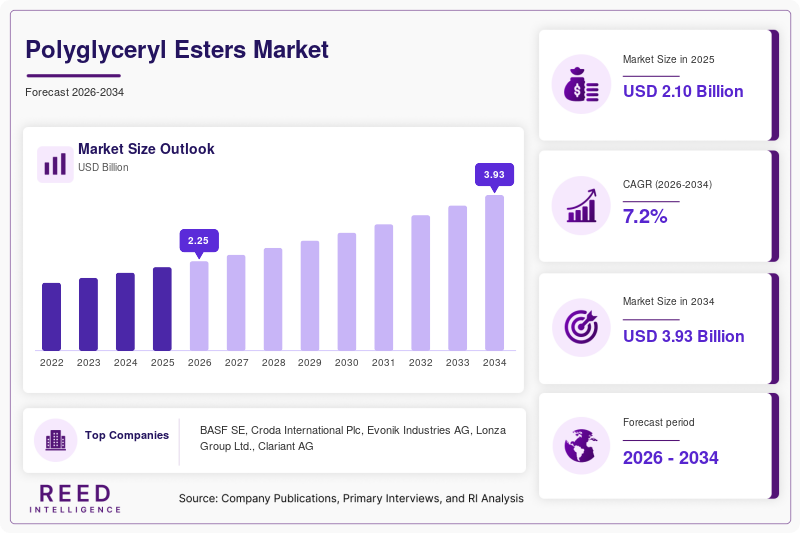
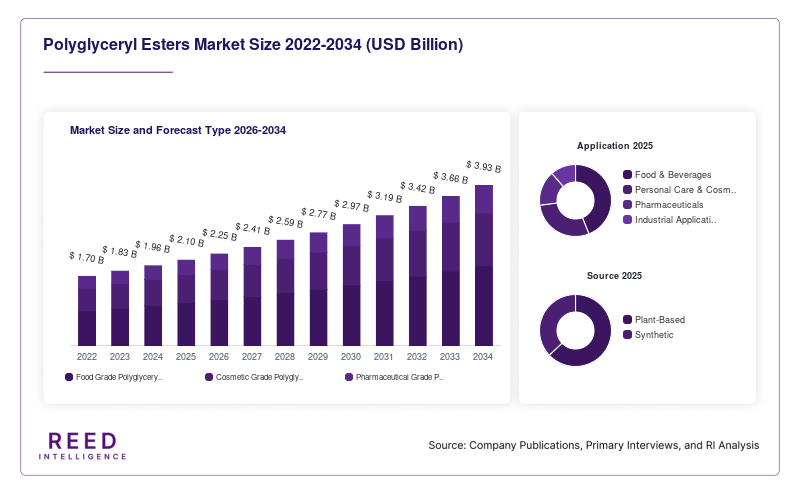
The global Polyglyceryl Esters Market size was valued at approximately USD 2.1 billion in 2025 and is projected to reach USD 3.9 billion by 2034, expanding at a CAGR of 7.2% during the forecast period (2025–2034). Polyglyceryl esters, derived from glycerol and fatty acids, are widely utilized as emulsifiers, stabilizers, and surfactants across industries such as personal care, food & beverages, pharmaceuticals, and industrial applications.
A key global factor supporting market growth has been the increasing shift toward bio-based and sustainable ingredients. As consumers and regulatory bodies push for cleaner labels and environmentally friendly formulations, manufacturers are increasingly adopting polyglyceryl esters as alternatives to synthetic emulsifiers. This trend has been particularly evident in cosmetics and food sectors, where natural and plant-derived ingredients have gained significant traction.
Key Highlights
- Dominant region: Asia Pacific held approximately 38% market share in 2025, while it is expected to grow at a CAGR of 8.1%, making it the fastest-growing region.
- Leading subsegment: Food-grade polyglyceryl esters dominated with a 42% share, while personal care applications are projected to grow fastest at a CAGR of 8.5%.
- Dominant country: China accounted for USD 480 million in 2025 and is estimated to reach USD 520 million in 2026.
Market Trends
Rising Adoption of Clean Label Ingredients
The global push for transparency in ingredient sourcing has accelerated the demand for clean label products. Polyglyceryl esters, being plant-derived and biodegradable, align well with this trend. Food manufacturers increasingly prefer these esters as emulsifiers in bakery, dairy, and processed foods to meet consumer demand for natural additives. Similarly, cosmetic brands are reformulating products to eliminate petrochemical-based emulsifiers, replacing them with polyglyceryl esters. This shift has significantly influenced the Polyglyceryl Esters Market growth, particularly in premium and organic product segments.
Expansion of Multifunctional Cosmetic Ingredients
Polyglyceryl esters are gaining traction as multifunctional ingredients in personal care formulations. Beyond emulsification, they offer moisturizing, skin-conditioning, and mild surfactant properties. This multifunctionality reduces the need for multiple additives, enabling cost-efficient and simplified formulations. As the beauty industry moves toward minimalistic formulations, these esters are becoming integral to product innovation. The trend is particularly strong in skincare and haircare, contributing to the evolving Polyglyceryl Esters Market trends globally.
Market Drivers
Increasing Demand from the Personal Care Industry
The personal care sector has emerged as a major driver for the Polyglyceryl Esters Market. With rising consumer awareness regarding skin health and ingredient safety, manufacturers are incorporating mild, non-irritating emulsifiers into their formulations. Polyglyceryl esters meet these requirements, making them suitable for sensitive skin products, baby care, and organic cosmetics. The rapid expansion of skincare routines and premium beauty products globally has further fueled demand.
Growth in Processed and Convenience Foods
The increasing consumption of processed and convenience foods has significantly boosted the demand for effective emulsifiers. Polyglyceryl esters enhance texture, stability, and shelf life in a wide range of food products such as baked goods, margarine, and confectionery. Their compatibility with food safety standards and ability to improve product quality have made them essential in modern food processing. This has positively impacted the Polyglyceryl Esters Market size and share, especially in urbanized regions.
Market Restraint
High Production Costs Compared to Synthetic Alternatives
Despite their advantages, the relatively high production cost of polyglyceryl esters poses a significant restraint on market growth. The manufacturing process involves bio-based raw materials and advanced processing techniques, which can be more expensive than producing conventional synthetic emulsifiers. This cost difference becomes a critical factor for price-sensitive industries, particularly in developing regions where cost efficiency is a priority.
Additionally, fluctuations in the prices of raw materials such as vegetable oils can impact overall production costs. Small and medium-sized manufacturers may find it challenging to adopt these ingredients at scale, limiting market penetration. While demand for natural ingredients is rising, the price-performance balance remains a key concern. This restraint continues to influence the overall Polyglyceryl Esters Market analysis, especially in cost-competitive segments such as bulk food production.
Market Opportunities
Expansion in Pharmaceutical Applications
The pharmaceutical industry presents a growing opportunity for the Polyglyceryl Esters Market. These esters are increasingly used as excipients in drug formulations due to their biocompatibility and low toxicity. They enhance drug solubility and stability, making them suitable for oral, topical, and injectable formulations. As pharmaceutical research advances and demand for effective drug delivery systems increases, the use of polyglyceryl esters is expected to expand significantly.
Growth in Emerging Economies
Emerging economies in Asia Pacific, Latin America, and Africa offer substantial growth potential. Rising disposable incomes, urbanization, and changing consumer lifestyles are driving demand for personal care and processed food products. Local manufacturers are increasingly adopting sustainable ingredients to align with global standards. This trend is expected to create new avenues for market expansion and strengthen the Polyglyceryl Esters Market forecast over the coming years.
Segmental Analysis
By Type
Food-grade polyglyceryl esters dominated the market, accounting for approximately 42% of the share in 2025. Their widespread use in bakery, dairy, and processed food products contributed to their leading position. These esters improve texture, emulsification, and shelf life, making them essential in food formulations.
Cosmetic-grade polyglyceryl esters are expected to be the fastest-growing segment, with a projected CAGR of 8.5%. Their increasing use in skincare and haircare products, driven by demand for natural and mild ingredients, will support growth.
By Application
The food & beverages segment held the largest share, approximately 40% in 2025. The extensive use of polyglyceryl esters as emulsifiers and stabilizers in processed foods contributed to its dominance.
The personal care segment is projected to grow at the fastest rate, with a CAGR of 8.7%. Rising demand for organic and natural cosmetics, along with increasing consumer awareness, will drive this growth.
By Source
Plant-based sources dominated the market with a 65% share in 2025, reflecting the growing preference for sustainable and renewable raw materials. These sources align with clean label and eco-friendly product trends.
Synthetic sources are expected to witness moderate growth, with a CAGR of 5.8%, driven by their cost-effectiveness in industrial applications.
By End-Use Industry
The food industry accounted for the largest share at 38% in 2025, supported by high demand for emulsifiers in processed foods.
The pharmaceutical industry is expected to grow at the fastest rate, with a CAGR of 8.3%, driven by increasing use of polyglyceryl esters in drug formulations.
Regional Analysis
North America
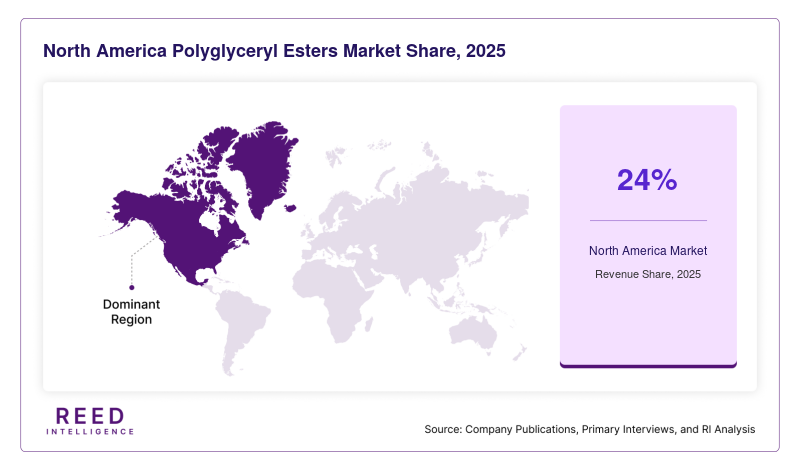
North America accounted for approximately 24% of the Polyglyceryl Esters Market share in 2025 and is projected to grow at a CAGR of 6.5% during 2025–2034. The region’s growth will be supported by strong demand for clean label food products and natural cosmetics. Regulatory frameworks promoting safe and sustainable ingredients will further drive adoption.
The United States dominated the regional market due to its advanced food processing and personal care industries. The growing preference for organic and natural products has encouraged manufacturers to incorporate polyglyceryl esters into formulations. Additionally, innovation in product development and the presence of established market players contribute to steady growth.
Europe
Europe held around 22% market share in 2025 and is expected to grow at a CAGR of 6.8%. The region’s emphasis on sustainability and stringent regulations regarding chemical usage will support market expansion. Demand for eco-friendly emulsifiers in cosmetics and food applications will continue to rise.
Germany emerged as the dominant country, driven by its strong manufacturing base and focus on green chemistry. The country’s well-established cosmetics and pharmaceutical sectors have increasingly adopted bio-based ingredients, boosting demand for polyglyceryl esters.
Asia Pacific
Asia Pacific led the Polyglyceryl Esters Market with a 38% share in 2025 and is projected to grow at the fastest CAGR of 8.1%. Rapid industrialization, urbanization, and rising consumer awareness regarding product quality will drive growth in the region.
China dominated the regional market due to its large-scale production capabilities and growing demand from food and personal care industries. Increasing investments in manufacturing infrastructure and export-oriented production have strengthened the country’s position in the global market.
Middle East & Africa
The Middle East & Africa accounted for approximately 8% of the market share in 2025 and is expected to grow at a CAGR of 6.2%. The region’s growth will be driven by expanding food processing industries and rising demand for personal care products.
Saudi Arabia led the regional market, supported by increasing investments in industrial diversification and consumer goods sectors. The growing focus on quality and safety standards in food and cosmetics will further drive demand.
Latin America
Latin America held around 8% share in 2025 and is projected to grow at a CAGR of 6.7%. Increasing urbanization and changing consumer preferences toward processed foods and personal care products will support market growth.
Brazil dominated the region due to its large consumer base and expanding food and beverage industry. The adoption of natural ingredients in cosmetics and food applications has contributed to steady market growth.
Competitive Landscape
The Polyglyceryl Esters Market is moderately fragmented, with several global and regional players competing on product quality, innovation, and pricing. Companies are focusing on expanding their product portfolios and investing in sustainable production technologies.
A leading player in the market is BASF SE, which has established a strong presence through its diverse product offerings and continuous innovation. The company recently introduced advanced bio-based emulsifiers to cater to growing demand for sustainable ingredients.
Other key players are actively engaging in strategic collaborations, mergers, and acquisitions to strengthen their market position and expand their geographic reach. Innovation in green chemistry and product customization remains a key competitive strategy.
Key Players
- BASF SE
- Croda International Plc
- Evonik Industries AG
- Lonza Group Ltd.
- Clariant AG
- Kerry Group Plc
- Palsgaard A/S
- Estelle Chemicals Pvt. Ltd.
- Oleon NV
- Stearinerie Dubois
- Riken Vitamin Co., Ltd.
- Sakamoto Yakuhin Kogyo Co., Ltd.
- Taiyo Kagaku Co., Ltd.
- IOI Oleo GmbH
- Colonial Chemical Inc.
Recent Developments
- In 2024, BASF SE expanded its bio-based emulsifier portfolio to include advanced polyglyceryl esters for cosmetic applications.
- Croda International Plc introduced new sustainable emulsifier solutions targeting the clean beauty segment.
- Evonik Industries AG invested in green chemistry technologies to enhance production efficiency.
- Palsgaard A/S launched innovative food-grade emulsifiers to improve bakery product quality.
- Clariant AG strengthened its presence in Asia Pacific through strategic partnerships and product innovations.
Polyglyceryl Esters Market Segments
Type
- Food Grade Polyglyceryl Esters
- Cosmetic Grade Polyglyceryl Esters
- Pharmaceutical Grade Polyglyceryl Esters
Application
- Food & Beverages
- Personal Care & Cosmetics
- Pharmaceuticals
- Industrial Applications
Source
- Plant-Based
- Synthetic
End-Use Industry
- Food Industry
- Cosmetics & Personal Care
- Pharmaceutical Industry
- Industrial Sector
Distribution Channel
- Direct Sales (B2B)
- Distributors & Wholesalers
- Online Chemical Marketplaces
By Region
- North America
- Europe
- APAC
- Middle East and Africa
- LATAM