Polyglycolic Acid in the Oil and Gas Industry Market Size, Share & Demand Report By Application (Temporary Plugging & Diversion, Frac Balls, Dissolvable Frac Plugs, Others), By Form (Fibers, Films & Sheets, Pellets, Others), By End-Use (Drilling, Well Completion, Production), By Product Type (Standard Grade, High-Performance Grade), By Region & Segment Forecasts, 2025–2034
USD 3950
Market Overview
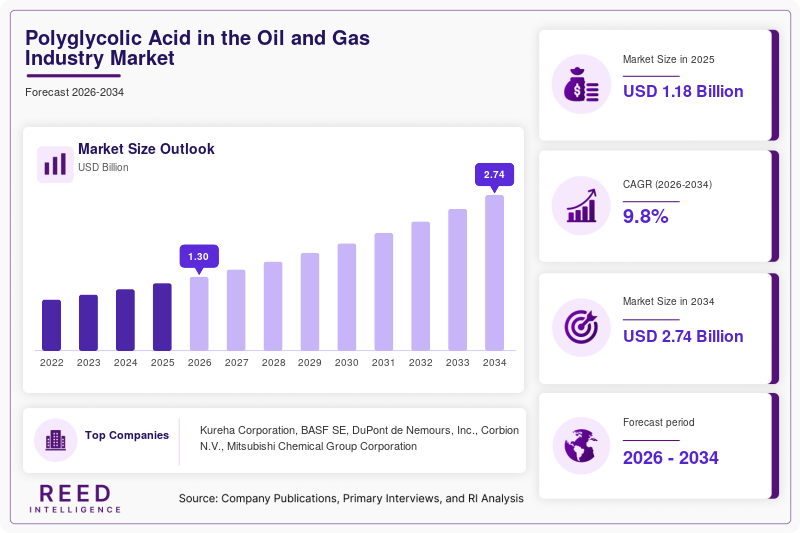
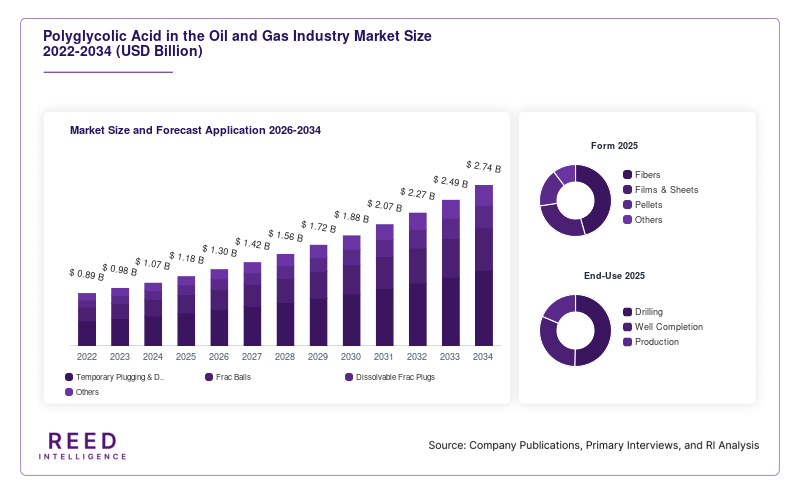
The Polyglycolic Acid in the Oil and Gas Industry Market was valued at approximately USD 1.18 billion in 2025 and is projected to reach USD 2.74 billion by 2034, expanding at a CAGR of 9.8% from 2025 to 2034. The increasing demand for high-performance degradable polymers in downhole applications has significantly contributed to the expansion of the Polyglycolic Acid in the Oil and Gas Industry Market. Polyglycolic acid (PGA) is widely utilized for temporary plugging, frac balls, and dissolvable tools, offering superior mechanical strength and predictable degradation rates in harsh well environments.
A key global factor supporting market growth is the rising focus on operational efficiency in unconventional oil and gas extraction, particularly in shale formations. Operators are adopting advanced materials like PGA to reduce intervention costs and improve well productivity, thereby strengthening the overall market outlook.
Key Highlights
- North America dominated the market with a 42% share in 2025, while Asia Pacific is expected to register the fastest growth at a CAGR of 11.6%.
- By application, temporary plugging & diversion tools led with a 38% share, whereas dissolvable frac plugs are projected to grow fastest at a CAGR of 12.4%.
- By form, fibers accounted for the largest share of 36%, while films & sheets are anticipated to expand at a CAGR of 10.9%.
- The United States remained the dominant country with USD 410 million in 2025 and is estimated to reach USD 438 million in 2026.
Market Trends
Rising Adoption of Dissolvable Materials in Well Completion
The Polyglycolic Acid in the Oil and Gas Industry Market is witnessing increasing adoption of dissolvable materials to streamline well completion processes. PGA-based tools eliminate the need for mechanical retrieval, reducing rig time and operational costs. This shift aligns with the industry's push toward automation and efficiency in multi-stage hydraulic fracturing operations. As operators aim to enhance well productivity while minimizing downtime, the use of PGA continues to gain traction.
Technological Advancements in Polymer Engineering
Continuous innovation in polymer chemistry is shaping the Polyglycolic Acid in the Oil and Gas Industry Market. Enhanced formulations with controlled degradation rates and improved thermal stability are being developed to withstand extreme downhole conditions. These advancements are enabling broader application across high-pressure, high-temperature (HPHT) wells. As a result, manufacturers are focusing on tailored PGA solutions, expanding the scope of applications and strengthening market growth prospects.
Market Drivers
Increasing Unconventional Oil & Gas Exploration
The expansion of shale gas and tight oil exploration is a major driver of the Polyglycolic Acid in the Oil and Gas Industry Market. These operations require efficient zonal isolation and temporary plugging solutions, where PGA materials play a critical role. Their ability to degrade without leaving residue makes them ideal for complex well architectures, thereby boosting their demand across unconventional resources.
Cost Reduction and Operational Efficiency
Oilfield operators are prioritizing technologies that reduce operational costs and improve efficiency. The use of PGA eliminates the need for costly intervention processes such as milling or retrieval. This advantage directly contributes to reduced downtime and improved return on investment, driving the adoption of PGA-based solutions across the industry.
Market Restraint
High Production Costs of Polyglycolic Acid
One of the primary challenges in the Polyglycolic Acid in the Oil and Gas Industry Market is the relatively high cost of production compared to conventional materials. The complex manufacturing process and dependence on specialized raw materials contribute to elevated pricing. This cost factor limits adoption among smaller operators and in cost-sensitive regions. Additionally, fluctuating raw material prices can impact profit margins for manufacturers. While technological advancements are expected to gradually reduce costs, price sensitivity remains a constraint affecting overall market penetration.
Market Opportunities
Expansion in Deepwater and HPHT Wells
The growing number of deepwater and high-pressure, high-temperature (HPHT) projects presents significant opportunities for the Polyglycolic Acid in the Oil and Gas Industry Market. PGA’s ability to maintain structural integrity under extreme conditions makes it suitable for these challenging environments. As exploration activities move into deeper reserves, the demand for advanced materials like PGA is expected to increase.
Increasing Adoption in Emerging Markets
Emerging economies are investing heavily in oil and gas infrastructure, creating new avenues for market expansion. Regions such as Asia Pacific and the Middle East are witnessing increased drilling activities, which is likely to drive demand for PGA-based solutions. The growing focus on enhancing recovery rates and improving well efficiency further supports the adoption of advanced materials in these markets.
Segmental Analysis
By Application
Temporary plugging and diversion tools dominated the Polyglycolic Acid in the Oil and Gas Industry Market, accounting for 38% of the total share in 2025. These tools were widely used to improve fluid distribution during hydraulic fracturing operations.
Dissolvable frac plugs are expected to be the fastest-growing subsegment, with a CAGR of 12.4%. Their ability to eliminate post-fracturing removal processes will drive their adoption, particularly in multi-stage fracturing operations.
By Form
Fibers held the largest share of 36% in 2025, owing to their extensive use in reinforcement and filtration applications within oilfield operations. Their mechanical strength and flexibility made them suitable for various downhole applications.
Films and sheets are projected to grow at a CAGR of 10.9%, driven by their increasing use in controlled degradation applications. Their uniform structure allows precise performance in specialized well conditions.
By End-Use Application
Well completion applications dominated with a 45% share in 2025, as PGA materials are essential in optimizing well productivity.
Drilling applications are expected to grow at a CAGR of 10.7%, supported by increasing demand for efficient drilling solutions and advanced materials.
By Product Type
Standard-grade PGA accounted for 52% of the market in 2025, due to its widespread availability and cost-effectiveness.
High-performance PGA is anticipated to grow at a CAGR of 11.3%, driven by demand for materials capable of withstanding extreme conditions.
Regional Analysis
North America
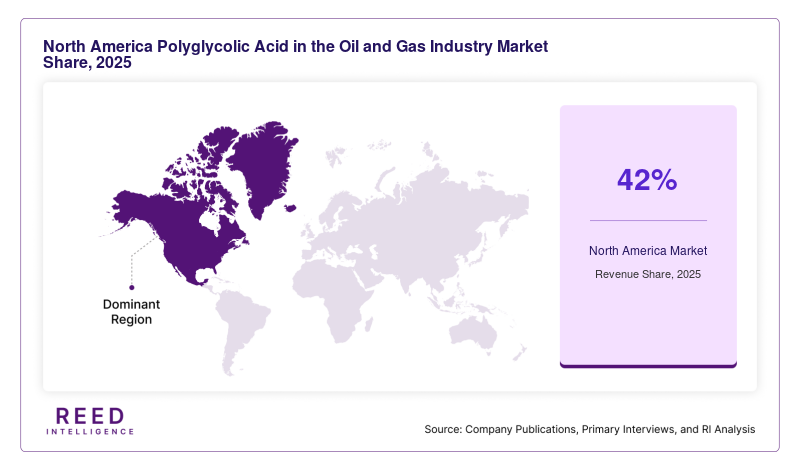
North America accounted for 42% of the Polyglycolic Acid in the Oil and Gas Industry Market in 2025 and is expected to grow at a CAGR of 9.2% through 2034. The region’s dominance was attributed to extensive shale gas exploration and advanced oilfield technologies.
The United States led the region due to its strong presence in unconventional drilling. The widespread adoption of hydraulic fracturing and horizontal drilling created sustained demand for PGA-based dissolvable tools. Continuous innovation in well completion technologies further strengthened market growth.
Europe
Europe held approximately 18% market share in 2025 and is projected to expand at a CAGR of 8.5%. The region’s growth was supported by technological advancements and increased focus on efficient resource extraction.
Norway emerged as the dominant country due to its offshore exploration activities. The need for reliable materials in harsh North Sea conditions encouraged the adoption of PGA solutions, particularly for subsea well operations.
Asia Pacific
Asia Pacific represented 16% of the market in 2025 and is expected to register the fastest growth at a CAGR of 11.6%. Rising energy demand and expanding exploration activities drove the regional market.
China dominated the region due to its significant investments in shale gas development. Government initiatives to enhance domestic energy production contributed to the increased use of advanced materials, including PGA.
Middle East & Africa
The Middle East & Africa accounted for 14% of the market in 2025 and is anticipated to grow at a CAGR of 10.1%. The region’s growth was driven by large-scale oilfield developments and enhanced oil recovery projects.
Saudi Arabia led the market due to its extensive oil reserves and ongoing investment in advanced drilling technologies. The adoption of PGA materials supported efficient well completion processes in complex reservoirs.
Latin America
Latin America held around 10% market share in 2025 and is expected to grow at a CAGR of 9.7%. Increasing offshore exploration and investment in oil infrastructure contributed to market growth.
Brazil emerged as the leading country due to its deepwater exploration projects. The need for high-performance materials in offshore drilling environments encouraged the adoption of PGA-based solutions.
Competitive Landscape
The Polyglycolic Acid in the Oil and Gas Industry Market is moderately consolidated, with key players focusing on product innovation and strategic collaborations. Leading companies are investing in research and development to enhance material performance and expand application areas.
The market leader, Kureha Corporation, has maintained a strong position through continuous advancements in high-performance PGA products. The company recently expanded its production capacity to meet growing demand from the oil and gas sector.
Other prominent players are focusing on partnerships with oilfield service providers to strengthen their market presence. The competitive landscape is characterized by technological innovation, product differentiation, and regional expansion strategies.
Key Players
- Kureha Corporation
- BASF SE
- DuPont de Nemours, Inc.
- Corbion N.V.
- Mitsubishi Chemical Group Corporation
- SABIC
- Eastman Chemical Company
- ExxonMobil Chemical Company
- Saudi Basic Industries Corporation
- Chevron Phillips Chemical Company
- Arkema S.A.
- Solvay S.A.
- Toray Industries, Inc.
- Teijin Limited
- Dow Inc.
Recent Developments
- In 2024, Kureha Corporation expanded its PGA production capacity to support increasing demand from oilfield applications.
- BASF SE introduced advanced polymer formulations with improved degradation control.
- DuPont focused on developing high-strength PGA materials for extreme well conditions.
- Mitsubishi Chemical Group enhanced its supply chain capabilities to support global demand.
- SABIC invested in research initiatives aimed at improving polymer performance for energy applications.
Polyglycolic Acid in the Oil and Gas Industry Market Segments
Application
- Temporary Plugging & Diversion
- Frac Balls
- Dissolvable Frac Plugs
- Others
Form
- Fibers
- Films & Sheets
- Pellets
- Others
End-Use
- Drilling
- Well Completion
- Production
Product Type
- Standard Grade
- High-Performance Grade
By Region
- North America
- Europe
- APAC
- Middle East and Africa
- LATAM