Polyisobutenyl Succinic Anhydride Market Size, Share & Demand Report By Type (Thermal PIBSA, Chlorinated PIBSA), By Application (Lubricant Additives, Fuel Additives, Others), By End-Use Industry (Automotive, Industrial, Marine, Others), By Molecular Weight (Low, Medium, High), By Region & Segment Forecasts, 2025–2034
USD 3950
Market Overview
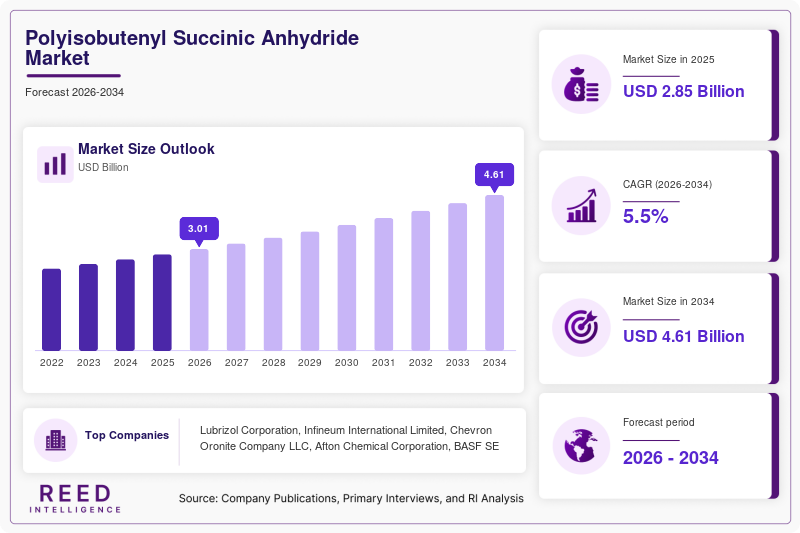
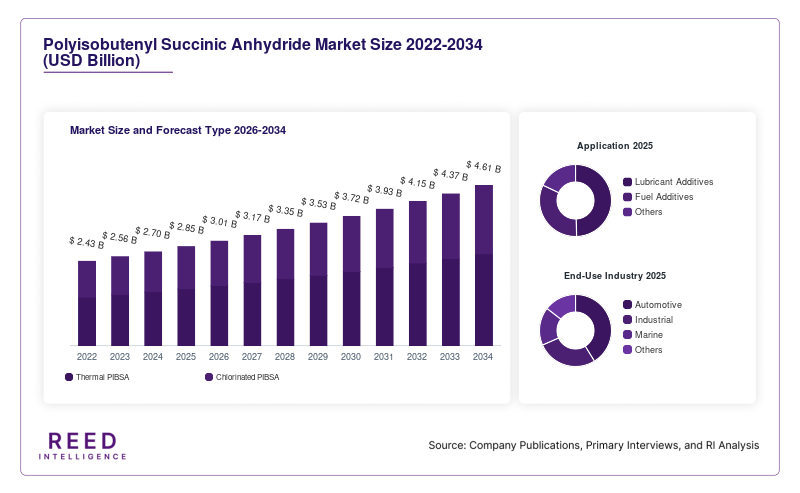
The global Polyisobutenyl Succinic Anhydride Market size was valued at approximately USD 2.85 billion in 2025 and is projected to reach USD 4.62 billion by 2034, expanding at a CAGR of 5.5% during the forecast period (2025–2034). The market growth is primarily supported by the steady expansion of the global lubricants industry, particularly in automotive and industrial applications, where PIBSA serves as a critical intermediate for dispersants and detergent additives.
A key global factor driving the Polyisobutenyl Succinic Anhydride Market is the rising demand for high-performance engine oils that comply with evolving emission regulations. PIBSA-based additives enhance fuel efficiency, reduce sludge formation, and extend engine life, making them essential in modern lubricant formulations. The growing vehicle parc and industrial machinery deployment across emerging economies continue to sustain long-term demand.
Key Highlights
- Asia Pacific dominated the market with a 42% share in 2025, while it is expected to register the fastest CAGR of 6.4% through 2034.
- By type, Thermal PIBSA held the leading share at 61%, whereas Chlorinated PIBSA is projected to grow at a CAGR of 6.1%.
- By application, Lubricant Additives accounted for the largest share at 68%, while Fuel Additives will expand at a CAGR of 6.3%.
- The United States remained the dominant country with market values of USD 620 million in 2025 and USD 650 million in 2026.
Market Trends
Increasing Shift Toward High-Performance Additives
The Polyisobutenyl Succinic Anhydride Market is witnessing a transition toward advanced additive chemistries that enhance lubricant efficiency under extreme operating conditions. Manufacturers are focusing on PIBSA derivatives that offer improved thermal stability and oxidation resistance. This trend aligns with the growing need for high-performance lubricants in heavy-duty engines, marine equipment, and industrial machinery. As engine technologies evolve, additive formulations are becoming more complex, increasing the reliance on PIBSA intermediates.
Integration of Sustainable and Low-Emission Formulations
Environmental considerations are shaping product development strategies in the Polyisobutenyl Succinic Anhydride Market. Companies are investing in low-chlorine or chlorine-free PIBSA production methods to reduce environmental impact. Additionally, the adoption of bio-based feedstocks and cleaner production processes is gaining attention. This trend reflects regulatory pressures and customer demand for sustainable chemical solutions, particularly in Europe and North America, where environmental compliance standards are stringent.
Market Drivers
Expanding Automotive Lubricants Demand
The increasing global vehicle population and rising demand for fuel-efficient engines are driving the Polyisobutenyl Succinic Anhydride Market. PIBSA is widely used in dispersants that prevent deposit formation in engines, thereby enhancing performance and longevity. Growth in passenger vehicles, commercial fleets, and hybrid technologies is contributing to higher consumption of lubricant additives, directly influencing PIBSA demand.
Industrialization and Machinery Usage Growth
Rapid industrial development, especially in emerging economies, is accelerating the use of heavy machinery and equipment. This has led to increased demand for industrial lubricants, where PIBSA-based additives play a crucial role in maintaining operational efficiency. Sectors such as manufacturing, mining, and energy are key contributors, as they require durable lubricants capable of withstanding harsh conditions.
Market Restraint
Volatility in Raw Material Prices
The Polyisobutenyl Succinic Anhydride Market faces a significant challenge due to fluctuations in the prices of raw materials such as polyisobutylene and maleic anhydride. These materials are derived from petrochemical sources, making them susceptible to crude oil price volatility. Price instability impacts production costs and profit margins for manufacturers, creating uncertainty in pricing strategies.
Additionally, supply chain disruptions and geopolitical factors can further exacerbate raw material availability issues. Smaller manufacturers are particularly affected, as they have limited capacity to absorb cost variations. This restraint may hinder market growth, especially in price-sensitive regions where end users prioritize cost efficiency over performance enhancements.
Market Opportunities
Growth in Electric and Hybrid Vehicle Fluids
The rise of electric and hybrid vehicles presents new avenues for the Polyisobutenyl Succinic Anhydride Market. Although electric vehicles require fewer traditional engine oils, they still depend on specialized lubricants for thermal management systems and gear components. PIBSA-based additives can be adapted to meet these requirements, opening opportunities for innovation and diversification.
Expansion in Emerging Economies
Emerging markets in Asia Pacific, Latin America, and Africa offer significant growth potential due to increasing industrialization and automotive adoption. Infrastructure development and rising disposable incomes are driving demand for vehicles and machinery, thereby boosting lubricant consumption. Manufacturers are focusing on establishing regional production facilities and distribution networks to capitalize on these opportunities.
Segmental Analysis
By Type
Thermal PIBSA dominated the Polyisobutenyl Succinic Anhydride Market with a 61% share in 2025. Its widespread adoption has been attributed to its cost-effectiveness and suitability for standard lubricant formulations. Thermal PIBSA has been preferred in applications where moderate performance characteristics are sufficient.
Chlorinated PIBSA is expected to witness the fastest growth at a CAGR of 6.1% during the forecast period. Its superior reactivity and efficiency in producing high-performance dispersants will drive demand. This subsegment will benefit from increasing requirements for advanced lubricant additives in high-stress operating environments.
By Application
Lubricant additives accounted for the largest share of 68% in 2025 in the Polyisobutenyl Succinic Anhydride Market. This dominance has been driven by the extensive use of PIBSA in dispersant production, which helps maintain engine cleanliness and efficiency.
Fuel additives are projected to grow at a CAGR of 6.3%. Rising demand for fuel efficiency and emission reduction will support this growth. PIBSA-based fuel additives will gain traction due to their ability to improve combustion and reduce deposits.
By End-Use Industry
The automotive sector held the dominant share of 55% in 2025, reflecting the extensive use of PIBSA in engine oils and transmission fluids. The sector has been a major contributor due to the high consumption of lubricants in vehicles.
The industrial sector is expected to grow at the fastest CAGR of 5.9%. Increasing machinery usage and the need for high-performance lubricants will drive demand. Industrial applications will expand as manufacturing activities continue to rise globally.
By Molecular Weight
High molecular weight PIBSA accounted for 58% of the market share in 2025, as it has been widely used in applications requiring strong dispersant properties. Its effectiveness in maintaining engine cleanliness has supported its dominance.
Medium molecular weight PIBSA is anticipated to grow at a CAGR of 5.8%, driven by its balanced performance characteristics. It will be increasingly adopted in applications requiring both efficiency and cost optimization.
Regional Analysis
North America
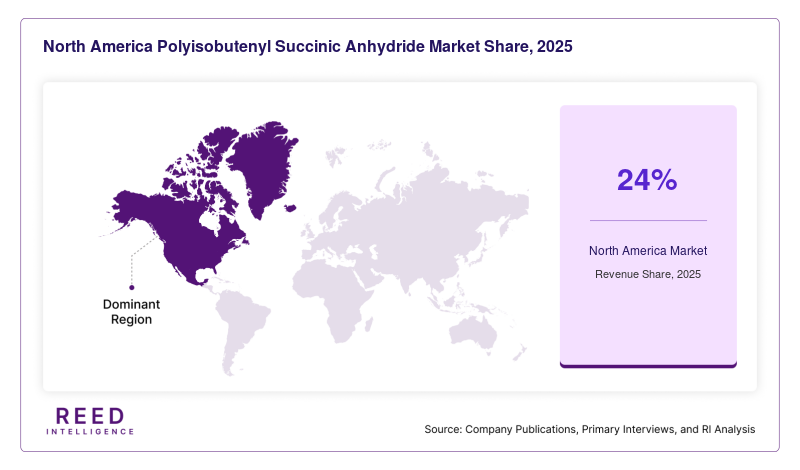
North America accounted for approximately 24% of the Polyisobutenyl Succinic Anhydride Market share in 2025 and is expected to grow at a CAGR of 4.8% during the forecast period. The region’s mature automotive and industrial sectors have historically driven steady demand for lubricant additives.
The United States dominated the regional market due to its advanced refining and chemical manufacturing capabilities. A key growth factor is the strong presence of established lubricant manufacturers investing in high-performance additive technologies. Continuous innovation in engine oil formulations has supported sustained demand for PIBSA.
Europe
Europe held around 21% market share in 2025 and is projected to grow at a CAGR of 4.9% through 2034. The region has been characterized by stringent environmental regulations and a focus on sustainable chemical production.
Germany emerged as the leading country, driven by its automotive engineering sector. The emphasis on reducing emissions and improving fuel efficiency has led to increased adoption of advanced lubricant additives. Regulatory frameworks have also encouraged the development of low-chlorine PIBSA variants.
Asia Pacific
Asia Pacific led the Polyisobutenyl Succinic Anhydride Market with a 42% share in 2025 and is anticipated to expand at a CAGR of 6.4%, making it the fastest-growing region. Rapid industrialization and urbanization have been key contributors to market growth.
China dominated the region due to its extensive manufacturing base and large automotive production capacity. The country’s focus on expanding industrial output and infrastructure development has significantly increased demand for lubricants, thereby driving PIBSA consumption.
Middle East & Africa
The Middle East & Africa accounted for approximately 7% of the market in 2025 and is expected to grow at a CAGR of 5.2%. The region’s oil and gas industry has played a central role in supporting demand for industrial lubricants.
Saudi Arabia led the regional market, supported by its strong petrochemical sector. Investments in downstream industries and diversification initiatives have contributed to the increasing use of lubricant additives in industrial applications.
Latin America
Latin America held nearly 6% of the Polyisobutenyl Succinic Anhydride Market share in 2025 and is projected to grow at a CAGR of 5.0%. Economic recovery and industrial expansion have supported market development.
Brazil dominated the region due to its growing automotive and manufacturing sectors. The country’s increasing demand for commercial vehicles and industrial equipment has driven lubricant consumption, thereby boosting PIBSA demand.
Competitive Landscape
The Polyisobutenyl Succinic Anhydride Market is moderately consolidated, with key players focusing on product innovation and capacity expansion. Leading companies include Lubrizol, Infineum, Chevron Oronite, Afton Chemical, and BASF.
Lubrizol has been recognized as a market leader due to its extensive product portfolio and strong presence in lubricant additives. The company recently expanded its production capabilities to meet growing demand in Asia Pacific, enhancing its global footprint.
Other players are investing in research and development to introduce advanced PIBSA derivatives with improved performance characteristics. Strategic collaborations and regional expansions remain common approaches to strengthen market position.
Key Players List
- Lubrizol Corporation
- Infineum International Limited
- Chevron Oronite Company LLC
- Afton Chemical Corporation
- BASF SE
- Clariant AG
- LANXESS AG
- Evonik Industries AG
- BRB International BV
- Tianhe Chemicals Group
- Shandong Hongrui Chemical Co., Ltd.
- ISCA UK Ltd.
- Adeka Corporation
- Wuxi South Petroleum Additives Co., Ltd.
- Jinzhou Kangtai Lubricant Additives Co., Ltd.
Recent Developments
- 2024: Lubrizol expanded its additive manufacturing facility in Asia to enhance PIBSA production capacity.
- 2024: BASF introduced a new low-chlorine PIBSA variant targeting environmentally compliant formulations.
- 2023: Afton Chemical launched advanced dispersant technology using PIBSA intermediates.
- 2023: Chevron Oronite strengthened its distribution network in Latin America.
- 2023: Infineum invested in R&D for next-generation lubricant additives.
Polyisobutenyl Succinic Anhydride Market Segments
Type
- Thermal PIBSA
- Chlorinated PIBSA
Application
- Lubricant Additives
- Fuel Additives
- Others
End-Use Industry
- Automotive
- Industrial
- Marine
- Others
Molecular Weight
- Low
- Medium
- High
By Region
- North America
- Europe
- APAC
- Middle East and Africa
- LATAM