Polymer Derived Ceramics Market Size, Share & Demand Report By Material Type (Silicon Carbide, Silicon Nitride, Oxides, Others), By Application (Aerospace Components, Energy Storage Systems, Electronics, Industrial Equipment), By Form (Fibers, Coatings, Monoliths, Composites), By End-Use Industry (Aerospace & Defense, Electronics & Semiconductor, Energy & Power, Automotive, Healthcare) By Region & Segment Forecasts, 2026–2034
USD 3950
Market Overview
The Polymer Derived Ceramics Market size was valued at approximately USD 2.85 billion in 2026 and is projected to reach USD 6.72 billion by 2034, expanding at a compound annual growth rate (CAGR) of 11.3% during 2026–2034. The market growth has been consistently supported by the increasing demand for high-performance ceramics in extreme environments, particularly in aerospace, energy, and electronics applications. Polymer-derived ceramics (PDCs) offer superior thermal stability, oxidation resistance, and mechanical strength, making them suitable for next-generation industrial applications.
A major global factor contributing to market expansion is the rising investment in advanced material science for energy-efficient and lightweight solutions. Governments and private players are focusing on materials that improve performance while reducing energy consumption, which has significantly boosted the adoption of polymer-derived ceramics.
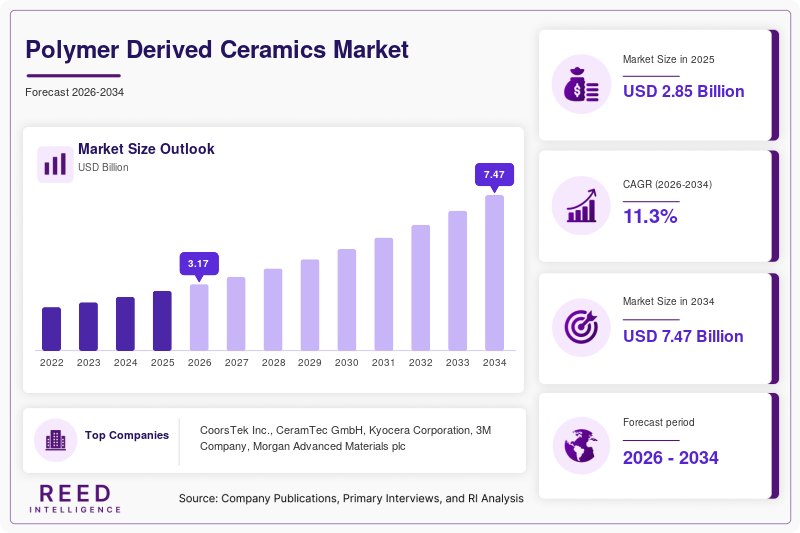
Key Highlights
- Dominant region: Asia Pacific accounted for 38.6% market share in 2025, while North America is projected to register the fastest CAGR of 12.1%.
- Leading subsegments: Silicon carbide (SiC) dominated the material segment, while silicon nitride (Si₃N₄) is expected to grow at a CAGR of 12.7%.
- Application leadership: Aerospace components held the largest share, while energy storage applications are projected to grow at 13.4% CAGR.
- Dominant country: China led the market with USD 0.78 billion in 2024 and USD 0.86 billion in 2025.
Market Trends
Additive Manufacturing Integration
The integration of additive manufacturing technologies with polymer-derived ceramics is emerging as a transformative trend. Manufacturers are increasingly adopting 3D printing techniques to produce complex ceramic components with precision and reduced material waste. This trend is particularly relevant in aerospace and medical sectors where customized geometries and lightweight structures are critical. The ability to tailor microstructures and properties through advanced fabrication methods is significantly enhancing product innovation within the Polymer Derived Ceramics Market.
Rising Demand in Energy Storage Systems
Another notable trend is the growing use of polymer-derived ceramics in energy storage systems, including lithium-ion batteries and solid oxide fuel cells. These materials provide improved thermal stability and electrochemical performance, making them suitable for next-generation energy solutions. As global energy transition efforts intensify, the demand for high-performance ceramic materials is expected to rise steadily, influencing the overall market outlook.
Market Drivers
Increasing Demand from Aerospace and Defense
The aerospace and defense sector has emerged as a major driver for the Polymer Derived Ceramics Market. The need for lightweight materials capable of withstanding high temperatures and corrosive environments has significantly increased the adoption of PDCs. These materials are widely used in turbine components, thermal protection systems, and structural parts. The growing number of space exploration missions and defense modernization programs is further supporting market growth.
Expansion of Electronics and Semiconductor Industry
The rapid growth of the electronics and semiconductor industry is another key factor driving the market. Polymer-derived ceramics are used in insulating layers, substrates, and microelectronic components due to their excellent dielectric properties. The increasing demand for compact and high-performance electronic devices is encouraging manufacturers to adopt advanced ceramic materials, thereby boosting the overall market size.
Restraint
High Production Costs and Processing Complexity
One of the primary challenges in the Polymer Derived Ceramics Market is the high cost associated with production and processing. The synthesis of precursor polymers and their conversion into ceramics requires specialized equipment and expertise. This complexity increases manufacturing costs, limiting the widespread adoption of these materials, especially in cost-sensitive industries.
Market Opportunities
Emerging Applications in Biomedical Engineering
Polymer-derived ceramics are gaining traction in biomedical applications such as implants and tissue engineering scaffolds. Their biocompatibility and ability to mimic natural bone structures present significant growth opportunities. As healthcare technologies advance, the demand for innovative biomaterials is expected to create new avenues for market expansion.
Growth in Renewable Energy Infrastructure
The increasing focus on renewable energy infrastructure offers promising opportunities for the Polymer Derived Ceramics Market. These materials are used in solar panels, wind turbines, and energy storage systems due to their durability and resistance to harsh environmental conditions. The global push toward sustainable energy solutions is expected to drive demand in this segment over the forecast period.
Segmental Analysis
By Material Type
Dominant Subsegment: Silicon Carbide (SiC)
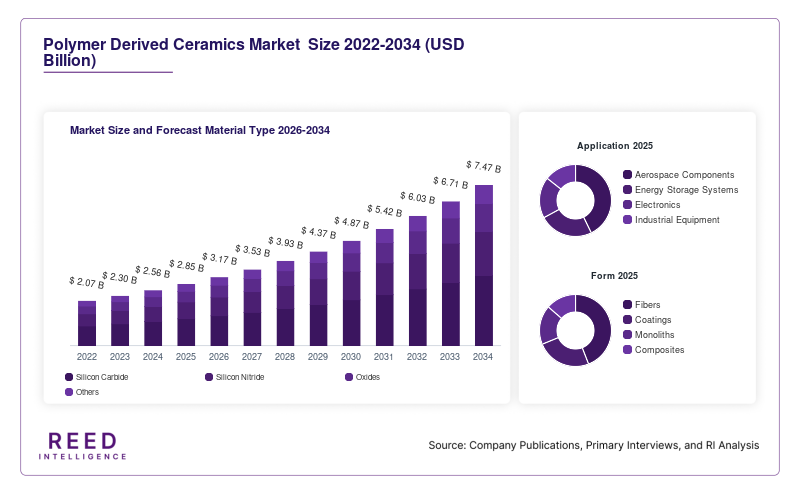
Silicon carbide dominated the material segment and accounted for 42.5% share in 2025. Its widespread use is attributed to high thermal conductivity, excellent mechanical strength, and resistance to oxidation. These properties make it suitable for applications in aerospace and electronics industries.
Fastest-Growing Subsegment: Silicon Nitride (Si₃N₄)
Silicon nitride is projected to grow at a CAGR of 12.7% during the forecast period. Its superior fracture toughness and thermal shock resistance will drive its adoption in high-performance applications, particularly in automotive and energy sectors.
By Application
Dominant Subsegment: Aerospace Components
Aerospace components held the largest share of 36.8% in 2025. The demand for lightweight and heat-resistant materials has significantly contributed to the dominance of this segment.
Fastest-Growing Subsegment: Energy Storage Systems
Energy storage systems are expected to grow at a CAGR of 13.4%. The increasing need for efficient energy solutions and advancements in battery technologies will support this growth.
By Form
Dominant Subsegment: Fibers
Fibers accounted for 34.2% share in 2025 due to their extensive use in reinforcement applications and composite materials.
Fastest-Growing Subsegment: Coatings
Coatings are projected to grow at a CAGR of 12.9%. Their ability to enhance surface properties and protect against corrosion will drive their demand across industries.
By End-Use Industry
Dominant Subsegment: Aerospace & Defense
The aerospace & defense segment dominated with 39.5% share in 2025. High demand for advanced materials in critical applications contributed to its leadership.
Fastest-Growing Subsegment: Energy & Power
The energy & power sector is expected to grow at a CAGR of 13.1%, driven by increasing investments in renewable energy projects and infrastructure development.
Regional Analysis
North America
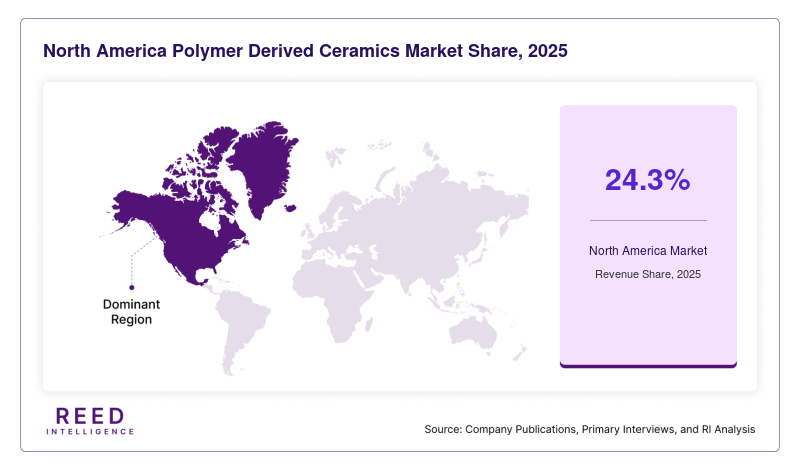
North America accounted for 24.3% of the Polymer Derived Ceramics Market share in 2025 and is projected to grow at a CAGR of 12.1% during 2026–2034. The region’s growth is driven by advancements in aerospace technologies and strong research and development activities. The United States dominated the regional market due to increased investment in defense and space exploration programs.
Europe
Europe held 21.7% market share in 2025 and will grow at a CAGR of 10.6% over the forecast period. The region benefits from a well-established automotive and industrial manufacturing base. Germany emerged as the dominant country, supported by its focus on high-performance materials and engineering excellence.
Asia Pacific
Asia Pacific led the Polymer Derived Ceramics Market with 38.6% share in 2025 and is expected to grow at a CAGR of 11.5%. Rapid industrialization and expanding electronics manufacturing are key growth drivers. China dominated the region due to large-scale production capabilities and strong demand from multiple industries.
Middle East & Africa
The Middle East & Africa accounted for 7.2% share in 2025 and is anticipated to grow at a CAGR of 9.4%. The region is witnessing increasing adoption of advanced materials in energy and infrastructure projects. Saudi Arabia led the market, driven by investments in industrial diversification initiatives.
Latin America
Latin America held 8.2% market share in 2025 and is projected to grow at a CAGR of 9.8%. The region’s growth is supported by expanding industrial sectors and rising demand for advanced materials. Brazil dominated the market due to its growing manufacturing and energy sectors.
Competitive Landscape
The Polymer Derived Ceramics Market is characterized by the presence of several established players focusing on innovation and strategic partnerships. The competitive environment is moderately consolidated, with companies investing in research and development to enhance product performance and expand application areas.
A leading player in the market is CoorsTek Inc., which has strengthened its position through continuous innovation in advanced ceramic technologies. The company recently expanded its production capabilities to meet growing demand from aerospace and electronics industries. Other key players are focusing on collaborations, mergers, and acquisitions to enhance their market presence and global footprint.
Companies are also emphasizing sustainable manufacturing practices and cost optimization to remain competitive. The increasing demand for high-performance materials is encouraging new entrants, thereby intensifying competition within the market.
Key Players List
- CoorsTek Inc.
- CeramTec GmbH
- Kyocera Corporation
- 3M Company
- Morgan Advanced Materials plc
- Saint-Gobain Ceramic Materials
- NGK Spark Plug Co., Ltd.
- Schunk Ingenieurkeramik GmbH
- Rauschert GmbH
- Superior Technical Ceramics
- Blasch Precision Ceramics
- International Syalons Ltd.
- Lancer Systems
- Haydale Graphene Industries plc
- Starfire Systems Inc.
Recent Developments
- In 2025, CoorsTek Inc. announced the expansion of its advanced ceramics manufacturing facility to increase production capacity.
- Kyocera Corporation introduced a new range of polymer-derived ceramic components for semiconductor applications.
- 3M Company invested in research focused on improving ceramic coating technologies.
- Morgan Advanced Materials plc launched a new product line targeting renewable energy applications.
- CeramTec GmbH entered into a strategic partnership to develop next-generation ceramic materials for industrial use.
Polymer Derived Ceramics Market Segments
Material Type
- Silicon Carbide
- Silicon Nitride
- Oxides
- Others
Application
- Aerospace Components
- Energy Storage Systems
- Electronics
- Industrial Equipment
Form
- Fibers
- Coatings
- Monoliths
- Composites
End-Use Industry
- Aerospace & Defense
- Electronics & Semiconductor
- Energy & Power
- Automotive
- Healthcare
By Region
- North America
- Europe
- APAC
- Middle East and Africa
- LATAM