Polymer Nanomembrane Market Size, Share & Demand Report By Type (Reverse Osmosis Nanomembranes, Ultrafiltration Nanomembranes, Nanofiltration Membranes, Nanocomposite Membranes, Others), By Application (Water Treatment, Biomedical Applications, Food and Beverage Processing, Energy Storage and Fuel Cells, Electronics Manufacturing, Chemical Processing), By End Use (Industrial Manufacturing, Healthcare and Pharmaceuticals, Municipal Utilities, Electronics and Semiconductor Industry, Research Insti
USD 3950
Market Overview
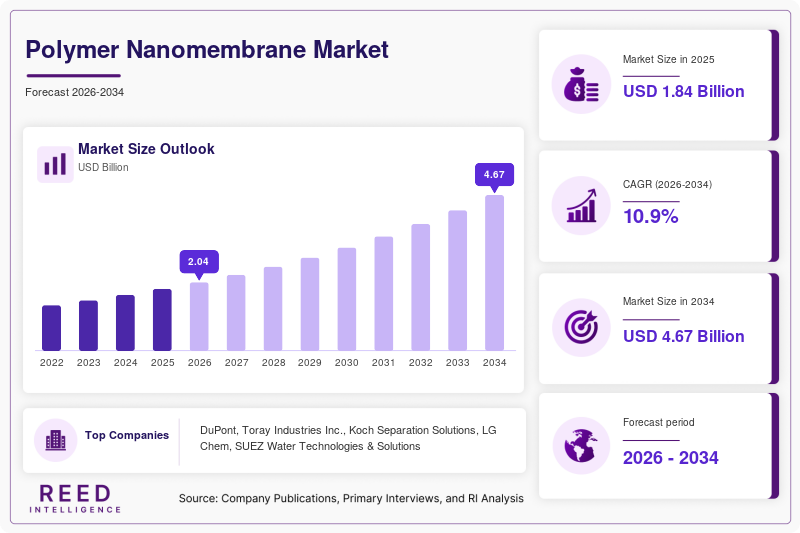
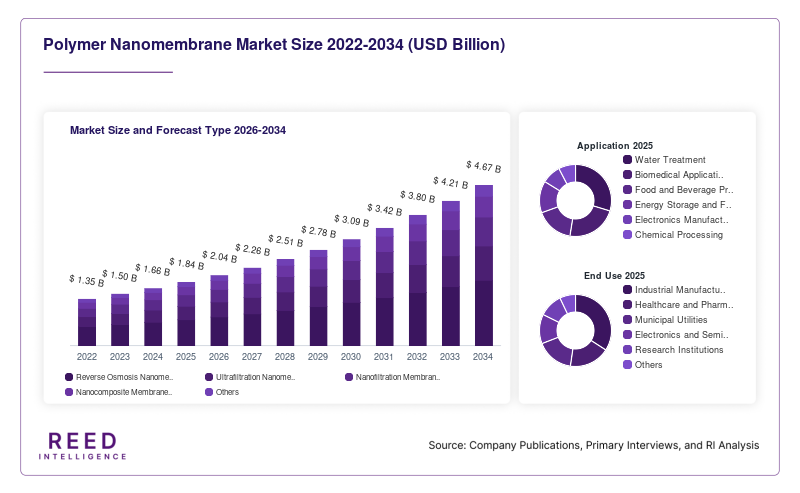
The global Polymer Nanomembrane Market size was valued at USD 1.84 billion in 2026 and is projected to reach USD 4.21 billion by 2034, expanding at a CAGR of 10.9% during the forecast period. The market is experiencing stable growth due to rising demand for advanced filtration, selective separation, and energy-efficient membrane technologies across water treatment, healthcare, electronics, and industrial processing industries. Polymer nanomembranes are increasingly preferred because they offer high permeability, low energy consumption, lightweight structures, and enhanced chemical resistance compared to conventional filtration materials. Growing industrial wastewater generation and increasing investments in sustainable purification technologies continue to support long-term market expansion.
The rapid expansion of pharmaceutical manufacturing and biotechnology research has also strengthened market demand. Polymer nanomembranes are widely used in drug purification, protein separation, and laboratory-scale filtration systems. Their ability to support nanoscale separation processes while maintaining operational efficiency has increased their adoption in precision medical and research applications. In addition, manufacturers are investing in multilayer polymer nanomembrane technologies that improve durability, selectivity, and operational lifespan. Government initiatives focused on clean water accessibility and industrial emission reduction are further contributing to global adoption.
Key Highlights
- North America dominated the market with a 35.1% share in 2025, while Asia Pacific is expected to grow at the fastest CAGR of 11.8% during 2026–2034.
- By type, reverse osmosis nanomembranes accounted for the largest share of 39.4%, while nanocomposite membranes are projected to grow at a CAGR of 12.6%.
- By application, water treatment led with a 43.2% share, whereas biomedical applications are expected to expand at a CAGR of 12.1%.
- By end use, industrial manufacturing accounted for the largest market share of 37.6%, while healthcare and pharmaceuticals are projected to grow at a CAGR of 11.9%.
- The United States remained the dominant country, with market values of USD 480 million in 2024 and USD 535 million in 2025.
Market Trends
Expansion of Sustainable Water Filtration Technologies
The growing global focus on sustainable water management has significantly increased the adoption of polymer nanomembrane technologies in municipal and industrial filtration systems. Water treatment facilities are replacing conventional filtration methods with advanced nanomembrane systems to reduce energy consumption and improve contaminant removal efficiency. Polymer nanomembranes are increasingly used for desalination, wastewater recycling, and chemical separation because they provide high filtration accuracy while maintaining lower operational costs. Industries such as food processing, chemicals, and mining are integrating advanced membrane systems to comply with stricter environmental regulations. Manufacturers are also developing recyclable and biodegradable membrane materials to align with sustainability targets and reduce environmental impact.
The adoption of smart monitoring systems in water treatment infrastructure is further accelerating market growth. Real-time pressure and contamination tracking technologies are improving membrane maintenance and reducing downtime in industrial operations. Public and private investments in water infrastructure modernization projects across Asia Pacific and the Middle East are expected to support long-term demand for polymer nanomembrane products. The combination of environmental compliance requirements and rising water scarcity concerns continues to strengthen market penetration across both developed and emerging economies.
Rising Integration in Biomedical and Pharmaceutical Applications
Polymer nanomembranes are gaining strong momentum in biomedical and pharmaceutical industries due to their precision filtration and biocompatibility properties. Pharmaceutical manufacturers increasingly use nanomembrane technologies in drug purification, protein concentration, vaccine production, and sterile filtration applications. The growing demand for advanced biologics and personalized medicine has accelerated the need for highly selective separation systems capable of operating at nanoscale levels. Polymer nanomembranes are also used in controlled drug delivery systems because they can regulate molecular transport with high efficiency.
Research institutions and healthcare companies are investing in next-generation membrane technologies that support tissue engineering and biosensing applications. The rise of wearable medical devices and implantable biosensors has encouraged the development of ultra-thin and flexible polymer membranes with improved durability. In addition, increasing investments in biotechnology research and laboratory automation are creating new commercial opportunities for membrane manufacturers. The healthcare sector continues to demand filtration systems with higher purity standards, supporting long-term innovation and expansion within the Polymer Nanomembrane Market.
Market Drivers
Increasing Demand for Industrial Wastewater Treatment
Rapid industrialization and increasing wastewater discharge volumes are driving the demand for efficient filtration and purification technologies worldwide. Industries such as chemicals, oil and gas, textiles, pharmaceuticals, and food processing generate large quantities of contaminated wastewater that require advanced treatment before disposal or reuse. Polymer nanomembranes are becoming a preferred solution because they offer high filtration efficiency, lower energy requirements, and better contaminant separation compared to traditional treatment systems. Governments are implementing stricter environmental regulations related to industrial discharge, forcing companies to upgrade their water treatment infrastructure.
Large manufacturing facilities are investing in closed-loop water recycling systems to reduce freshwater consumption and minimize environmental impact. Polymer nanomembranes help industries achieve operational sustainability while lowering long-term water procurement costs. Their resistance to harsh chemicals and high-pressure conditions also makes them suitable for demanding industrial environments. Growing awareness regarding water scarcity and industrial pollution is expected to further accelerate adoption across both developed and emerging markets during the forecast period.
Growth in Advanced Energy and Electronics Applications
The expansion of renewable energy systems and advanced electronics manufacturing is creating significant demand for polymer nanomembrane technologies. Nanomembranes are increasingly used in fuel cells, battery separators, hydrogen purification, and energy storage systems due to their selective transport properties and lightweight design. The growing global focus on clean energy transition has encouraged investments in fuel cell technologies, particularly in transportation and stationary power generation applications. Polymer nanomembranes help improve energy efficiency and operational performance in these systems.
In the electronics sector, semiconductor manufacturers use nanomembranes in ultra-pure water filtration and microelectronic fabrication processes. Rising production of consumer electronics, electric vehicles, and advanced sensors is contributing to higher demand for high-performance membrane systems. Manufacturers are developing heat-resistant and chemically stable membranes to meet the strict quality standards required in electronics production. Increasing investments in research and development activities related to nanotechnology and advanced materials are expected to create sustained growth opportunities across the global market.
Market Restraint
High Manufacturing Costs and Membrane Fouling Challenges
The Polymer Nanomembrane Market faces notable challenges associated with high manufacturing costs and membrane fouling issues. Advanced polymer nanomembranes require specialized raw materials, precision fabrication technologies, and controlled production environments, resulting in higher overall production costs compared to conventional membrane systems. Small and medium-sized enterprises often face difficulties in adopting these technologies due to substantial initial investment requirements. In price-sensitive markets, industries may continue using traditional filtration systems because of budget limitations and lower installation expenses.
Membrane fouling remains another critical operational challenge affecting long-term efficiency and maintenance costs. Organic compounds, microorganisms, and suspended particles can accumulate on membrane surfaces over time, reducing filtration performance and increasing cleaning frequency. Frequent maintenance procedures may disrupt industrial operations and raise operational expenditures for end users. In seawater desalination plants and chemical processing facilities, severe fouling conditions can reduce membrane lifespan and increase replacement costs. Although manufacturers are developing anti-fouling coatings and self-cleaning membrane technologies, these solutions still involve additional expenses. The combination of high production costs and operational maintenance concerns may limit adoption rates in certain developing regions where infrastructure budgets remain constrained.
Market Opportunities
Expansion of Desalination Infrastructure in Water-Stressed Regions
Growing freshwater shortages and rising urban populations are creating strong opportunities for polymer nanomembrane manufacturers in desalination projects. Countries across the Middle East, North Africa, and parts of Asia Pacific are investing heavily in seawater desalination infrastructure to ensure long-term water security. Polymer nanomembranes are increasingly used in reverse osmosis systems because they improve salt rejection efficiency while reducing energy consumption. Governments and utility providers are prioritizing advanced membrane technologies to increase operational reliability and lower water production costs.
The expansion of smart city projects and industrial zones in water-scarce regions is expected to generate sustained demand for high-capacity membrane filtration systems. Companies are developing next-generation membranes with enhanced permeability and anti-fouling properties to improve desalination efficiency. Public-private partnerships focused on water infrastructure modernization are also supporting market expansion. As desalination becomes a critical solution for addressing global water shortages, polymer nanomembrane suppliers are likely to benefit from rising investments and long-term infrastructure contracts.
Increasing Adoption in Flexible Electronics and Wearable Devices
The rapid growth of wearable technologies and flexible electronic devices is opening new growth avenues for the Polymer Nanomembrane Market. Advanced polymer membranes are being integrated into sensors, smart textiles, biosensors, and electronic skin applications because of their flexibility, lightweight structure, and nanoscale permeability control. Consumer demand for health monitoring devices and connected medical wearables is encouraging electronics manufacturers to adopt advanced membrane technologies that improve device sensitivity and comfort.
Research organizations and technology companies are investing in ultra-thin polymer nanomembranes designed for flexible circuits and energy storage components. These membranes support improved conductivity, moisture control, and thermal management in next-generation electronic devices. The growing integration of Internet of Things technologies in healthcare and consumer electronics is expected to accelerate demand for miniaturized and efficient membrane systems. As flexible electronics continue to expand into industrial, medical, and consumer applications, polymer nanomembrane manufacturers are likely to experience increasing commercialization opportunities.
Segmental Analysis
By Type
Reverse osmosis nanomembranes accounted for the largest share of the Polymer Nanomembrane Market in 2024, representing 39.4% of total revenue. The dominance of this segment is primarily linked to its widespread use in desalination, industrial wastewater treatment, and municipal purification systems. Reverse osmosis nanomembranes provide high filtration efficiency and strong contaminant rejection capabilities, making them suitable for demanding water treatment applications. Industries prefer these membranes because they help reduce operational costs while maintaining high purification standards. Increasing investments in seawater desalination facilities and industrial water recycling infrastructure continue to support segment growth. In addition, technological advancements in membrane design are improving permeability and reducing energy consumption, further strengthening adoption across large-scale industrial operations.
By Application
Water treatment represented the dominant application segment in 2024, accounting for 43.2% of the global Polymer Nanomembrane Market. The increasing need for clean water access and industrial wastewater recycling continues to support strong demand for membrane filtration technologies. Polymer nanomembranes are widely used in municipal treatment plants, desalination facilities, and industrial processing units because they provide efficient separation of dissolved contaminants, bacteria, and chemical compounds. Governments across multiple countries are implementing strict wastewater discharge regulations, encouraging industries to invest in advanced treatment systems. In addition, rapid urbanization and population growth are increasing pressure on existing water resources, driving further investments in sustainable purification infrastructure. The segment also benefits from the growing integration of automated monitoring technologies that improve filtration efficiency and reduce maintenance requirements.
By End Use
Industrial manufacturing accounted for the largest share of the global market in 2024, representing 37.6% of total revenue. Industries including chemicals, oil and gas, food processing, mining, and electronics rely heavily on polymer nanomembranes for filtration, purification, and separation processes. These membranes help improve operational efficiency by reducing waste generation and minimizing water consumption in industrial facilities. Increasing environmental compliance requirements are encouraging manufacturers to modernize existing treatment infrastructure with advanced membrane technologies. In sectors such as electronics and semiconductors, polymer nanomembranes are essential for ultra-pure water production and contamination control. Their durability and resistance to harsh operating environments make them highly suitable for large-scale industrial applications. The ongoing expansion of manufacturing activities in emerging economies is expected to sustain strong segment demand.
Regional Analysis
North America
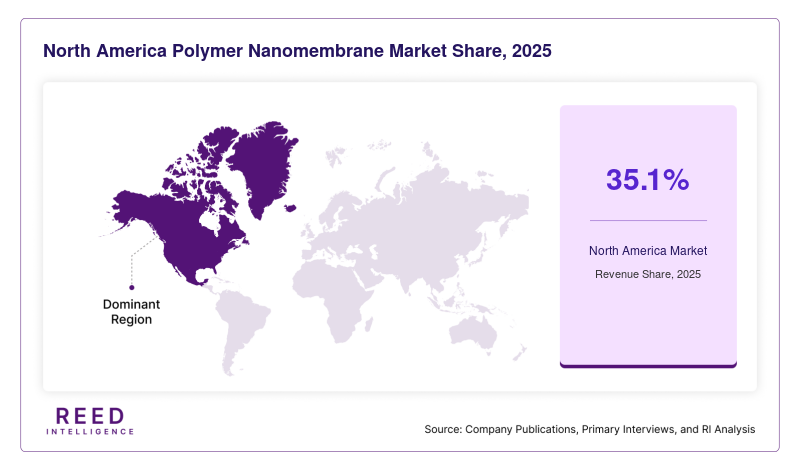
North America accounted for 35.1% of the global Polymer Nanomembrane Market in 2025 and is expected to maintain stable growth at a CAGR of 9.8% through 2034. The region benefits from advanced industrial infrastructure, strong investments in water treatment technologies, and widespread adoption of high-performance filtration systems. Demand for polymer nanomembranes is increasing across pharmaceutical manufacturing, municipal water treatment, and semiconductor production industries. Environmental regulations related to wastewater discharge and industrial emissions continue to encourage the replacement of conventional filtration systems with advanced nanomembrane technologies.
The United States remained the dominant contributor to regional revenue generation due to its large biotechnology, healthcare, and industrial processing sectors. Increasing investments in clean energy technologies and hydrogen fuel cell development are supporting membrane demand across energy applications. Major companies are also investing in research partnerships focused on anti-fouling membrane materials and AI-enabled filtration systems. Government funding programs for water infrastructure modernization and sustainable manufacturing initiatives continue to strengthen long-term market expansion across the country.
Europe
Europe represented 27.4% of the global market in 2025 and is projected to grow at a CAGR of 9.4% during the forecast period. The region continues to witness strong demand for advanced membrane systems in industrial wastewater recycling and environmental protection applications. Strict European environmental policies related to water reuse and industrial discharge are encouraging industries to adopt high-efficiency nanomembrane technologies. Countries across Western Europe are increasing investments in sustainable manufacturing practices, further supporting market growth.
Germany emerged as the leading country within the European market due to its strong chemical processing, automotive, and industrial engineering sectors. The country’s focus on energy-efficient production technologies has accelerated the adoption of polymer nanomembranes in industrial filtration systems. Research institutes and manufacturers are collaborating on advanced membrane materials with improved thermal resistance and durability. Increasing investments in green hydrogen projects and industrial decarbonization initiatives are also creating additional opportunities for membrane manufacturers across the region.
Asia Pacific
Asia Pacific held a 24.3% share of the global Polymer Nanomembrane Market in 2025 and is expected to record the fastest CAGR of 11.8% through 2034. Rapid industrialization, urban population growth, and increasing water treatment investments are major factors driving regional demand. Countries across the region are expanding wastewater recycling infrastructure and desalination capacity to address rising water scarcity concerns. Strong manufacturing growth in electronics, chemicals, and pharmaceuticals is also contributing to higher adoption of advanced filtration technologies.
China remained the dominant country in Asia Pacific because of its large-scale industrial production and growing environmental protection initiatives. The government continues to invest heavily in wastewater treatment projects and industrial pollution control measures, increasing the demand for polymer nanomembrane systems. Expanding semiconductor manufacturing and renewable energy projects are further strengthening regional market growth. Domestic manufacturers are also focusing on cost-effective membrane production technologies to support broader commercial adoption across developing economies.
Middle East & Africa
The Middle East & Africa region accounted for 7.2% of the global market in 2025 and is forecast to grow at a CAGR of 10.3% during the assessment period. Rising desalination activities and increasing industrial development are supporting demand for polymer nanomembranes across the region. Governments are investing in advanced water treatment technologies to address freshwater scarcity and improve long-term water sustainability. The expansion of petrochemical and energy industries has further increased the need for efficient filtration systems capable of operating under harsh environmental conditions.
Saudi Arabia emerged as the leading country within the regional market due to large-scale desalination infrastructure and industrial diversification projects. The country continues to invest in smart water management systems and energy-efficient filtration technologies as part of its long-term economic development plans. Increasing urbanization and population growth are placing additional pressure on water resources, encouraging greater adoption of advanced membrane technologies. International partnerships with technology providers are also helping accelerate the modernization of regional water treatment infrastructure.
Latin America
Latin America captured 6.0% of the global Polymer Nanomembrane Market in 2025 and is anticipated to expand at a CAGR of 9.1% through 2034. The region is experiencing rising demand for advanced filtration systems in mining, food processing, and municipal water treatment applications. Governments are increasing efforts to improve wastewater management infrastructure and reduce industrial pollution levels. Growing awareness regarding water conservation and environmental sustainability is encouraging industries to adopt more efficient membrane technologies.
Brazil remained the dominant market in Latin America due to its large industrial base and expanding investments in sanitation infrastructure. The country’s agricultural processing and mining industries generate substantial wastewater volumes, creating demand for advanced treatment systems. Increasing public investments in urban water supply modernization projects are also supporting membrane adoption. Domestic and international manufacturers are introducing cost-effective filtration solutions designed specifically for regional industrial conditions, contributing to broader market penetration.
Competitive Landscape
The Polymer Nanomembrane Market is characterized by increasing technological innovation, strategic partnerships, and investments in advanced membrane engineering. Leading companies are focusing on expanding production capacities, improving membrane durability, and developing anti-fouling solutions to strengthen their competitive positions. Market participants are also investing in research collaborations with universities and industrial laboratories to accelerate the commercialization of next-generation nanomembrane technologies.
DuPont remains one of the leading companies in the market due to its extensive membrane product portfolio and strong global distribution network. The company recently expanded its advanced water filtration manufacturing capabilities to address rising demand from industrial and municipal treatment sectors. Other major companies including Toray Industries, Koch Separation Solutions, SUEZ Water Technologies, and LG Chem are actively investing in nanocomposite membrane technologies and energy-efficient filtration systems.
Key Players
- DuPont
- Toray Industries Inc.
- Koch Separation Solutions
- LG Chem
- SUEZ Water Technologies & Solutions
- Hydranautics
- 3M Company
- Asahi Kasei Corporation
- Nitto Denko Corporation
- Synder Filtration Inc.
- Pentair plc
- Veolia Water Technologies
- Toyobo Co. Ltd.
- Membranium
- Pall Corporation
Recent Developments
- In February 2026, DuPont introduced a new anti-fouling polymer nanomembrane platform designed for large-scale desalination plants and industrial wastewater treatment facilities.
- In September 2025, Toray Industries expanded its nanomembrane production facility in Asia Pacific to support rising demand from semiconductor and pharmaceutical industries.
- In January 2026, LG Chem announced a strategic partnership with a regional water utility provider to develop energy-efficient membrane filtration systems for smart water infrastructure projects.
- In July 2025, Koch Separation Solutions launched an advanced nanocomposite membrane series focused on chemical processing and high-temperature industrial applications.
- In March 2026, SUEZ Water Technologies & Solutions introduced AI-enabled monitoring systems integrated with polymer nanomembrane filtration platforms to improve operational efficiency and predictive maintenance capabilities.
Polymer Nanomembrane Market Segments
Type
- Reverse Osmosis Nanomembranes
- Ultrafiltration Nanomembranes
- Nanofiltration Membranes
- Nanocomposite Membranes
- Others
Application
- Water Treatment
- Biomedical Applications
- Food and Beverage Processing
- Energy Storage and Fuel Cells
- Electronics Manufacturing
- Chemical Processing
End Use
- Industrial Manufacturing
- Healthcare and Pharmaceuticals
- Municipal Utilities
- Electronics and Semiconductor Industry
- Research Institutions
- Others
By Region
- North America
- Europe
- APAC
- Middle East and Africa
- LATAM