Polymer Resin Market Size, Share & Demand Report By Type (Polyethylene (PE), Polypropylene (PP), Polyvinyl Chloride (PVC), Polystyrene (PS)), By Form (Virgin Resin, Recycled Resin), By Application (Packaging, Construction Materials, Automotive Components), By End-Use Industry (Consumer Goods & Packaging, Building & Construction, Automotive & Transportation, Electrical & Electronics, Healthcare & Medical Devices), By Region & Segment Forecasts, 2026–2034
USD 3950
Market Overview
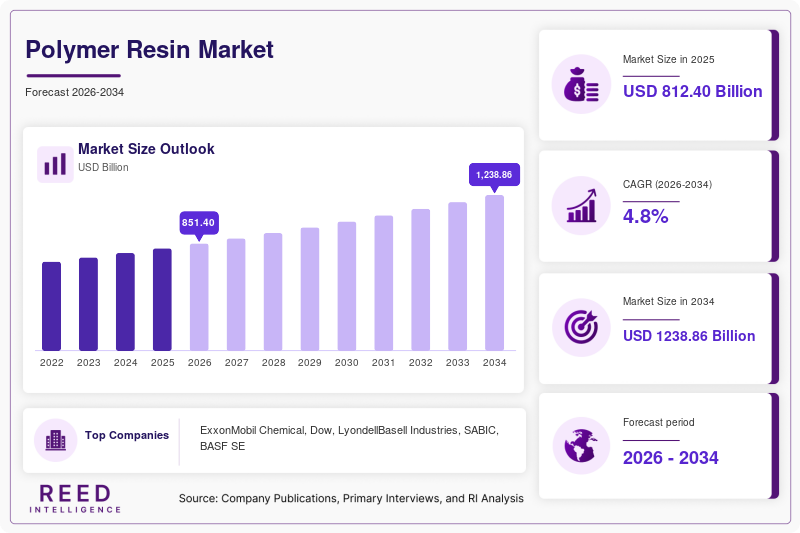
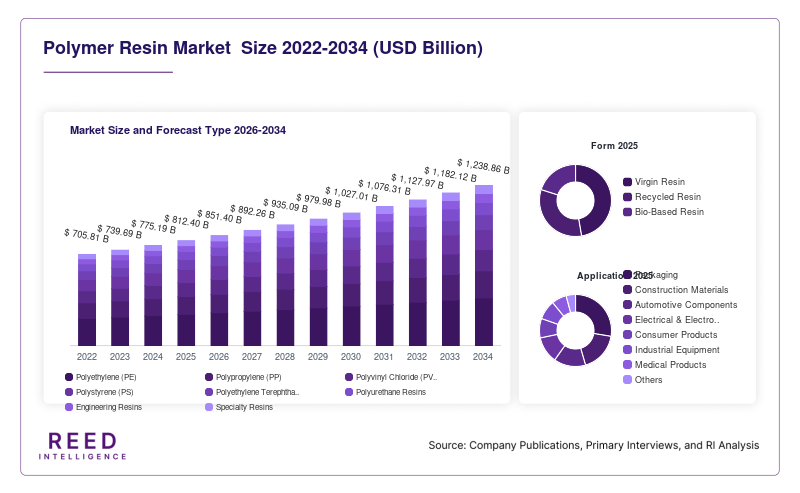
The Polymer Resin Market was valued at USD 812.4 billion in 2026 and is projected to reach USD 1,184.7 billion by 2034, expanding at a CAGR of 4.8% during 2026–2034. Polymer resins are essential raw materials used across packaging, automotive, construction, electronics, consumer goods, healthcare, and industrial manufacturing sectors. These materials provide durability, flexibility, chemical resistance, lightweight properties, and cost efficiency, making them indispensable in modern production processes.
A major global factor supporting market expansion has been the continued growth of advanced manufacturing and infrastructure development across emerging and developed economies. Increasing investments in transportation systems, residential and commercial construction, consumer electronics, and sustainable packaging solutions have generated sustained demand for polymer-based materials. Manufacturers are increasingly developing specialty and high-performance resins that meet evolving regulatory, environmental, and performance requirements.
Key Highlights
- North America dominated the Polymer Resin Market with a 34.8% share in 2025, while Asia Pacific is projected to register the fastest CAGR of 5.9% during 2026–2034.
- By Resin Type, Polyethylene (PE) accounted for the largest share of 29.6% in 2025, while bio-based resins are anticipated to grow at a CAGR of 7.4%.
- By Application, Packaging held the leading market share of 37.9% in 2025, whereas electrical and electronics applications are forecast to expand at a CAGR of 6.6%.
- By End-Use Industry, Consumer Goods & Packaging represented 41.3% of market revenue in 2025, while healthcare is expected to grow at a CAGR of 6.8%.
- By Processing Method, Injection Molding generated 35.7% share in 2025, while 3D printing and additive manufacturing processing is expected to expand at 7.1% CAGR.
- The United States remained the dominant country market, valued at USD 233.8 billion in 2024 and USD 244.9 billion in 2025.
Market Trends
Expansion of Recyclable and Circular Polymer Resin Solutions
The industry is witnessing increasing adoption of recyclable polymer resin formulations designed to support circular economy objectives. Manufacturers are investing in mechanical and chemical recycling technologies to improve material recovery rates and reduce virgin resin consumption. Brand owners are demanding resin grades that can maintain performance while incorporating recycled content, creating new opportunities for innovative product development.
Demand for post-consumer recycled resins is increasing across packaging, consumer goods, and industrial applications. Companies are introducing advanced resin blends that provide improved compatibility, durability, and processing efficiency while supporting sustainability goals.
Growing Adoption of High-Performance Specialty Resins
Industries such as electronics, healthcare, aerospace, and automotive are increasingly utilizing specialty polymer resins with enhanced thermal stability, chemical resistance, electrical insulation, and mechanical strength. These advanced materials enable manufacturers to meet stringent performance requirements while reducing product weight and improving reliability.
The increasing complexity of electronic devices and advanced industrial equipment is accelerating demand for engineered polymer solutions capable of performing in demanding operating environments.
Market Drivers
Rising Demand for Flexible Packaging Solutions
The rapid expansion of e-commerce, food delivery services, and consumer packaged goods industries has increased demand for flexible packaging materials. Polymer resins offer superior sealing characteristics, lightweight performance, transparency, and moisture resistance. Manufacturers continue to expand production capacities to meet rising consumption of packaging films, containers, pouches, and protective materials.
As packaging producers seek cost-effective and efficient solutions, polymer resins remain a preferred material due to their versatility and processing advantages.
Increasing Use of Lightweight Materials in Transportation
Automotive manufacturers are increasingly incorporating lightweight polymer components to improve fuel efficiency, vehicle range, and overall performance. Polymer resins replace heavier metal components in interiors, exteriors, electrical systems, and structural applications.
The shift toward electric mobility has accelerated material innovation, as vehicle manufacturers require lightweight and durable materials that contribute to battery efficiency and performance optimization.
Market Restraint
Volatility in Petrochemical Raw Material Prices
Fluctuations in crude oil and petrochemical feedstock prices remain a significant challenge for resin manufacturers. Changes in raw material costs directly impact production expenses, profit margins, and pricing strategies. Supply chain disruptions and geopolitical uncertainties may further increase market instability and affect procurement planning across the value chain.
Market Opportunities
Development of Bio-Based Polymer Resins
The growing emphasis on environmental sustainability is creating opportunities for bio-based polymer resins derived from renewable feedstocks. Manufacturers are developing products that reduce dependence on fossil resources while maintaining comparable performance characteristics. Increasing regulatory support and consumer preference for environmentally responsible products are expected to encourage adoption across multiple industries.
Growth of Advanced Medical Applications
Healthcare applications are emerging as a significant opportunity area for polymer resin suppliers. Medical devices, diagnostic equipment, pharmaceutical packaging, and disposable healthcare products require specialized materials with high purity, biocompatibility, and regulatory compliance. Continued healthcare infrastructure expansion and increasing medical technology adoption are expected to create long-term demand for advanced resin solutions.
Segmental Analysis
By Resin Type
Polyethylene (PE) – Dominant Subsegment
Polyethylene represented the largest share of the Polymer Resin Market and accounted for 30.4% of revenue in 2025. Its broad use in films, packaging materials, containers, pipes, and industrial products contributed to market leadership. The material's balance of cost-effectiveness, durability, flexibility, and processability supported widespread adoption.
Bio-Based Resins – Fastest-Growing Subsegment
Bio-based resins are projected to register the fastest CAGR of 7.5% during 2026–2034. Growing interest in renewable materials and sustainable manufacturing practices will encourage adoption. Continuous advancements in bio-polymer production technologies will improve commercial viability and expand application opportunities.
By Application
Packaging – Dominant Subsegment
Packaging accounted for 38.2% market share in 2025. Polymer resins remained essential in flexible packaging, rigid containers, films, pouches, caps, closures, and protective materials. Growing consumer goods production and increasing demand for packaged products supported segment leadership.
Electrical & Electronics – Fastest-Growing Subsegment
Electrical and electronics applications are expected to expand at a CAGR of 6.7% over the forecast period. Increasing production of consumer electronics, smart devices, communication equipment, and electrical systems will create demand for advanced insulating and protective polymer materials.
By End-Use Industry
Consumer Goods & Packaging – Dominant Subsegment
Consumer goods and packaging represented 42.1% share in 2025. High production volumes across food products, beverages, household goods, and personal care products contributed to segment dominance.
Healthcare – Fastest-Growing Subsegment
Healthcare applications will grow at a CAGR of 6.9% through 2034. Rising demand for medical-grade materials, disposable healthcare products, and advanced medical equipment will strengthen adoption of specialized polymer resin formulations.
By Processing Technology
Injection Molding – Dominant Subsegment
Injection molding held 36.5% market share in 2025. The process remained widely used for manufacturing automotive parts, consumer products, industrial components, packaging solutions, and healthcare products. High production efficiency and design flexibility supported widespread utilization.
Additive Manufacturing – Fastest-Growing Subsegment
Additive manufacturing processing is forecast to expand at a CAGR of 7.2% during 2026–2034. Increased adoption of industrial 3D printing technologies and customized manufacturing solutions will create demand for advanced resin formulations designed specifically for additive production environments.
Regional Analysis
North America
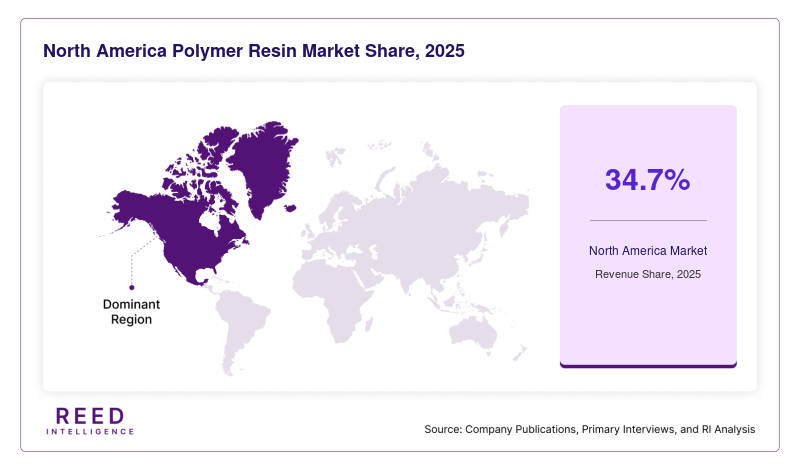
North America accounted for 34.7% of the Polymer Resin Market in 2025. The region benefited from strong industrial production, advanced manufacturing infrastructure, and consistent demand across packaging, automotive, healthcare, and consumer goods sectors. The regional market will expand at a CAGR of 4.3% during 2026–2034.
The United States remained the largest contributor to regional revenue. Growth is supported by investments in specialty polymer manufacturing facilities and increasing production of engineered materials for industrial applications.
Europe
Europe represented 25.9% market share in 2025. Strong industrial activity, sophisticated manufacturing capabilities, and broad adoption of advanced materials supported regional demand. The market will register a CAGR of 4.4% through 2034.
Germany dominated the regional market due to its extensive industrial production ecosystem. Continuous investments in advanced materials processing and industrial automation have supported polymer resin consumption across manufacturing sectors.
Asia Pacific
Asia Pacific held 27.6% market share in 2025 and is expected to witness the fastest expansion, with a projected CAGR of 6.1% during 2026–2034. Rapid industrialization, manufacturing growth, urban development, and rising consumer spending are driving market expansion.
China remained the leading country in the region. The country’s extensive manufacturing base, strong domestic consumption, and expanding industrial production capacity continue to support substantial polymer resin demand.
Middle East & Africa
The Middle East & Africa accounted for 6.1% of global revenue in 2025. Investments in industrial diversification, construction development, and petrochemical infrastructure contributed to regional market growth. The market will grow at a CAGR of 5.2% through 2034.
Saudi Arabia dominated regional demand due to ongoing petrochemical expansion projects and increasing downstream industrial development activities.
Latin America
Latin America captured 5.7% market share in 2025. Rising industrial production and growing demand from packaging and consumer product sectors supported market performance. The region will expand at a CAGR of 4.8% during the forecast period.
Brazil led the regional market owing to increasing domestic manufacturing activity and growing consumption of packaged consumer products.
Competitive Landscape
The Polymer Resin Market remains moderately consolidated, with global producers focusing on capacity expansion, product innovation, sustainability initiatives, and strategic partnerships. Market participants continue investing in advanced manufacturing technologies and specialty resin development to strengthen competitive positioning.
BASF SE – Market Leader
BASF SE maintained a leading position through its extensive portfolio of commodity and specialty polymer resins. The company continues investing in sustainable material technologies and advanced polymer development programs. Its recent expansion of circular economy-focused resin solutions strengthened its position in global industrial markets.
Dow Inc.
Dow continues to expand its packaging and specialty polymer product offerings while focusing on recyclable and performance-enhanced resin technologies.
LyondellBasell Industries
LyondellBasell emphasizes production efficiency improvements and development of advanced polyolefin materials serving industrial and consumer applications.
SABIC
SABIC maintains a strong global presence through integrated manufacturing capabilities and continued investment in engineering plastics and sustainable material solutions.
ExxonMobil Chemical
ExxonMobil Chemical focuses on advanced polymer technologies supporting packaging, automotive, industrial, and consumer goods applications while expanding high-performance product offerings.
Key Players List
- BASF SE
- Dow Inc.
- LyondellBasell Industries N.V.
- SABIC
- ExxonMobil Chemical Company
- INEOS Group Holdings S.A.
- Covestro AG
- Celanese Corporation
- LG Chem Ltd.
- Mitsubishi Chemical Group Corporation
- Sumitomo Chemical Co., Ltd.
- Formosa Plastics Corporation
- Reliance Industries Limited
- Arkema S.A.
- Borealis AG
Recent Developments
- Several leading resin manufacturers announced investments in advanced recycling facilities designed to increase production of circular polymer feedstocks and recycled resin products.
- Major polymer producers expanded polyethylene and polypropylene manufacturing capacities in Asia and the Middle East to address increasing industrial demand and strengthen export capabilities.
- Multiple companies introduced bio-based resin portfolios targeted at packaging and consumer product applications to support sustainability objectives and evolving regulatory requirements.
- Resin manufacturers accelerated digitalization initiatives within production facilities to improve operational efficiency, product consistency, and supply chain visibility.
- Strategic collaborations between polymer producers and packaging manufacturers increased to develop recyclable material solutions and improve circular economy outcomes across the value chain.
Polymer Resin Market Segments
Type
- Polyethylene (PE)
- Polypropylene (PP)
- Polyvinyl Chloride (PVC)
- Polystyrene (PS)
- Polyethylene Terephthalate (PET)
- Polyurethane Resins
- Engineering Resins
- Specialty Resins
Form
- Virgin Resin
- Recycled Resin
- Bio-Based Resin
Application
- Packaging
- Construction Materials
- Automotive Components
- Electrical & Electronics
- Consumer Products
- Industrial Equipment
- Medical Products
- Others
End-Use Industry
- Consumer Goods & Packaging
- Building & Construction
- Automotive & Transportation
- Electrical & Electronics
- Healthcare & Medical Devices
- Industrial Manufacturing
- Agriculture
- Others
By Region
- North America
- Europe
- APAC
- Middle East and Africa
- LATAM