Polymer Solar Cell Market Size, Share & Demand Report By Material Type (Conductive Polymers, Photovoltaic Inks, Polymer Blends, Transparent Electrodes), By Application (Building-Integrated Photovoltaics, Wearable Electronics, Portable Chargers, Smart Packaging, Transportation Systems), By End Use (Consumer Electronics, Automotive, Construction, Healthcare, Industrial Applications), By Region & Segment Forecasts, 2026–2034
USD 3950
Market Overview
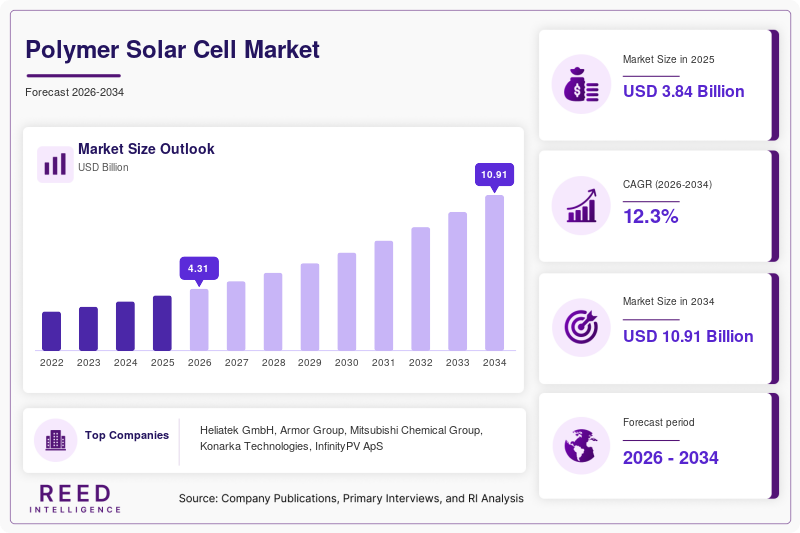
The global Polymer Solar Cell Market size was valued at USD 3.84 billion in 2026 and is projected to reach USD 9.72 billion by 2034, expanding at a CAGR of 12.3% during the forecast period from 2026 to 2034. The market is gaining traction due to rising investment in renewable energy technologies, increasing demand for lightweight photovoltaic systems, and growing interest in flexible solar energy solutions across commercial and residential sectors. Polymer solar cells are emerging as an alternative to conventional silicon-based photovoltaic systems because of their low manufacturing cost, mechanical flexibility, semi-transparency, and compatibility with roll-to-roll production techniques.
The growing global emphasis on carbon reduction and clean energy integration has significantly supported market expansion. Governments across major economies are introducing incentives for solar adoption, while manufacturers are focusing on improving conversion efficiency and operational durability. Polymer solar cells are increasingly being integrated into wearable electronics, portable devices, building-integrated photovoltaics, automotive applications, and smart consumer products. The rise of smart cities and sustainable infrastructure projects has also accelerated demand for flexible solar modules that can be deployed on irregular surfaces and lightweight structures.
Key Highlights
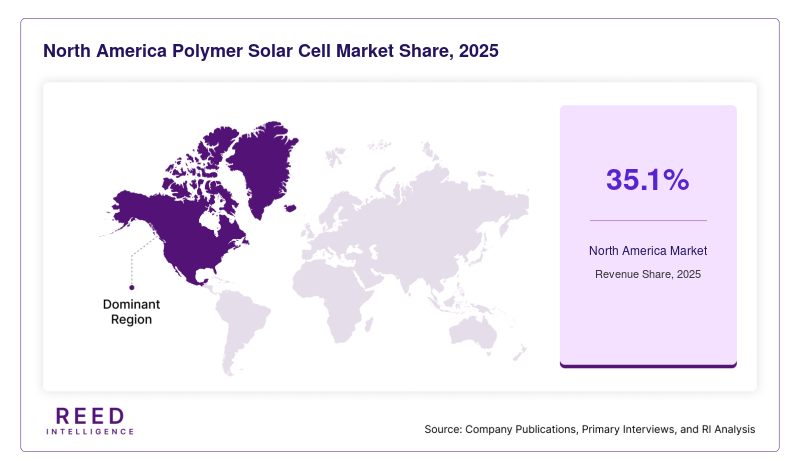
- North America dominated the market with a 35.1% share in 2025.
- Asia Pacific is expected to grow at the fastest CAGR of 13.1% during 2026–2034.
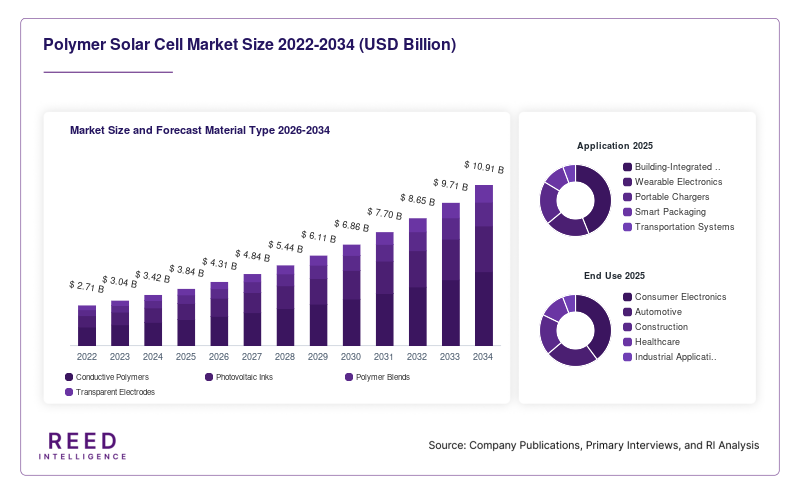
- By material type, conductive polymers accounted for the largest share of 39.4%.
- while photovoltaic inks are projected to grow at a CAGR of 14.2%.
- By application, building-integrated photovoltaics led with a 42.6% share, whereas wearable electronics are expected to expand at a CAGR of 14.7%.
- The United States remained the dominant country, with market values of USD 780 million in 2024 and USD 860 million in 2025.
Market Trends
Integration of Flexible Solar Technologies into Consumer Electronics
The increasing adoption of flexible and lightweight electronic devices is creating strong momentum for the Polymer Solar Cell Market. Consumer electronics manufacturers are exploring polymer solar cells for use in smartwatches, wireless headphones, fitness bands, portable chargers, and foldable devices. The ability of polymer solar cells to operate on curved and bendable surfaces provides a significant advantage compared to rigid crystalline silicon panels. Companies are investing in transparent and semi-transparent photovoltaic layers that can generate energy without affecting product aesthetics or portability. This trend is particularly visible in Asia Pacific and North America, where wearable electronics demand continues to rise across both consumer and industrial applications.
In addition, improvements in printed photovoltaic manufacturing processes are enabling cost-efficient mass production of flexible solar modules. Manufacturers are increasingly using roll-to-roll printing technology to reduce production time and material waste. The integration of polymer solar cells into portable electronics is also supporting the development of self-charging devices, reducing dependence on traditional charging infrastructure. This shift toward energy-autonomous electronics is expected to strengthen long-term demand for polymer solar technologies.
Growing Adoption of Building-Integrated Photovoltaic Systems
The use of polymer solar cells in building-integrated photovoltaic systems is becoming a major market trend due to rising investments in sustainable construction and energy-efficient infrastructure. Architects and construction companies are increasingly deploying lightweight photovoltaic materials on building facades, windows, rooftops, and glass surfaces. Polymer solar cells are suitable for modern infrastructure because they offer flexibility, lower weight, and customizable design features. Their semi-transparent nature allows natural light penetration while simultaneously generating electricity, making them attractive for commercial and institutional buildings.
Governments are supporting green construction projects through tax incentives, energy efficiency regulations, and net-zero emission targets. Urban development projects in Europe and North America are increasingly incorporating solar-integrated structures to reduce energy consumption and operational costs. In addition, technological advancements in organic photovoltaic materials are improving energy conversion efficiency and weather resistance, making these systems more commercially viable. This trend is expected to create long-term opportunities for manufacturers supplying advanced polymer solar modules to the construction sector.
Market Drivers
Rising Global Demand for Renewable and Portable Energy Solutions
The growing focus on renewable energy adoption is one of the primary factors driving the Polymer Solar Cell Market. Governments, industries, and consumers are actively seeking clean energy technologies to reduce dependence on fossil fuels and lower greenhouse gas emissions. Polymer solar cells are gaining attention because they can be manufactured using low-temperature processes and lightweight materials, making them suitable for portable and decentralized energy applications. Their compatibility with flexible substrates allows deployment in remote locations, temporary installations, and mobile devices where traditional solar panels may not be practical.
Demand for portable solar-powered products is increasing in outdoor recreation, military operations, disaster management, and emergency response applications. The ability to produce lightweight and foldable solar modules provides greater convenience and mobility for users. Furthermore, rising electricity prices and growing awareness regarding sustainable energy consumption are encouraging businesses and households to adopt alternative photovoltaic technologies. Continuous innovation in conductive polymers and electrode structures is also contributing to higher energy efficiency and stronger commercial adoption.
Expansion of Research and Commercialization Activities
Increasing research investments and commercialization efforts are significantly supporting market growth. Universities, renewable energy laboratories, and private companies are focusing on enhancing the efficiency, durability, and scalability of polymer solar cells. Research activities are centered on improving charge transport layers, active materials, and encapsulation methods to address performance degradation challenges. Several companies are entering strategic collaborations with material suppliers and technology developers to accelerate product innovation and expand manufacturing capabilities.
Public and private funding programs are also encouraging pilot-scale production and commercialization projects. Governments in countries such as the United States, Germany, China, South Korea, and Japan are supporting next-generation photovoltaic technologies through grants and renewable energy initiatives. Commercial adoption is increasing in automotive interiors, smart packaging, transportation systems, and low-power electronic devices. The rising availability of printed and flexible photovoltaic modules is helping reduce production costs and improving accessibility for multiple end-use industries.
Market Restraint
Limited Operational Stability and Lower Efficiency Compared to Conventional Solar Cells
Despite growing adoption, the Polymer Solar Cell Market faces challenges associated with lower efficiency and limited long-term operational stability compared to conventional silicon-based photovoltaic technologies. Polymer solar cells are more sensitive to moisture, oxygen exposure, ultraviolet radiation, and temperature fluctuations, which can reduce performance over time. This limitation affects large-scale deployment in harsh environmental conditions and creates concerns regarding long-term return on investment for commercial users.
The relatively lower power conversion efficiency of polymer solar cells also restricts their application in high-energy-demand sectors. Although research institutions and manufacturers are continuously improving material composition and encapsulation methods, performance levels still remain below advanced silicon and perovskite solar technologies in several commercial applications. In addition, limited awareness regarding polymer solar technology among end users and investors slows adoption in developing markets. Some manufacturers also face difficulties related to scaling production while maintaining consistent product quality and durability standards.
These challenges can increase operational costs for companies involved in research, testing, and product validation. For example, construction companies integrating building-integrated photovoltaics often require additional protective layers and maintenance systems to ensure long-term performance. Such requirements may increase installation complexity and reduce cost competitiveness compared to established photovoltaic alternatives.
Market Opportunities
Expansion of Solar-Powered Wearable and Smart Textile Applications
The increasing development of wearable electronics and smart textiles presents a major growth opportunity for the Polymer Solar Cell Market. Flexible polymer solar cells can be embedded into clothing, backpacks, sportswear, medical monitoring devices, and military uniforms to generate portable electricity. This capability supports the creation of self-powered wearable systems that reduce dependence on external charging infrastructure. Demand for connected wearable devices is increasing across healthcare, fitness tracking, defense, and consumer electronics sectors, creating favorable conditions for polymer solar technology adoption.
Manufacturers are focusing on ultra-thin photovoltaic materials that can maintain flexibility and comfort without compromising energy generation capability. Research in conductive fibers and printable electronics is also enabling the integration of polymer solar cells into fabrics and flexible surfaces. In addition, increasing investments in smart healthcare monitoring systems and remote patient care technologies are expected to strengthen demand for wearable solar-powered devices. The ability to combine lightweight energy generation with portable electronics is likely to create substantial long-term revenue opportunities.
Growing Investments in Smart Infrastructure and Sustainable Urban Development
Rapid urbanization and rising investment in smart infrastructure projects are creating new opportunities for polymer solar cell manufacturers. Governments and private developers are increasingly focusing on energy-efficient buildings, smart transportation systems, and renewable energy integration within urban environments. Polymer solar cells can be integrated into windows, facades, public transportation shelters, parking structures, and smart lighting systems because of their lightweight and adaptable design characteristics.
The growing emphasis on net-zero construction and sustainable urban planning is encouraging adoption of building-integrated photovoltaics across commercial and residential projects. Several cities in Europe, North America, and Asia Pacific are implementing renewable energy targets for public infrastructure developments. Polymer solar technology offers architectural flexibility and aesthetic compatibility, which supports adoption in modern urban construction projects. In addition, advancements in transparent photovoltaic materials are enabling energy generation through glass surfaces and building exteriors, expanding the commercial potential of the market
Segmental Analysis
By Material Type
Conductive polymers accounted for the largest share of the Polymer Solar Cell Market in 2024, representing 39.4% of total revenue. These materials are widely used because they provide effective charge transport, flexibility, and compatibility with low-cost manufacturing processes. Conductive polymers are increasingly adopted in printed solar modules, wearable electronics, and building-integrated photovoltaic systems due to their lightweight properties and ease of processing. Manufacturers are focusing on improving polymer morphology and molecular design to enhance energy conversion efficiency and environmental stability. The segment also benefits from increasing research activities aimed at developing high-performance donor and acceptor materials for next-generation photovoltaic systems. Growing commercial deployment of flexible solar products in consumer electronics and infrastructure applications continues to support demand for conductive polymer materials.
Photovoltaic inks are expected to witness the fastest CAGR of 14.2% during the forecast period due to increasing adoption of printed electronics and roll-to-roll manufacturing technologies. These inks enable low-cost production of lightweight and flexible solar modules that can be integrated into various surfaces and portable devices. Manufacturers are investing in advanced ink formulations that improve conductivity, durability, and print quality while reducing material waste. The growing popularity of smart packaging, wearable devices, and energy-harvesting consumer products is accelerating demand for printable photovoltaic solutions. In addition, research institutions are focusing on improving ink stability and compatibility with large-scale production methods, which is expected to expand commercialization opportunities across multiple industries.
By Application
Building-integrated photovoltaics represented the dominant application segment in 2024, accounting for 42.6% of the global market share. The segment is growing due to rising adoption of energy-efficient building materials and increasing emphasis on sustainable urban development. Polymer solar cells are increasingly incorporated into facades, rooftops, skylights, and windows because of their lightweight structure and semi-transparent properties. Construction companies and architects prefer these solutions for modern commercial buildings where energy generation and aesthetic design are equally important. Government regulations supporting net-zero construction and renewable energy integration are also contributing to segment growth. In addition, advancements in transparent photovoltaic films and flexible installation methods are improving the commercial viability of building-integrated polymer solar technologies.
Wearable electronics are projected to register the fastest CAGR of 14.7% from 2026 to 2034 due to rising consumer demand for self-powered portable devices. Flexible polymer solar cells are increasingly used in smartwatches, fitness trackers, medical monitoring systems, and smart clothing applications. Their ability to generate energy on curved and movable surfaces makes them suitable for wearable technology integration. Electronics manufacturers are focusing on lightweight designs and enhanced energy efficiency to improve product usability and battery life. The increasing adoption of connected healthcare devices and smart textile technologies is further supporting demand. Furthermore, advancements in flexible conductive materials and miniaturized photovoltaic systems are expected to create additional growth opportunities for wearable applications.
By End Use
Consumer electronics accounted for the largest share of the Polymer Solar Cell Market in 2024, contributing 37.8% of total revenue. The segment benefits from growing demand for portable, lightweight, and energy-efficient electronic devices. Polymer solar cells are increasingly integrated into wireless accessories, mobile devices, e-readers, and portable chargers to support sustainable energy consumption and reduce charging dependency. The rapid expansion of the global smart device industry is encouraging manufacturers to incorporate alternative power generation technologies into compact electronic products. In addition, advancements in flexible displays and foldable electronics are creating favorable conditions for polymer solar module integration. Companies are also investing in printed photovoltaic technologies that enable thin and adaptable solar layers for modern electronic devices.
The automotive segment is anticipated to grow at the fastest CAGR of 13.9% during the forecast period due to rising adoption of electric vehicles and energy-efficient transportation technologies. Automotive manufacturers are exploring polymer solar cells for vehicle roofs, interior systems, charging support applications, and smart mobility solutions. Lightweight photovoltaic materials help reduce overall vehicle weight while supporting auxiliary energy generation. Increasing investments in connected transportation infrastructure and electric mobility are creating new commercial opportunities for flexible solar technologies. In addition, the ability of polymer solar cells to conform to curved automotive surfaces enhances their suitability for modern vehicle designs. Ongoing research focused on improving durability and energy output is expected to accelerate adoption across the automotive industry.
Regional Analysis
North America
North America accounted for 35.1% of the global Polymer Solar Cell Market share in 2025 and is expected to maintain steady expansion during the forecast period with a CAGR of 11.4% from 2026 to 2034. The region benefits from strong investment in renewable energy technologies, established photovoltaic research infrastructure, and rising deployment of flexible solar systems across commercial sectors. Demand for lightweight and portable energy systems is increasing among electronics manufacturers, defense organizations, and sustainable construction companies. The presence of advanced material science companies and supportive clean energy policies also contributes to regional market growth.
The United States remained the dominant country in North America due to high renewable energy investment and active commercialization of advanced photovoltaic technologies. Federal clean energy incentives and tax benefits are encouraging adoption of solar-integrated infrastructure and portable energy systems. Universities and private firms are collaborating on next-generation conductive polymer research to improve energy efficiency and durability. In addition, the growing wearable electronics market in the United States is accelerating demand for compact and flexible polymer solar modules integrated into consumer and industrial products.
Europe
Europe represented 27.3% of the global Polymer Solar Cell Market in 2025 and is projected to expand at a CAGR of 11.8% during the forecast period. Strong environmental regulations and aggressive carbon neutrality targets are supporting renewable energy investments across the region. European countries are increasingly adopting building-integrated photovoltaics and flexible solar technologies in commercial construction and public infrastructure projects. Government-backed sustainability initiatives and funding programs for next-generation energy solutions are also strengthening market expansion.
Germany emerged as the dominant country in the European market due to its strong photovoltaic manufacturing ecosystem and commitment to renewable energy adoption. The country continues to invest heavily in sustainable construction and energy-efficient industrial operations. German research institutes are actively developing advanced polymer blends and encapsulation technologies to improve solar cell stability and efficiency. Furthermore, rising deployment of smart infrastructure projects and energy-positive buildings is supporting increased use of polymer solar modules in architectural applications.
Asia Pacific
Asia Pacific held a 24.8% share of the global Polymer Solar Cell Market in 2025 and is expected to witness the fastest CAGR of 13.1% from 2026 to 2034. The region is benefiting from rapid industrialization, expanding electronics manufacturing, and growing renewable energy investments. Countries across Asia Pacific are increasing production capacity for photovoltaic materials and printed electronics. Demand for low-cost and lightweight solar technologies is also rising across residential, transportation, and consumer electronics sectors.
China dominated the regional market due to large-scale photovoltaic manufacturing capabilities and extensive government support for renewable energy technologies. The country has become a major hub for flexible electronics production and printed solar module development. Chinese companies are investing in roll-to-roll manufacturing technologies to improve production efficiency and reduce costs. Additionally, strong domestic demand for smart consumer devices and energy-efficient urban infrastructure is contributing to rapid adoption of polymer solar cell applications.
Middle East & Africa
The Middle East & Africa accounted for 6.5% of the global Polymer Solar Cell Market share in 2025 and is projected to grow at a CAGR of 10.2% through 2034. Increasing awareness regarding renewable energy diversification and rising solar infrastructure investments are supporting market expansion across the region. Governments are actively exploring lightweight photovoltaic technologies for deployment in remote areas, smart city developments, and off-grid energy systems. Polymer solar cells are gaining attention because they can operate in portable and flexible applications where conventional panels may face installation limitations.
Saudi Arabia remained the leading country in the regional market due to ongoing investments in renewable energy projects and smart infrastructure initiatives. The country’s long-term economic diversification plans are encouraging adoption of advanced clean energy technologies. Construction firms and technology developers are increasingly integrating flexible solar materials into commercial infrastructure projects. Furthermore, rising interest in energy-efficient transportation systems and portable renewable power solutions is creating additional opportunities for polymer solar cell deployment.
Latin America
Latin America captured 6.3% of the global Polymer Solar Cell Market in 2025 and is anticipated to register a CAGR of 10.7% during the forecast period. The market is expanding due to growing renewable energy adoption, increasing electricity demand, and favorable government support for solar energy projects. Countries across the region are focusing on decentralized power generation and sustainable urban development. Polymer solar cells are being explored for lightweight solar installations, agricultural applications, and portable power systems in remote locations.
Brazil dominated the Latin American market owing to rising investment in solar energy infrastructure and growing awareness regarding alternative photovoltaic technologies. The country’s expanding construction sector is creating demand for building-integrated photovoltaic solutions in commercial and residential developments. Brazilian energy companies are also investing in flexible solar technologies for rural electrification and off-grid applications. In addition, increasing adoption of portable consumer electronics and wearable devices is expected to strengthen long-term market demand.
Competitive Landscape
The Polymer Solar Cell Market is characterized by increasing competition among photovoltaic material suppliers, renewable energy companies, and flexible electronics manufacturers. Market participants are focusing on product innovation, strategic collaborations, and research investments to strengthen their technological capabilities and expand market presence. Companies are investing in advanced conductive polymers, printable photovoltaic inks, and roll-to-roll manufacturing systems to improve energy efficiency and reduce production costs.
Heliatek GmbH remains one of the leading companies in the market due to its strong expertise in organic photovoltaic technology and flexible solar module development. The company has expanded its commercial partnerships with construction and infrastructure firms to strengthen adoption of building-integrated photovoltaic solutions. Several other companies are also focusing on pilot production facilities and large-scale commercialization strategies to address rising demand for lightweight solar technologies.
Key Players
- Heliatek GmbH
- Armor Group
- Mitsubishi Chemical Group
- Konarka Technologies
- InfinityPV ApS
- Solarmer Energy Inc.
- Epishine AB
- ASCA SAS
- DisaSolar
- NanoFlex Power Corporation
- Merck KGaA
- BASF SE
- Sumitomo Chemical Co., Ltd.
- Toshiba Corporation
- Panasonic Holdings Corporation
Recent Developments
- In February 2026, Heliatek GmbH introduced an upgraded flexible organic photovoltaic film designed for commercial building facades and smart infrastructure projects.
- In September 2025, Epishine AB expanded its printed solar module production capacity to support rising demand from consumer electronics and indoor energy harvesting applications.
- In June 2025, Armor Group partnered with a wearable electronics manufacturer to develop lightweight polymer solar charging solutions for smart textile products.
- In March 2026, Mitsubishi Chemical Group announced new research initiatives focused on improving the durability and moisture resistance of conductive polymer materials used in flexible solar cells.
Polymer Solar Cell Market Segments
Material Type
- Conductive Polymers
- Photovoltaic Inks
- Polymer Blends
- Transparent Electrodes
Application
- Building-Integrated Photovoltaics
- Wearable Electronics
- Portable Chargers
- Smart Packaging
- Transportation Systems
End Use
- Consumer Electronics
- Automotive
- Construction
- Healthcare
- Industrial Applications
By Region
- North America
- Europe
- APAC
- Middle East and Africa
- LATAM