Polysorbate 80 Market Size, Share & Demand Report By Grade (Pharmaceutical Grade, Food Grade, Industrial Grade), By Application (Pharmaceuticals, Food & Beverages, Cosmetics & Personal Care, Industrial Applications), By Distribution Channel (Direct Sales, Distributors, Online Platforms) By Region & Segment Forecasts, 2025–2034
USD 3950
Market Overview
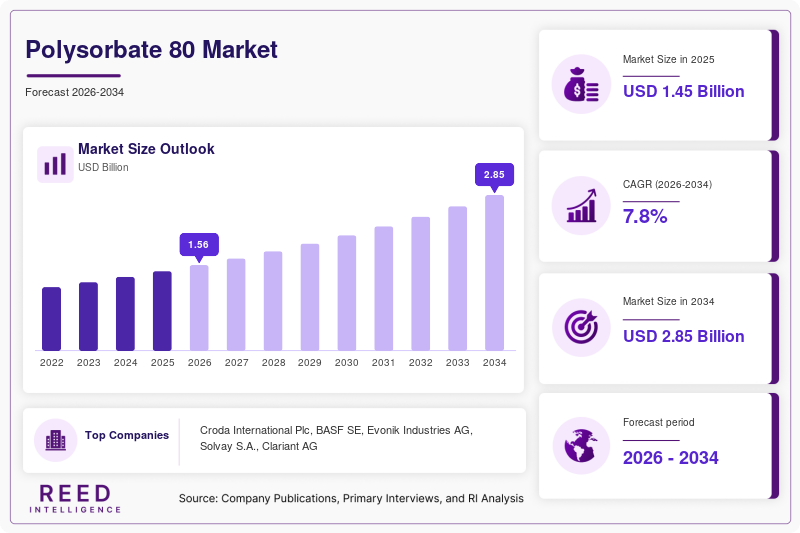
The global Polysorbate 80 Market size was valued at approximately USD 1.45 billion in 2025 and is projected to reach nearly USD 2.85 billion by 2034, expanding at a compound annual growth rate (CAGR) of 7.8% from 2025 to 2034. Polysorbate 80, a nonionic surfactant widely used as an emulsifier, stabilizer, and dispersing agent, plays a crucial role across pharmaceutical, food & beverage, and cosmetic industries. Its compatibility with a wide range of formulations has supported consistent demand growth across developed and emerging markets.
One major global factor supporting market expansion is the rising demand for biopharmaceuticals and injectable drugs. Polysorbate 80 is commonly used to stabilize protein-based therapeutics, reducing aggregation and improving shelf life. As the pharmaceutical pipeline continues to expand globally, the demand for high-purity excipients such as Polysorbate 80 has increased significantly.
Key Highlights
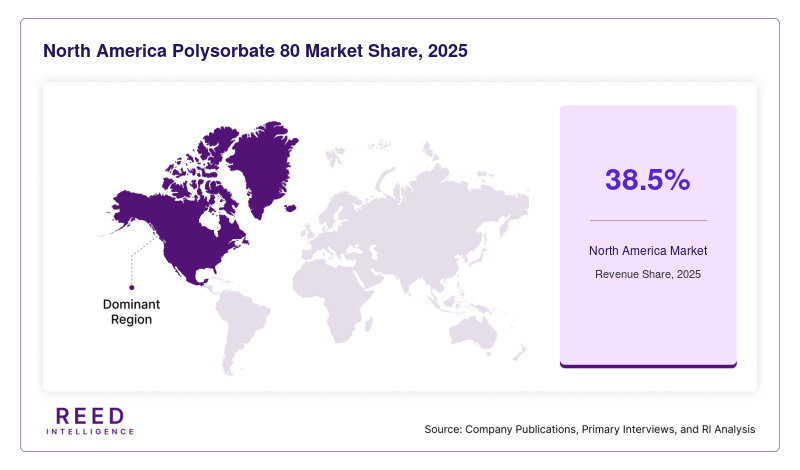
- North America dominated the market with a 38.5% share in 2025, while Asia Pacific is expected to register the fastest growth at a CAGR of 9.4% through 2034.
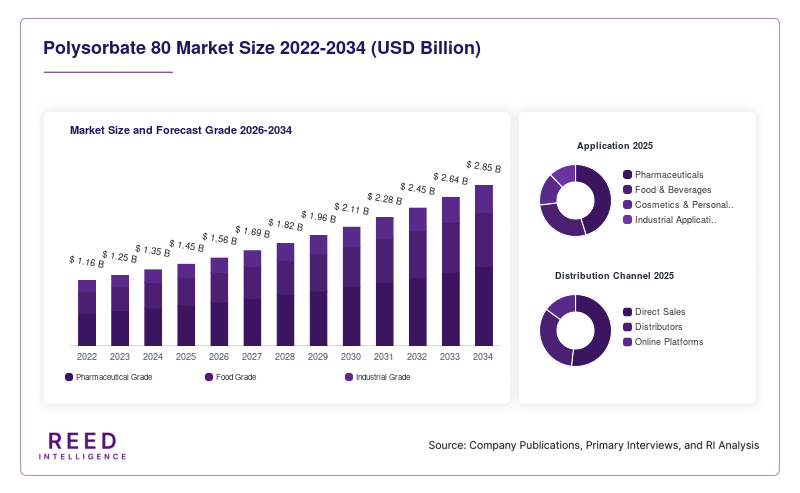
- By application, pharmaceuticals led with a 46.2% share in 2025, while the cosmetics segment is projected to grow fastest at a CAGR of 8.6%.
- By grade, pharmaceutical-grade Polysorbate 80 accounted for 52.7% share, whereas food-grade is expected to grow at a CAGR of 7.2%.
- The United States remained the dominant country, with a market value of USD 420 million in 2025, expected to reach USD 452 million in 2026.
Market Trends
Increasing Use in Biopharmaceutical Formulations
The expanding biologics sector has significantly influenced the Polysorbate 80 Market. As protein-based drugs are highly sensitive to environmental conditions, Polysorbate 80 is widely used to prevent denaturation and aggregation. This trend is further supported by the increasing number of monoclonal antibody therapies and vaccine production, particularly in developed markets. Manufacturers are also focusing on high-purity grades to meet stringent regulatory standards, further shaping market dynamics.
Shift Toward Clean-Label and Natural Ingredients
The growing consumer preference for clean-label and naturally derived ingredients is impacting the market landscape. While Polysorbate 80 is synthetically derived, manufacturers are exploring bio-based alternatives and sustainable production processes to align with evolving regulatory and consumer expectations. This trend is particularly evident in the food and cosmetics industries, where transparency and ingredient safety are key purchasing factors.
Market Drivers
Growth in Pharmaceutical and Vaccine Production
The increasing global demand for vaccines and advanced therapeutics is a major driver of the Polysorbate 80 Market. As a stabilizing agent, it ensures the efficacy and safety of injectable drugs and biologics. Rising healthcare investments and ongoing research into complex biologics have further strengthened its demand. Additionally, regulatory approvals for new drugs have contributed to the consistent consumption of pharmaceutical-grade Polysorbate 80.
Expanding Food Processing Industry
The rapid growth of the processed food industry is another key factor driving the market. Polysorbate 80 is widely used as an emulsifier in ice creams, sauces, and bakery products, enhancing texture and stability. Increasing urbanization, changing dietary patterns, and rising disposable incomes have boosted demand for packaged and convenience foods, thereby supporting the market’s steady expansion.
Market Restraint
Regulatory Concerns and Quality Variability
One of the major challenges in the Polysorbate 80 Market is the stringent regulatory framework governing its use, especially in pharmaceutical and food applications. Regulatory bodies require high levels of purity and consistency, which can be difficult to maintain due to variations in raw materials and manufacturing processes. Concerns regarding impurities such as peroxide formation and degradation products can impact product stability, particularly in sensitive biologic formulations.
Additionally, increasing scrutiny from regulatory authorities regarding synthetic additives has created pressure on manufacturers to ensure compliance with evolving standards. This not only increases production costs but also limits market entry for smaller players. Such factors can hinder market growth, particularly in regions with strict regulatory environments.
Market Opportunities
Development of High-Purity and Customized Grades
The growing demand for specialized pharmaceutical formulations presents a significant opportunity for manufacturers to develop high-purity and customized grades of Polysorbate 80. Tailored solutions that meet specific formulation requirements can enhance drug stability and performance. Companies investing in advanced purification technologies are likely to gain a competitive edge in this segment.
Expansion in Emerging Markets
Emerging economies in Asia Pacific and Latin America offer considerable growth potential for the Polysorbate 80 Market. Rapid industrialization, expanding healthcare infrastructure, and increasing consumption of processed foods are key factors driving demand. Local production capabilities and strategic partnerships can help manufacturers tap into these high-growth markets and strengthen their global presence.
Segmental Analysis
By Grade
Pharmaceutical-grade Polysorbate 80 dominated the market, accounting for 52.7% of the share in 2025. Its extensive use in injectable drugs and biologics contributed to its leading position.
Food-grade Polysorbate 80 is expected to witness the fastest growth, with a projected CAGR of 7.2%. Increasing demand for processed and convenience foods will drive this segment, as manufacturers seek effective emulsifiers to enhance product quality.
By Application
The pharmaceutical segment held the largest share at 46.2% in 2025, driven by the widespread use of Polysorbate 80 in drug formulations. Its ability to stabilize active ingredients made it essential in this sector.
The cosmetics segment is projected to grow at the fastest CAGR of 8.6%, supported by rising demand for personal care products. Polysorbate 80’s role as an emulsifier in creams and lotions will drive its adoption.
By End-Use Industry
The healthcare industry emerged as the dominant end-use segment, accounting for 44.8% share in 2025. The increasing production of biologics and vaccines supported its growth.
The food and beverage industry is expected to grow at a CAGR of 7.5%, driven by rising consumption of processed foods and changing consumer lifestyles.
By Distribution Channel
Direct sales dominated the market with a 58.3% share in 2025, as large manufacturers preferred direct procurement to ensure quality and consistency.
Online distribution channels are expected to grow at the fastest CAGR of 8.9%, driven by digitalization and the increasing adoption of e-commerce platforms for chemical procurement.
Regional Analysis
North America
North America accounted for 38.5% of the Polysorbate 80 Market share in 2025 and is expected to grow at a CAGR of 6.9% through 2034. The region had a well-established pharmaceutical and food processing industry, which contributed to its dominant position.
The United States led the regional market due to strong biopharmaceutical manufacturing capabilities. The presence of advanced research facilities and a robust regulatory framework supported the adoption of high-quality excipients. Increased investment in drug development further strengthened demand.
Europe
Europe held a 27.3% market share in 2025 and is projected to expand at a CAGR of 7.1% during the forecast period. The region had a mature pharmaceutical sector and a strong focus on quality standards.
Germany emerged as the leading country, driven by its advanced chemical manufacturing industry. The country’s emphasis on innovation and sustainability supported the development of high-purity Polysorbate 80 for diverse applications.
Asia Pacific
Asia Pacific captured 21.8% of the market share in 2025 and is anticipated to grow at the fastest CAGR of 9.4% through 2034. Rapid industrialization and increasing healthcare investments contributed to the region’s growth.
China dominated the regional market, supported by large-scale production and expanding pharmaceutical manufacturing. Government initiatives to strengthen domestic drug production further boosted demand for excipients like Polysorbate 80.
Middle East & Africa
The Middle East & Africa region accounted for 6.4% of the market in 2025 and is expected to grow at a CAGR of 6.5% over the forecast period. Growth was supported by increasing investments in healthcare infrastructure and food processing industries.
Saudi Arabia led the region, driven by its efforts to diversify the economy and develop local manufacturing capabilities. The expansion of pharmaceutical production facilities supported market growth.
Latin America
Latin America held a 6.0% share in 2025 and is projected to grow at a CAGR of 6.8% through 2034. The region experienced steady growth due to rising demand for processed foods and pharmaceuticals.
Brazil emerged as the dominant country, supported by a growing food processing industry and increasing healthcare expenditure. Local production and imports contributed to market expansion.
Competitive Landscape
The Polysorbate 80 Market is moderately consolidated, with key players focusing on product quality, innovation, and strategic collaborations. Leading companies are investing in research and development to produce high-purity grades that meet stringent regulatory requirements.
A prominent market leader is Croda International Plc, which has strengthened its position through continuous product innovation and expansion of its pharmaceutical excipient portfolio. The company recently introduced advanced purification technologies to enhance product stability and performance.
Other major players are actively expanding their global presence through mergers, acquisitions, and partnerships. Competitive strategies also include capacity expansion and the development of sustainable production processes to meet evolving market demands.
Key Players List
- Croda International Plc
- BASF SE
- Evonik Industries AG
- Solvay S.A.
- Clariant AG
- Lonza Group AG
- Merck KGaA
- Ashland Global Holdings Inc.
- Kao Corporation
- NOF Corporation
- Stepan Company
- SPI Pharma Inc.
- Spectrum Chemical Manufacturing Corp.
- Mohini Organics Pvt. Ltd.
- Jinchang Chemical
Recent Developments
- Croda International Plc expanded its pharmaceutical excipient production capacity in 2024 to meet growing global demand.
- BASF SE introduced a refined Polysorbate 80 formulation aimed at improving stability in biologic drugs.
- Evonik Industries AG partnered with biotech firms to develop customized excipient solutions.
- Clariant AG focused on sustainable manufacturing processes to reduce environmental impact.
- Lonza Group AG enhanced its product portfolio with high-purity grades for advanced drug delivery systems.
Polysorbate 80 Market Segments
Grade
- Pharmaceutical Grade
- Food Grade
- Industrial Grade
Application
- Pharmaceuticals
- Food & Beverages
- Cosmetics & Personal Care
- Industrial Applications
Distribution Channel
- Direct Sales
- Distributors
- Online Platforms
By Region
- North America
- Europe
- APAC
- Middle East and Africa
- LATAM