Polyurea Grease Market Size, Share & Demand Report By Product Type (Mineral Oil-Based Polyurea Grease, Synthetic Oil-Based Polyurea Grease, Semi-Synthetic Polyurea Grease), By Application (Automotive Bearings, Electric Motors, Industrial Machinery, Construction Equipment, Mining Equipment, Renewable Energy Systems), By End-Use Industry (Automotive, Industrial Manufacturing, Power Generation, Renewable Energy, Mining, Transportation), By Region & Segment Forecasts, 2026–2034
USD 3950
Market Overview
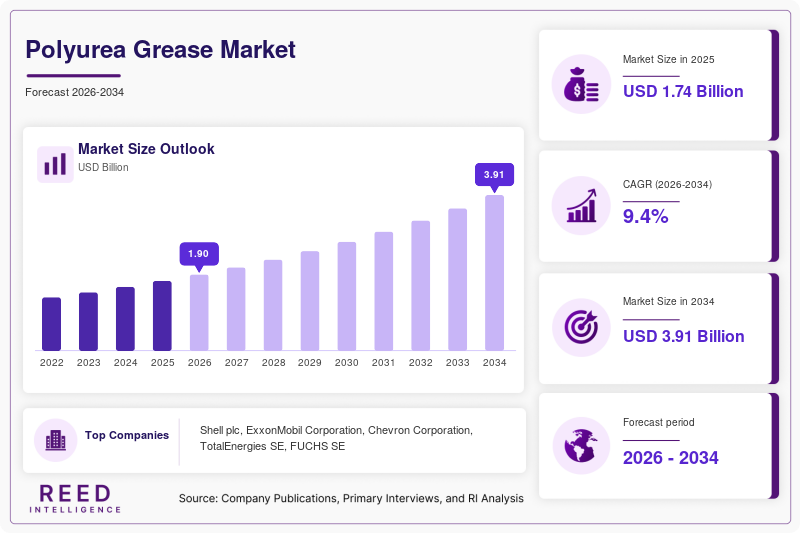
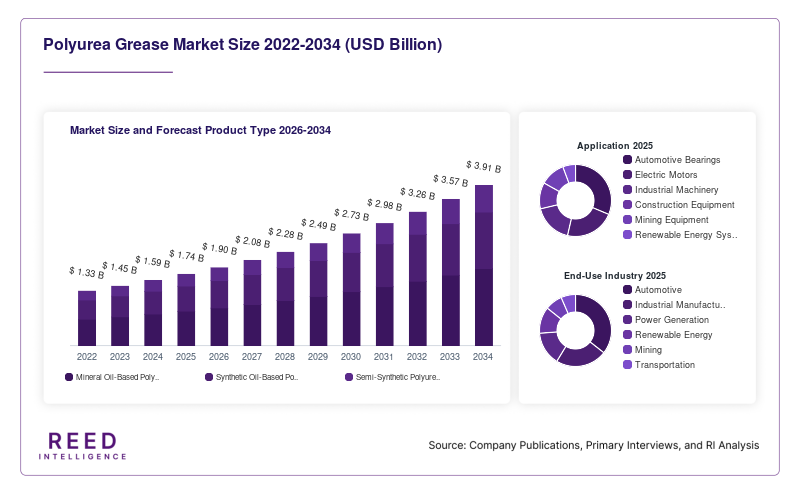
The global Polyurea Grease Market size was valued at USD 1.74 billion in 2026 and is projected to reach USD 3.58 billion by 2034, expanding at a CAGR of 9.4% during the forecast period from 2026 to 2034. The market is witnessing stable expansion due to increasing demand for high-performance lubricants across automotive, industrial machinery, mining, power generation, and heavy equipment applications. Polyurea grease is widely used because of its oxidation stability, water resistance, long service life, and compatibility with electric motor bearings operating under elevated temperatures. Industries seeking longer equipment maintenance intervals are increasingly shifting toward premium grease formulations, supporting long-term market development.
The growth of industrial automation and energy-efficient machinery has accelerated the adoption of advanced lubricants globally. Manufacturing companies are investing in machinery capable of operating continuously under severe conditions, thereby increasing the requirement for greases that can reduce wear, friction, and downtime. Polyurea-based grease has gained traction in sectors such as steel processing, construction, wind energy, and transportation due to its ability to maintain lubrication performance across variable temperatures and heavy loads. In addition, stringent maintenance regulations in developed economies have encouraged the replacement of conventional lithium-based lubricants with technologically advanced alternatives.
Key Highlights
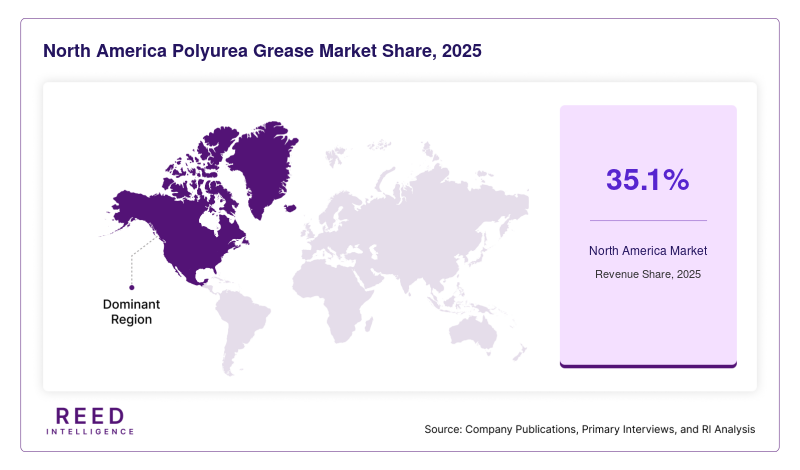
- North America dominated the market with a 35.1% share in 2025.
- Asia Pacific is expected to grow at the fastest CAGR of 10.8% during 2026–2034.
- By product type, mineral oil-based polyurea grease accounted for the largest share of 42.4%.
- while synthetic oil-based polyurea grease is projected to grow at a CAGR of 11.6%.
- By application, automotive bearings led with a 39.2% share, whereas electric motor applications are expected to expand at a CAGR of 12.1%.
- The United States remained the dominant country, with market values of USD 470 million in 2024 and USD 518 million in 2025.
Market Trends
Rising Adoption of Electric Vehicles and E-Mobility Systems
The growing production of electric vehicles has become a notable trend influencing the Polyurea Grease Market. Electric drivetrains require lubricants capable of operating at high rotational speeds while maintaining low noise and minimal friction. Polyurea grease has emerged as a preferred option because it delivers enhanced oxidation resistance and extended bearing performance in electric motors. Automotive manufacturers are increasingly integrating advanced lubrication systems to improve battery efficiency and reduce thermal stress within electric powertrains. As EV manufacturing capacity expands in China, Germany, the United States, and South Korea, lubricant suppliers are developing customized polyurea formulations tailored for next-generation mobility platforms.
The trend is also supported by stricter vehicle efficiency regulations and consumer preference for low-maintenance transportation solutions. Electric buses, hybrid trucks, and railway electrification projects are increasing demand for premium greases that can support long operational cycles. In addition, automotive component suppliers are focusing on high-temperature bearing systems that require specialized lubricants with superior mechanical stability. This transition toward electrified transportation continues to reshape lubricant consumption patterns across global markets.
Increasing Preference for Long-Life Industrial Lubricants
Industrial operators are increasingly shifting toward long-life lubricants that reduce maintenance frequency and operational downtime. Polyurea grease is gaining strong acceptance across heavy industries because of its durability, water resistance, and compatibility with high-speed bearings. Manufacturing plants are adopting predictive maintenance technologies and automated machinery that require reliable lubrication under continuous operating conditions. As a result, industries such as mining, cement, steel, and pulp & paper are moving away from conventional greases toward advanced synthetic and polyurea-based alternatives.
The trend is particularly visible in industries where equipment failure can lead to substantial production losses. Operators are emphasizing lubricant efficiency as part of broader cost optimization strategies. In addition, wind turbines and renewable energy systems require lubricants capable of functioning for extended periods under fluctuating environmental conditions. Polyurea grease formulations with enhanced thermal stability are therefore witnessing stronger market penetration. Manufacturers are responding by launching high-performance grease products designed for industrial automation and smart factory environments.
Market Drivers
Expansion of Industrial Manufacturing Activities
Rapid industrialization across emerging economies is significantly supporting the growth of the Polyurea Grease Market. Countries including China, India, Indonesia, Vietnam, and Brazil are expanding manufacturing infrastructure in sectors such as automotive, machinery, steel, and electronics. These industries rely heavily on efficient lubrication systems to ensure equipment reliability and minimize operational interruptions. Polyurea grease is increasingly used in high-load and high-temperature applications where conventional lubricants may degrade quickly. The demand for longer maintenance cycles and reduced machine wear is encouraging industrial facilities to adopt premium grease technologies.
Global investments in industrial automation are also contributing to market expansion. Automated machinery and robotic systems require lubricants with strong oxidation resistance and stable viscosity performance. Polyurea grease fulfills these operational requirements, making it suitable for modern production facilities. Furthermore, increasing capital expenditure in heavy industries and infrastructure development projects is accelerating the installation of industrial equipment that depends on advanced lubrication systems for continuous operation.
Growth in Renewable Energy and Power Generation Infrastructure
The expansion of renewable energy infrastructure is emerging as a major growth driver for the Polyurea Grease Market. Wind turbines, hydroelectric systems, and solar power equipment require durable lubricants capable of performing in harsh operating environments. Polyurea grease offers high thermal stability and resistance to moisture, making it suitable for bearings and rotating components used in renewable energy applications. Governments worldwide are increasing investments in clean energy projects to meet carbon reduction goals, thereby creating sustained demand for industrial lubricants.
Wind energy installations, particularly offshore turbines, operate under challenging environmental conditions where lubrication failure can lead to high maintenance costs. Polyurea grease supports longer service intervals and reduces equipment downtime, making it valuable for renewable energy operators. In addition, expanding electricity generation capacity in developing economies is boosting the use of turbines, generators, and transmission systems that require specialized grease formulations. The increasing integration of energy-efficient machinery across power plants continues to strengthen demand for advanced lubricants globally.
Market Restraint
Volatility in Raw Material Prices and Availability
Fluctuating raw material prices remain a significant challenge for the Polyurea Grease Market. The production of polyurea grease depends on petroleum-based feedstocks, specialty additives, and thickening agents that are sensitive to crude oil price movements and global supply chain disruptions. Sudden increases in raw material costs can affect profit margins for lubricant manufacturers and create pricing instability across end-use industries. Smaller manufacturers often face difficulties in maintaining consistent production levels during periods of supply shortages or elevated transportation costs.
The market is also affected by environmental regulations governing chemical processing and lubricant disposal. Compliance with evolving sustainability standards may increase operational expenses for producers. In some developing economies, the availability of lower-cost conventional greases limits the adoption of premium polyurea-based products, particularly among small industrial operators with budget constraints. Additionally, fluctuations in global trade conditions and geopolitical tensions can disrupt the supply of essential additives and specialty chemicals, impacting overall market growth and production planning.
Market Opportunities
Development of High-Performance Synthetic Formulations
The growing demand for high-performance lubricants presents significant opportunities for manufacturers operating in the Polyurea Grease Market. Industries increasingly require greases capable of functioning under extreme temperatures, high loads, and corrosive conditions. Synthetic polyurea grease formulations are gaining attention because they offer extended service life and improved oxidation stability compared to mineral oil-based products. Manufacturers investing in advanced additive technologies and customized formulations are expected to gain a competitive advantage in sectors such as aerospace, electric vehicles, and renewable energy.
The opportunity is further supported by rising maintenance efficiency requirements across industrial operations. Companies are focusing on predictive maintenance systems that depend on long-lasting lubrication solutions to reduce unexpected equipment failures. As industrial equipment becomes more technologically advanced, demand for specialized lubricants tailored to specific operational conditions is expected to increase steadily. This trend creates new revenue streams for producers capable of delivering premium synthetic grease products with enhanced performance characteristics.
Expanding Demand from Emerging Economies
Emerging economies are creating substantial opportunities for the Polyurea Grease Market due to rapid infrastructure development and industrial expansion. Countries across Asia Pacific, Latin America, and the Middle East are increasing investments in transportation, construction, mining, and manufacturing sectors. These industries require reliable lubrication solutions for heavy equipment and industrial machinery operating in demanding conditions. Polyurea grease manufacturers are expanding distribution networks and production facilities to capitalize on rising regional demand.
The opportunity is particularly strong in countries experiencing accelerated urbanization and industrial modernization. Governments are supporting infrastructure upgrades, renewable energy projects, and domestic manufacturing initiatives that drive lubricant consumption. Additionally, the rising penetration of electric vehicles in developing markets is expected to increase demand for specialized automotive greases. Companies introducing cost-effective and application-specific lubricant solutions are likely to strengthen their market presence in these rapidly developing economies.
Segmental Analysis
By Product Type
Mineral oil-based polyurea grease dominated the market in 2024 with a share of 42.4% due to its broad industrial applicability and relatively lower production cost. These products are extensively used across automotive bearings, industrial machinery, mining equipment, and construction applications where stable lubrication and oxidation resistance are required. Manufacturers prefer mineral oil-based variants because they provide balanced performance under moderate operating conditions while remaining economically viable for large-scale industrial use. Demand remains particularly strong in developing economies where industries prioritize cost-effective maintenance solutions without compromising machinery reliability. Additionally, the widespread availability of mineral oil feedstocks and established manufacturing infrastructure continue to support the segment’s dominance across global markets.
The segment is also benefiting from growing demand in heavy industries where equipment operates continuously under challenging conditions. Polyurea-thickened mineral grease products provide water resistance and long operational life, making them suitable for applications requiring extended lubrication intervals. Industrial operators continue to adopt these products to minimize downtime and reduce equipment wear. Their compatibility with multiple industrial systems further strengthens market penetration in sectors such as manufacturing, steel production, and transportation infrastructure.
By Application
Automotive bearings accounted for the largest share of 39.2% in 2024 due to the extensive use of polyurea grease in wheel bearings, chassis systems, and electric motor components. Automotive manufacturers increasingly utilize high-performance greases to improve component durability and reduce maintenance intervals. Polyurea grease is particularly valued for its resistance to oxidation and ability to perform under elevated temperatures generated within vehicle systems. Growing global vehicle production and rising adoption of electric mobility platforms are further supporting the segment’s dominance. The demand is especially strong in passenger vehicles and commercial transportation systems where long-lasting lubrication solutions improve operational efficiency and reduce downtime.
The automotive sector’s shift toward lightweight and energy-efficient vehicle components has also increased the need for advanced lubrication systems. Polyurea grease helps minimize friction and supports smoother operation of high-speed bearings in electric drivetrains. In addition, stringent fuel efficiency and emissions regulations are encouraging automakers to adopt lubricants capable of enhancing overall vehicle performance. Expanding aftermarket maintenance services and replacement demand for automotive lubricants continue to reinforce the segment’s leading market position.
By End-Use Industry
The industrial manufacturing segment dominated the market in 2024 with a share of 44.6% due to extensive lubricant usage across machinery, conveyors, pumps, compressors, and heavy equipment systems. Manufacturing facilities increasingly rely on polyurea grease because of its ability to reduce wear, improve equipment durability, and support long operational cycles. Industries such as steel processing, cement production, pulp & paper, and chemical manufacturing require lubricants capable of performing under demanding thermal and mechanical conditions. The expansion of industrial automation and predictive maintenance systems has further increased demand for reliable lubrication products that minimize operational disruptions.
Industrial manufacturers are also focusing on improving productivity and reducing maintenance-related costs. Polyurea grease supports these objectives by providing enhanced oxidation resistance and mechanical stability compared to conventional grease products. As manufacturing plants adopt continuous production systems and smart factory technologies, the requirement for advanced lubrication solutions continues to increase. Strong industrial output growth across emerging economies is expected to sustain the segment’s dominance over the forecast period.
Regional Analysis
North America
North America accounted for 35.1% of the global Polyurea Grease Market in 2025 and continues to maintain a strong position due to advanced industrial infrastructure and widespread adoption of premium lubricants. The region is projected to expand at a CAGR of 8.7% during the forecast period. Demand remains strong across automotive manufacturing, mining, aerospace, and power generation industries. Industrial operators in the United States and Canada increasingly prefer long-life lubrication products that reduce maintenance costs and improve machinery reliability. High adoption of automated equipment and predictive maintenance technologies is further strengthening regional market expansion.
The United States dominates the regional market due to its large industrial base and extensive automotive production capabilities. The country is witnessing increased demand for electric motor lubricants used in renewable energy systems and electric vehicles. One major growth factor is the expansion of wind energy infrastructure across states such as Texas and Iowa, where turbines require high-performance greases for long operational cycles. Rising investments in industrial automation and smart manufacturing facilities are also supporting the adoption of advanced polyurea lubricant technologies.
Europe
Europe represented 27.4% of the global Polyurea Grease Market in 2025 and is anticipated to grow at a CAGR of 8.3% through 2034. The market is supported by stringent industrial maintenance standards and rising demand for energy-efficient lubrication systems. Automotive manufacturing remains a major contributor to regional lubricant consumption, particularly in Germany, France, and Italy. Industrial sectors across Europe are increasingly adopting synthetic and specialty greases to comply with sustainability regulations and improve operational efficiency.
The region also benefits from a strong renewable energy sector, particularly in offshore wind power installations. Polyurea grease is widely used in turbine bearings and rotating components because of its resistance to moisture and oxidation. Industrial machinery modernization programs across European manufacturing facilities are further contributing to steady demand for high-performance lubricants. Additionally, rising investments in automated production lines are increasing the need for durable grease formulations.
Asia Pacific
Asia Pacific held 24.8% of the global Polyurea Grease Market in 2025 and is projected to record the fastest CAGR of 10.8% during the forecast period. Rapid industrialization, urbanization, and manufacturing growth are major factors supporting regional demand. Countries such as China, India, Japan, and South Korea are expanding production capacities across automotive, electronics, steel, and heavy machinery industries. Increasing industrial equipment usage is driving the need for advanced lubrication systems capable of operating under high temperatures and continuous workloads.
Infrastructure development projects across emerging economies are also supporting market expansion. Construction equipment, mining machinery, and industrial motors increasingly require durable greases that reduce wear and extend operational life. In addition, rising awareness regarding equipment efficiency and predictive maintenance is encouraging industries to transition toward high-performance lubricant solutions. Regional manufacturers are expanding production capacities to meet growing demand from industrial and transportation sectors.
Middle East & Africa
The Middle East & Africa accounted for 7.2% of the global Polyurea Grease Market in 2025 and is expected to grow at a CAGR of 8.1% through 2034. Growth is primarily supported by investments in oil & gas infrastructure, mining operations, and industrial construction projects. Heavy machinery operating in extreme temperatures requires lubricants with strong thermal stability and resistance to contamination. Polyurea grease is increasingly preferred in industrial equipment applications where long operational life and reduced maintenance are critical requirements.
The region is also experiencing gradual industrial diversification initiatives aimed at reducing dependence on hydrocarbon revenues. Governments in Gulf countries are investing in manufacturing, transportation, and renewable energy projects, thereby increasing demand for industrial lubricants. Mining activities in African nations are further supporting consumption of high-performance greases for heavy-duty machinery operating in challenging environments.
Latin America
Latin America captured 5.5% of the global Polyurea Grease Market in 2025 and is forecast to expand at a CAGR of 7.9% during the forecast period. Industrial recovery, infrastructure development, and expanding mining operations are supporting regional market growth. Countries across the region are increasing investments in manufacturing and transportation sectors, creating demand for reliable lubrication solutions. Polyurea grease is increasingly used in construction machinery, industrial bearings, and automotive applications requiring long-lasting lubrication performance.
The region’s mining sector remains an important contributor to lubricant consumption. Equipment used in mining operations often operates under high pressure and contaminated environments, increasing the need for high-performance grease formulations. Industrial modernization initiatives and growing awareness regarding preventive maintenance are also encouraging the adoption of advanced lubricants across manufacturing facilities and logistics operations.
Competitive Landscape
The Polyurea Grease Market is moderately consolidated with the presence of multinational lubricant manufacturers and regional specialty grease suppliers competing through product innovation, distribution expansion, and industrial partnerships. Companies are increasingly investing in synthetic grease technologies and application-specific formulations to strengthen market presence across automotive, industrial, and renewable energy sectors. Product differentiation based on oxidation resistance, thermal stability, and maintenance efficiency remains a major competitive strategy among leading players.
Shell plc remains one of the leading participants in the market due to its extensive industrial lubricant portfolio and strong global distribution network. The company has focused on expanding premium grease solutions for electric mobility and industrial automation applications. ExxonMobil, Chevron Corporation, and TotalEnergies continue investing in research and development activities aimed at improving grease durability and operational performance under extreme conditions. SKF and FUCHS are also strengthening their market positions through specialized lubrication products designed for bearings and industrial equipment.
Key Players
- Shell plc
- ExxonMobil Corporation
- Chevron Corporation
- TotalEnergies SE
- FUCHS SE
- SKF Group
- BP plc
- Petro-Canada Lubricants
- Klüber Lubrication
- Lubrizol Corporation
- Valvoline Inc.
- Idemitsu Kosan Co., Ltd.
- Sinopec Corporation
- Phillips 66 Company
- Indian Oil Corporation Ltd.
Recent Developments
- Shell plc expanded its specialty grease production capacity in Asia during 2025 to address increasing industrial and electric vehicle lubricant demand.
- FUCHS SE introduced a new synthetic polyurea grease series designed for high-speed electric motor applications and renewable energy systems in 2025.
- ExxonMobil Corporation partnered with industrial equipment manufacturers in North America to develop advanced lubrication solutions for automated manufacturing facilities in 2024.
Polyurea Grease Market Segments
Product Type
- Mineral Oil-Based Polyurea Grease
- Synthetic Oil-Based Polyurea Grease
- Semi-Synthetic Polyurea Grease
Application
- Automotive Bearings
- Electric Motors
- Industrial Machinery
- Construction Equipment
- Mining Equipment
- Renewable Energy Systems
End-Use Industry
- Automotive
- Industrial Manufacturing
- Power Generation
- Renewable Energy
- Mining
- Transportation
By Region
- North America
- Europe
- APAC
- Middle East and Africa
- LATAM