Polyvinylidene Chloride Coated Film Market Size, Share & Demand Report By Type (Biaxially Oriented PVDC Coated Films, Mono-axially Oriented PVDC Coated Films), By Application (Food Packaging, Pharmaceutical Packaging, Industrial Packaging), By End-Use (Food & Beverage, Healthcare, Consumer Goods), By Region & Segment Forecasts, 2026–2034
USD 3950
Market Overview
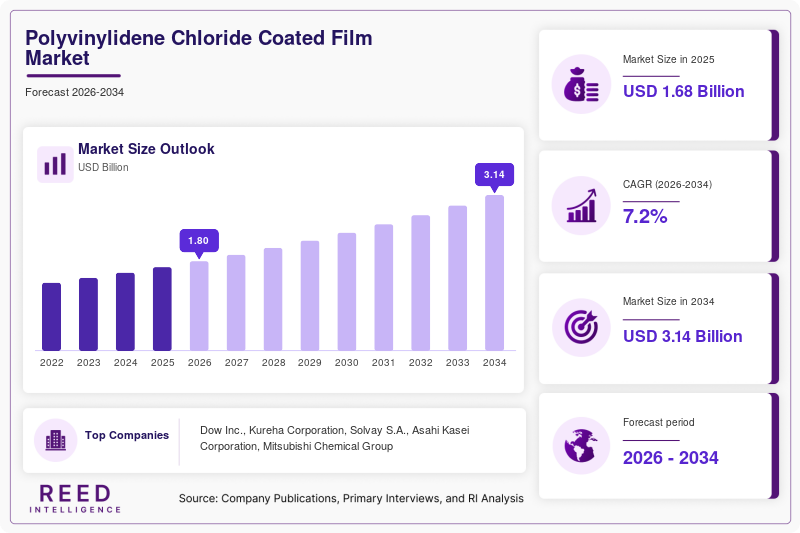
The Polyvinylidene Chloride Coated Film Market size was valued at approximately USD 1.68 billion in 2026 and is projected to reach USD 2.94 billion by 2034, expanding at a CAGR of 7.2% during the forecast period (2026–2034). The market has demonstrated consistent expansion driven by the rising demand for high-barrier packaging solutions across food, pharmaceutical, and consumer goods industries. Polyvinylidene chloride (PVDC) coated films are widely recognized for their superior moisture, oxygen, and aroma barrier properties, making them suitable for extending product shelf life and preserving quality.
A major global factor supporting market growth is the rapid expansion of the packaged food sector. Increasing urbanization, changing dietary habits, and the growth of organized retail have significantly boosted demand for advanced packaging materials. PVDC-coated films have become an integral component in flexible packaging due to their performance advantages over traditional materials, especially in applications requiring extended shelf stability and contamination protection.
Key Highlights
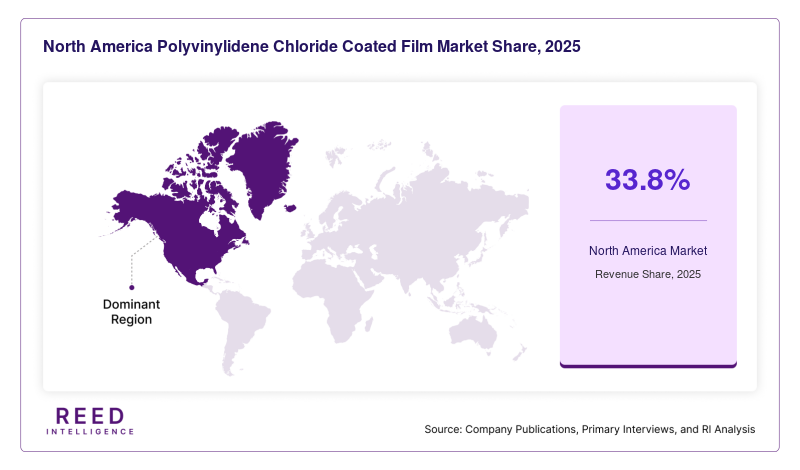
- North America dominated the market with a 33.8% share in 2025.
- Asia Pacific is expected to grow at the fastest CAGR of 9.1% during 2026–2034.
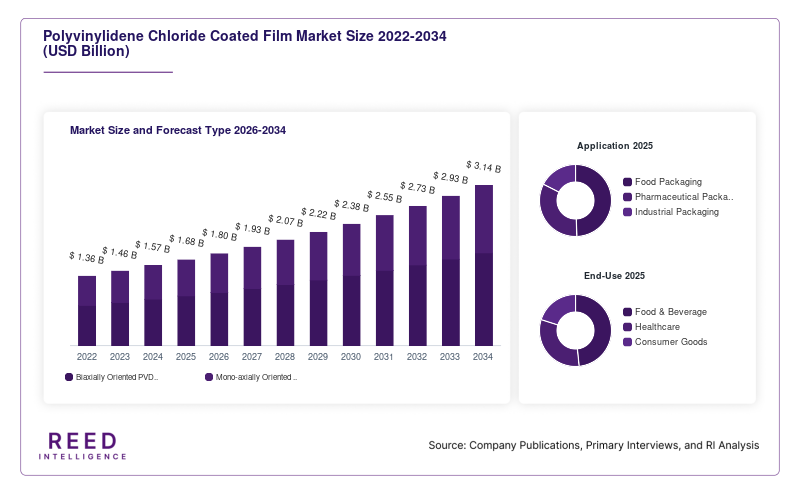
- By type, biaxially oriented films accounted for the largest share of 42.6%, while mono-axially oriented films are projected to grow at a CAGR of 8.4%.
- By application, food packaging led with a 48.3% share, whereas pharmaceutical packaging is expected to expand at a CAGR of 8.9%.
- The United States remained the dominant country, with market values of USD 410 million in 2024 and USD 445 million in 2025.
Market Trends
Increasing adoption of high-barrier sustainable packaging solutions
The Polyvinylidene Chloride Coated Film Market is witnessing a notable shift toward sustainable yet high-performance packaging solutions. Manufacturers are increasingly focusing on developing PVDC-coated films that offer reduced environmental impact without compromising barrier properties. Innovations include thinner coatings, recyclable multilayer structures, and compatibility with emerging circular economy frameworks. The demand for such materials is particularly strong in regions with stringent environmental regulations, where packaging producers are required to balance sustainability goals with functional performance. Additionally, brand owners are investing in eco-conscious packaging to align with consumer expectations and regulatory compliance, which is further accelerating innovation in PVDC-coated film technologies.
Growing integration of PVDC films in pharmaceutical blister packaging
Another significant trend is the increasing use of PVDC-coated films in pharmaceutical blister packaging. These films provide excellent protection against moisture and oxygen, which is essential for maintaining drug efficacy and shelf life. As the global pharmaceutical industry expands, particularly in emerging economies, the demand for reliable packaging materials is rising steadily. PVDC-coated films are preferred due to their ability to meet strict regulatory standards while ensuring product integrity. Furthermore, advancements in coating technologies are enabling improved transparency, printability, and sealing performance, making these films more versatile for diverse pharmaceutical applications.
Market Drivers
Rising demand from the global food packaging industry
The rapid growth of the global food packaging industry is a major driver for the Polyvinylidene Chloride Coated Film Market. Increasing consumption of packaged and processed foods has created a strong need for materials that can extend shelf life and maintain product freshness. PVDC-coated films offer excellent barrier properties against oxygen and moisture, making them ideal for packaging perishable items such as meat, dairy, and ready-to-eat meals. The expansion of e-commerce and cold chain logistics has further increased the demand for durable and protective packaging solutions. As consumer preferences shift toward convenience and quality, the adoption of PVDC-coated films continues to rise.
Expansion of pharmaceutical and healthcare sectors
The growth of the pharmaceutical and healthcare industries is another key factor driving market expansion. PVDC-coated films are widely used in blister packaging to protect sensitive drugs from environmental factors. With increasing investments in healthcare infrastructure and rising demand for medications, particularly in developing regions, the need for high-performance packaging materials is growing. Regulatory requirements for drug safety and quality assurance have also contributed to the adoption of PVDC-coated films. Additionally, the development of advanced drug delivery systems has created new opportunities for specialized packaging solutions, further boosting market demand.
Market Restraint
Environmental concerns and regulatory challenges
One of the primary restraints affecting the Polyvinylidene Chloride Coated Film Market is the growing concern over environmental impact and regulatory restrictions. PVDC is a chlorine-based polymer, and its disposal can pose environmental challenges, particularly in regions with strict waste management regulations. Governments and environmental organizations are increasingly promoting the use of recyclable and biodegradable materials, which may limit the adoption of PVDC-coated films. For example, packaging manufacturers in Europe are facing pressure to reduce the use of multi-layer materials that are difficult to recycle. This has led to increased research into alternative barrier materials such as EVOH and bio-based coatings. While PVDC offers superior performance, its environmental footprint may hinder long-term growth unless sustainable solutions are developed.
Market Opportunities
Development of recyclable and eco-friendly PVDC alternatives
The growing emphasis on sustainability presents a significant opportunity for innovation within the Polyvinylidene Chloride Coated Film Market. Companies are investing in research and development to create recyclable PVDC-coated films or alternative coatings that maintain similar barrier properties. Advances in material science are enabling the development of hybrid films that combine performance with environmental compatibility. These innovations are expected to open new avenues in regions with strict environmental regulations. Furthermore, partnerships between packaging manufacturers and recycling organizations are facilitating the adoption of sustainable solutions, thereby enhancing market growth potential.
Expansion in emerging economies and untapped markets
Emerging economies present substantial growth opportunities for the market due to increasing industrialization, urbanization, and rising consumer spending. Countries in Asia Pacific, Latin America, and Africa are witnessing rapid growth in food processing and pharmaceutical industries, which drives demand for high-quality packaging materials. The expansion of retail infrastructure and growing awareness about product safety are also contributing to market growth. Additionally, favorable government policies and investments in manufacturing capabilities are encouraging the adoption of advanced packaging technologies. As these regions continue to develop, the demand for PVDC-coated films is expected to increase significantly.
Segmental Analysis
By Type
Biaxially oriented PVDC-coated films accounted for the largest share of approximately 42.6% in 2024. These films are widely used due to their superior strength, clarity, and barrier properties. They offer enhanced durability and resistance to environmental factors, making them suitable for demanding applications such as food and pharmaceutical packaging. The ability to maintain product integrity and extend shelf life has made biaxially oriented films a preferred choice among manufacturers. Additionally, their compatibility with various printing and lamination processes further increases their adoption across multiple industries.
Mono-axially oriented PVDC-coated films are expected to be the fastest-growing subsegment, with a projected CAGR of 8.4% during the forecast period. These films are gaining popularity due to their cost-effectiveness and ease of processing. They are particularly suitable for applications where directional strength is required. The growing demand for flexible packaging solutions in emerging markets is driving the adoption of mono-axially oriented films. Furthermore, advancements in manufacturing technologies are improving the performance characteristics of these films, making them more competitive in the market.
By Application
Food packaging emerged as the dominant application segment, accounting for a share of 48.3% in 2024. PVDC-coated films are extensively used in this segment due to their ability to provide excellent barrier protection against moisture and oxygen. This ensures the preservation of food quality and extends shelf life, which is critical for perishable products. The increasing demand for convenience foods and ready-to-eat meals has further boosted the adoption of these films. Additionally, the growth of e-commerce and retail sectors has increased the need for durable and protective packaging solutions.
Pharmaceutical packaging is the fastest-growing application segment, with a projected CAGR of 8.9%. The increasing demand for effective drug packaging solutions is driving the adoption of PVDC-coated films. These films are widely used in blister packaging to protect medications from environmental factors. The growth of the pharmaceutical industry, particularly in emerging markets, is contributing to the expansion of this segment. Regulatory requirements for drug safety and quality assurance are also playing a significant role in driving demand.
By End-Use
The food and beverage industry dominated the end-use segment, accounting for a significant share in 2024. The widespread use of PVDC-coated films in packaging applications such as meat, dairy, and snacks has contributed to this dominance. The need for high-barrier materials to ensure product freshness and safety has driven the adoption of these films. Additionally, the increasing demand for packaged and processed foods has further strengthened the position of this segment.
The healthcare industry is expected to be the fastest-growing end-use segment, with a CAGR of 8.7%. The rising demand for advanced packaging solutions in the pharmaceutical sector is driving growth in this segment. PVDC-coated films are widely used for packaging medical devices and drugs, ensuring protection against environmental factors. The expansion of healthcare infrastructure and increasing investments in research and development are contributing to the growth of this segment.
Regional Analysis
North America
North America held a significant share of the Polyvinylidene Chloride Coated Film Market, accounting for approximately 33.8% in 2025. The region is expected to grow at a CAGR of 6.5% during the forecast period. The presence of established food processing and pharmaceutical industries has contributed to steady demand for high-barrier packaging materials. Technological advancements and strong distribution networks further support market growth in this region.
The United States dominates the North American market due to its well-developed industrial base and high consumption of packaged goods. A unique growth factor is the increasing adoption of advanced packaging technologies in the food sector, driven by consumer demand for extended shelf life and product safety. This trend continues to strengthen the market position of PVDC-coated films.
Europe
Europe accounted for a considerable market share of around 28.4% in 2025 and is projected to grow at a CAGR of 6.8% during the forecast period. The region’s focus on sustainability and regulatory compliance has influenced the adoption of innovative packaging solutions. Despite environmental concerns, PVDC-coated films remain widely used due to their superior barrier properties.
Germany leads the European market, supported by its strong manufacturing sector and advanced packaging industry. A unique growth factor is the increasing investment in research and development to create environmentally friendly packaging materials. This has led to the development of modified PVDC films that align with regulatory requirements while maintaining performance standards.
Asia Pacific
Asia Pacific is the fastest-growing region in the Polyvinylidene Chloride Coated Film Market, with a projected CAGR of 9.1% during 2026–2034. The region held a market share of approximately 24.7% in 2025. Rapid urbanization, population growth, and increasing disposable incomes are driving demand for packaged food and pharmaceuticals.
China dominates the regional market due to its large manufacturing base and growing consumer market. A unique growth factor is the expansion of the food processing industry, which requires high-performance packaging solutions. Government initiatives to improve food safety standards are also contributing to increased adoption of PVDC-coated films.
Middle East & Africa
The Middle East & Africa region accounted for around 7.2% of the market share in 2025 and is expected to grow at a CAGR of 7.0%. The region’s developing infrastructure and increasing investment in food and healthcare sectors are driving market growth. Demand for durable packaging materials is rising steadily.
Saudi Arabia is a key market within the region, supported by its growing industrial sector. A unique growth factor is the expansion of retail and logistics infrastructure, which increases the need for reliable packaging solutions. This trend is expected to boost the demand for PVDC-coated films in the coming years.
Latin America
Latin America held a market share of approximately 5.9% in 2025 and is projected to grow at a CAGR of 7.3%. The region is experiencing steady growth due to increasing demand for packaged food and pharmaceuticals. Economic development and urbanization are key factors supporting market expansion.
Brazil dominates the Latin American market, driven by its large consumer base and expanding food industry. A unique growth factor is the rising adoption of modern packaging technologies to improve product quality and shelf life. This is expected to drive demand for PVDC-coated films in the region.
Competitive Landscape
The Polyvinylidene Chloride Coated Film Market is moderately fragmented, with several global and regional players competing based on product innovation, quality, and pricing strategies. Companies are focusing on expanding their product portfolios and investing in research and development to meet evolving customer requirements. Strategic partnerships and mergers are also common, enabling companies to strengthen their market presence and expand their geographic reach.
One of the leading players in the market is Dow Inc., which has established a strong presence through its advanced material solutions and extensive distribution network. A recent development includes the introduction of new high-barrier film technologies designed to improve sustainability and performance. Other key players are also investing in eco-friendly solutions to address environmental concerns and regulatory challenges, which is expected to shape the competitive landscape in the coming years.
Key Players
- Dow Inc.
- Kureha Corporation
- Solvay S.A.
- Asahi Kasei Corporation
- Mitsubishi Chemical Group
- SKC Co., Ltd.
- Cosmo Films Ltd.
- Jindal Poly Films Ltd.
- Bemis Company, Inc.
- Berry Global Inc.
- Uflex Ltd.
- Amcor plc
- Sealed Air Corporation
- Toray Industries, Inc.
- Kuraray Co., Ltd.
Recent Developments
- A leading manufacturer introduced a new generation of recyclable PVDC-coated films aimed at reducing environmental impact while maintaining barrier performance.
- Several companies expanded their production capacities in Asia Pacific to meet the growing demand for flexible packaging materials.
- Strategic collaborations between packaging firms and technology providers have resulted in improved coating processes, enhancing film durability and efficiency.
Polyvinylidene Chloride Coated Film Market Segments
Type
- Biaxially Oriented PVDC Coated Films
- Mono-axially Oriented PVDC Coated Films
Application
- Food Packaging
- Pharmaceutical Packaging
- Industrial Packaging
End-Use
- Food & Beverage
- Healthcare
- Consumer Goods
By Region
- North America
- Europe
- APAC
- Middle East and Africa
- LATAM