Pool Room Dehumidifiers Market Size, Share & Demand Report By Product Type (Refrigerant-Based Pool Room Dehumidifiers), By Installation Type (Wall-Mounted Systems, Ceiling-Mounted Systems, Floor-Standing Systems), By End User (Commercial Facilities, Luxury Residential Indoor Pools), By Distribution Channel (Direct Sales, HVAC Equipment Distributors, Specialized Contractors), By Region & Segment Forecasts, 2026–2034
USD 3950
Market Overview
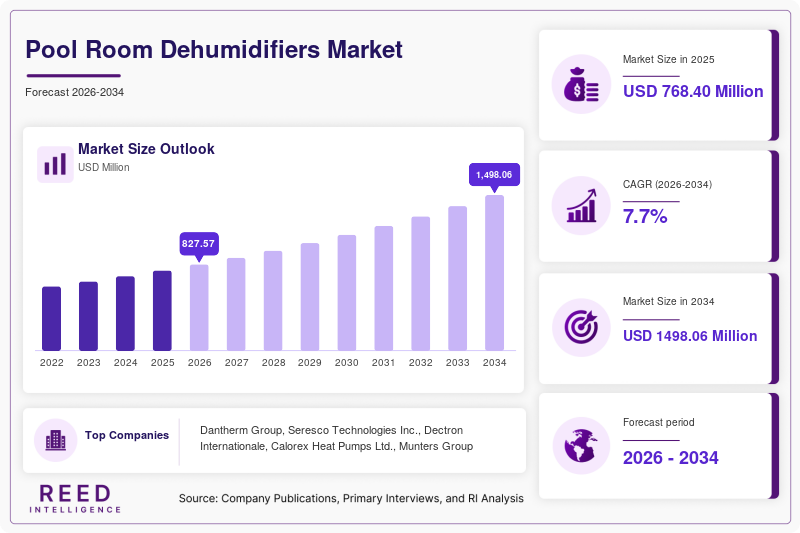
The Pool Room Dehumidifiers Market was valued at USD 768.4 million in 2026 and is projected to reach USD 1.39 billion by 2034, expanding at a CAGR of 7.7% during the forecast period (2026–2034). Pool room dehumidifiers are specialized climate-control systems designed to regulate humidity levels in indoor swimming pool environments. These systems help prevent condensation, structural deterioration, mold growth, corrosion, and indoor air quality issues while maintaining occupant comfort and protecting building infrastructure.
A major global factor supporting market growth has been the increasing development of indoor recreational and wellness facilities. Rising investments in hotels, fitness centers, sports complexes, aquatic centers, luxury residential projects, and wellness resorts have increased the demand for efficient humidity control systems. As indoor pools become more common in both commercial and high-end residential properties, facility operators are prioritizing dehumidification solutions that improve environmental control while reducing maintenance costs.
Key Highlights
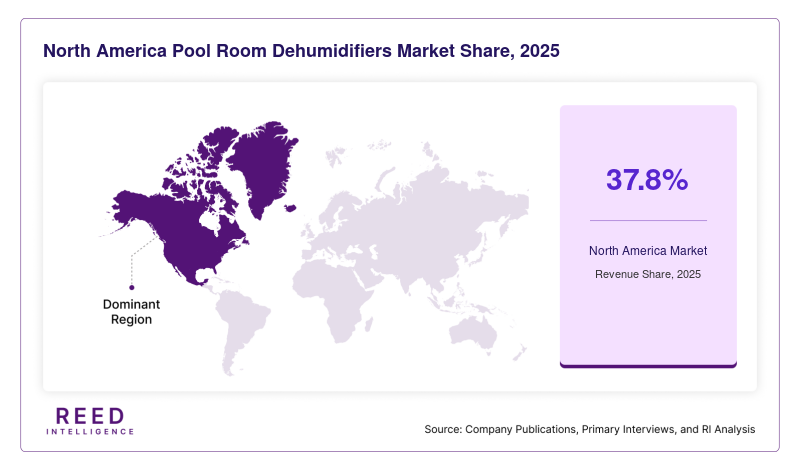
- North America accounted for the largest market share of 37.8% in 2025, while Asia Pacific is anticipated to register the fastest CAGR of 9.1% during 2026–2034.
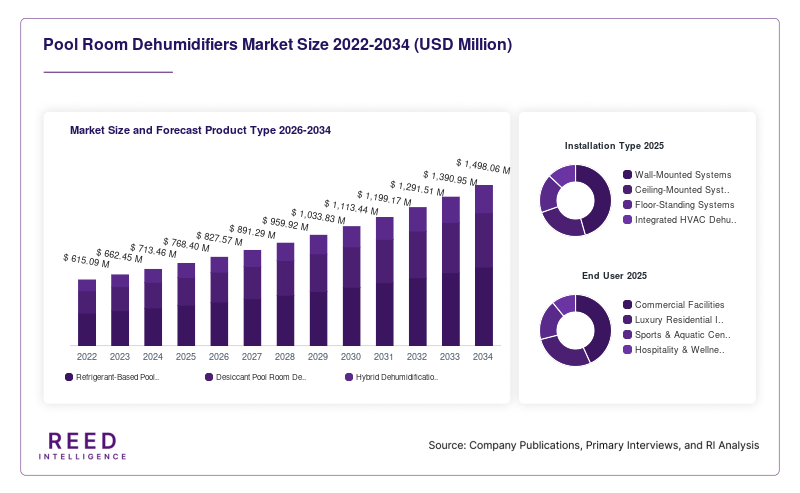
- By Product Type, Refrigerant-Based Pool Room Dehumidifiers held the dominant share of 58.6% in 2025, while Hybrid Dehumidification Systems are projected to expand at a CAGR of 9.8%.
- By Installation Type, Wall-Mounted Systems represented the leading share of 41.9% in 2025, whereas Integrated HVAC Dehumidification Systems are forecast to grow at a CAGR of 10.2%.
- By End User, Commercial Facilities accounted for 64.7% of the market in 2025, while Luxury Residential Indoor Pools are projected to register a CAGR of 8.9%.
- By Distribution Channel, Direct Sales captured the largest share of 46.5% in 2025, whereas Online B2B Procurement Platforms are expected to grow at a CAGR of 10.6%.
- The United States, the dominant country market, was valued at USD 206.7 million in 2024 and increased to USD 223.8 million in 2025.
Market Trends
Integration of Smart Monitoring and Remote Control Technologies
Manufacturers are increasingly incorporating Internet of Things (IoT) connectivity, cloud-based monitoring platforms, and intelligent sensors into pool room dehumidification systems. Facility managers can remotely monitor humidity levels, energy consumption, maintenance schedules, and equipment performance through digital dashboards. These technologies improve operational efficiency while reducing downtime and service costs. The growing demand for smart building management solutions is accelerating adoption across commercial facilities.
Shift Toward Energy Recovery and Sustainable System Designs
Energy efficiency has become a central focus in the Pool Room Dehumidifiers Market. Modern systems increasingly feature heat recovery technology that captures and reuses thermal energy generated during dehumidification processes. These solutions help lower operational expenses and improve overall building energy performance. As sustainability objectives gain importance across construction and facility management sectors, energy-recovery dehumidification systems are becoming a preferred choice among end users.
Market Drivers
Expansion of Indoor Aquatic and Wellness Infrastructure
The increasing construction of indoor swimming pools, wellness centers, rehabilitation facilities, and aquatic recreation complexes is driving demand for specialized humidity control equipment. Indoor pool environments require precise climate management to maintain structural integrity and user comfort. Growing investments in recreational and wellness infrastructure continue to generate demand for advanced dehumidification technologies.
Rising Focus on Indoor Air Quality and Building Protection
Building owners and facility operators are increasingly prioritizing indoor air quality and long-term asset preservation. Excessive humidity can lead to mold development, corrosion, condensation damage, and reduced occupant comfort. The need to maintain healthy indoor environments while protecting building materials and equipment is encouraging broader adoption of pool room dehumidifiers across multiple applications.
Market Restraint
High Initial Installation and Capital Costs
Pool room dehumidification systems often require specialized engineering, ventilation integration, and customized installation procedures. The substantial upfront investment associated with equipment procurement and system implementation may discourage adoption among budget-sensitive facility operators, particularly within smaller projects and emerging markets.
Market Opportunities
Retrofitting of Aging Indoor Pool Facilities
A significant number of indoor swimming facilities operate with outdated climate-control systems. Modernization projects present substantial opportunities for manufacturers to replace older equipment with energy-efficient dehumidification technologies that improve performance, reduce maintenance requirements, and enhance sustainability outcomes.
Growth in Premium Residential Indoor Pool Construction
The increasing popularity of luxury residences featuring indoor swimming pools is creating new market opportunities. Homeowners investing in premium recreational amenities require advanced humidity control solutions capable of maintaining indoor comfort while protecting building finishes and furnishings from moisture-related damage.
Segmental Analysis
By Product Type
The Pool Room Dehumidifiers Market is segmented into Refrigerant-Based Pool Room Dehumidifiers, Desiccant Pool Room Dehumidifiers, and Hybrid Dehumidification Systems.
Refrigerant-Based Pool Room Dehumidifiers accounted for the largest share of 58.6% in 2025. Their dominance was attributed to cost efficiency, operational reliability, and suitability for a broad range of indoor swimming pool environments. These systems remain widely adopted across commercial and residential installations due to their proven performance characteristics.
Hybrid Dehumidification Systems are projected to expand at a CAGR of 9.8% through 2034. Growth will be driven by their ability to combine multiple moisture-control technologies while improving energy efficiency and operational flexibility in demanding indoor environments.
By Installation Type
The market is segmented into Wall-Mounted Systems, Ceiling-Mounted Systems, Floor-Standing Systems, and Integrated HVAC Dehumidification Systems.
Wall-Mounted Systems held the dominant share of 41.9% in 2025. Their leadership position was supported by installation simplicity, space optimization advantages, and compatibility with a wide variety of facility layouts.
Integrated HVAC Dehumidification Systems are expected to witness a CAGR of 10.2% during the forecast period. Growth will result from increasing demand for centralized environmental control solutions capable of managing temperature, ventilation, and humidity through unified building management platforms.
By End User
The Pool Room Dehumidifiers Market is segmented into Commercial Facilities, Luxury Residential Indoor Pools, Sports & Aquatic Centers, and Hospitality & Wellness Facilities.
Commercial Facilities accounted for the largest share of 64.7% in 2025. The segment maintained leadership due to the widespread presence of indoor swimming pools within recreation centers, educational institutions, fitness clubs, and community aquatic facilities.
Luxury Residential Indoor Pools are anticipated to register a CAGR of 8.9% through 2034. Growth will be supported by increasing demand for premium home amenities and rising investment in customized indoor leisure environments.
By Distribution Channel
The market is segmented into Direct Sales, HVAC Equipment Distributors, Specialized Contractors, and Online B2B Procurement Platforms.
Direct Sales captured 46.5% of market revenue in 2025. Their dominance was supported by the technical complexity of dehumidification projects and the need for customized engineering consultation during equipment selection and installation.
Online B2B Procurement Platforms are forecast to grow at a CAGR of 10.6% during the forecast period. Growth will stem from increasing digital procurement adoption and greater accessibility of technical product information through online purchasing channels.
Regional Analysis
North America
North America accounted for 37.8% of the global Pool Room Dehumidifiers Market share in 2025 and is expected to expand at a CAGR of 7.1% through 2034. The region benefits from a large installed base of indoor aquatic facilities, advanced building technologies, and strong adoption of specialized HVAC systems.
The United States remained the dominant country market. Growth is supported by continuous investment in sports facilities, hotels, wellness centers, and residential indoor pool projects requiring advanced humidity management solutions.
Europe
Europe represented 29.4% of the global market share in 2025 and is projected to register a CAGR of 7.3% during the forecast period. Demand remains supported by strict building performance standards and widespread adoption of energy-efficient climate-control technologies.
Germany emerged as the leading country market. Growth is influenced by increasing investment in sustainable building systems and the modernization of recreational and wellness facilities equipped with indoor aquatic environments.
Asia Pacific
Asia Pacific held 21.3% of the global Pool Room Dehumidifiers Market share in 2025 and is anticipated to grow at a CAGR of 9.1% from 2026 to 2034. Rapid urbanization and growing investments in hospitality infrastructure continue to support regional market development.
China remained the dominant country market. Growth is driven by expanding construction of premium residential developments, hotels, sports complexes, and integrated wellness facilities featuring indoor swimming pools.
Middle East & Africa
The Middle East & Africa accounted for 5.2% of global revenue in 2025 and is projected to expand at a CAGR of 8.0% during the forecast period. The region is witnessing increasing development of luxury hospitality properties and recreational infrastructure requiring humidity management solutions.
United Arab Emirates represented the dominant country market. Growth is supported by ongoing investments in premium tourism developments and indoor leisure facilities designed to operate in challenging climatic conditions.
Latin America
Latin America captured 6.3% of the global market share in 2025 and is expected to register a CAGR of 7.5% through 2034. Increasing investments in commercial recreation facilities and hospitality infrastructure continue to support market growth.
Brazil remained the dominant country market. Growth is influenced by expanding indoor sports facilities and rising adoption of modern HVAC technologies within commercial building projects.
Competitive Landscape
The Pool Room Dehumidifiers Market remains moderately consolidated, with manufacturers competing through product efficiency, technological innovation, energy performance, and customized engineering solutions. Market participants are increasingly focusing on smart controls, heat recovery technologies, environmentally responsible refrigerants, and integrated building management capabilities.
Dantherm Group maintained a leading market position due to its extensive portfolio of pool dehumidification systems and strong presence across commercial aquatic facilities. The company recently introduced an advanced energy-recovery dehumidification platform designed to improve operational efficiency while reducing energy consumption in large indoor pool environments.
Other notable market participants including Seresco Technologies Inc., Dectron Internationale, Calorex Heat Pumps Ltd., and Munters Group continue to strengthen their market presence through product innovation, strategic partnerships, and expansion into emerging infrastructure markets.
Key Players List
- Dantherm Group
- Seresco Technologies Inc.
- Dectron Internationale
- Calorex Heat Pumps Ltd.
- Munters Group
- Desert Aire LLC
- Dryair Manufacturing Corp.
- AquaCal AutoPilot Inc.
- Therma-Stor LLC
- Bry-Air Inc.
- Condair Group
- DehuTech AB
- Trotec GmbH
- FläktGroup Holding GmbH
- Fisen Corporation
Recent Developments
- In February 2026, a major manufacturer launched a new heat-recovery pool dehumidification system designed to reduce facility energy consumption.
- In April 2026, several companies introduced cloud-connected monitoring platforms for real-time humidity management and predictive maintenance.
- In August 2026, industry participants expanded production capacity to address growing demand from hospitality and recreational infrastructure projects.
- In November 2026, manufacturers integrated environmentally responsible refrigerants into next-generation dehumidification equipment portfolios.
- In March 2027, leading suppliers introduced advanced variable-speed compressor technologies to improve operational efficiency.
- In June 2027, companies expanded partnerships with HVAC engineering firms to strengthen project-based solution offerings.
- In September 2027, market participants launched compact dehumidification systems tailored for premium residential indoor pool installations.
- In January 2028, several manufacturers enhanced digital building management integration capabilities for commercial aquatic facilities.
Pool Room Dehumidifiers Market Segments
Product Type
- Refrigerant-Based Pool Room Dehumidifiers
- Desiccant Pool Room Dehumidifiers
- Hybrid Dehumidification Systems
Installation Type
- Wall-Mounted Systems
- Ceiling-Mounted Systems
- Floor-Standing Systems
- Integrated HVAC Dehumidification Systems
End User
- Commercial Facilities
- Luxury Residential Indoor Pools
- Sports & Aquatic Centers
- Hospitality & Wellness Facilities
Distribution Channel
- Direct Sales
- HVAC Equipment Distributors
- Specialized Contractors
- Online B2B Procurement Platforms
By Region
- North America
- Europe
- APAC
- Middle East and Africa
- LATAM