Porous Electrodes Electrolyzer Market Size, Share & Demand Report By Electrolyzer Type (PEM Electrolyzers, Alkaline Electrolyzers), By Material Type (Nickel-Based Porous Electrodes), By Application (Hydrogen Production, Energy Storage, Industrial Gas Processing), By End-Use Industry (Energy & Utilities, Transportation, Chemicals, Industrial Manufacturing), By Distribution Channel (Direct Sales, Distributors, Online Sales) By Region & Segment Forecasts, 2026–2034
USD 3950
Market Overview
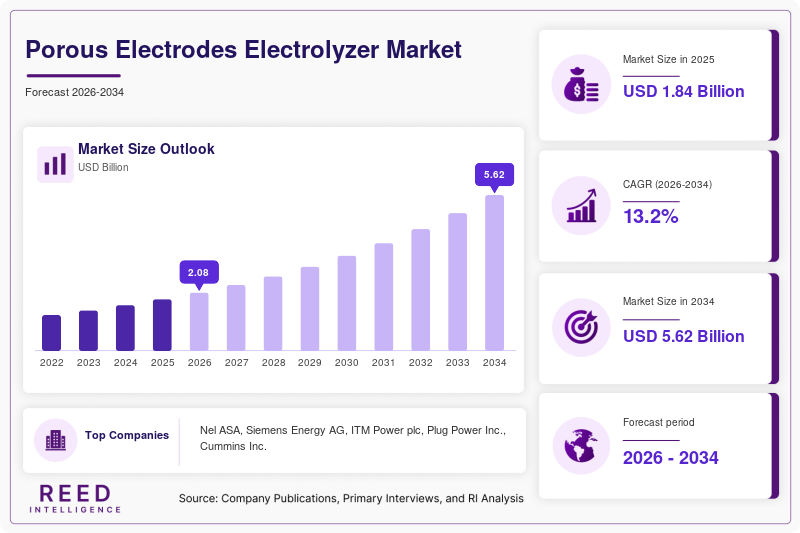
The global Porous Electrodes Electrolyzer Market size was valued at USD 1.84 billion in 2026 and is projected to reach USD 4.96 billion by 2034, expanding at a CAGR of 13.2% during the forecast period of 2026–2034. The market growth is being shaped by rising investments in hydrogen production infrastructure and the transition toward low-carbon industrial processes across developed and emerging economies. Increasing adoption of electrolyzer systems in renewable energy integration projects has accelerated the deployment of porous electrode technologies that improve electrochemical efficiency and enhance gas diffusion performance.
The growing emphasis on clean hydrogen production has encouraged manufacturers to develop advanced porous electrode materials with enhanced conductivity, corrosion resistance, and catalytic activity. Industries such as power generation, transportation, chemicals, and energy storage are increasingly integrating electrolyzer systems to support decarbonization targets. Porous electrodes have become essential components in proton exchange membrane (PEM), alkaline, and solid oxide electrolyzers due to their role in improving reaction efficiency and reducing operational losses.
Key Highlights:
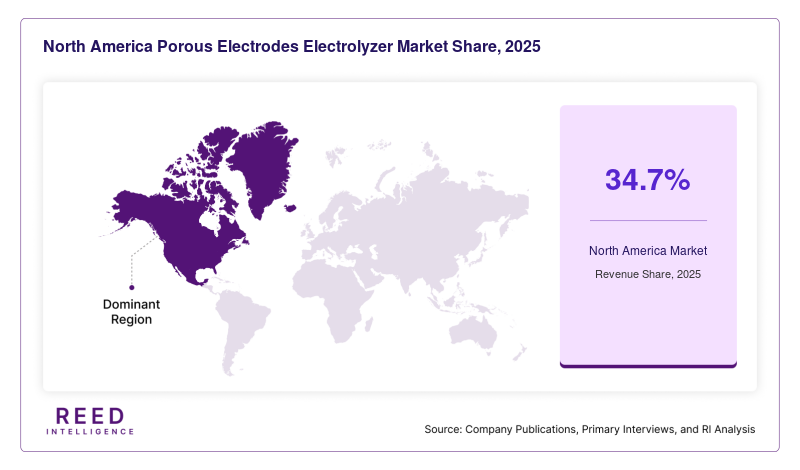
- North America accounted for 34.7% of the global Porous Electrodes Electrolyzer Market share in 2025, while Asia Pacific is projected to register the fastest CAGR of 14.6% during 2026–2034.
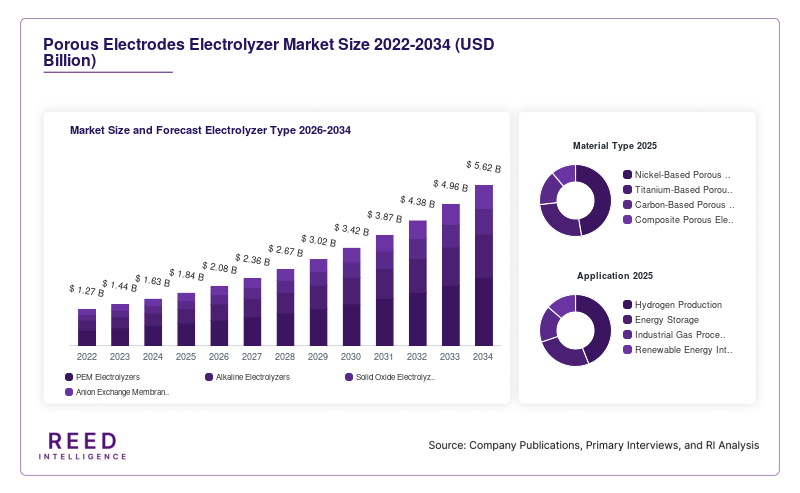
- By electrolyzer type, PEM electrolyzers held the leading market share of 41.8% in 2025, while solid oxide electrolyzers are anticipated to grow at a CAGR of 15.3% during the forecast period.
- By material type, nickel-based porous electrodes dominated with 38.5% share in 2025, whereas composite porous electrodes are expected to expand at a CAGR of 14.8%.
- By application, hydrogen production represented 47.2% of the market share in 2025, while energy storage applications are forecast to witness a CAGR of 15.1%.
- The U.S. Porous Electrodes Electrolyzer Market was valued at USD 462.5 million in 2024 and reached USD 516.8 million in 2025.
Market Trends
Advanced Nanostructured Porous Electrode Development
Manufacturers are increasingly investing in nanostructured porous electrode technologies to improve catalytic efficiency and electrochemical performance. Advanced manufacturing methods such as additive manufacturing, plasma spraying, and precision coating technologies are enabling the development of electrodes with enhanced porosity and conductivity. These innovations are improving gas diffusion rates and reducing energy losses in electrolyzer operations.
The integration of nanomaterials and engineered catalysts is also helping companies achieve higher operational stability in demanding industrial environments. This trend is expected to strengthen the adoption of next-generation electrolyzer systems across hydrogen production facilities and renewable energy projects.
Integration of Renewable Energy with Electrolyzer Systems
The growing deployment of solar and wind energy projects is encouraging integration of electrolyzers for energy conversion and storage applications. Porous electrodes are becoming essential for maintaining efficiency during variable renewable power supply conditions. Energy companies are increasingly investing in large-scale green hydrogen facilities supported by renewable electricity generation.
Electrolyzer manufacturers are also introducing modular systems designed for renewable energy compatibility. This trend is contributing to greater adoption of porous electrode technologies in decentralized hydrogen generation and industrial energy storage systems.
Market Drivers
Rising Global Investments in Green Hydrogen Infrastructure
Governments and private organizations are increasing investments in green hydrogen infrastructure projects to support decarbonization goals. Large-scale hydrogen production facilities require high-performance electrolyzer systems equipped with efficient porous electrodes to optimize operational output. Growing funding for hydrogen transportation, storage, and industrial utilization projects is supporting consistent market expansion.
Industrial sectors such as refining, chemicals, steel production, and heavy transportation are increasing hydrogen adoption to reduce carbon emissions. This transition is strengthening long-term demand for advanced porous electrode electrolyzer systems.
Increasing Demand for High-Efficiency Electrolysis Technologies
Industrial operators are focusing on improving energy efficiency and reducing operational costs in hydrogen production facilities. Porous electrodes improve ion transport and gas diffusion efficiency, making them essential for modern electrolyzer systems. Manufacturers are therefore investing in advanced materials and precision engineering to improve system performance.
The rising adoption of automated industrial process control systems is also encouraging the use of high-efficiency electrolyzers with enhanced operational stability and reduced maintenance requirements.
Market Restraint
High Initial Capital and Material Costs
The Porous Electrodes Electrolyzer Market faces challenges associated with high production and installation costs. Advanced porous electrode materials, catalyst coatings, and precision manufacturing technologies significantly increase system expenses. Smaller industrial operators and developing economies often face budget limitations that restrict rapid adoption of advanced electrolyzer systems.
Market Opportunities
Expansion of Green Ammonia Production Facilities
The increasing development of green ammonia projects is creating new opportunities for electrolyzer manufacturers. Green ammonia production facilities require efficient hydrogen generation systems supported by durable porous electrodes. Growing investments in sustainable fertilizer manufacturing and maritime fuel alternatives are expected to strengthen market demand.
Emerging Applications in Industrial Energy Storage
Industrial energy storage systems are increasingly adopting hydrogen-based technologies to manage renewable energy variability. Porous electrode electrolyzers are becoming important for long-duration energy storage applications due to their operational efficiency and scalability. This trend is expected to create new revenue opportunities for manufacturers and material suppliers.
Segmental Analysis
By Electrolyzer Type
PEM Electrolyzers
PEM electrolyzers held the dominant market share of 41.8% in 2025. These systems gained strong adoption due to high operational efficiency, compact design, and rapid response capability for renewable energy applications. Industries preferred PEM systems for hydrogen production projects requiring dynamic operational flexibility.
Solid Oxide Electrolyzers
Solid oxide electrolyzers are projected to expand at the fastest CAGR of 15.3% during 2026–2034. Increasing demand for high-temperature electrolysis and industrial waste heat utilization is expected to support segment growth. These systems offer improved energy conversion efficiency for large-scale industrial applications.
By Material Type
Nickel-Based Porous Electrodes
Nickel-based porous electrodes accounted for 38.5% of the market share in 2025. These materials were widely adopted due to strong corrosion resistance, conductivity, and cost efficiency in alkaline electrolyzer systems.
Composite Porous Electrodes
Composite porous electrodes are anticipated to witness a CAGR of 14.8% during the forecast period. The segment growth is being supported by advancements in material engineering and the development of multi-functional electrode structures with improved catalytic performance.
By Application
Hydrogen Production
Hydrogen production represented the leading application segment with 47.2% market share in 2025. Increasing investments in green hydrogen facilities and industrial decarbonization projects supported strong segment demand.
Energy Storage
Energy storage applications are forecast to expand at a CAGR of 15.1% during 2026–2034. Rising integration of renewable energy systems and demand for long-duration energy storage technologies are expected to drive segment growth.
By End-Use Industry
Energy & Utilities
The energy and utilities segment dominated the market with 39.4% share in 2025. Utilities increasingly deployed electrolyzer systems to support renewable energy balancing and hydrogen infrastructure projects.
Transportation
The transportation segment is expected to grow at a CAGR of 14.4% during the forecast period. Rising adoption of hydrogen fuel cell vehicles and investments in hydrogen refueling infrastructure are anticipated to strengthen demand.
By Distribution Channel
Direct Sales
Direct sales accounted for the largest market share of 61.3% in 2025. Large industrial projects often relied on direct procurement agreements with electrolyzer manufacturers for customized solutions and long-term technical support.
Online and Third-Party Distribution
Online and third-party distribution channels are projected to grow at a CAGR of 13.7% during the forecast period. Increasing digital procurement practices and expanding global supplier networks are expected to support growth.
Regional Analysis
North America
North America accounted for 34.7% of the global Porous Electrodes Electrolyzer Market share in 2025. The region benefited from strong investments in hydrogen infrastructure development and industrial decarbonization initiatives. The United States remained the dominant regional market due to growing deployment of hydrogen hubs and clean energy projects.
The U.S. government supported multiple hydrogen production initiatives focused on renewable energy integration and industrial sustainability. Increasing investments in fuel cell transportation infrastructure also strengthened demand for advanced electrolyzer technologies with high-performance porous electrodes.
North America is projected to grow at a CAGR of 12.8% during 2026–2034.
Europe
Europe held 28.5% of the global Porous Electrodes Electrolyzer Market share in 2025. The region experienced substantial demand from industrial hydrogen production projects and renewable energy storage initiatives. Germany remained the leading country due to strong investment in green hydrogen manufacturing and industrial energy transition programs.
European manufacturers continued expanding production facilities for PEM and solid oxide electrolyzers to support regional clean energy targets. Growing adoption of carbon-neutral industrial strategies also encouraged demand for advanced porous electrode systems.
Europe is forecast to expand at a CAGR of 13.1% during the forecast period.
Asia Pacific
Asia Pacific represented 23.6% of the global market share in 2025 and is anticipated to register the fastest CAGR of 14.6% during 2026–2034. China dominated the regional market due to rapid industrialization and large-scale renewable energy expansion projects.
The region witnessed increasing deployment of electrolyzer systems across hydrogen transportation, industrial manufacturing, and energy storage sectors. Government-backed hydrogen roadmaps in China, Japan, South Korea, and India supported investments in electrolyzer manufacturing capacity and advanced material development.
Middle East & Africa
Middle East & Africa accounted for 7.2% of the global market share in 2025. Saudi Arabia emerged as the dominant country due to rising investments in green hydrogen and ammonia production projects supported by renewable energy resources.
Large-scale industrial diversification programs encouraged adoption of advanced electrolyzer technologies in the region. Hydrogen export strategies and clean energy infrastructure development are expected to strengthen market expansion during the forecast period.
The region is expected to grow at a CAGR of 12.2% from 2026 to 2034.
Latin America
Latin America captured 6.0% of the global Porous Electrodes Electrolyzer Market share in 2025. Brazil remained the dominant country due to increasing renewable energy integration and industrial modernization initiatives.
The region witnessed growing adoption of electrolyzer systems in renewable hydrogen production projects and industrial energy applications. Expanding solar and wind energy capacities supported market growth across multiple countries.
Latin America is projected to register a CAGR of 11.7% during the forecast period.
Competitive Landscape
The Porous Electrodes Electrolyzer Market is moderately consolidated with major players focusing on product innovation, strategic partnerships, and production capacity expansion. Companies are investing in advanced porous material technologies and catalyst optimization to improve electrolyzer efficiency and operational durability.
Nel ASA remained a leading player in the market due to its strong hydrogen technology portfolio and global project presence. The company recently expanded its electrolyzer manufacturing capacity to support rising green hydrogen demand across Europe and North America.
Siemens Energy focused on large-scale PEM electrolyzer projects integrated with renewable energy systems. ITM Power emphasized modular hydrogen production systems for industrial applications. Plug Power expanded hydrogen infrastructure partnerships to strengthen market presence in transportation and industrial sectors. Cummins Inc. increased investments in advanced electrolyzer manufacturing technologies and hydrogen ecosystem development.
Key Players List
- Nel ASA
- Siemens Energy AG
- ITM Power plc
- Plug Power Inc.
- Cummins Inc.
- Thyssenkrupp Nucera
- Bloom Energy Corporation
- McPhy Energy S.A.
- Air Liquide
- Toshiba Energy Systems & Solutions Corporation
- Enapter AG
- HydrogenPro ASA
- Sunfire GmbH
- John Cockerill
- H-TEC SYSTEMS GmbH
Recent Developments
- Nel ASA announced expansion of its automated electrolyzer production facility to support rising global hydrogen demand.
- Siemens Energy introduced an upgraded PEM electrolyzer platform designed for renewable energy integration projects.
- ITM Power entered a strategic partnership for large-scale industrial hydrogen generation infrastructure deployment.
- Plug Power expanded hydrogen ecosystem investments across transportation and industrial sectors in North America.
- Thyssenkrupp Nucera launched a new high-capacity alkaline electrolyzer system optimized for green hydrogen production.
Porous Electrodes Electrolyzer Market Segments
Electrolyzer Type
- PEM Electrolyzers
- Alkaline Electrolyzers
- Solid Oxide Electrolyzers
- Anion Exchange Membrane Electrolyzers
Material Type
- Nickel-Based Porous Electrodes
- Titanium-Based Porous Electrodes
- Carbon-Based Porous Electrodes
- Composite Porous Electrodes
Application
- Hydrogen Production
- Energy Storage
- Industrial Gas Processing
- Renewable Energy Integration
End-Use Industry
- Energy & Utilities
- Transportation
- Chemicals
- Industrial Manufacturing
Distribution Channel
- Direct Sales
- Distributors
- Online Sales
By Region
- North America
- Europe
- APAC
- Middle East and Africa
- LATAM