Porous Prill Ammonium Nitrate Market Size, Share & Demand Report By Grade (Industrial Grade, High-Density Porous Prill Ammonium Nitrate, Standard Porous Grade), By Application (Mining Explosives, Infrastructure Blasting, Quarrying Operations, Construction Blasting, Defense and Industrial Applications), By End-Use (Metal Mining, Coal Mining, Construction and Tunneling, Quarrying Industry, Energy and Infrastructure), By Region & Segment Forecasts, 2026–2034
USD 3950
Market Overview
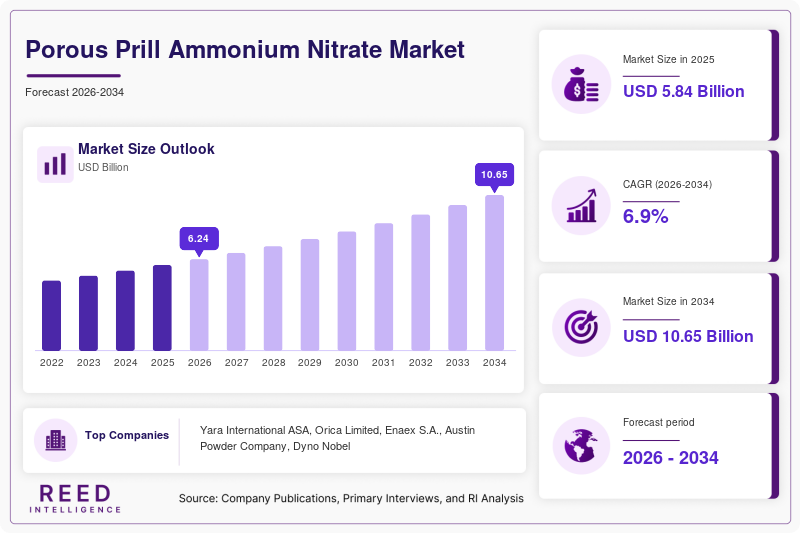
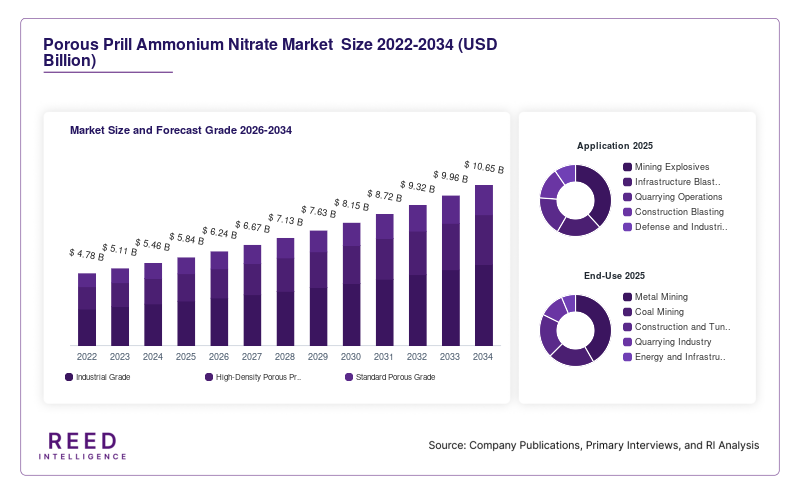
The global Porous Prill Ammonium Nitrate Market size was valued at USD 5.84 billion in 2026 and is projected to reach USD 9.96 billion by 2034, expanding at a CAGR of 6.9% during the forecast period from 2026 to 2034. The market continues to develop steadily due to rising demand from mining, quarrying, infrastructure construction, and industrial blasting operations across both developed and emerging economies. Porous prill ammonium nitrate is widely used in bulk explosives because of its high absorbency, controlled detonation performance, and operational efficiency in large-scale blasting activities. Growing investments in transportation infrastructure, underground mining projects, and energy extraction activities have contributed significantly to market expansion.
One of the major global factors supporting market growth is the increase in mineral extraction activities associated with rising demand for metals used in renewable energy systems, electric vehicles, and urban infrastructure. Countries are increasing investments in copper, lithium, iron ore, gold, and rare earth mining to secure long-term industrial supply chains. This has created stable demand for blasting-grade ammonium nitrate products, particularly porous prill variants that offer enhanced fuel oil retention and improved blasting performance. In addition, the expansion of smart mining technologies and automated blasting systems has encouraged the use of standardized and high-purity explosive materials, further strengthening product adoption.
Key Highlights
- North America dominated the market with a 35.1% share in 2025, while Asia Pacific is expected to grow at the fastest CAGR of 8.4% during 2026–2034.
- By grade, industrial grade accounted for the largest share of 63.8%, while high-density porous prill ammonium nitrate is projected to grow at a CAGR of 7.8%.
- By application, mining explosives led with a 54.6% share, whereas infrastructure blasting is expected to expand at a CAGR of 8.1%.
- By end-use, metal mining accounted for the highest share of 47.2%, while construction and tunneling activities are anticipated to grow at a CAGR of 7.9%.
- The United States remained the dominant country, with market values of USD 1.42 billion in 2024 and USD 1.53 billion in 2025.
Market Trends
Expansion of Automated Mining and Precision Blasting Technologies
Mining operators are increasingly adopting automated drilling and precision blasting systems to improve mineral recovery rates and reduce operational costs. This transition has accelerated the use of porous prill ammonium nitrate products because they offer consistent density, reliable detonation characteristics, and improved absorption of fuel oil mixtures used in industrial explosives. Large mining firms in Australia, Canada, Chile, and South Africa are integrating digital blasting solutions with real-time monitoring technologies to optimize fragmentation outcomes and minimize waste generation. As a result, manufacturers are developing higher-performance porous prill products that support advanced blasting applications. The growing use of autonomous mining vehicles and remote-controlled blasting operations is also encouraging the demand for standardized explosive-grade materials with stable chemical composition and predictable performance under challenging environmental conditions.
Rising Investments in Infrastructure and Underground Construction Projects
The increasing number of large-scale infrastructure projects worldwide has strengthened demand for blasting materials used in tunneling, highway expansion, railway development, hydropower construction, and urban transit systems. Governments in Asia Pacific and the Middle East are allocating substantial budgets for transportation corridors, smart city projects, and energy infrastructure, creating higher consumption of industrial explosives. Porous prill ammonium nitrate has become an important material in controlled blasting applications due to its operational efficiency and cost-effectiveness. Contractors involved in underground metro rail systems and mountain tunneling projects prefer blasting solutions that offer better fragmentation control and reduced vibration impact. The trend toward complex underground construction activities is expected to support steady market demand, particularly in regions experiencing rapid urbanization and industrial growth.
Market Drivers
Growth in Global Metal and Mineral Extraction Activities
The steady rise in demand for industrial metals and critical minerals has become a major driver for the porous prill ammonium nitrate market. Industries such as renewable energy, automotive manufacturing, electronics, and infrastructure construction require large volumes of copper, lithium, iron ore, nickel, and rare earth elements. Mining companies are expanding extraction operations and opening new exploration sites to meet long-term commodity demand. Porous prill ammonium nitrate is extensively used in blasting applications because it improves explosive efficiency and supports effective rock fragmentation. Countries with large mining sectors, including Australia, China, Canada, Brazil, and India, continue to increase mining investments, thereby supporting product consumption. In addition, deeper underground mining projects require reliable blasting materials that can perform under varying geological conditions, further increasing market demand.
Increase in Public Infrastructure Spending Across Emerging Economies
Rapid urbanization and industrial development across emerging economies have resulted in significant public investment in transportation and construction infrastructure. Governments are developing highways, tunnels, airports, railways, dams, and industrial corridors to strengthen economic productivity and regional connectivity. These projects require extensive drilling and blasting activities, especially in mountainous and hard-rock terrains. Porous prill ammonium nitrate is widely utilized in these operations because of its compatibility with bulk explosive formulations and large-scale blasting systems. Infrastructure development initiatives in India, Southeast Asia, the Gulf countries, and Latin America are generating stable demand for industrial explosives. The growth of smart cities and energy infrastructure projects has also increased the need for efficient blasting materials capable of supporting faster project execution and lower operational costs.
Market Restraint
Stringent Environmental and Safety Regulations Affecting Explosive Materials
The porous prill ammonium nitrate market faces operational challenges due to strict regulations governing the production, transportation, storage, and use of explosive-grade ammonium nitrate products. Regulatory agencies across North America, Europe, and several Asia Pacific countries have implemented rigorous safety standards to reduce industrial accidents, environmental contamination, and unauthorized use of explosive materials. Manufacturers are required to invest heavily in compliance systems, secure logistics infrastructure, employee training, and advanced monitoring technologies, increasing operational costs across the value chain.
Environmental concerns associated with nitrogen emissions, groundwater contamination, and improper disposal of blasting residues have also led to tighter industrial oversight. In several regions, mining and construction operators must obtain additional permits and conduct environmental impact assessments before initiating blasting activities. These procedures can delay project execution and reduce short-term product demand. Furthermore, fluctuations in raw material availability and rising transportation restrictions for hazardous chemicals create additional supply chain complexities. Smaller manufacturers often face financial pressure due to the high cost of regulatory compliance, limiting market entry and expansion opportunities in highly regulated regions.
Market Opportunities
Expansion of Critical Mineral Mining for Clean Energy Applications
The global transition toward clean energy technologies is creating substantial opportunities for the porous prill ammonium nitrate market. Demand for critical minerals such as lithium, cobalt, copper, graphite, and nickel continues to increase due to rapid growth in electric vehicle manufacturing, renewable power generation, and battery storage systems. Mining companies are expanding exploration and extraction projects across regions including Latin America, Africa, Australia, and Southeast Asia to secure long-term mineral supply chains. These projects require large-scale blasting operations that depend heavily on high-performance industrial explosives. Porous prill ammonium nitrate products are expected to witness increased demand because they provide efficient fuel absorption and stable detonation performance in challenging mining environments. The expansion of clean energy infrastructure is likely to create sustained long-term growth opportunities for market participants.
Development of Advanced Low-Emission Blasting Solutions
Manufacturers are increasingly focusing on the development of environmentally aligned blasting technologies that reduce harmful emissions and improve operational safety. This trend presents significant opportunities for companies investing in advanced porous prill ammonium nitrate formulations with enhanced combustion efficiency and lower nitrogen oxide emissions. Mining operators are under growing pressure to reduce environmental impact while maintaining productivity and cost efficiency. As a result, suppliers are developing customized explosive-grade materials that support cleaner blasting processes and improved fragmentation outcomes.
Technological innovation in coated ammonium nitrate products, digital blasting optimization, and controlled detonation systems is expected to create new revenue streams across the industry. Companies that integrate sustainability-focused solutions into their product portfolios are likely to gain competitive advantages in regions with strict environmental regulations. The adoption of green mining practices and carbon reduction strategies is also expected to increase demand for advanced blasting materials over the forecast period.
Segmental Analysis
By Grade
Industrial grade porous prill ammonium nitrate accounted for the largest market share of 63.8% in 2024 due to its extensive use in mining, quarrying, and construction blasting applications. Industrial grade products are widely preferred because they provide reliable absorption capacity for fuel oil mixtures and support efficient detonation performance in large-scale blasting operations. Mining companies prioritize industrial grade ammonium nitrate for open-pit extraction projects involving hard rock fragmentation and controlled blasting. The segment also benefits from its relatively lower operational cost and broad availability across developed and emerging markets. Growing investments in infrastructure modernization, transportation corridors, and energy development projects have further strengthened demand for industrial grade products. Manufacturers continue to focus on improving product consistency, moisture resistance, and storage stability to support evolving industrial requirements.
High-density porous prill ammonium nitrate is projected to register the fastest CAGR of 7.8% during the forecast period due to rising demand for advanced blasting solutions in underground mining and complex excavation projects. High-density variants provide enhanced fuel absorption, improved blasting energy distribution, and better performance in wet or difficult geological conditions. Mining operators are increasingly adopting these products to improve fragmentation quality, reduce operational downtime, and enhance overall blasting efficiency. The growth of deep mining activities for copper, lithium, and precious metals has accelerated the adoption of high-performance blasting materials. Additionally, infrastructure projects involving tunnels, hydropower systems, and underground transportation networks are increasing demand for high-density formulations capable of supporting controlled and precision blasting applications in challenging environments.
By Application
Mining explosives represented the dominant application segment with a market share of 54.6% in 2024. The segment continues to benefit from expanding mineral extraction activities associated with rising global demand for industrial metals and critical minerals. Porous prill ammonium nitrate is widely used in mining explosives because it supports efficient fuel oil retention and stable detonation performance across various geological conditions. Large-scale open-pit mining projects for copper, iron ore, coal, and gold require substantial quantities of blasting materials to maintain operational productivity. The growing adoption of automated drilling and blasting systems has also increased the need for standardized and high-purity ammonium nitrate products. Furthermore, investments in mining exploration across Australia, Canada, Africa, and Latin America continue to strengthen long-term demand for explosive-grade porous prill ammonium nitrate products.
Infrastructure blasting is expected to expand at the fastest CAGR of 8.1% during the forecast period due to increasing global investment in transportation, energy, and urban development projects. Governments are allocating significant budgets toward highways, tunnels, metro rail systems, hydropower facilities, and smart city construction, all of which require controlled blasting activities. Porous prill ammonium nitrate products are increasingly utilized in infrastructure blasting because they offer operational efficiency, improved fragmentation control, and reduced vibration impact. The expansion of underground transportation systems in densely populated urban areas has also increased the need for precision blasting technologies. In addition, the development of renewable energy infrastructure and mountain tunneling projects is expected to generate stable demand for advanced blasting materials over the coming years.
By End-Use
Metal mining emerged as the leading end-use segment with a market share of 47.2% in 2024. The segment is supported by rising global demand for copper, nickel, lithium, cobalt, and iron ore used in electric vehicles, renewable energy systems, and industrial manufacturing. Mining companies continue to increase investments in exploration and production projects to secure long-term supply chains for critical minerals. Porous prill ammonium nitrate is extensively used in metal mining operations because it supports efficient blasting performance and cost-effective rock fragmentation. Open-pit and underground mines rely heavily on blasting-grade ammonium nitrate products to improve operational productivity and extraction efficiency. Increasing automation in mining activities and the adoption of digital blasting technologies have also contributed to the growth of the metal mining segment across major resource-producing countries.
Construction and tunneling activities are anticipated to record the fastest CAGR of 7.9% throughout the forecast period due to rising urbanization and infrastructure expansion worldwide. Large-scale transportation projects involving highways, railway tunnels, underground metro systems, and hydropower facilities require advanced blasting materials for efficient excavation and rock removal operations. Porous prill ammonium nitrate products are increasingly preferred in these projects because they provide reliable performance, improved fragmentation control, and compatibility with modern blasting systems. Governments across Asia Pacific, the Middle East, and Latin America are investing heavily in urban infrastructure and regional connectivity projects, creating significant growth opportunities for suppliers. The expansion of smart city initiatives and underground construction activities is expected to sustain long-term demand within this segment.
Regional Analysis
North America
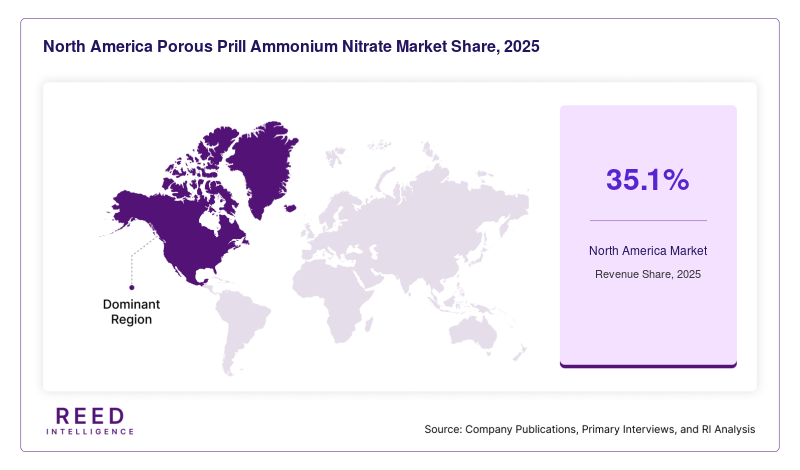
North America accounted for 35.1% of the global porous prill ammonium nitrate market in 2025 and is projected to expand at a CAGR of 5.9% during the forecast period. The region benefits from extensive mining activities, advanced industrial infrastructure, and stable demand from construction and quarrying sectors. Large-scale extraction of copper, gold, iron ore, and industrial minerals across the United States and Canada continues to support market growth. The presence of established explosive manufacturers and advanced supply chain systems has further strengthened regional market development.
The United States remained the dominant country in North America due to its strong mining output and extensive infrastructure modernization programs. Increasing investments in tunnel construction, highway upgrades, and renewable energy infrastructure have accelerated the need for controlled blasting operations. Another unique growth factor is the rapid adoption of automated mining systems across major extraction sites. Mining operators are increasingly implementing precision blasting technologies that require consistent and high-quality porous prill ammonium nitrate products, thereby supporting long-term market demand.
Europe
Europe represented 23.4% of the global porous prill ammonium nitrate market in 2025 and is anticipated to grow at a CAGR of 5.4% through 2034. The market is supported by steady infrastructure rehabilitation projects, quarrying activities, and underground transportation developments across several European countries. Governments are investing in railway expansion, hydropower facilities, and urban transit systems that require efficient blasting materials for tunneling and excavation activities. The region also benefits from established industrial safety standards and advanced blasting technologies.
Germany emerged as the leading country within the European market due to its strong industrial base and continued investment in transportation infrastructure. The country has increased spending on railway modernization, tunnel construction, and underground engineering projects to improve regional connectivity. A unique growth factor in Germany is the growing focus on sustainable quarrying and environmentally responsible blasting practices. Industrial operators are increasingly using advanced blasting materials that improve operational efficiency while supporting compliance with environmental regulations.
Asia Pacific
Asia Pacific held 28.7% of the global porous prill ammonium nitrate market in 2025 and is projected to record the fastest CAGR of 8.4% during the forecast period. Rapid industrialization, urban expansion, and increasing mining activities across China, India, Australia, and Southeast Asia are supporting strong regional demand. Governments are investing heavily in transportation infrastructure, energy projects, and industrial corridors, creating significant opportunities for blasting-grade ammonium nitrate products. Expanding metal extraction activities for copper, lithium, and iron ore have also strengthened market growth.
China remained the dominant country in the Asia Pacific market due to its extensive mining sector and large-scale infrastructure development initiatives. The country continues to expand railway networks, hydropower stations, underground metro systems, and industrial construction projects that require controlled blasting operations. A distinctive growth factor in China is the government’s strategic investment in critical mineral supply chains associated with renewable energy technologies. This has increased mining activities and created sustained demand for industrial explosives and related blasting materials.
Middle East & Africa
The Middle East & Africa region accounted for 7.6% of the global porous prill ammonium nitrate market in 2025 and is expected to grow at a CAGR of 6.7% through 2034. The region is experiencing rising demand for blasting materials due to increasing mining exploration activities, energy infrastructure development, and large-scale construction projects. Countries in the Gulf region are investing heavily in smart cities, transportation networks, and industrial diversification initiatives. In Africa, expanding gold, copper, and diamond mining projects continue to support market growth.
South Africa dominated the regional market because of its well-established mining industry and extensive mineral reserves. The country remains one of the major producers of gold, platinum, and manganese, requiring significant blasting operations in underground and open-pit mines. A unique growth factor in South Africa is the modernization of aging mining infrastructure combined with rising adoption of digital blasting systems. Mining companies are increasingly investing in advanced explosive technologies to improve operational safety, productivity, and resource recovery efficiency.
Latin America
Latin America captured 5.2% of the global porous prill ammonium nitrate market in 2025 and is forecast to expand at a CAGR of 6.3% during the study period. The region benefits from abundant mineral resources and increasing foreign investment in copper, lithium, silver, and iron ore extraction projects. Governments across Latin America are encouraging mining development to strengthen export revenues and industrial growth. Expanding quarrying operations and infrastructure projects have also contributed to the regional demand for blasting-grade ammonium nitrate products.
Brazil emerged as the dominant country in the Latin American market due to its extensive mining operations and infrastructure expansion programs. The country continues to attract investments in iron ore extraction and transportation projects associated with export logistics. One unique growth factor in Brazil is the rapid development of lithium exploration activities linked to global battery manufacturing demand. This has created additional opportunities for blasting operations and increased consumption of porous prill ammonium nitrate across mining regions.
Competitive Landscape
The porous prill ammonium nitrate market is characterized by the presence of global chemical manufacturers, regional explosive material suppliers, and mining service providers competing on the basis of production capacity, product quality, distribution networks, and technological innovation. Companies are increasingly investing in advanced manufacturing facilities, sustainable blasting solutions, and strategic partnerships with mining operators to strengthen their market position. Market participants are also focusing on supply chain optimization and long-term contracts with construction and mining companies to ensure stable revenue generation.
Yara International remained one of the leading players in the market due to its strong global distribution network, integrated production capabilities, and broad portfolio of industrial ammonium nitrate products. The company recently expanded its industrial explosives supply operations in Asia Pacific to support rising demand from mining and infrastructure sectors. Other major companies are emphasizing low-emission blasting technologies and customized explosive-grade materials designed for advanced mining applications. Strategic acquisitions, regional capacity expansions, and investments in digital blasting systems continue to shape competition across the global market.
Key Players
- Yara International ASA
- Orica Limited
- Enaex S.A.
- Austin Powder Company
- Dyno Nobel
- CF Industries Holdings Inc.
- EuroChem Group
- Incitec Pivot Limited
- San Corporation
- Sichuan Gold Elephant Chemical Co. Ltd.
- OSTCHEM Holding
- Deepak Fertilisers and Petrochemicals Corporation Ltd.
- Acron Group
- Hanwha Corporation
- MAXAMCorp Holding S.L.
Recent Developments
- In March 2026, Yara International ASA expanded its industrial ammonium nitrate production capacity in Southeast Asia to support rising demand from mining and infrastructure blasting operations.
- In September 2025, Orica Limited launched an advanced digital blasting optimization platform integrated with porous prill ammonium nitrate solutions for precision mining applications.
- In November 2025, Dyno Nobel introduced low-emission blasting formulations designed to improve environmental performance and operational efficiency in large-scale mining projects.
- In January 2026, Enaex S.A. strengthened its Latin American distribution network to support growing copper and lithium mining activities across Chile and Peru.
- In October 2025, EuroChem Group invested in automated process control technologies for ammonium nitrate manufacturing facilities to improve product consistency and industrial safety standards.
Porous Prill Ammonium Nitrate Market Segments
Grade
- Industrial Grade
- High-Density Porous Prill Ammonium Nitrate
- Standard Porous Grade
Application
- Mining Explosives
- Infrastructure Blasting
- Quarrying Operations
- Construction Blasting
- Defense and Industrial Applications
End-Use
- Metal Mining
- Coal Mining
- Construction and Tunneling
- Quarrying Industry
- Energy and Infrastructure
By Region
- North America
- Europe
- APAC
- Middle East and Africa
- LATAM