Porous Silicon Substrate Market Size, Share, Demand Report By Type (Nanoporous Silicon Substrates, Microporous Silicon Substrates, Macroporous Silicon Substrates), By Application (Biosensors, Photonic Devices, Drug Delivery Systems, Energy Storage), By End-Use (Healthcare & Biotechnology, Semiconductor Industry, Energy & Power, Industrial Electronics) By Region & Segment Forecasts, 2026–2034
USD 3950
Market Overview
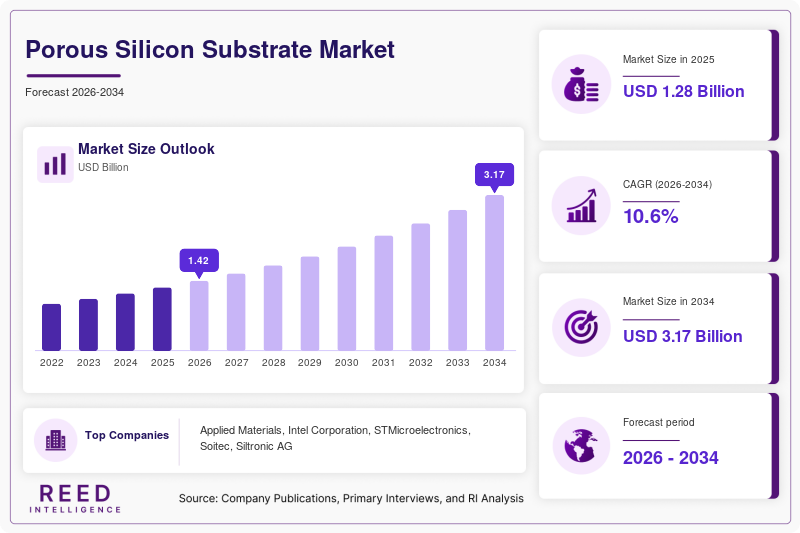
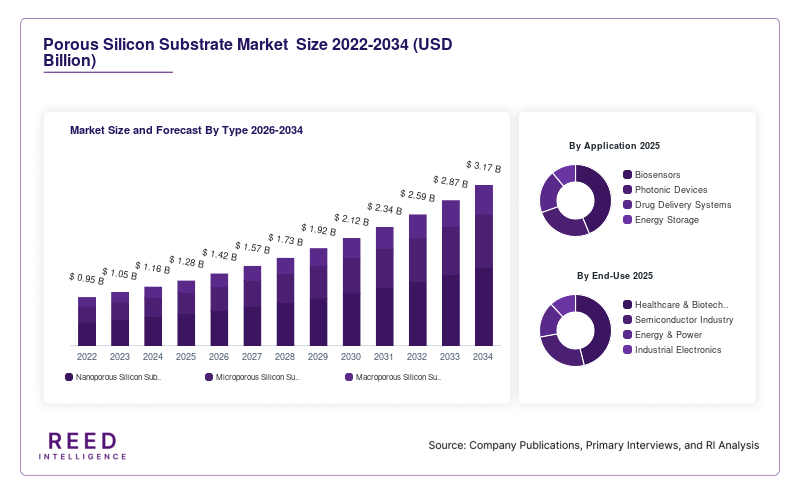
The Porous Silicon Substrate Market is projected to reach USD 1.42 billion in 2026 and is anticipated to expand to USD 3.18 billion by 2034, registering a compound annual growth rate (CAGR) of 10.6% during 2026–2034. The market growth is primarily driven by the increasing adoption of porous silicon substrates in advanced semiconductor manufacturing, biosensors, photonics, and energy storage applications. Their superior surface area, tunable pore structure, and compatibility with silicon-based electronics make them a critical material in next-generation device fabrication.
A key global factor supporting market expansion is the rapid acceleration of semiconductor miniaturization and the growing demand for high-performance materials in nanoelectronics. As industries shift toward smaller, faster, and more energy-efficient components, porous silicon substrates are being increasingly integrated into MEMS devices, medical diagnostics, and optoelectronic systems. Additionally, rising investments in research and development across Asia Pacific and North America are accelerating material innovation and commercialization.
Key Highlights
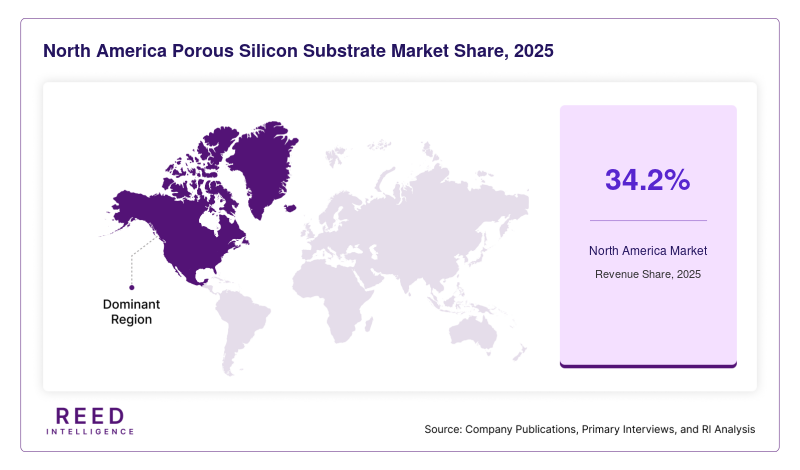
- North America dominated the market with a 34.2% share in 2025.
- Asia Pacific is expected to grow at the fastest CAGR of 11.2% during 2026–2034.
- By type, nanoporous silicon substrates accounted for the largest share of 38.5%.
- while macroporous silicon substrates are projected to grow at a CAGR of 12.4%.
- By application, biosensors led with a 41.7% share, whereas photonic devices are expected to expand at a CAGR of 11.8%.
- The United States remained the dominant country, with market values of USD 510 million in 2024 and USD 560 million in 2025.
Market Trends
Integration of Porous Silicon in Advanced Biosensing Technologies
One of the most significant trends in the Porous Silicon Substrate Market is the increasing integration of porous silicon materials in biosensing and diagnostic applications. The high surface-to-volume ratio of porous silicon enables enhanced sensitivity in detecting biological molecules, making it suitable for point-of-care testing devices and lab-on-chip systems. Hospitals and diagnostic laboratories are increasingly adopting silicon-based biosensors for real-time disease detection, particularly for glucose monitoring, cancer biomarker detection, and infectious disease screening. In addition, ongoing advancements in surface functionalization techniques are improving selectivity and stability, which is further expanding the adoption of porous silicon substrates in biomedical engineering. The convergence of nanotechnology and healthcare is expected to significantly strengthen this trend over the forecast period.
Growing Use in Photonics and Optoelectronic Devices
Another key trend shaping the market is the rising use of porous silicon substrates in photonics and optoelectronics. Due to their tunable refractive index and luminescent properties, porous silicon materials are being widely used in optical sensors, waveguides, and light-emitting devices. The demand for high-speed communication systems and fiber-optic networks is pushing manufacturers to explore advanced silicon-based optical components. Additionally, research institutions are actively developing porous silicon-based photonic crystals to enhance signal processing efficiency and reduce energy loss. This trend is further supported by the expansion of 5G infrastructure and increasing demand for data-intensive applications, which require highly efficient optical materials.
Market Drivers
Rising Demand from Semiconductor and Nanoelectronics Industry
The primary driver of the Porous Silicon Substrate Market is the increasing demand from the semiconductor and nanoelectronics industry. As device architectures become more compact and complex, manufacturers require substrates with enhanced surface characteristics and improved thermal and electrical properties. Porous silicon substrates provide excellent compatibility with silicon wafers while enabling advanced structuring at the nanoscale. This makes them highly valuable in microelectromechanical systems (MEMS), integrated circuits, and sensor technologies. Furthermore, the global semiconductor shortage in recent years has encouraged companies to diversify material sourcing and invest in innovative substrate technologies. Governments across major economies are also supporting semiconductor manufacturing through funding programs, which indirectly boosts demand for porous silicon substrates in fabrication processes.
Expansion of Medical Diagnostics and Biotechnology Applications
Another major driver is the expanding application of porous silicon substrates in medical diagnostics and biotechnology. These substrates are increasingly used in drug delivery systems, biosensors, and implantable medical devices due to their biocompatibility and controlled degradation properties. The healthcare industry’s growing focus on early disease detection and personalized medicine is significantly increasing the adoption of silicon-based sensing platforms. Additionally, advancements in nanomedicine and bioengineering are enabling the development of highly sensitive diagnostic tools that rely on porous silicon structures. The increasing prevalence of chronic diseases and the rising demand for rapid diagnostic technologies are further accelerating market growth.
Market Restraint
High Production Complexity and Cost Constraints
A major restraint affecting the Porous Silicon Substrate Market is the high production complexity and associated manufacturing costs. The fabrication of porous silicon substrates requires precise electrochemical etching processes, specialized equipment, and controlled environmental conditions. These requirements increase operational costs and limit large-scale commercial production. Additionally, maintaining uniform pore distribution and structural stability remains a technical challenge, particularly for high-performance applications in photonics and biomedical devices. Small and medium-scale manufacturers often face difficulties in scaling production while maintaining quality consistency. Furthermore, the lack of standardized production protocols across regions leads to variations in product quality, which affects adoption in sensitive industries such as healthcare and aerospace. As a result, despite strong demand potential, cost-related constraints continue to slow down widespread commercialization of porous silicon substrates.
Market Opportunities
Expansion in Energy Storage and Battery Technologies
One of the most promising opportunities in the Porous Silicon Substrate Market lies in energy storage applications, particularly lithium-ion batteries and next-generation solid-state batteries. Porous silicon offers high surface area and improved lithium-ion diffusion characteristics, which can significantly enhance battery capacity and charging efficiency. With the global shift toward electric vehicles and renewable energy storage systems, demand for high-performance anode materials is increasing rapidly. Research institutions and battery manufacturers are actively exploring porous silicon as a replacement or additive material to graphite-based anodes. This transition presents significant growth potential for market players, especially as governments implement clean energy policies and electric mobility initiatives.
Increasing R&D Investments in Nanotechnology and Material Science
Another key opportunity is the rising investment in nanotechnology and material science research. Universities, government institutions, and private companies are focusing on developing advanced porous silicon structures for diverse applications, including quantum computing, photonic circuits, and environmental sensing. These research activities are expanding the application scope of porous silicon substrates beyond traditional industries. In addition, collaborations between academic institutions and semiconductor companies are accelerating commercialization of experimental technologies. As innovation pipelines strengthen, the Porous Silicon Substrate Market is expected to benefit from continuous product development and new application discoveries.
Segmental Analysis
By Type
Nanoporous silicon substrates dominated the market with a 42.3% share in 2024, driven by their extensive use in biosensors and photonic devices. Their high surface area and tunable properties make them highly suitable for advanced sensing applications. Industries prefer nanoporous structures due to their compatibility with semiconductor fabrication processes and superior performance in optical and biomedical systems.
The fastest-growing subsegment is macroporous silicon substrates, expected to grow at a CAGR of 12.4%, supported by rising demand in energy storage and filtration technologies. Their larger pore size enables better ion transport and fluid interaction, making them suitable for battery and environmental applications.
By Application
Biosensors held the largest share of 41.7% in 2024, driven by growing demand in healthcare diagnostics and wearable medical devices. Porous silicon’s biocompatibility and sensitivity enhance biosensor performance significantly.
Photonic devices are the fastest-growing subsegment with a CAGR of 11.8%, supported by advancements in optical communication systems and increasing demand for high-speed data transmission technologies.
By End-Use
Healthcare and biotechnology dominated with a 39.5% share in 2024, driven by increasing adoption of diagnostic and therapeutic devices. Porous silicon substrates are widely used in implantable devices and drug delivery systems.
Energy storage is the fastest-growing end-use segment with a CAGR of 12.1%, driven by electric vehicle expansion and demand for high-capacity battery materials.
Regional Analysis
North America
North America accounted for 34.2% market share in 2025, with a projected CAGR of 10.1% during 2026–2034. The region’s strong semiconductor ecosystem and advanced research infrastructure continue to support steady market expansion. Increasing demand for MEMS devices and biosensors is further driving regional adoption.
The United States is the dominant country in the region, supported by strong investments in nanotechnology and semiconductor manufacturing. A key growth factor is the presence of leading research universities and government-backed innovation programs that accelerate material science advancements.
Europe
Europe held a 27.6% market share in 2025 and is expected to grow at a CAGR of 9.4%. The region benefits from strong automotive electronics and healthcare sectors that increasingly utilize porous silicon-based sensors and devices.
Germany leads the European market due to its advanced semiconductor and automotive industries. A key growth factor is the increasing adoption of miniaturized electronic components in electric vehicles and industrial automation systems.
Asia Pacific
Asia Pacific accounted for 26.8% market share in 2025 and is projected to grow at the fastest CAGR of 11.2%. Rapid industrialization and strong semiconductor manufacturing bases in the region are driving demand.
China dominates the regional market, supported by large-scale electronics production and government incentives for semiconductor self-reliance, boosting porous silicon substrate adoption.
Middle East & Africa
The region held a 6.3% market share in 2025, with a CAGR of 8.7% during the forecast period. Growth is driven by gradual adoption of advanced medical technologies and increasing investments in research infrastructure.
Israel is the leading country, supported by strong innovation in semiconductor research and defense electronics, which fuels demand for advanced substrate materials.
Latin America
Latin America accounted for a 5.1% market share in 2025, growing at a CAGR of 8.9%. Market growth is supported by increasing electronics imports and expanding healthcare diagnostics applications.
Brazil leads the region due to rising industrialization and growing adoption of advanced diagnostic systems in urban healthcare facilities.
Competitive Landscape
The Porous Silicon Substrate Market is moderately consolidated, with key players focusing on innovation, R&D investment, and strategic partnerships. Leading companies include Applied Materials, STMicroelectronics, Siltronic AG, Intel Corporation, and Soitec. These companies are actively engaged in developing advanced silicon wafer technologies and expanding their presence in high-growth applications such as biosensors and photonics.
Applied Materials remains a leading player due to its strong portfolio in semiconductor fabrication equipment and materials engineering solutions. Recent developments include increased investment in advanced substrate engineering technologies aimed at enhancing nanoscale precision and production efficiency. Companies are also collaborating with research institutions to explore new applications of porous silicon in biomedical and energy storage sectors, further strengthening competitive positioning.
Key Players List
- Applied Materials
- Intel Corporation
- STMicroelectronics
- Soitec
- Siltronic AG
- GlobalWafers Co.
- SUMCO Corporation
- Wolfspeed Inc.
- Ferrotec Holdings
- Nova Electronic Materials
- MEMC Electronic Materials
- Okmetic Oy
- Shin-Etsu Chemical Co.
- IQE plc
- Resonac Holdings
Recent Developments
- In 2025, several semiconductor manufacturers expanded R&D investments into porous silicon-based biosensor platforms to improve diagnostic sensitivity.
- A European consortium announced pilot-scale production of macroporous silicon substrates for next-generation lithium-ion battery anodes in early 2026.
- A leading Asian semiconductor firm initiated collaboration with research universities to develop photonic integrated circuits using porous silicon materials for 5G communication systems.
Porous Silicon Substrate Market Segments
By Type
- Nanoporous Silicon Substrates
- Microporous Silicon Substrates
- Macroporous Silicon Substrates
By Application
- Biosensors
- Photonic Devices
- Drug Delivery Systems
- Energy Storage
By End-Use
- Healthcare & Biotechnology
- Semiconductor Industry
- Energy & Power
- Industrial Electronics
By Region
- North America
- Europe
- APAC
- Middle East and Africa
- LATAM